

The D12 publishes five things a buyer can use: Bluetooth V5.4, a 100 mAh cell, a charge time of about two hours, a rated runtime of about seven hours, and a Type-C charging interface. It publishes no frame weight, no ingress rating, no acoustic detail, no microphone pickup figure, no certificate numbers and no colourway count. A short published list is not a thin product — it is a short contract. This piece is the method for turning those eleven rows into a purchase order your quality team, your customs broker and your channel can all act on.
The D12 sits in the middle of our Bluetooth audio range, which makes it a reasonable candidate for a first bulk order and a poor candidate for a blind one. Buyers who treat the published list as complete tend to discover the gaps during pre-shipment inspection, when the changes are expensive. Buyers who treat the gaps as a checklist tend to close them in a single written exchange and keep the model. The difference is one document, not one month.
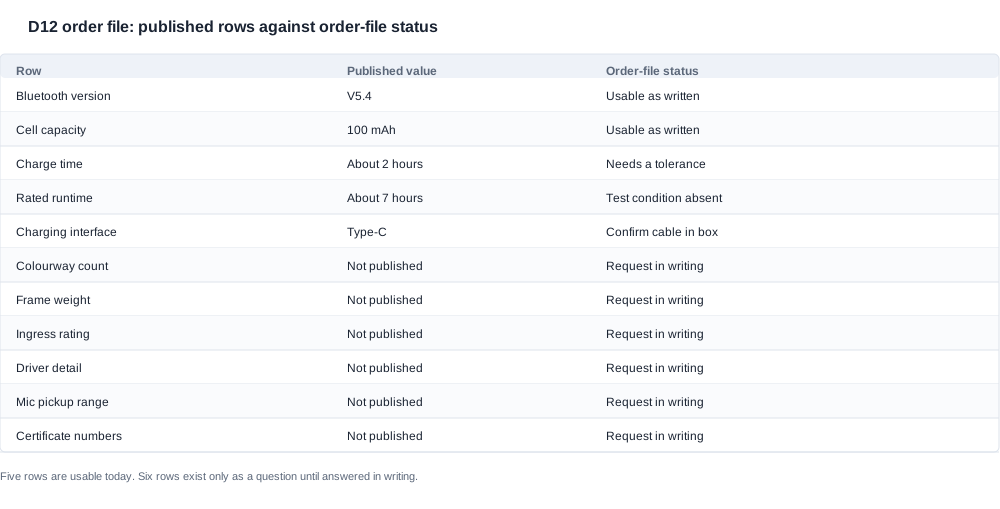
D12 published rows and the six gaps that decide your landed cost
Five published rows can become acceptance criteria as they stand. Six rows are simply absent, and each absence has a commercial consequence that lands somewhere other than the specification sheet.
- Frame weight. Not published. Weight sets the freight tier, the carton volume and the shipping figures your channel will quote back to you. It is also the row most correlated with returns, because it is the first thing a customer notices.
- Ingress rating. Not published. Until a rating exists, you cannot describe the D12 as sealed, splash-resistant or industrial, whatever the retail copy you have seen elsewhere implies.
- Driver and acoustic detail. Not published. No driver size, no frequency response, no leakage figure. That blocks any sound quality claim in your own listing copy, however confident the supplier sounds on a call.
- Microphone pickup range. Not published. On an open-ear design this is the row reviewers test first and the row your return notes will quote back at you.
- Certification numbers. Not published. No number, no issuing body, no validity date. Your compliance file stays incomplete until all three exist.
- Colourway count. Not published. Without it you cannot build a colour curve, a packaging plan or a per-variant MOQ assumption.
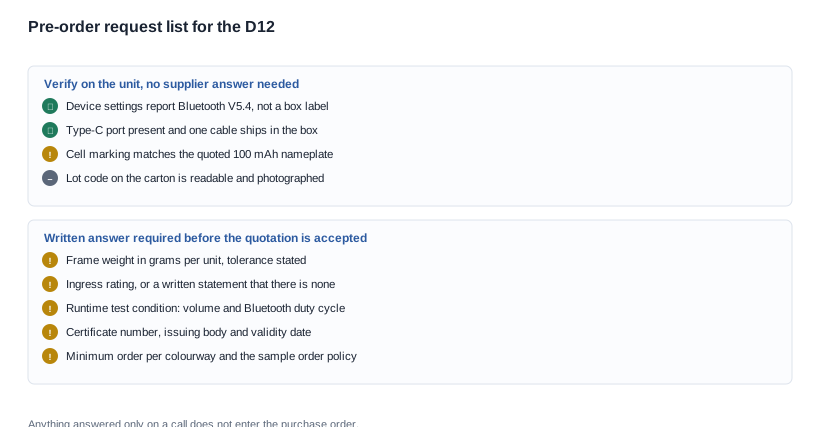
A published list is a claim about documentation, not a statement of capability. Reading one correctly means asking three questions of every row: what was measured, on what sample, and under what condition. A row that answers only the first is a catalogue entry. A row that answers all three is a specification, and it is the only kind that belongs in a contract. Most supplier pages in this category are written in the first register — a version number, a capacity, a runtime — because that register converts best in a search result. Your order file has to be written in the second register, whatever the supplier's own page says.
Order the six requests by commercial impact rather than by how awkward they are to ask. Frame weight and certification come first, because they change your freight cost and your ability to clear the goods at all. Colourways come second, because they change artwork and packaging timelines rather than legality. Runtime condition, acoustics and microphone pickup come third: they matter most to your channel and least to your logistics team, which is exactly why they get deferred forever. Sequencing the request this way means the two answers that can stop an order arrive first, while there is still time to act on them.
The five published rows carry a second problem of their own. A rated runtime of about seven hours, stated without a test condition, is a ceiling rather than an expectation. The same figure measured at a different volume with a different Bluetooth duty cycle can be materially shorter. The D12 publishes roughly seven hours; the K01, the LC-105 and the ZH12 publish eight; the G07 publishes six. None of those numbers carries a stated condition, so none of them compares to another. Treat the whole runtime column as unranked until somebody supplies the method.

Turning published rows into criteria a supplier can be held to
A published figure becomes a criterion the moment you attach three things to it: the value, the method, and the tolerance. Miss any one and the figure is decoration.
| Row | Write the criterion this way |
|---|---|
| Bluetooth version | Device settings report V5.4 on every unit in the sample, not on the carton |
| Cell capacity | Nameplate reads 100 mAh; measured capacity at least 95% of nominal on one unit per lot |
| Charge time | Full charge within two hours at the declared ambient condition, from the supplied cable |
| Rated runtime | At least the declared hours at the declared volume and Bluetooth duty cycle |
| Charging interface | Type-C port present; one cable present in every retail box |
| Colourways | Exact count per order, matched to the artwork revision on file |
Write them into the specification annex of the purchase order rather than into an email thread. An answer that exists only in correspondence is not a term, and it is not evidence when a shipment arrives short of the agreed figure. Quality control teams ask for this for a simple reason: an inspection sheet can only record what the specification says. If the row is absent, the inspector records nothing, and the unit passes.
Two of these rows are worth more attention than their simplicity suggests. The cable-in-box row prevents the most avoidable return driver on any Type-C product, because a missing cable is a return, a refund and a review in one event. The colourway row prevents a packaging and artwork revision three weeks into production, which is a change fee at best and a reprint at worst.
Traceability is the row nobody writes down and everybody needs. Ask how units are marked, whether the marking carries the model code and the lot, and whether the carton code is the same code that appears on the unit. A lot code that exists only on the outer carton disappears the moment the box is opened for resale, which leaves you unable to trace a defect report back to a production run. This is a cheap request and a frequent refusal, and the refusal is itself the finding.
Sampling decides whether your criteria are enforced or merely stated. Agree the sample size and the defect allowance in the purchase order rather than leaving either to an inspector's discretion on the day. A stated inspection level with named defect classes — cosmetic, functional, packaging — gives both sides the same reference point. Without it, a passed inspection means only that nobody opened the box in a way that produced an obvious complaint. Draw the sample from packed cartons rather than from a finished-goods pile, because packed units are the units that reach your customer.
The written request that produces answers worth having
Send the six absent rows as one message, with a stated deadline, during supplier evaluation rather than after the purchase order is issued. One message matters for a reason that has nothing to do with efficiency: a supplier who answers six questions in a single response is giving you a signal about how they will handle an inspection finding later. A supplier who answers two and goes quiet is giving you the same signal earlier and more cheaply.
Ask for a number, a method and a document on every line. Concretely:
- Frame weight — grams per unit, tolerance across the lot, and the shipping carton gross weight with the units per carton.
- Ingress rating — the rating itself, or a written statement that none exists for this model.
- Acoustics — driver size, frequency response band, and any published leakage measurement.
- Microphone pickup — the test distance and noise condition used for any call quality claim.
- Certification — certificate number, issuing body, model designation covered, and the expiry date.
- Commercial terms — MOQ per colourway, sample order policy, lead time from deposit, and the warranty period on offer.
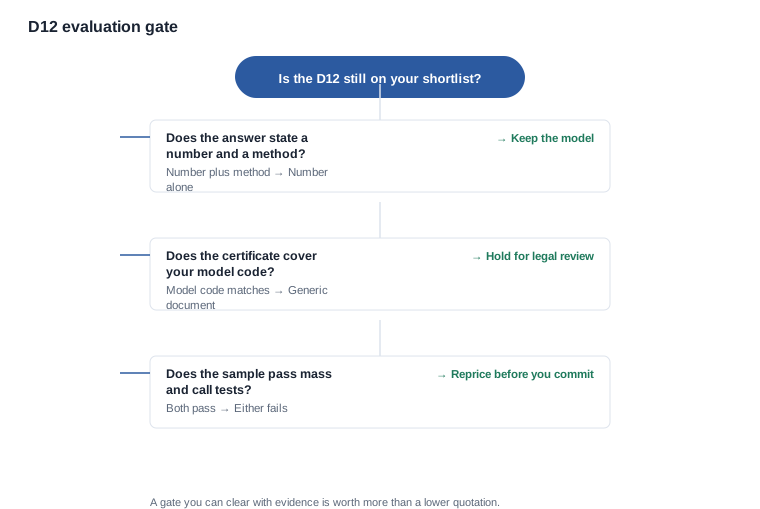
Red flags to watch in the reply. A certificate whose model designation does not match the code on your purchase order is the most serious, because it means the document does not cover your goods. A photograph of a label with no legible model stamp is the second. A supplier who answers two questions and calls the rest the same as another model has effectively told you they do not maintain per-model records, which is a due diligence finding about the factory rather than about the product.

Read the answers for shape as much as content. A number with a stated method and an attached document is usable. A number without a method is a starting point for negotiation. A confident adjective is nothing at all, and it should be recorded as absent rather than as answered.
Score the reply before you score the price. A three-column sheet — row, answer type, evidence attached — turns a supplier comparison from an opinion into a record, and it takes about ten minutes per supplier. In practice the spread is wider than buyers expect: the same six questions to four suppliers commonly produce two complete answers, one partial answer with a promise of the rest, and one refusal dressed as a clarification request. The complete answers are usually not the cheapest quotations, and that is the trade-off worth making deliberately rather than by accident.

Sample order protocol: four tests that predict your first return rate
A sample order settles more than a specification. It settles the questions that no file can answer, and it does so cheaply if you design it before it ships. Order one unit per colourway plus two spares, and keep a signed test sheet with both party names on it.
- Mass and balance. Weigh five units separately and record the spread. A tight spread means a stable bill of materials; a wide spread points at cell or component substitution, which then puts your whole certification file in question.
- Call test in reproduced background noise. Run the same short call at two positions — desk and street — with the same speaker at a fixed distance. Record whether the far end can separate speech from the environment. This is the test that maps directly to the return note you would otherwise receive three months later.
- Charge cycle and runtime. Time a full charge from the stated low point, then run to depletion at the declared volume and duty cycle. Write down what you actually measured, including the ambient condition.
- Port, cable and packaging. Confirm the cable is in every box, the port is undamaged, and the carton survives the handling it will actually see. Packaging is part of the acceptance criteria, not a finishing touch.
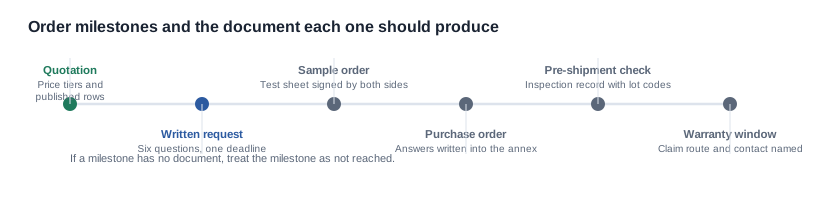
Record each result with the date, the unit serial or lot code and the person who measured it. That record is what makes the sample useful later: it is the baseline against which the pre-shipment sample is compared. If the lot from production behaves differently from the sample lot, you have evidence rather than an argument.
Reproducing background noise matters more than most buyers expect, because an unreproduced test produces a number nobody can compare to anything. Pick one condition and write it down precisely: a fixed source at a fixed distance, a fixed playback level, a fixed position for the unit. Record the setup before you record the result, because the setup is the part you forget first.
Weigh five units separately rather than averaging them. The average tells you nothing about process control; the spread tells you whether the bill of materials is stable. A spread wide enough to shift your freight tier is worth raising with the factory as a process question, not only logging in your own files.
Keep the sample units after the test. When the production lot arrives, the same four tests run on the same equipment turn the sample into a baseline rather than an anecdote, and that comparison is the evidence you want in a quality claim conversation rather than a dispute about whether anything was ever wrong.

Terms that hold when a shipment arrives short of the agreement
The written answers only protect you if they sit somewhere with legal weight. Split the commercial file into three places and do not let them overlap.
| Term | Where it belongs | What to state |
|---|---|---|
| Specification values | Purchase order annex | The value, the test method and the tolerance for each row |
| Payment terms | Supply agreement | Deposit percentage, balance trigger, and what the trigger is |
| Warranty | Supply agreement | Period, what it covers, and the claim route after shipment |
| Inspection | Purchase order | Pre-shipment sample size, defect allowance, and who pays on failure |
| Incoterms | Purchase order | The named term and place, so freight and risk transfer are unambiguous |
| Certification validity | Supply agreement | Certificates must be valid on the shipment date, not only when produced |
Two clauses are worth negotiating hard because they cost the supplier nothing and save you later. First, tie the balance payment to a passed inspection rather than to a shipping date, so the money and the evidence move together. Second, write the defect allowance and the remedy beside it, because an allowance without a remedy is a negotiation that happens after the container has sailed. Where a supplier resists both, that resistance is itself a finding worth recording against the supplier, not against the model.
There is a real trade-off inside each of these clauses, and pretending otherwise makes the negotiation worse. Tying the balance to inspection moves risk onto the supplier, who will price that risk into the quotation or ask for the inspection window to be capped. Capping the window protects you from an inspection that stalls the shipment, which protects the supplier from an inspection that never finishes. Both positions are reasonable. What is not reasonable is discovering the mismatch once the container is booked. Settling the window length before you commit is a five-minute conversation that otherwise becomes a three-week argument.
A warranty period written as a duration without a claim route is decoration. Name who receives the claim, in which market, within what window from delivery, and what evidence they must supply. Without those four things, your channel partner will absorb the cost of the dispute rather than pass it back to you.
Where the D12 is the wrong model to shortlist
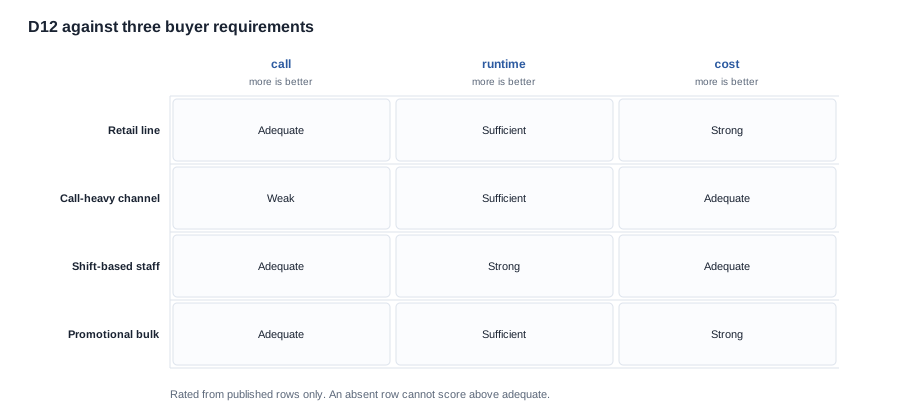
Honest shortlisting means naming the cases the D12 does not serve. If your channel leads with call quality, the absence of any published microphone pickup figure makes the D12 a poor anchor, and a model with a documented pickup specification will sell more easily at the same price. If your buyers are on long shifts, the roughly seven-hour runtime with no stated condition is a claim you cannot defend; a model with a documented condition and a longer figure is the safer anchor. If your market expects a sealed or rugged product, no published ingress rating means the D12 simply cannot be positioned there at any price.
For general retail, promotional bulk and staff use, the D12 is a reasonable pick. The published rows are consistent, the interface is current, the cell sits in a normal range, and the absences are absences of documentation rather than evidence of a problem. That is a workable basis — provided you close the six rows before the purchase order, not after.
Buyers often ask for a single recommendation, and the honest answer is conditional rather than absolute. If your channel tests audio before it tests specification — which is common in promotional retail — the D12 publishes enough to support a functional listing and nothing more, so the listing should not promise more than the file can defend. If your channel runs a technical review before purchase, the absence of acoustic and pickup data will be noticed, and the model will lose to one that publishes a method. In both cases the deciding variable is not the model. It is how early you close the six rows. A buyer who closes them during supplier evaluation negotiates the specification; a buyer who closes them after the deposit negotiates the consequences.
The D12 supports a functional listing and not a performance one. We will publish the five rows we have and name the six we do not, because a buyer who plans around the first list and discovers the second at retail has a problem they could have avoided for the cost of one email. Send us your market, channel and target volume and we will tell you which of the six we can answer in writing today.
One question belongs in the same exchange as the six, and it is the one most buyers forget: what the lead time actually covers. Whether the stated lead time runs from deposit, from artwork approval or from a confirmed purchase order changes your whole inventory plan, and the three readings can differ by weeks. Ask which clock starts the period, ask whether it holds at your volume and at your colour count, and ask what happens to it if a component is substituted late in production. We will answer those in writing for the D12 as well.
Related reading
- Where this model sits against the alternatives — which Bluetooth audio glasses model to pick
- The document set to request before you commit — Bluetooth SIG certification checklist
- How to read competing runtime figures — battery comparison for Bluetooth audio glasses
- What private labelling changes in the order file — private label options
- Packaging decisions that affect freight tier — packaging options
Send us the target market, the quantity and the required configuration, and we will come back with what is available and what is not.


