

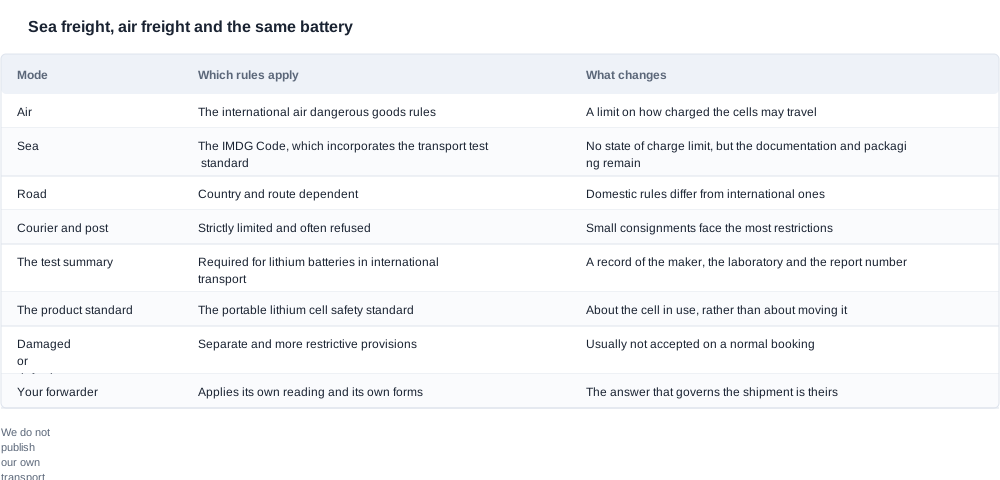
Yes, and the reason it is worth being precise about is that the test is not an air-only requirement, which is the most common misunderstanding in this category. A lithium cell that cannot lawfully be moved by air cannot lawfully be moved by sea either. The mode does not change the test. What the mode changes is everything around it: the state of charge that may be carried, the packing, the marking, the documentation and the stowage rules.
So the honest answer has two halves. The transport test and the test summary are required regardless of how the goods travel, and they are the part that has to be settled before the goods are made. The rest of the regime depends on the mode and the route, and it belongs to your forwarder to confirm at booking. This page separates the two, because a buyer who treats the whole thing as "air paperwork" discovers the sea position in the middle of a sailing cycle.
One note on the name itself before anything else. The standard is UN38.3. The form "UN383.3" appears often enough in correspondence, in search queries and in forwarding instructions that it is worth saying plainly: there is no UN383.3, and a document or a request referring to it is referring to UN38.3. If a forwarder or a supplier sends you "UN383.3" paperwork, ask which document they mean before you spend a week chasing it.
Do I need UN38.3 for sea freight: the part that is not mode-specific
UN38.3 lives in the United Nations Manual of Tests and Criteria, and it exists because lithium cells can behave dangerously when they are damaged, shorted or overcharged. The test regime covers overcharge, short circuit and high temperature, and it produces a test summary recording the battery maker, the testing laboratory, the report number and the battery model.
Those hazards exist in a container on a ship exactly as they exist in a hold on an aircraft. The test is about the battery, not about the vehicle, and the international rules for both modes require the same evidence. The sea regime is the IMDG Code, which incorporates the same test standard, and the air regime has its own packing instructions that also require it. If you have the test summary, you have the foundation for both. If you do not, you have neither, and there is no version of the question in which sea is easier.
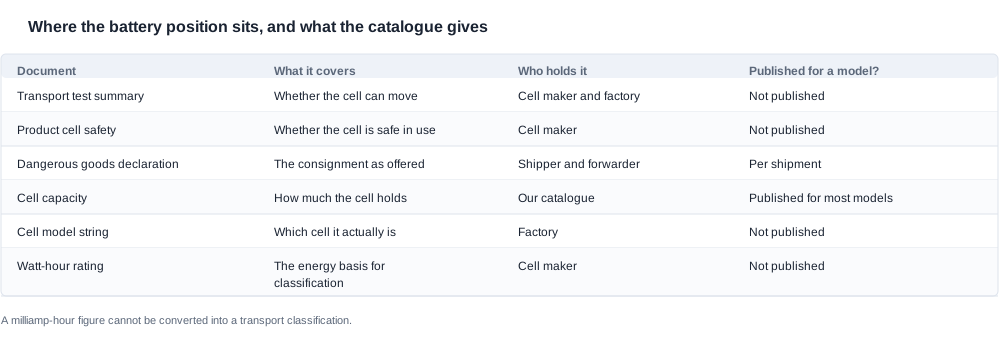
A distinction worth holding on to at the same time: the transport test and the product cell safety standard are different documents with different purposes. The transport standard is about whether the goods can move. The product standard, IEC 62133, is about whether the cell is safe in the product. Most programmes need both, and they come from different activities — one from the cell maker's transport file, the other from the cell maker's product file. A buyer who asks for "the battery certificate" is asking for one of them and will often receive whichever is easier to produce, which is a good reason to name the two documents separately in the request.
Now the part that is specific to this category, and the part that decides how much work the transport position is. The catalogue publishes battery capacities, not battery identities. The camera models publish batteries between 220 and 290 mAh. The audio range publishes per-side cells of 55 mAh on the doubled-cell models and 100 mAh on the single-cell ones. The charging cases are published too: 1400 mAh on the CY03, the CY05 and the L1 Pro, 900 or 1400 mAh on the L2 Utral, and a foldable 1200 mAh on the MT6, with a case and no published capacity on the KY06 and the MT5, and no case row at all for the V03, the V06 and the S7.
A capacity is not a classification. The transport regime keys on the cell's identity, its chemistry, its energy in watt-hours and its state of charge, and none of those can be derived from a milliamp-hour figure on a catalogue page. Our catalogue publishes no cell model string, no watt-hour rating and no test summary for any model. That is not an omission to complain about — a catalogue is the wrong document for it — but it has a direct consequence: the transport position has to be established per model, from the factory, in writing, before the order rather than after it.
One more structural point that is easy to miss. The catalogue publishes charging method for most models — magnetic charging on 17 models and Type-C on 7 — but it publishes nothing about the state of charge at dispatch, and that is a parameter with a transport dimension. A product shipped with a full charge in the case and a full charge in the glasses is a different consignment from one shipped at a lower state of charge, and the practical way to manage it is a packing instruction agreed in advance with the factory rather than a hope.

What the test summary does, and when do i need un383.3 for sea freight is asked
The test summary is the document that travels with the consignment and allows the goods to be accepted. It is mandatory for lithium batteries in international transport, and it has been required since the start of 2020.
Two things make it operationally important rather than formally important.
It ties a specific cell model to a specific report. The summary has to match the cell actually inside the product. A summary for a cell the factory has since substituted will not match the goods, and the mismatch is found at the port, in front of a container that has already been loaded and is already paying storage. This is not a hypothetical in this category, because a cell substitution is a routine manufacturing decision taken for cost, lead time or availability, and the paperwork does not always follow it. The question to ask the factory is therefore not "do you have the summary" but "which cell is fitted in the current production configuration, and what is the notification commitment if that changes".
It is the document your forwarder asks for when they book. That is what makes the timing dependency run backwards from the shipment date. The summary has to exist, and have been issued, before the booking is accepted — not before the goods are made, and certainly not in the week before the vessel. Asking for it at the point of order is what prevents a sailing cycle from being spent in a queue.
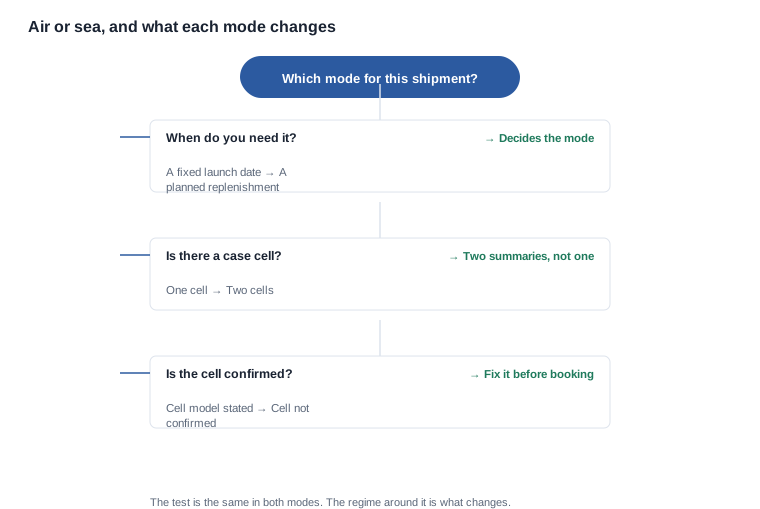
And then the second-cell problem, which is specific to this product category because so many of the models ship with a charging case. A product with a case has two cells, and a second cell is a second line in the dangerous goods declaration and, in most structures, a second summary. Look again at which models are affected: the CY03, the CY05, the L1 Pro, the L2 Utral, the MT6, the KY06 and the MT5 all have a case, while the V03, the V06, the S7 and the V03 Pro do not. So for roughly a third of the range the question is one cell and for the rest it is two, and the answers differ. Ask explicitly whether the case is a separate dangerous goods line, and if it is, obtain the second summary.
One thing worth being clear about, because it comes up in every conversation: the transport file is not the same thing as the certification file. Our export-certification page is a picture page carrying ten patent certificate images, eight design patents and two utility models, and our catalogue publishes no per-model certification row for any model. So a supplier who says the product has its certificates has not necessarily answered the transport question, and a document that is framed as a certification is not the document the forwarder will accept at booking.
There is a related question that has nothing to do with the mode and gets asked at the worst possible time, which is whether a cell that is fitted in a sample is the same cell that will be fitted in production. Samples and production runs are not always built in the same window, and the cell availability that allowed a sample to be built may have changed by the time the order runs. Ask for the cell that is committed to the production configuration, and ask whether the sample's cell is expected to be the production cell. The answer decides whether the document you are holding at the sample stage is the document you will need at the booking stage.
And one more that belongs to the buyer's own file rather than to the factory: if your market requires the product-side battery documentation — which most do, for the product rather than for the shipment — then that is a document you will need per model, and the models with a charging case need it for the case cell as well. The certification checklist sets out the wider document set, and the point here is that the transport file and the product file are requested in the same message and then tracked separately, because they expire on different schedules and they are produced by different activities.

Where sea and air differ, and where do i need un383.3 for sea freight is the same answer
The state of charge. This is the difference buyers notice. The air regime places a limit on how charged lithium ion batteries may travel, and the sea regime does not impose an equivalent restriction. That is the main practical reason a buyer chooses sea for a battery product, and it is the reason a planned replenishment is cheaper by air.
The regime itself. The IMDG Code is a different body of rules with its own packing, marking, documentation and stowage provisions, and it is revised on its own cycle. Your forwarder works to the edition in force on the day of shipment, not the edition that was current when the order was placed, and the difference between those two editions is exactly the sort of thing that turns into a documentation query.
The lead time and the cost. Sea is slower and usually cheaper per unit. For a consumer product on a planned launch schedule with inventory built in advance, that is a reasonable trade. It is a poor trade for a stock top-up, where a month of transit is a month of empty shelf, and it is a poor trade for a launch with a fixed date that cannot move.
The packing footprint. The battery content shapes the packing, and the packing is what determines the volumetric footprint of the consignment, so part of the freight cost follows the battery rather than the product. This is a cost-model detail rather than a compliance one, but it belongs in the same comparison.
The exceptions. Damaged or defective batteries have separate and more restrictive provisions and are usually not accepted on a normal booking at all. If a consignment includes a cell that has been damaged or has had a fault, that has to be raised with the forwarder before the goods are offered, not afterwards. It is also worth asking the factory what happens to a unit that fails a test after the goods have been packed — whether it is quarantined, whether it is returned, and whether it stays in the consignment. The answer determines whether you need a contingency at all.
And a fourth difference that is not about batteries but about how the two modes behave when something goes wrong. Air freight fails fast and expensively: a refused or held consignment is a short cycle and a re-booking. Sea freight fails slowly: a held container can sit for weeks while the document is corrected, and the storage and demurrage accumulate on both sides. That difference is a good reason to hold the documentation in a state where it can be produced at short notice — which in practice means keeping the current version of the summary and the cell confirmation together, rather than filing them and forgetting where they are.
And here is where the answer is the same in both modes, which is the part that gets lost in the comparison. The test is the same test. The summary is the same document and is required in both. The cell has to match the report in both. The forwarder needs the document at booking in both. The exceptions apply in both. What differs is the regime wrapped around a shared core, and the core is the part you cannot skip.
The sequence to follow when do i need un383.3 for sea freight comes up
Work through this at the point the order is placed rather than at the point of booking, and in this order.
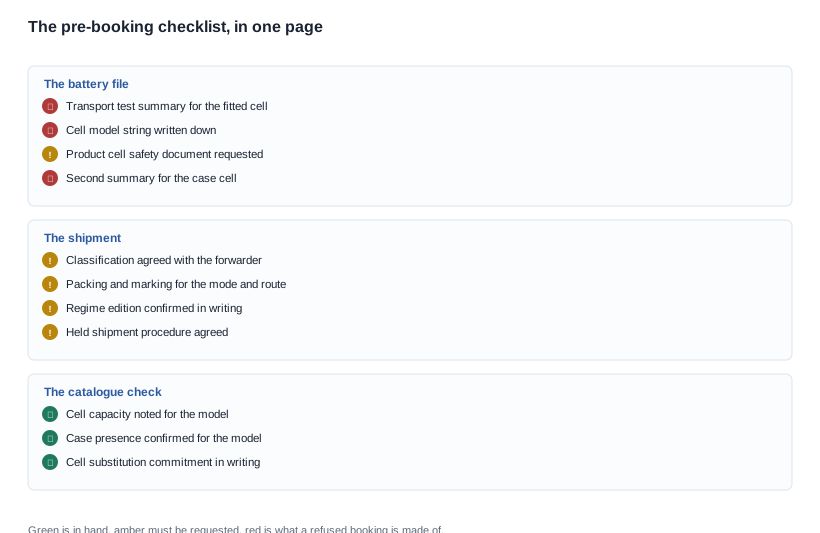
- Ask for the transport test summary for the exact cell in the exact model you are buying. Not for the range, not for the model family, not for "the battery we use" — for the cell in that configuration.
- Check the cell model on the summary against the cell in the product. Our catalogue gives you the capacity; the cell model string has to come from the factory, and it is the field that makes the comparison possible.
- Ask for the product cell safety documentation separately. It is a different document, it comes from a different activity, and it is the one your market file needs rather than the one the forwarder needs.
- Establish whether the charging case is a separate dangerous goods line, and obtain the second summary if it is. This applies to the seven models that ship with a case and not to the four that do not.
- Get a written confirmation of the cell in the current production configuration, and a notification commitment if it changes. This is the clause that prevents the port surprise.
- Establish the classification with your forwarder before the booking, and confirm the packing, marking and documentation they require for the mode and the route.
- Confirm the regime and the edition the forwarder will work to, in writing, and ask what happens if the shipment is held — who pays the storage, how long it can sit, and what triggers a re-book.
- Decide the mode per shipment rather than per policy. Air for a launch or a stock top-up, sea for a planned replenishment, and treat the choice as a function of the date, the battery content and the inventory position rather than as a standing rule.

Where this sits in the sequence matters as much as the order of the steps. The market entry sequence sets out the stages, and the transport position belongs to the stage where the configuration is frozen — because a cell change after the freeze is a document change after the freeze, and that is the point at which the timeline stops being controllable. The certification checklist covers the wider document set that has to be consistent across the product, the market and the shipment, and the battery transport page sets out the transport documents in full.
A note on sequencing the requests across the whole programme rather than one shipment. The transport position is stable for as long as the cell is stable, so it belongs to the configuration freeze and not to each booking. What belongs to each booking is the mode, the route, the packing instruction and the edition in force. Buyers who re-request the whole battery file for every shipment waste weeks and, worse, get a fresh confirmation of something that has not changed, which reads as diligence without being any. Ask for the cell confirmation once, get the notification commitment once, and then let the shipment carry the evidence.
What a supplier can and cannot confirm about do i need un383.3 for sea freight
This is a documentation question with a known answer, and the right time to resolve it is when the order is placed. We do not publish our own transport files or our cell test summaries, and the model-level certificate numbers, the minimum order quantities, the production capacity and the lead times are all still open internally, so we will not tell you that a document exists before the company has confirmed it.
What we can do is specific. For a named model and configuration, we can tell you which cell is fitted, what documents we hold for it, and what your forwarder will then need for the mode you have chosen. We can provide the document set for your own compliance file. And we can answer the question that actually blocks a first shipment, which is not "is this battery dangerous" but "is there a document that matches this cell, issued and available, at the time we book".
What we cannot do is give you a classification advice for a route, or confirm a document that has not been issued. Classification belongs to the forwarder and to the shipper who holds the declaration; our job is to make sure the goods and the paperwork match.
Three due diligence questions that are worth asking any supplier, including us, and that separate a real answer from a comfortable one. Which cell model is fitted in the current production configuration, and what is the report number for it? Is the charging case a separate line in the declaration, and where is its summary? And: what happens to a cell substitution — who tells us, and when? A supplier who answers all three with documents and dates is telling you the truth about its own supply chain. A supplier who answers all three with assurances is telling you that the question has not been asked internally, and you should assume the document will be produced after the booking rather than before it.
There is a fourth question that is less obvious and increasingly decisive: who inside the factory owns the transport file? Not the sales team, not the account manager — the person or function that holds the cell documentation and the declaration content. In a factory that runs many customers, the transport file is usually held by the shipping or the compliance function, and the commercial conversation is usually held by sales. If nobody in the commercial conversation can produce the cell documentation, then your request needs to be routed to a different desk, and it is better to discover that at the order than at the booking.
And one question to ask yourself, which is not a supplier question at all: does the transport position change what you are allowed to claim on the product? The catalogue publishes an IP rating for the V06 and the S7 only, and no model in the range carries a published drop rating, so a listing that implies a ruggedised, water-resistant or drop-proof product is making a claim the catalogue does not support, whatever the transport paperwork says. The transport regime governs how the goods move. It says nothing about how they perform once they are on a customer's head, and the two get confused in marketing copy more often than in compliance files.
Commercially, this belongs in the same conversation as the freight mode and the lead time, because a refused booking costs a sailing cycle rather than a freight difference, and a cycle is the unit your launch schedule is written in. Ask for the transport position in the same message that asks for the quotation, so it is answered in week one rather than discovered in week eight.
Tell us the model, the destination and the mode, and we will tell you what to request from us and what your forwarder will need for it.
Related reading
- The documents a battery shipment needs — battery transport
- The product side of the battery documentation — certification checklist
- The stage where the transport position is settled — the market entry sequence
Tell us the model, the destination and the mode, and we will tell you what to request from us and what your forwarder will need for it.


