

We run our own assembly and final test. We also subcontract some upstream steps. That is the direct answer, and it is the answer we would give if you asked it on a call rather than in writing, so there is no point dressing it up.
What follows is the longer version, because the question itself is a poor instrument for what buyers are actually trying to find out. A line count measures throughput. It tells you how many units a site can push through a week. It says nothing about whether the incoming inspection is checking the characteristics that matter, whether the firmware flashed into your units is the version you approved, or whether the packing step includes the accessory your customer will complain is missing. None of those have a line attached to them.
Do you want a line count, or do you want to know who touches the unit?
It is worth being clear about what a line count is a proxy for, because buyers consistently read it as a proxy for something else.
A production line count is a throughput measurement. Twenty lines and four lines can both produce a thousand good units a week; the difference is how quickly you can absorb an order that doubles, and how many parallel paths you have for a hot model. That is genuinely useful information for a buyer with a seasonal peak or a plan to grow into a second market. It is not a proxy for quality, and it is a very poor proxy for capability.
The failure mode we see most often is a buyer who visits, counts, photographs the floor and leaves reassured. In the same category we have seen buyers receive a batch in which every unit passed the end-of-line test and a meaningful minority still failed in the field. Those two outcomes are not in conflict, and the reason is not that the factory was careless. It is that the end-of-line test and the field failure are testing different things.
So the question worth asking is not how many lines but who touches the unit, at which step, and against what written criterion. Three things determine the outcome of your order, and they can have three different answers:
- Who builds it. Which entity, at which site, performing which steps.
- Who tests it. Whether the test is defined by you, by the factory, or by nobody.
- Who answers when it is wrong. The party who carries the obligation when a batch fails at your end-of-line test.
Note that a factory can pass all three and still not own the production lines, and a factory can own the production lines and still fail all three. These are independent questions and they deserve independent answers. We have written about how to separate them in our factory versus trading company material, because the distinction comes up in almost every enquiry we receive.
There is a further reason the line-count question misleads. It invites a binary — factory or trading company — and the reality in this category is a gradient. A trading company with no manufacturing capability is one end. A fully vertically integrated manufacturer is the other. Most established suppliers in this category sit somewhere in the middle, with a mix of in-house and partner steps that is specific to their model range. The useful thing for a buyer to establish is where the mix sits for their model, not where the company sits on a spectrum in general.
The scenario that shows this best is a buyer who arranged a factory visit, was shown an impressive floor, counted the lines, and came away satisfied. The order that followed was fine. The order after that one was not, because the second order was a different configuration — a new colour, a slightly different package — and the first order had been built from a build slot that was reserved for a platform the factory actually runs in volume. The new configuration went to a partner line, with a different test protocol, and the buyer had no visibility of the change because nothing in the relationship had been designed to reveal it. A line count could not have prevented that. A written statement of which steps are in house for this configuration, and a change rule requiring notification when a step moves, would have.
This is the practical argument for treating the in-house question as configuration-specific. The answer for the model you are buying today is the answer that matters, and it can change between configurations and between quarters.

Do you know which steps happen in house and which are subcontracted?
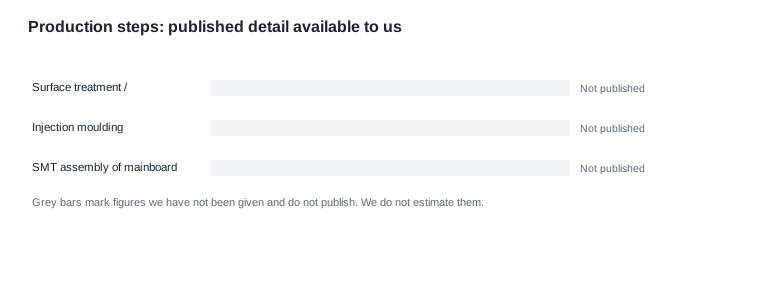
For our own operation, we can describe the shape of it. We will not quote a headcount or a line number, because those figures have not been provided to us in a form we are willing to publish and an unverified number is a claim made on somebody else's behalf.
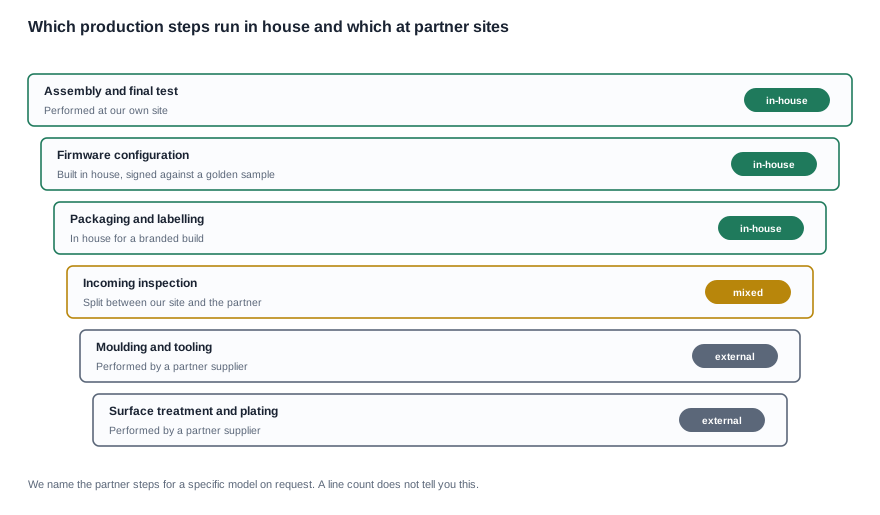
The honest description is that the steps closest to the customer — assembly, firmware configuration, final test, packaging and labelling for a branded build — sit with us, while the more specialised upstream processes such as moulding, surface treatment and plating are performed by partner suppliers. We will name those partners if you need to audit them, and we will tell you which steps are subcontracted for the specific model you are buying rather than a general description of the company.
The other thing worth saying is how our published product data relates to our own operation. The specification data in our catalogue comes from the manufacturer's catalogue, and where the catalogue is silent, our catalogue is silent too. That is a deliberate choice and it has a consequence for buyers: there are rows in our documentation that are simply open, and filling them with typical values would have been easier for everyone and would have been dishonest.
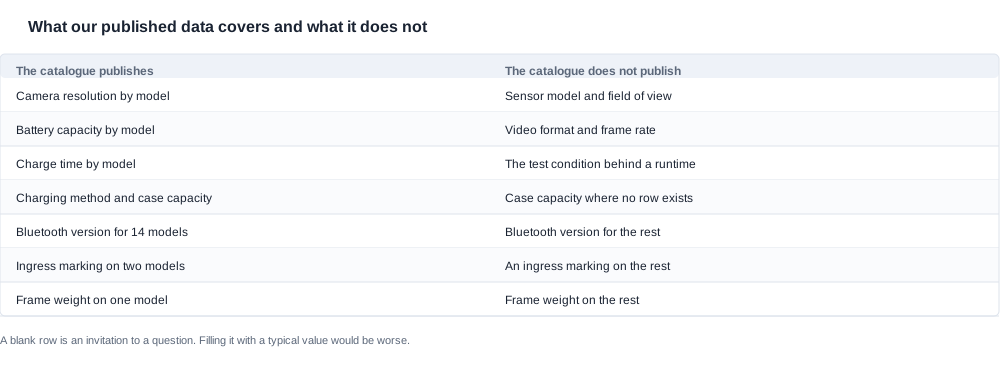
Look at the right-hand column for a moment. The camera tier publishes a resolution — eight megapixels across most models, thirteen for the L2 Utral and the S7, and the L1 Pro — but it does not publish the sensor model, the field of view or the video format. The camera batteries are published at 220 to 290 mAh and the rated runtime at roughly five to eight hours, but the test condition behind those runtime figures is not published, so the number cannot be converted into a guaranteed working day. Charging method is published across the range — magnetic on seventeen models, Type-C on seven — and is open on the CY05 and the MT6, and the CY03 and the L1 Pro.
A buyer who has read those rows knows more about our operation than a buyer who counted lines, because the gaps tell them where to ask. A row that is blank is an invitation to a question. A line count is not.
The one place where our documentation is genuinely thin and where the answer is most likely to be a partner site rather than us is the ingress and environmental testing. Only two models in the whole catalogue carry an ingress marking, and where a model carries one, no third-party test report number is published. If ingress protection is a requirement rather than a preference, that is a question to put to us directly about the specific model, and it is a question we will answer with the manufacturer rather than from our own pages.
Do you have a test gate you control, or one you have to trust?
Here is the single most useful thing you can ask a smart glasses supplier, and it takes one sentence: can I send you a test specification and have your team run my units against it, and will you tell me the result whatever it is?
A supplier that accepts it has given you a quality gate you control. A supplier that deflects — because the items take too long, because the criteria are unusual, because the team is busy this month — has told you something more useful than a line count ever would. A factory's own end-of-line test is designed to protect the factory. Your test is designed to protect you, and those are rarely the same set of characteristics.

The sequence matters as much as the idea. A specification sent after the first order has been built is a complaint. A specification sent with the purchase order is a design input, and the production run is built against it from the first article onwards. That is the difference between a gate and a post-mortem, and it is entirely within the buyer's control to get right.
It is worth being specific about what belongs in such a specification, because the most common failure is a specification that is too vague to fail anything. In this category, the characteristics that generate the most field failures are the ones that are hardest to state:
- The functional behaviour you depend on — recording that starts on the correct trigger, audio that pairs on the first attempt, a charge that reaches a usable level within a stated window.
- The cosmetic tolerances — the colour of a moulded part against an approved sample, the finish, the fit of a charging case.
- The accessories — what is in the box, and whether the box is the packaging you approved.
- The identifiers — the model designation, the serial or batch number, the labelling that has to match your documentation.
- The labelling and packing — transit labelling, the shipping marks, the carton and pallet configuration.
The fifth of those is where the most late-stage surprises live, and it is also the point where a factory's answer is informative. A supplier who asks for your carton marks and your transit labels before they build is a supplier who has shipped to a marketplace before. One who has not heard of transit labelling may still be excellent, and may simply not have sold into your channel.
It is worth dwelling on one particular row in the published data, because it illustrates what a missing number actually costs a buyer. The camera tier publishes a rated runtime of roughly five to eight hours, and it does not publish the test condition behind that figure. It is entirely possible for two suppliers to quote five hours and mean completely different things — one measuring a lightly used unit in a quiet room, another measuring a unit recording continuously until the battery stops. Both numbers are honest. Neither can be compared to the other. A buyer who writes "runtime: five hours" into their own listing and their own product page has made a commitment they cannot verify, and the first customer complaint will be about it.
The same applies to the charge time, where the published ceiling across the range is two hours or less, with about one hour published for the D17 and the ZH12. The ceiling tells you how long a customer might wait. It does not tell you under what conditions the unit reached full charge, whether it was at the supplied current, or whether a partially used cell behaves the same as a new one. These are not pedantic distinctions in a product where the charging method differs across the range — magnetic on seventeen models and Type-C on seven — and where four models have no published charging method at all.
The general principle is worth stating plainly because it applies to every category: a published number without a published condition is a starting point for a question, not a specification. If your acceptance criterion depends on it, the condition has to be agreed in writing before the order, and that is a line item in the test specification rather than something to be discovered in a quality dispute later.
There is a related discipline that belongs here, and it is the reason the test gate works: an end-of-line test result per unit, recorded, with a defined action for a failure. A test that is performed but not recorded cannot be used to investigate a batch six months later, and a test with no defined failure action is a ritual rather than a control.

Do you know what the golden sample is and who can change it?
The golden sample is the single most underrated artefact in an OEM programme, and the reason it is underrated is that it costs nothing to create and everything to recreate.
A golden sample is the physical unit that has been approved — by you, against your specification, with your branding, your packaging and your configuration — and that then governs what the production line is measured against. It is the answer to "what exactly did we agree on" when the conversation in month eight is about whether a part is the same as the one that was approved in month one.
Three attributes make it work, and all three have to be present:
- It is physically retained. Not a photograph, not a description, not a memory. An actual unit, held by both parties, or at least one of them with the other notified.
- It is versioned. A golden sample that changes silently is worse than none. When a firmware version, a colour standard, a packaging revision or a component substitute changes, the golden sample changes with it, and both parties know it happened and when.
- It has a change rule. Somebody can authorise a deviation, and everybody knows who that person is. Without this, the change happens anyway and the paperwork catches up later, which is the worst possible order.
The change rule is the part that is usually missing, and it is where the commercial exposure sits. A substitution approved by a purchasing manager, because a component was unavailable and the schedule mattered more than the specification, can change a product in a way that is invisible until a customer complains. The question to ask is not whether changes happen — they always do — but who can authorise one, against what evidence, and how you find out.
The same logic extends to batch traceability, and it connects directly to the after-sales conversation. If a customer returns a defective unit and there is no way to tie it to a production run, then the fault cannot be investigated, the root cause cannot be found, and the fix cannot be applied to the batches that follow. The identifier that makes this possible has to exist on the unit, in your receiving records, and in the supplier's production records, and all three have to use the same format. Most manufacturers will have a batch or serial scheme; the question is whether it is the same scheme you are recording at goods-in.
The trade-off worth naming is that a rigorous golden sample and change process adds a little time to the front of the programme and removes a large amount of ambiguity from the back of it. Buyers who treat the approval stage as an obstacle to be compressed usually discover later that the compression was paid for twice.
There is a custody question buried in here that is worth settling in writing, because it is the point at which a golden sample usually goes wrong. Who physically holds the approved unit? If the supplier holds it, it sits in their building and you rely on their record of it. If you hold it, it travels and needs to come back for a comparison when a question arises, and there is a risk it does not. Some programmes solve this by holding one on each side, which is the strongest arrangement, since the two units then also act as a check on each other. What does not work is holding a photograph and a description and calling it a golden sample, because the purpose of the artefact is that a physical unit can be put next to a physical unit.
Storage is the other half. A golden sample in a drawer is not a control if it degrades — batteries age, plastics take a set, coatings dull, adhesives fail — and by the time you need it, it may no longer represent what a new production unit looks like. A supplier that keeps golden samples under controlled conditions and can say when each one was made and what it is a sample of is doing something that most suppliers do not do, and it is worth asking, because the answer tells you how seriously the rest of the approval process is taken.
Finally, on the after-sales side, the golden sample is also the reference for a claim. When a customer returns a defective unit and you want to know whether it is within the agreed quality band, the comparison that answers the question is against the approved unit, not against a catalogue photograph. That is one more reason the artefact has to survive: it is used at the end of the programme, not only at the start.
Do you watch a unit get tested, or do you read about it?
If you can visit, visit. If you cannot, ask for a video walk-through of the production and test area, unedited, on a working day, and ask questions during it that only somebody in the operation could answer. Not "can you show me the line" — everyone can show you a line. Ask which model is running, what the current batch is, where the last failure went, what the biggest cause of rejection was last month.
A visit or a walk-through is not proof of capability, and we would be misleading you if we suggested otherwise. What it does is close the gap between a description and an observation at very low cost, and it is remarkably effective at separating a real operation from a front office with a good photograph on the wall. It is also the check that catches the awkward middle ground we described earlier — a company with a real site, doing real work, but not doing your work.
The questions that survive that observation, and which we would put in the first meeting with any supplier on a shortlist:
- Which site builds my order, and which steps happen here versus at a partner?
- Can you run my test specification, and will you report the result either way?
- What is the golden sample for my configuration, who holds it, and who can authorise a change?
- What identifiers are on the unit, and do they match the format my receiving team records?
- What was your most common rejection cause last month, and what did you change?
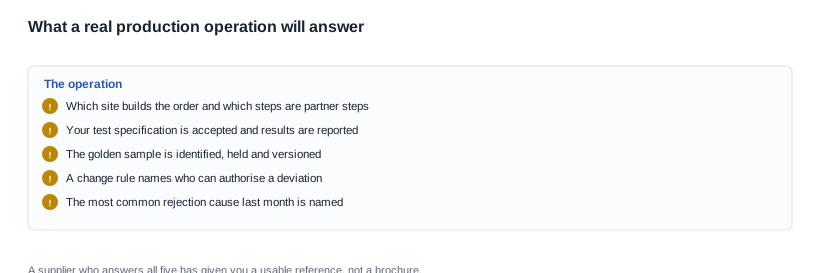
The checklist above is the form we would send to a supplier we were auditing, and the status markers on it are how we would read the reply. A supplier that answers all five plainly has given you a usable reference. A supplier that answers four and explains the fifth has given you a usable reference with one open item, which is fine if you know which item it is. A supplier that answers none of them has given you a brochure, and the due diligence you can do on a brochure is limited to checking that the address is real.
The fifth question is the one that most reliably distinguishes an operation from a brochure. Every factory has a most common rejection cause, and every factory has an opinion about it. A supplier who says "quality is our priority" has told you nothing. A supplier who says "the charging case lid cracked in about two percent of units, we changed the material" has told you about their process, their measurement and their honesty, all in one sentence.
The measurement habits in the published data are a useful cross-check on all of this. Our catalogue publishes what a competent operation publishes: the resolution tier per model, the battery capacity, the charge time, the case capacity, the charging interface, the rated runtime, the Bluetooth version where it is available, the colour options, the ingress marking where one exists, and the frame weight on the one model where we have it. The gaps are real, and so is the pattern in them. Where a figure is published for some models and not others, the reason is usually that the figure is not uniform across the range, and a supplier who claims uniform quality across a heterogeneous range is describing a marketing position rather than a production one.
On our own position, then: we run assembly and final test ourselves, we subcontract some upstream steps and will name them, we publish the product data the manufacturer's catalogue gives us and leave the rest open rather than filling it in, and we do not publish a line count, a headcount or a capacity figure. If you want to know whether that is enough for your programme, the right next step is not a second round of questions to us. It is a look at the operation, and a request to see it tested against a specification that is yours.
Related reading
- Standard OEM engagement and pricing — standard OEM options
- What a development process should produce — oem development process
- Checking a factory rather than a trader — factory vs trading company
Tell us the specification you want tested against and we will tell you whether we can run it and what evidence we will show you.


