

This question has two halves, and they get confused constantly — including by suppliers answering it. The first half is what the regulation requires of you if you place a product on the European market. The second half is what a factory can do about it. The first half is a fixed requirement with several routes. The second half is a service, and whether we offer it is a fact about our own business rather than about the law.
We are going to answer both, and we are going to be clear about which is which, including on the part where the honest answer is that we do not publish a position.
Do you need a named person, or do you need a manufacturer inside the Union?
The requirement itself is not complicated, and it is worth stating accurately because the popular summaries of it get the role wrong.
The General Product Safety Regulation, (EU) 2023/988, has applied since 13 December 2024. It replaced the General Product Safety Directive, and it applies to consumer products made anywhere in the world that are placed on the European market — not only to products manufactured inside the Union. A consumer product designed exclusively for professional use that later reaches the consumer market also falls under it.
Where a manufacturer is established outside the European Union, the regulation expects a person or entity established within the Union to be identified on the product and in the accompanying documentation, and to perform the tasks the regulation assigns to that role. That named party is what people mean when they say an EU responsible person or an authorised representative. We have set out the framework in more detail on our GPSR obligations page.
Now the part that is usually got wrong. This is a role with obligations, not an address. The tasks attached to it are the substance of the requirement:
- Keep the technical documentation and make it available to a market surveillance authority on request.
- Verify that the product complies with the general safety requirements, and that the documentation and labelling match what is actually on the market.
- Answer a request from a market surveillance authority, and cooperate with it on an investigation.
- Implement a corrective action — a withdrawal, a recall, a consumer warning — when a product is found unsafe.
- Cooperate with the authority on any recall.
A forwarding service that receives mail and passes it on satisfies none of those. So does a distributor who takes delivery in the Union and never touches the technical file. The question "do you have a European address" is therefore a poor proxy for the question that matters, and a supplier who answers it with an address has either misunderstood the question or is hoping you will not ask the second one.
There is a related point that catches experienced importers: the role is not interchangeable with the importer of record. In the Union, the responsible person is a safety and documentation designation. The importer of record is a customs and tax designation, in the United States and in the Union both. They can be the same party, they are often the same party, and they are not required to be. A buyer who has arranged one of them has not arranged the other, and this is a distinction worth making explicit in a contract rather than assuming it.
The professional-use point deserves a sentence of its own, because it catches people who assume the regulation only concerns consumer retail. A product designed exclusively for professional use that later reaches the consumer market falls under the regulation as well. That matters commercially for smart glasses in particular, because the same hardware is frequently positioned in both directions — sold to an industrial or institutional buyer for a specific application, and sold to consumers through a different channel. The professional channel does not immunise the consumer channel, and the physical product is the same. If your business has a genuine dual route, the compliance analysis has to be done for each side separately rather than for the product.
And the reverse case is worth naming too: a product that is genuinely, exclusively industrial and never reaches consumers is not caught by this particular regulation, though other regimes still apply to it. The question to ask is not "is this a consumer product" but "does this unit, as configured and as sold, reach a consumer", and the answer needs to be true in the channel as well as in the product.
The third point, and the one with the most practical bite, is that the role has to be held by a party that is actually established in the Union. A factory established outside the Union cannot appoint itself, cannot create a legal presence in a member state on a customer's behalf, and cannot hand over a role it does not hold. Any answer that blurs this is either wrong or has a hidden third party in it.

Do you know who is placing the product on the market?
This is the question that determines everything else, and it is the one most often left unanswered because it does not feel like a compliance question. It is a commercial fact about your own supply chain, and it is the first thing to establish.
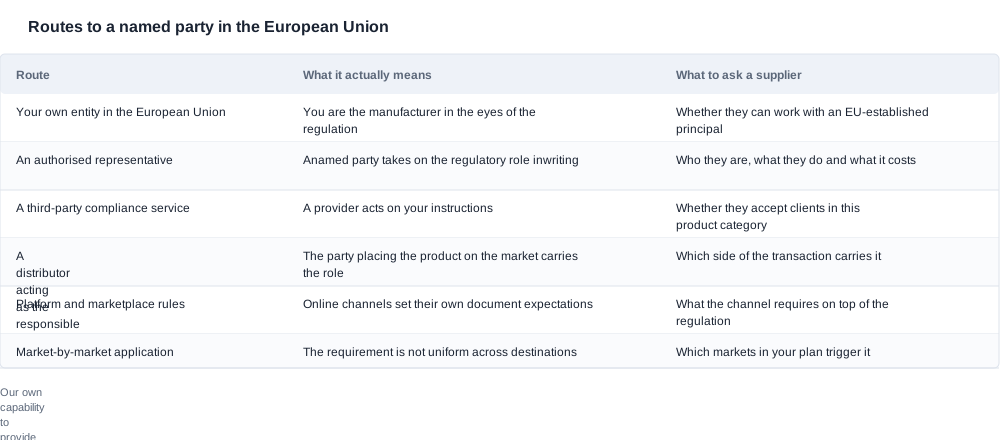
In the European Union, the obligation follows the party that places the product on the market. That produces a small number of routes, and each one suits a different kind of buyer.
Your own entity in the Union. If you already have a company or a registered establishment in a member state, you are the manufacturer in the eyes of the regulation and no separate responsible person is needed. This is the cleanest route and it costs nothing, but it is only open to a buyer who has a presence in Europe already.
A representative appointed in writing. A named party in the Union takes the role on your behalf under a written mandate. They hold the documentation, deal with the authority and handle the corrective actions. This is the route most non-European brands take, it is a service with a cost, and the cost varies with the provider and with how much of the work they take on.
A third-party compliance service. A provider acts on your instructions, which is often the same thing as the previous route under a different name. The questions to ask a provider are specific: do they accept clients in your product category, are they prepared to be named on the product itself, and does the mandate cover the recall task or only the paperwork?
A distributor or channel partner holding the role. Where the party placing the product on the market in the Union is itself established there, the obligation can sit with them. This is a genuine route rather than a workaround, and it is the one most often mis-assumed, because in a multi-layer distribution chain it is easy to be wrong about which party actually places the product on the market.
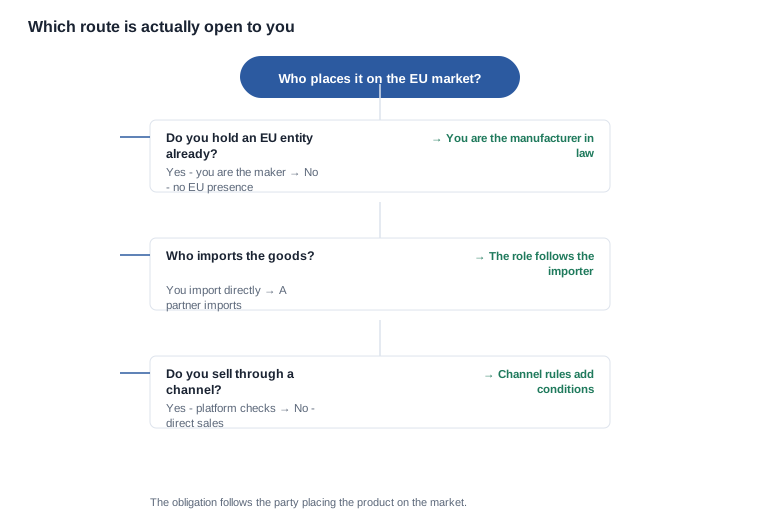
There is a fifth layer that is not part of the regulation but binds you just as hard, and it is worth separating clearly. Marketplaces and platforms operate their own document checks. In several cases they require a named responsible person to be visible on the listing, and they impose their own format and evidence requirements on top of the legal position. A product can satisfy the regulation in full and still be rejected by a channel that wanted more, and the reverse also happens: a listing can be blocked for a document that the regulation does not require but the platform does.
The practical consequence is that the channel layer is sometimes the binding constraint, not the legal one. A buyer who has spent four weeks getting the legal position right can still be prevented from publishing on a marketplace because the platform wanted the responsible person's details in a particular field of the listing form, with the mandate reference, and the platform's own review cycle sits on a different clock from the provider's appointment process. Any launch plan that does not name the channel's review as a dependency is a plan with a hole in it.
The trade-off here is genuinely a trade-off, and it is worth naming it as one rather than treating the marketplace requirement as pure overhead. Selling through a platform gives reach and it gives a demand signal that is hard to get elsewhere. It also gives a third party a veto over your documentation, on its own timetable, with its own standards that are frequently stricter than the legal minimum. Some buyers respond by designing for the strictest channel they intend to use and letting that be the internal standard, which is a reasonable approach when a single channel dominates the plan. Others keep the legal position as the standard and treat each channel's extra requirements as a per-channel cost. Which one you choose depends on how many channels you are running and how much of the volume each one represents.
The way to work this out is to build a small table before you talk to anyone, one row per market and one column per channel, and fill in three cells: who imports, who holds the safety role, and what the channel requires. It takes an afternoon and it is the difference between a launch and a launch with a fortnight of delay in it. The market-by-market differences are set out in our select by market material, and the document side is in the certification checklist.

Do you expect a factory to appoint someone it cannot appoint?
This is where the question turns into a real conversation, so here is the shape of it.
A factory can do several genuinely useful things. It can prepare the technical documentation and the risk assessment, because it knows the product and holds the test evidence. It can make the model codes, the labelling and the batch traceability match the documentation, which is a manufacturing and labelling discipline. It can supply the test reports the file needs. And it can structure the order so that the party placing the product on the market is clearly identified, rather than left implicit in a chain of forwarders.
A factory cannot do two things at all. It cannot appoint itself as the responsible person in the European Union, because it is established outside the Union, and it cannot create a legal presence in a member state on a customer's behalf. Nor can it hand over a role it does not hold, whatever the marketing material says.
Whether a factory can put you in contact with a provider, or whether it works with a specific one, is a commercial arrangement. On our side, we do not publish a position on whether we provide or arrange a named party in the European Union, and we would rather say that plainly than name a partner we have not confirmed. The same applies to the rest of our own document position: our product catalogue does not carry a per-model certification row, and our export-certification page is a picture page of ten patent certificate images — eight design patents and two utility models — rather than a per-model certificate register. The model-level certificate numbers, the test report numbers, the minimum order quantities and the lead times are all not published in our documentation.
That is a long list of things we do not publish, and it is worth being honest about why. It is not a marketing position; it is that our own source material records these as unresolved. We would rather hand you a page that says "not published, and here is exactly who holds the answer" than one that says "certified" in a way that turns out to describe a different model, a different variant or a different customer.
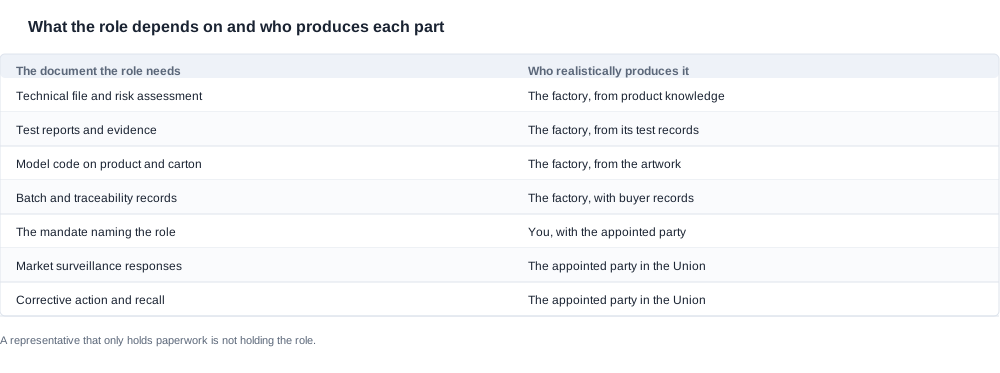
That table is the practical version of the answer. The left column is the set of documents the responsible person will need in order to do the job properly; the right column says who in your arrangement is realistically going to produce each one. A buyer who has worked through it will quickly see whether the person they are appointing has what they need.
It is worth adding a line about what a factory should be willing to put in writing when a buyer asks for the document set, because a refusal or a vague answer tells you something. A supplier who can confirm which of these documents it produces, in what format, against which model variant, and on what timescale, is a supplier whose documentation function exists. A supplier who says "we can provide certificates" without being able to say which document, which model or which entity it comes from, has given you a sentence rather than an answer — and that sentence will not survive a platform's document check.
There is a version of this request that also reveals whether a supplier is thinking about your programme or about their catalogue. Ask for the document set for a specific model, at a specific configuration, with the label copy you have approved. A catalogue-level answer is a generic one. A programme-level answer names the model code, the batch scheme, the label artwork version and the date. Since almost every buyer in this category is doing private-label work, the second answer is the one that matters, and the question is trivial to ask.

Do you have the document set the role depends on?
The single most common reason a file gets rejected is not a missing document. It is a mismatch between the documents.
A model code appears on the product, on the packaging, on the manual, in the test report, in the technical file and in the declaration of conformity. If the code on the carton is spelled differently from the code in the test report — a space, a hyphen, a capital letter, an extended designation — the file does not cover the product, and the responsible person cannot act on a product their file does not describe. This sounds trivial and it is the most frequent failure we see, because every document is prepared by a different person on a different day and nobody is looking across them.
The other mismatches that matter are:
- The product and the file describing different configurations. A file written for a stock build does not cover a private-label build with different labelling.
- The batch records and the shipment. Traceability has to link the units in a consignment to the production run, or a recall cannot be executed. That requires the identifier on the unit, the identifier in your goods-in records, and the identifier in the supplier's production records to be the same format.
- The claimed features and the evidence. A file is not a brochure. Where a claim appears in the file, the evidence behind it has to be in the file.

The sequence above is the one we would suggest, and the order matters more than it looks. Fixing the model code before the artwork goes to print saves a reprint. Fixing the label before the packaging is tooled saves a plate. Fixing the batch scheme before the first production run saves the possibility that you cannot trace a batch at all — and that one is genuinely unrecoverable, because the identifiers are moulded, printed or laser-marked into the product.
There is one more thing to be aware of, which is that the obligation does not expire when the relationship does. When a mandate ends, the documents have to move, and somebody has to know where they are, and for how long. A role that is held for the length of a contract and then quietly lapses leaves a product on the market in the Union with nobody named against it. Whatever route you take, the end-of-relationship question deserves a paragraph in the agreement, and it is the one clause that almost nobody writes until the first time it matters.
Do you have a schedule for the route you chose?
The compliance question is the one buyers ask. The schedule question is the one that decides whether your launch date survives, and it belongs in the same conversation.
The seven questions we would want answered before you commit to a route are these:
- Who is the party placing this product on the market in each European market you sell into? Settle this first; it determines which routes are even open.
- Is the product sold online as well as through distributors? The online channel may impose its own requirement regardless of the legal position.
- If you appoint a representative, what exactly is in the mandate? Ask for the list of tasks it covers, because a narrow mandate that omits the corrective-action and recall obligations is not the role the regulation describes.
- What does the provider need from the factory? Usually the technical file, the risk assessment, the test reports and the batch records — a document list your factory should be able to produce, and one worth asking for at the start.
- Which model codes appear on the product, the packaging, the manual and the documents? A mismatch here is the most common reason a file gets rejected.
- How long does each route take? This is a schedule question, and it is the one that decides whether a launch date survives.
- What happens at the end of the relationship? When the mandate ends, the documents have to move and somebody has to know where they are.
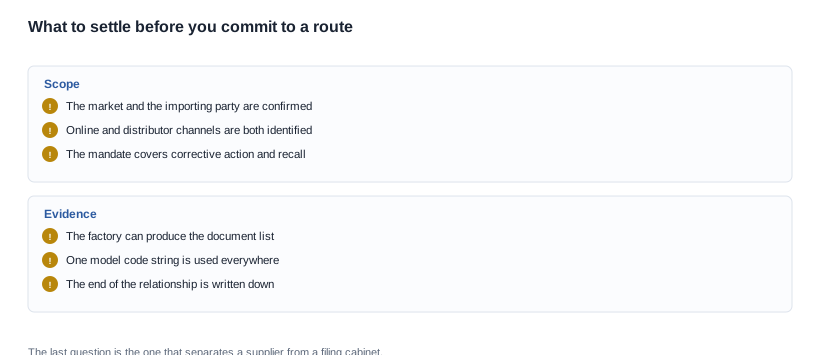
The seventh question is the one we would add to a list of your own, because it is the one that distinguishes a supplier who has thought about compliance as an operating discipline from one who has treated it as a document to be filed. It also has a commercial dimension that is easy to miss: if the role is appointed for your brand specifically, then it is attached to your brand, and a change of brand, a change of entity or a change of country changes the arrangement. Whatever is agreed should be written in a way that survives that.
There is also a scheduling point that belongs in the same place. The route you choose determines the critical path, and the routes have genuinely different timings. Appointing your own entity is fast because there is nothing to appoint. Using a distributor who already holds the role can be equally fast, because the appointment is a confirmation rather than a process. Using a third-party provider is slower, because the provider will want the document set before they will sign, and the document set is the slowest part. Whichever route you are on, the schedule is driven by the documents rather than by the appointment, and the practical advice is to start assembling the document set before the appointment conversation, so that the two run in parallel rather than in series.
The commercial dimension of all this is worth putting plainly. Compliance work is a cost, it is a lead-time cost, and it is a cost that sits entirely outside the unit price. Every buyer in this category carries it, every supplier in this category helps with some part of it, and the differentiator is not whether the cost exists but how honestly it is described before you commit. A supplier who tells you early that the document set has open rows, that the certification position for a particular model needs to be confirmed with the manufacturer, and that the appointment timeline is what it is, is worth more than one who absorbs the cost quietly and discovers it at the shipping date.
We will say plainly where we stand on our own side of this. The requirement is a legal obligation on the party placing the product on the market, and the genuinely useful thing a factory can do is make sure the product, the labels and the documentation are consistent, so that whoever holds the role can actually hold it. We will prepare the technical documentation to the best of our published knowledge. We will tell you honestly which rows in it are still open rather than presenting a certificate acronym as a completed file. And we will not point you at a named party in the Union that we have not confirmed.
If you tell us the markets, the sales channels and whether the product carries your own brand, we will tell you which routes are realistically open for you, what our side of the document set still needs, and what we cannot answer today. The commercial documents that have to match the file are covered under standard OEM options, and the full document set the role depends on is set out in the certification checklist.
Related reading
- The document set the role depends on — certification checklist
- The regulation behind the requirement — GPSR obligations
- The commercial documents that have to match the file — standard OEM options
- The markets where the rules differ — select by market
Tell us the destination markets, the sales channels and whether the product carries your own brand, and we will say which routes are open and what our side of the file still needs.


