
Yes, replacing defective units is a normal part of an OEM arrangement. The thing that determines whether it works is not the policy — it is the identifiers.
A replacement process without a way to identify the defective unit, its configuration and its production run becomes an argument rather than a transaction. And the arguments are almost never about whether the unit was faulty. They are about whether the evidence needed to decide that still exists, three weeks after the customer posted it, in a state that anyone can use.
We should also be straightforward about the limits of what we publish. There is no published warranty period, no published RMA policy and no published replacement policy in our documentation. The framework below is how a replacement programme works and what has to be agreed, which is the same in every supplier in this category. The specific terms — the window, the remedy, the freight, the stock pool — are agreed per programme.
Do you replace the unit, or do you replace the paperwork?
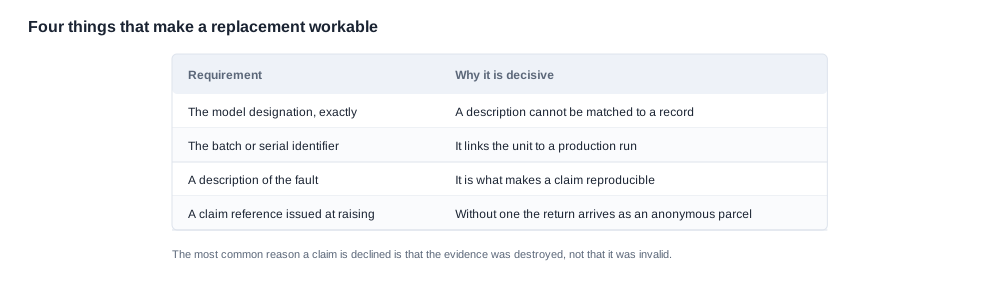
The first thing to understand is that a claim is an investigation, and the investigation runs on documents and identifiers rather than on descriptions. Four things have to be true before a defective unit can be replaced, and each of them has a failure mode that shows up regularly.
1. The model designation, exactly. A unit that comes back described as "the blue camera glasses" cannot be matched to a record. This is not a hypothetical in our own range: the catalogue carries one entry listed as "L2 Utral", with a note about the spelling, and a further "Utral Pro Max" designation whose meaning is not published. The light-responsive and bone conduction entries carry no model designation at all. If your programme includes one of those, the designation has to be agreed and printed before the first unit is built, because it cannot be reconstructed later from what a customer tells you.
2. The batch or serial identifier. This is the document that links a returned unit to a production run. It is the one most often not captured by the buyer — the units arrive, they go out to customers, and by the time a claim comes back there is no way to tie the unit to a run. It is also the single most common cause of an unresolvable claim, and it is entirely within the buyer's control.
3. A description of the fault. What failed, when it started, what the unit was doing at the time, and what happened to the unit afterwards. A unit that has been charged, powered on or repaired after the fault cannot be assessed, and the most common reason a claim is declined is that the evidence was destroyed rather than that the claim was invalid.
4. A claim reference issued at the point of raising. A unit returned without a reference arrives as an anonymous parcel and is frequently refused at the receiving door.
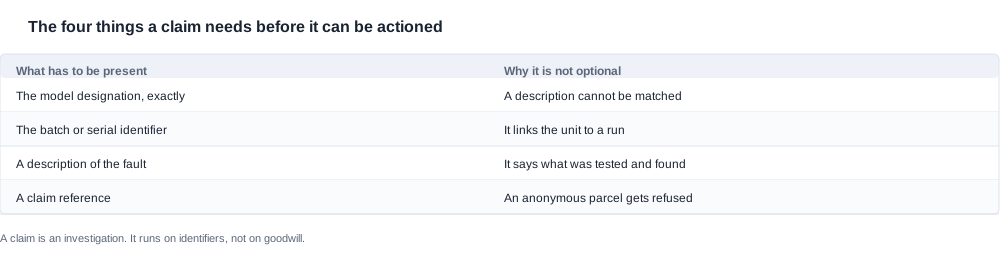
Those four are not bureaucratic. They are the minimum for a decision to be made on evidence rather than on goodwill, and they are the minimum for a decision to be made the same way on the hundredth claim as on the first.
There is a fifth thing that is not about the claim at all and is worth putting in the same conversation, because it changes the arithmetic of the whole programme. Whether the failure is even the supplier's to fix. A unit with a factory defect, a unit damaged in transit, a unit damaged in the buyer's warehouse and a unit that a customer has misused are four different events with four different costs, and a replacement programme that does not separate them is a programme where the cheapest outcome is to replace everything, which is a real cost that somebody is paying. A defect rate that is not classified by cause cannot be reduced, because you cannot fix what you have not separated.

Do you have the identifiers a claim needs?
Here is the honest position on our own documentation: we do not publish a per-model serial or batch scheme. Nothing in the published catalogue tells you what a unit's identifier looks like, which range it sits in, or how it is encoded. That is a real gap, and the sensible response to it is to ask before the first order rather than after the first claim.
What we can tell you is what the scheme has to achieve, because that is what determines whether a claim is resolvable six months later.
A batch or serial identifier has to be unique enough to isolate a run and consistent between three places: on or in the product, in your goods-in records, and in the supplier's production records. If any one of the three uses a different format or a different granularity, the link is broken at the point where it is needed. A scheme that identifies a production date but not a line within a day gives you a run of units; a scheme that identifies a single unit gives you one.
The granularity question is a commercial one as much as an operational one, and it is worth understanding before you agree it. A per-unit identifier gives you exact traceability, which is what a recall, a safety notice and a targeted replacement programme all need. It also carries a cost: an identifier has to be applied, checked, recorded at goods-in, and preserved through your own warehouse and your customer's, and every one of those is a step where it can be lost. A date-and-line batch identifier is cheaper to apply and easier to lose, and it is sufficient for the majority of quality claims while being insufficient for anything involving a specific unit's history.
The right choice depends on what your claims are actually about. If you are building a consumer brand whose exposure is a marketplace dispute over a single unit, a per-unit identifier is worth the operational discipline. If you are supplying a distributor who will handle returns at their own depot and only needs to trace a faulty batch, a batch identifier with a defined run size may be enough. The wrong choice is the one made by default, and it is often made by default.
Whatever you agree, the receiving procedure matters more than the scheme. Four things should happen every time a container is booked in: check the identifier against the packing list, record it in your own system in the same format, record the shipping and the date, and quarantine a small quantity rather than putting the whole shipment straight into saleable stock. That last one is a habit with a very high return, because it is what allows you to answer a question about a specific unit months later instead of guessing.
There is a second-order discipline here that is worth naming, and it is the difference between a scheme that works and a scheme that exists. A batch identifier is only useful if the person recording it understands what it identifies. The receiving team needs to know, in one line, what the identifier tells them — a production date, a production line, a shift, a batch of a given size — because the answer to "how many units could be affected by this defect" comes directly out of it, and that answer determines the scope of a recall, a safety notice or a targeted replacement. A scheme whose meaning is not written down produces a number in the database and no ability to act on it, which is the worst of both worlds: the cost of the scheme with none of the benefit.
The same applies to the packaging level. A buyer who records identifiers at the carton rather than the unit level has a scheme that can answer "which shipment" but not "which unit", and the difference matters enormously for a consumer channel where the claim arrives with one product in it and no shipping information.

The flow above is the ordinary case. The most common deviation is that the loop at the end — the investigation feeding a production change — does not happen, because the defective unit is discarded and the case is closed. That is the point at which the defect rate stops being a number and starts being a permanent cost.

Do you know who pays the freight in each direction?
Four decisions have to be agreed before the first order, and none of them is a detail. They are the difference between a claims process and a complaints process.
1. Who receives the return. The manufacturer's site, the distributor's warehouse, or the end customer's local depot. This determines the logistics of every unit that comes back, and it determines the language on your own customer-facing page, because the customer has to be told where to send it. Retrofitting this later means changing a website, a customer service script and a freight account at the same time.
2. Who pays the freight, in both directions. The return leg and the replacement leg are the two largest lines in a warranty programme, and both sit outside the unit price. They are also the two lines that decide whether a claim is worth processing. A return that costs more to ship back than the unit is worth will not come back, however generous the policy is, and the buyer has to design for that reality rather than around it.
3. What the remedy is. Replacement, credit or repair, and whether the customer receives a new unit or a repaired one. A repair has a lower cost and a different quality expectation, and a buyer who assumed a replacement has a problem the first time a repaired unit comes back — a unit that works, but that the customer can tell has been opened, and that will generate a second claim on a channel that already feels let down.
4. What the disposition of the defective unit is. Scrap, rework, or return to the buyer. This is the manufacturer's decision, and it is worth understanding, because it determines whether the fault is actually investigated and fed back into production. A programme where the defective unit is scrapped at the receiving door produces a replacement rate with no root cause behind it, which is an expensive way to buy a number that never improves.
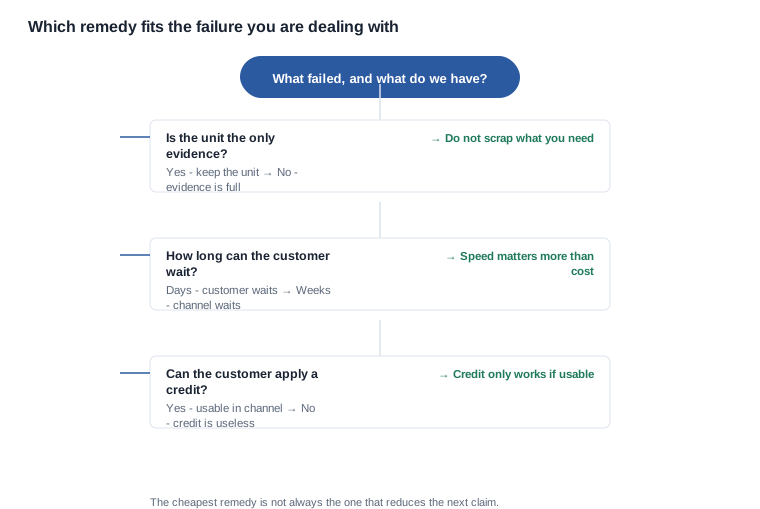
The decision on the remedy is a genuine trade-off, and the criteria are worth applying in order. The first criterion is the cost of the remedy, which is obvious and which is sometimes over-weighted — a credit that the customer cannot apply in your channel is not a credit. The second is the evidence you need: if the defective unit is the only evidence of the fault, then a repair that returns the unit to the customer destroys it, and a scrap disposition destroys it faster. The third is the time to remedy, because in a consumer channel a two-week replacement and a six-week replacement are not the same product experience. The fourth is the evidence the claim generates for the next claim, which points back to the disposition decision.
The trade-off worth naming is between cost and learning. A programme that replaces quickly without investigating is cheap per claim and expensive over a year, because the same defect keeps arriving. A programme that investigates every claim is expensive and eventually reduces the rate. The middle position, which most working programmes land on, is to investigate a sample — a defined proportion, or every claim above a severity threshold — and replace the rest on the buyer's evidence. What matters is that the threshold is written down, because an unstated threshold becomes "we look at the ones we have time for".
Do you have a claim window you can work to?
The claim window and the inspection window are the two numbers that decide whether a straightforward claim fails, and they are the two numbers that are most often shorter than a buyer assumes. They are also not published in our documentation, which means they are not something to plan against until they are agreed in writing.
Four questions to ask before the first order, and the answers belong in the agreement rather than in a supplier's policy document:
- What is the claim reference format, and how is a claim opened? If the answer is a form, ask for a copy of the form. A claim form is the operational statement of everything else in this article, and reading it before the launch is worth more than reading any policy summary.
- What is the time limit for raising a claim after delivery, and what is the inspection window? These are two different numbers and they are frequently different from each other. The time limit is when you lose the right to claim. The inspection window is how long you have to return the unit once you have raised the claim. A buyer who discovers the second one on day nine of a ten-day window has a different problem from one who knew about it in advance.
- What evidence do you need, and in what form? Photographs, video, the outer carton, the inner packaging, the accessories, a written description. Asking this in advance is what stops a claim being held up for a missing photograph that could have been taken at the time.
- What is the replacement lead time, and what is the process for an urgent replacement? In many categories the answer is a separate stock pool, and it is worth knowing whether that pool exists before it is needed.
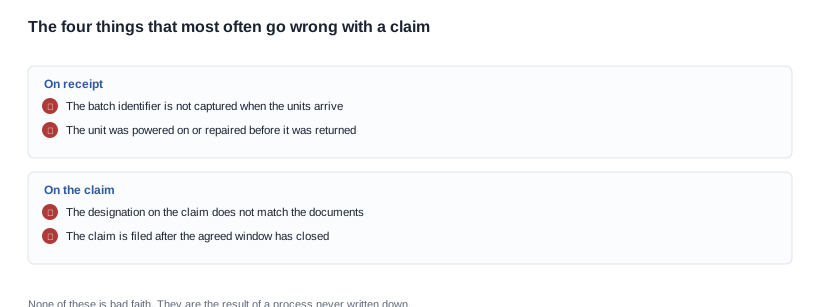
Those four failures are worth reading as a set, because they are all avoidable and three of them are within the buyer's control rather than the supplier's. The batch identifier not captured at receipt, the unit powered on before it was returned, the designation on the claim that does not match the documentation, and the claim filed after the window has closed. None of them is anybody acting in bad faith. They are the ordinary consequences of a process that was never written down, and they are why a claims procedure that a receiving team can follow without asking a question is worth more than any clause in the contract.
Do you want a remedy you can repeat, or one you renegotiate each time?
The point of all of this is to end up with a remedy you can repeat without a conversation, because at volume that is the only kind that works. A programme that is renegotiated per claim consumes more management attention than the claims themselves, and it produces inconsistent outcomes for customers who can tell.
Repeatability is a design property, not an outcome, and it is worth being deliberate about what produces it. Three things do. The first is a written procedure that a person can follow without asking a question, which means it names the identifiers, the windows, the contacts and the forms. The second is a decision rule that has already been made, so that the person handling a claim is applying a rule rather than forming a judgement. The third is a stock position, because a replacement programme that depends on a replacement unit being available somewhere is a programme with a lead time you do not control, and the customer experiences that lead time as the supplier's reliability.
The third point is the one that is easiest to overlook because it sits on the commercial side rather than the operational side, and it is the one that changes the economics of a claim. If the replacement unit comes from the same production slot as the original order, the claim is competing for capacity with live orders and a customer claim will lose. If it comes from a separate pool, the claim is served quickly and at a cost that has been planned for. Whether a pool exists for a given programme is a question to ask at the outset, and it is a question with a supplier-side answer that is worth more than a clause.
The counter-argument is worth stating fairly, because it is a real one: a dedicated stock pool ties up working capital that sits idle most of the time, and for a high-volume, low-defect programme it is poor economics. The resolution is not a rule but a calculation — the cost of the pool against the cost of the customer waiting, expressed in the terms the business actually uses, which for a consumer channel is usually the cost of a bad review and a lost customer rather than the cost of the freight.
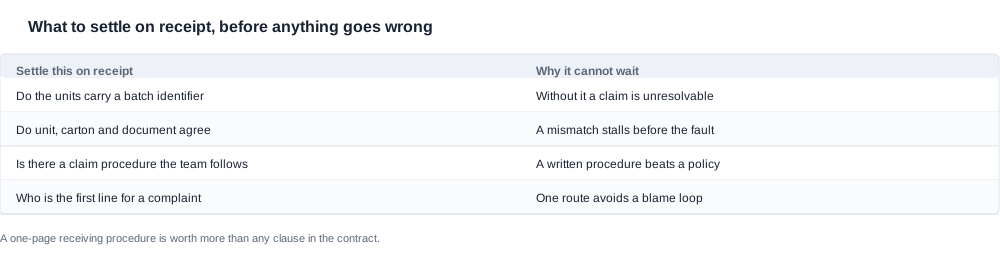
That final checklist is the operational version, and it is short enough to hand to a receiving team as a one-page procedure. If the answers to those four questions are written down and the receiving team follows them, the majority of claims in this category become straightforward transactions.
On our own position, we will say this plainly. We will replace defective units, and we will not adjudicate a claim from a description alone — because a claim without a model designation, a fault description and a claim reference is not something we can act on, and pretending otherwise produces a replacement that does not solve the problem and a customer who is still unhappy.
We will also be direct about the limits of what our published documentation can support, because it would be worse to imply otherwise. The frame weight is published for one model in the entire range — 158 g for the MT6, for the glasses only, excluding its 1200 mAh foldable case — and not published for the rest. The sensor model, the field of view, the video specification and the frame rate are not published across the camera tier. The microphone specification is not published across the whole range. The ingress marking appears on two models, the V06 and the S7, and on no others, with no third-party test report number published for either. The export-certification page is a picture page showing ten patent certificate images — eight design patents and two utility models — and it is not a per-model certificate register, and the model-level certificate numbers are not published. The certification position for the children's models is not published to us either.
Where a claim needs one of those figures, it has to be worked with the manufacturer, and we will say that rather than assert something we cannot evidence. A claim adjudicated against an unpublished number is not a claim, it is an opinion.
If you tell us the model, the configuration and the volume, we will tell you what the replacement arrangement looks like for that programme, which parts of it are ours and which are the manufacturer's, and which of the identifiers in the list above you need to have in place at goods-in. The after-sales and warranty support pages set out the routes, the claim procedure is covered in how to make a warranty claim, the handling of quality issues in quality claims handling, and the returns process in returns and RMA.
Related reading
- After-sales and warranty support
- How to make a warranty claim
- Quality claims handling
- Returns and RMA process
Send the model, the configuration and the volume and we will tell you what the replacement arrangement looks like.


