
We cannot answer that from a specification sheet, because our catalogue publishes no thermal data of any kind for any model. There is no operating temperature range, no thermal test report, no surface temperature figure, and no published description of what happens to the frame rate or to a recording when a long take pushes the device. What the camera platforms do publish is a cell capacity, a resolution tier, a charge time, a rated runtime and a charging method. That is the entire thermal-adjacent material in this catalogue.
That gap is worth taking seriously rather than treating as a missing line, because the question decides whether a content programme can use the product at all. This article is written for the buyer who has to answer the question for a customer. It sets out what actually determines the outcome, what a forty-minute test on a sample settles, and how to turn the result into a specification you can put in a listing and in an agreement.
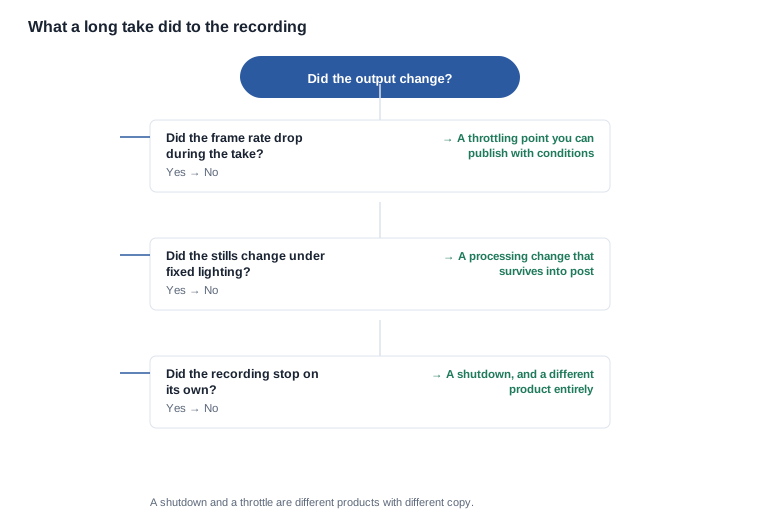
One reframing helps before anything else. "Does it overheat" is the wrong question, and "does it throttle, and when" is the right one. A warm device is not the dangerous device, and a frame that reduces its output in the second half of a take is a product fact a creator can plan a shoot around. A frame that shuts down is a returns driver. Those are different products, they need different listing copy, and only one of them is a defect.
It is worth saying who is actually asking the question in each case, because the answer changes. A creator asking it is worried about a ruined take. A product manager asking it is worried about a support ticket. A buyer asking it is worried about a launch date. Nobody is really asking about temperature, which is why nobody in this category finds a useful answer to it: the published figures describe electricity, not heat, and the question that matters to each of those three people is a behavioural one that has to be measured.
The application context is under smart glasses for content creation, the camera platforms are on the AI camera glasses page, and the session protocol is in how to test camera technology.
Does it overheat during long takes: the question behind the question
Three buyers ask this question for three different reasons, and the answer they need is different in each case.
A content brand is putting a first-person camera into a long-shoot workflow and needs to know whether the product holds for a full session. What they are defending is a delivery date and a creator's day.
A procurement manager is comparing camera platforms and needs to know which published rows actually bear on the thermal outcome. What they are defending is the shortlist.
A channel buyer is writing the listing and needs to know what may be claimed about sustained recording. What they are defending is the product page and, six months later, the returns line.
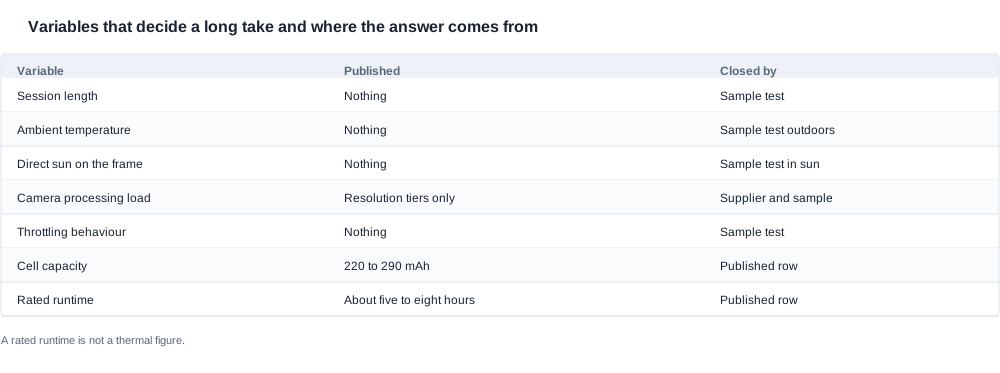
The published rows that bear on the outcome are few, and it is worth listing them precisely because they are easy to over-read. The camera tier publishes two resolution tiers: 13 MP on the L2 Utral and the S7, and the L1 Pro, and 8 MP across the KY06 and the MT6, the V03 and the CY03, and the CY05 and the V06, and the V03 Pro and the MT5. It publishes cell capacities in the range of 220 to 290 mAh and a rated runtime of about five to eight hours, with no test condition attached to either figure. It publishes charge times of 2 hours or less for most models, with only the D17 and the ZH12 publishing about one hour. And it publishes a charging method for most but not all — magnetic on seventeen models, Type-C on seven, and nothing published for the CY03 and the MT6, and the CY05 and the L1 Pro.
None of those rows is a thermal figure, and each of them can be misread as one. A rated runtime of eight hours is a runtime, not a statement about sustained thermal load. A resolution tier is a processing load, not a temperature. The most common error in this category is to treat the runtime row as though it settled the session-length question, and it does not.
What actually determines whether does it overheat during long takes
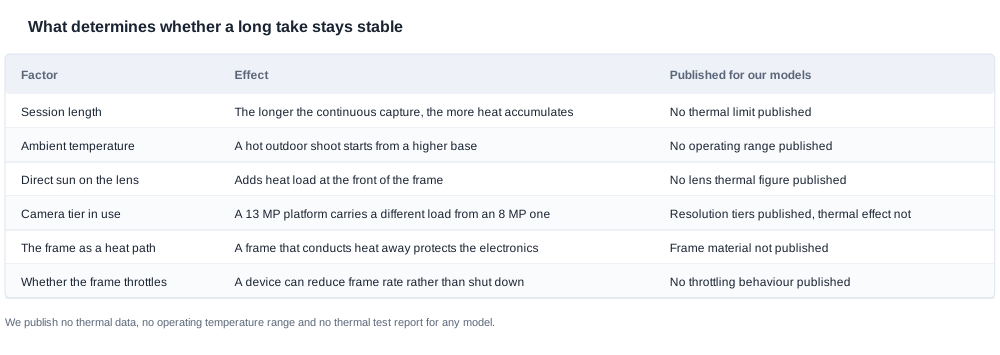
Five variables, and the honest position is that four of them have to come from a test rather than from a catalogue.
Session length. Nothing is published, and this is the variable buyers most often under-estimate, because the demonstration they watched was ninety seconds long. Heat accumulates rather than resetting instantly, so a device that is fine for three minutes can be entirely unsuitable for three hours, and there is no published threshold at which the behaviour changes.
Ambient temperature. Nothing is published. The same device behaves differently on a cool morning and on a summer afternoon, and an outdoor content-creation programme starts from a much higher base temperature than an indoor one.
Direct sun on the front of the frame. Nothing is published. In an outdoor shoot the front of the frame sits in direct sunlight while the electronics run, and the lens and the front of the frame absorb energy at the same time as the camera module behind them is generating its own. This is the most common way an outdoor session runs hotter than an indoor one, and it has nothing to do with the device's design.
The processing load of the camera tier. Resolution tiers are published with no thermal figure attached to either one, and the sensor model, which is what actually determines the processing load, is not published for any model. Two platforms with the same published cell capacity can behave very differently under the same camera load, and the catalogue gives a buyer no way to tell them apart on this axis.
Whether the frame throttles. Nothing is published, and the behaviour that matters commercially is not a shutdown. It is a reduction in frame rate, a drop in still-image quality, or a shortening of the recording, appearing in the second half of a long take. A device that throttles at thirty-five minutes is a different product from one that holds for two hours, and a creator discovers the difference on a long shoot rather than in a specification.
Two published rows compound the difficulty rather than resolving it. The charging method is not published for the MT6 and the L1 Pro, and the CY05 and the CY03, and four of those sit inside the camera tier, so for a chunk of the shortlist the physical thermal path of the device cannot even be described: a magnetic contact and a wired port do not move heat in the same way, and the enclosure design around them differs. And where a case is part of the proposition, the published capacities are 1400 mAh on the L1 Pro and the CY05, and the CY03, 900 or 1400 mAh on the L2 Utral and a foldable 1200 mAh case on the MT6, with a case present but no published capacity on the KY06 and the MT5, and no case row at all for the S7 and the V03, and the V06. A larger case cell in the loop means a second source of heat and a second long-running component in the workflow, and a buyer who tests the glasses alone has not tested the product they are selling.
One counterintuitive point deserves stating because it explains why a glasses form factor tolerates sustained electronics better than a handheld does. The frame is in contact with the wearer's head, and the head is a large, well-perfused heat sink. Heat generated by the electronics has a path away from the device through the frame into the wearer. The same mechanism has a second consequence, which is how a device gets judged: in a handheld camera, sustained warmth makes the device uncomfortable to hold, while worn on the head the warmth is spread across a large area and largely removed by circulation. The sensation is therefore different even where the internal temperature is identical, which is why comparing a glasses frame to a phone in a hand by feel is not a valid comparison.

The forty-minute test for does it overheat during long takes
This settles the question on a sample in about forty minutes, and it is the part of the evaluation a buyer can do without any supplier cooperation at all.
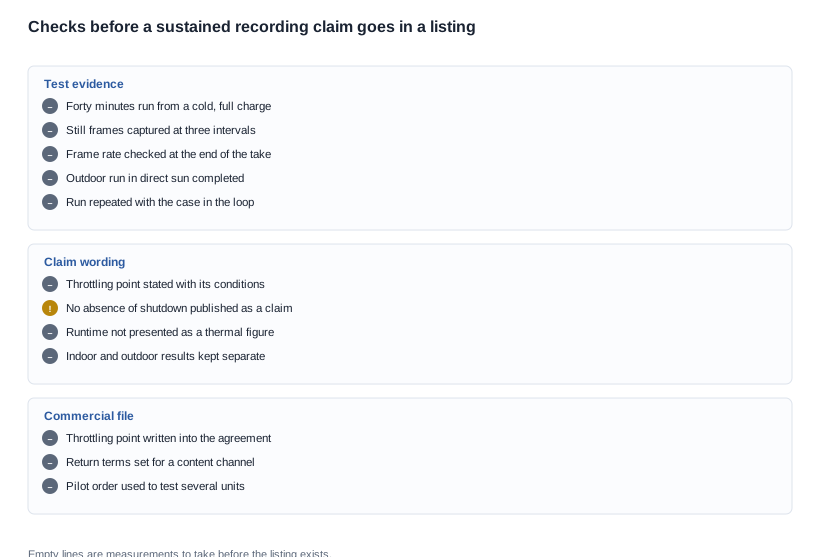
- Start from a cold device, fully charged, and record continuously for forty minutes with the camera moving, because a static frame does not exercise the same processing path.
- Record a still at minute five, minute twenty and minute thirty-five under identical lighting, and compare them. A change in sharpness, colour or processing between them is the throttling signature, and it is usually visible before it is measurable.
- Check the frame rate at the end of the take, not only the length of the file. A recording that continues at half the frame rate is throttling, and the creator will find it in post-production rather than on the shoot.
- Note where the frame is warmest and whether the warmth sits at the temple near the electronics or spreads across the front. The distribution tells you more than the absolute warmth.
- Repeat outdoors, in direct sun, because an indoor result does not transfer to the case that is most likely to produce a complaint.
- Then repeat with the charging case in the loop, if the case is part of the proposition. The case is a second heat source in the chain and a second thing that can fail, and it is worth knowing whether the product holds when the workflow involves docking it.
- Record the finding as a sentence with the ambient conditions attached. "It got hot" is not a finding. "At 30 degrees ambient with direct sun, the frame rate dropped at minute 28" is a finding you can act on, publish and defend.
The comparison across the three stills is the part people skip and the part that matters most. A frame rate drop is obvious when you look for it; a change in processing that leaves the file intact is not, and it is the one that reaches the customer as a quality complaint rather than as a technical failure.
Two practical notes on running the test properly. The first is units: run it on more than one unit, because the variation between units of the same model is usually smaller than the variation between models, and a single result can flatter or damn a platform by a wide margin. Two or three units turn an anecdote into a usable specification and cost nothing beyond time. The second is the sample itself. A supplier's sample policy often covers a unit in its box, which tells you nothing about the forty-minute behaviour, and if the camera program depends on sustained capture then the sample request should say so in writing before the sample is shipped. A sample that arrives without a full charge and a clear instruction to run it to the end will be tested by a buyer for three minutes, and the information will be lost.

Six ways a does it overheat during long take goes wrong in the field
These are the recurring patterns, written as risks to design out rather than as anecdotes.
The demonstration was treated as the specification. Symptom: a creator's long take degrades in the second half. Root cause: a ninety-second demonstration was read as a session-length result. Prevention: run the forty-minute test before the listing exists.
The indoor result was treated as the outdoor result. Symptom: a product that is fine in a studio throttles on a location shoot. Root cause: direct sun was never in the test. Prevention: repeat the test in sun, and publish the outdoor number separately if it differs.
The frame rate was not checked. Symptom: the recording looks fine on the shoot and the post-production is unusable. Root cause: only the length of the file was observed. Prevention: check the frame rate at the end of the take.
A handheld comparison was used to judge the frame. Symptom: the product is judged too hot because a phone in a hand felt worse. Root cause: two form factors compared on sensation rather than on output. Prevention: compare the throttling point, not the warmth.
The case was left out of the loop. Symptom: a product that is fine standalone degrades when the case is part of the workflow. Root cause: the case is a second heat source and a second failure point. Prevention: run the test with the case in the chain if the case ships with it.
A thermal claim was published from the absence of a shutdown. Symptom: a customer whose take throttles at thirty minutes says the product overheated. Root cause: a "does not overheat" claim was inferred from a device that did not switch off. Prevention: publish the throttling point with its conditions rather than an absence of failure.

What does it overheat during long takes is worth commercially
The throttling point is a publishable specification; the absence of a shutdown is not. A brand that can say "sustained capture at 13 MP for forty minutes at 30 degrees ambient, with the frame rate reducing at minute 35" has a claim a creator can plan a shoot around. A brand that says "does not overheat" has a claim a creator will disprove on a long shoot, and the cost of that lands in returns and in reviews.
The commercial lines worth spending negotiation time on are the ones that interact with how the product is judged on the shoot:
- Unit price and volume tiers, with the tier boundary stated in units so you know where a long-lead campaign lands.
- The accessory and case set with its own minimum order quantities, which is a separate commitment and, for a content channel, often a larger one.
- Packaging specification, including whether the pack is designed for a creator who is carrying the product between a shoot and an edit.
- Delivery splitting, so a content programme can be supplied in tranches rather than in one block.
- Payment nodes tied to inspection, which matter more where the product's usability is judged by a team you do not control.
- The warranty period with a stated response, and what it says about a unit returned after a long session.
- Return terms for a content channel, where a creator who cannot finish a take will return the product rather than the SD card.
- The terms of a pilot order, which in this category is the cheapest way to buy the forty-minute test across several units rather than one.
Some cost lines follow the process rather than the negotiation. Certification cost and lead time are determined by the testing body and the route taken. Tooling is often amortised across the first order while certification is charged per product family, and those two are frequently bundled into one line in a quotation that hides which is which — ask which one you are being quoted, because it decides whether the cost scales with your first order or with your catalogue.
One more commercial point belongs in this list, and it is the one that costs the most when it is missed. A throttling product generates a specific kind of support contact: the customer did nothing wrong, the product worked as designed, and the session was still unusable. That is hard to script, because the customer is not describing a fault and the agent has no fault to check. If the agreement does not say what happens in that situation, the cases get handled ad hoc by whoever picks up the phone, and the cost lands in the operating budget rather than in the product specification. Put the throttling point, the session length it was measured at, and the conditions in the agreement, and the support script becomes a sentence rather than an argument.
What belongs in the agreement: the published rows for the configuration ordered; the throttling point with its session length, its ambient temperature and its camera state; the runtime with whatever condition you can obtain for it; the sensor and video specification; and the warranty period with a stated response.
What belongs nowhere near it: any operating temperature range, surface temperature or thermal report that has not been produced, and any "does not overheat" claim.
The shortlist criterion follows from all of this. Between two camera platforms quoting the same price with the same lead time, the question that decides between them is which one will let you run the forty-minute test on a sample and which one will put the resulting throttling point into a written specification. That is a due diligence question with a commercial answer, and it is worth more than a price difference of a few points or a faster quoted lead time. A supplier who cannot name the sensor and the video specification is also a supplier whose thermal behaviour cannot be reasoned about in advance, because the processing load is what drives it.
What we publish about does it overheat during long takes today
We will not publish an operating temperature range, a surface temperature or a thermal test report for a product we have not tested, and we will not present a rated runtime as though it were a thermal result. The catalogue gives a cell capacity and a rated runtime with no test condition, and we have added nothing to that set that we cannot stand behind.
What we can do is check your forty-minute results against the published electrical figures for the model in question. A device that throttles far earlier than its cell capacity would predict is worth investigating, and that check needs no thermal data from us — it needs only the published rows and your measurements side by side.
Our camera technology upgrade considerations page covers the imaging side of a long shoot, battery life for different use cases covers the other half of the same session, and camera technology supplier verification sets out what a supplier has to show you before you rely on any of it.
Send us the model and the session length you need to support, and we will tell you which published figures apply and where the answer has to come from a test.


