
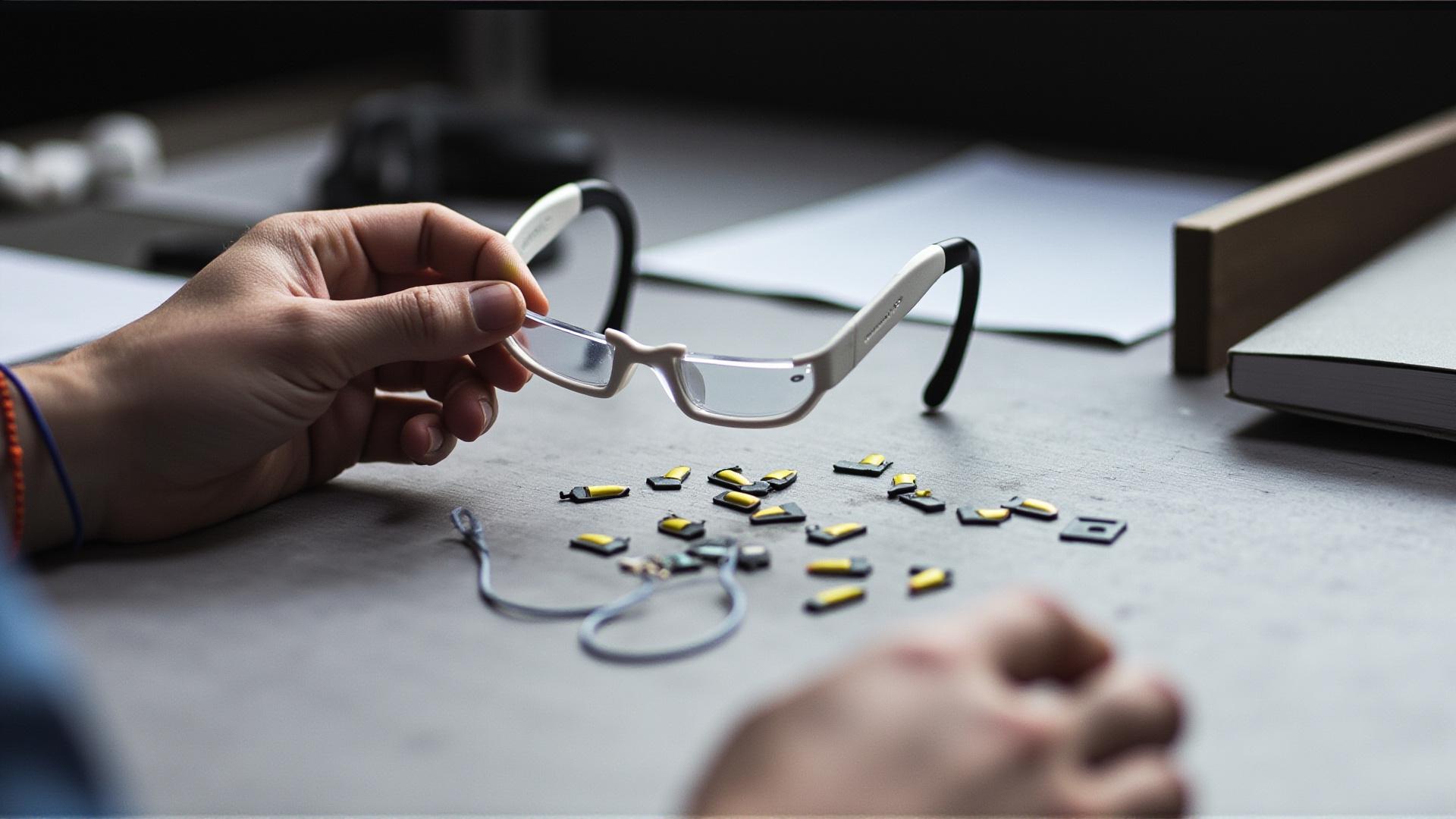
The G07's catalogue page publishes seven lines: Bluetooth V5.4, a 55 mAh × 2 cell arrangement, magnetic charging, a charge ceiling of two hours or less, about six hours of rated use, and one feature line naming an ultra-slim build with a detachable temple. A buyer can check six of those against a physical unit or against a document. The seventh is the problem — a detachable temple cannot be confirmed by a photograph, by a spec comparison or by a catalogue entry, because confirming it means performing an operation and watching what happens. Alongside that sit the items the page does not publish at all: no frame weight, no acoustic figures, no charging-case row, no certificate number, no protection marking, and no box-contents list. A review that ignores those gaps produces a clean sheet that says almost nothing.
So the review for this model has to run on three separate tracks, and the most common failure is running them as one. Physical observation settles what a unit is and does. Documents settle what the supplier is committed to. Written questions settle what neither of those can. The checklist below is organised by track, because a buyer who merges them ends up either treating a document as if it were a test result, or treating a sample as if it were a contract.
Nothing here commits us to a price, an order minimum or a delivery window, and nothing here ranks the model. We do not publish those figures for the G07 or for any other model in the range, so this page is a review protocol that any buyer can run against any supplier's unit.
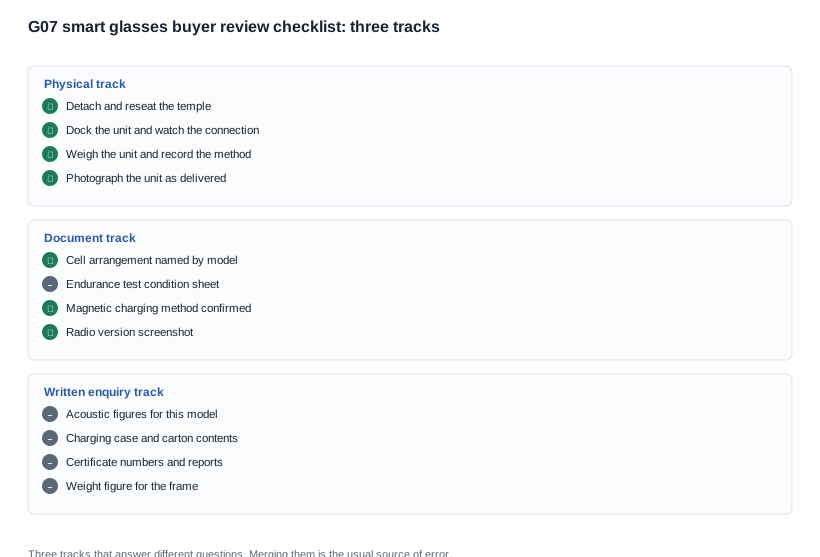
G07 smart glasses buyer review checklist: what a sample settles before anything is switched on
Before any power is applied, the physical checks are worth doing, and there is a reason for the sequence that goes beyond habit. A unit that arrives with a damaged temple, a misaligned charging contact or a cosmetic defect is a different commercial object from one that arrives clean, and the second one is far harder to claim against once the box has been opened and the unit has been running.
Three tracks, and why they must not be merged
The first track is physical observation. It answers what the unit in front of you actually is: how the temple behaves, how the charging interface seats, how the frame sits on the head, what the finish and the materials look like up close. The second track is documentary. It answers what the supplier is committed to: the cell arrangement, the condition attached to the endurance rating, the radio version, the conformity position. The third track is written enquiry, covering everything the other two cannot reach.
Merging the tracks produces two predictable errors. A physical result is sometimes written into the specification as though it were a commitment — a unit that ran for five and a half hours becomes a claim about a six-hour rating, when the correct statement is about that unit, on that day, under that workload. A document is sometimes treated as though it were a test result — a supplier confirmation of a cell arrangement is filed as proof that the cells inside the delivered carton are those cells, which is a different claim entirely.
The pre-power sequence
Four things get checked before the unit is switched on. The temple is detached and reseated, and the result is watched rather than assumed. The charging interface is seated on a dock and the indicator of a successful connection is observed. The frame is inspected for finish, seams and any visible damage, under the same light that will be used for photographic records. And the unit is weighed, because no published weight exists for this model and the measurement is the only figure that can go into a freight calculation. The weight comparison across the audio range explains why an unmeasured frame cannot be costed into a shipment, and the shipping weight note for the range covers the same gap at the carton level.
One unit cannot establish endurance, sound or conformity
Three things a reviewer usually hopes for cannot come from a single unit, however carefully it is handled. The first is the endurance rating: a sample produces one observation under the conditions the reviewer chooses, which is a fact about the sample and not a condition for the published figure. The second is the acoustic performance: without published driver, amplification or leakage figures, a listening session yields an impression, and an impression is not a specification. The method note on microphone testing sets out how to run a repeatable call test rather than an impression, and the range note on calls covers what a call channel should be asking for.
The third is conformity. No unit can demonstrate a certificate that has not been issued, and the catalogue publishes no certificate number for this model, so the review can only record that the question was asked and what was answered in return. The certification status of the G07 covers what that written request should contain.
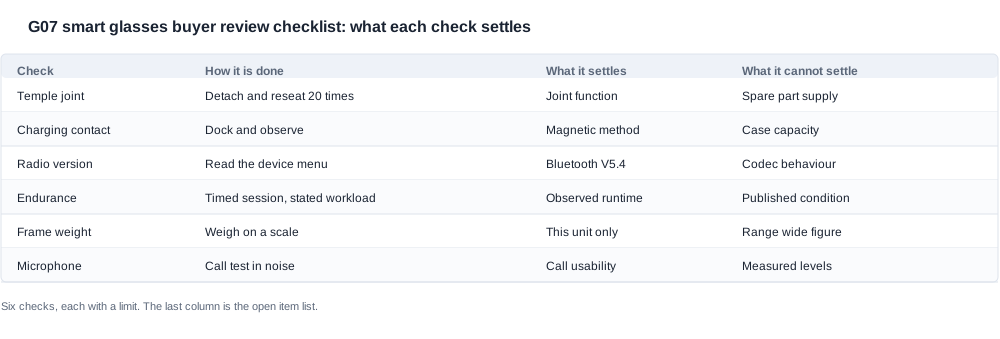

The temple that comes off: the one check a photograph cannot complete
The detachable temple is the one published line on this model's page that cannot be verified from a distance. A product photograph shows a temple that appears to be a temple. A rendering shows a joint that may or may not exist. Only an operation on a physical unit confirms the claim, and only an operation that is repeated confirms the quality of it.
The four operations on the joint
Four actions, in order, tell a reviewer almost everything they need to know. The first is a single detach with no special technique applied — if the release requires a particular posture, a fingernail, or a tool, that fact belongs in the record, because it defines the service procedure. The second is a reseat, confirming that the unit returns to a working state and that the electrical path through the temple is intact, which matters because the catalogue publishes no indicator row for this model and no control row of any kind. The third is a repeated cycle — twenty detach-and-reseat cycles on a single unit is a reasonable protocol for a first article — recording any change in the feel, any looseness and any failure. The fourth is a transport simulation, which is where a temple that is not positively retained becomes obvious.
That last step is the one most often skipped and the one with the clearest commercial consequence. A detachable part that is retained only by friction is a transit-risk item, and transit damage falls on the channel unless the packaging and the retention design have been agreed in advance. The durability testing note for sport models sets out the general approach to shock and cycling protocols that a review can borrow.
Recording the joint as a service proposition
What a reviewer records about the joint is not only a pass or a fail. It is the input to a spares decision, and the charging options for this model makes the same point about the accessories around it: a detachable part creates a second line in the parts plan, with its own supply route, its own stock policy and its own documentation. A review that records only the functional outcome leaves the channel with a working unit and no way to replace a broken one.
Three fields are worth capturing every time. The release method, in enough detail that another technician could repeat it. The reseat reliability, expressed as a count over a stated number of cycles rather than as a qualitative judgement. And the retention behaviour, described in terms that a packaging supplier can act on — whether the temple stays on the frame when the unit is inverted, shaken and boxed.
What to do when the temple comes loose in transit
A unit that arrives with a detached or loosened temple is not automatically a defect claim, and the right response depends on how the packaging was specified. If the carton was designed for a fixed-frame product, with the temples folded in the conventional way, then a loose temple is a packaging specification problem that the channel owns. If the packaging was specified with the detachable temple in mind, then a loose temple is a retention-design problem and the claim belongs with the supplier. Recording the condition of the packaging alongside the condition of the unit is what makes the difference recoverable later.

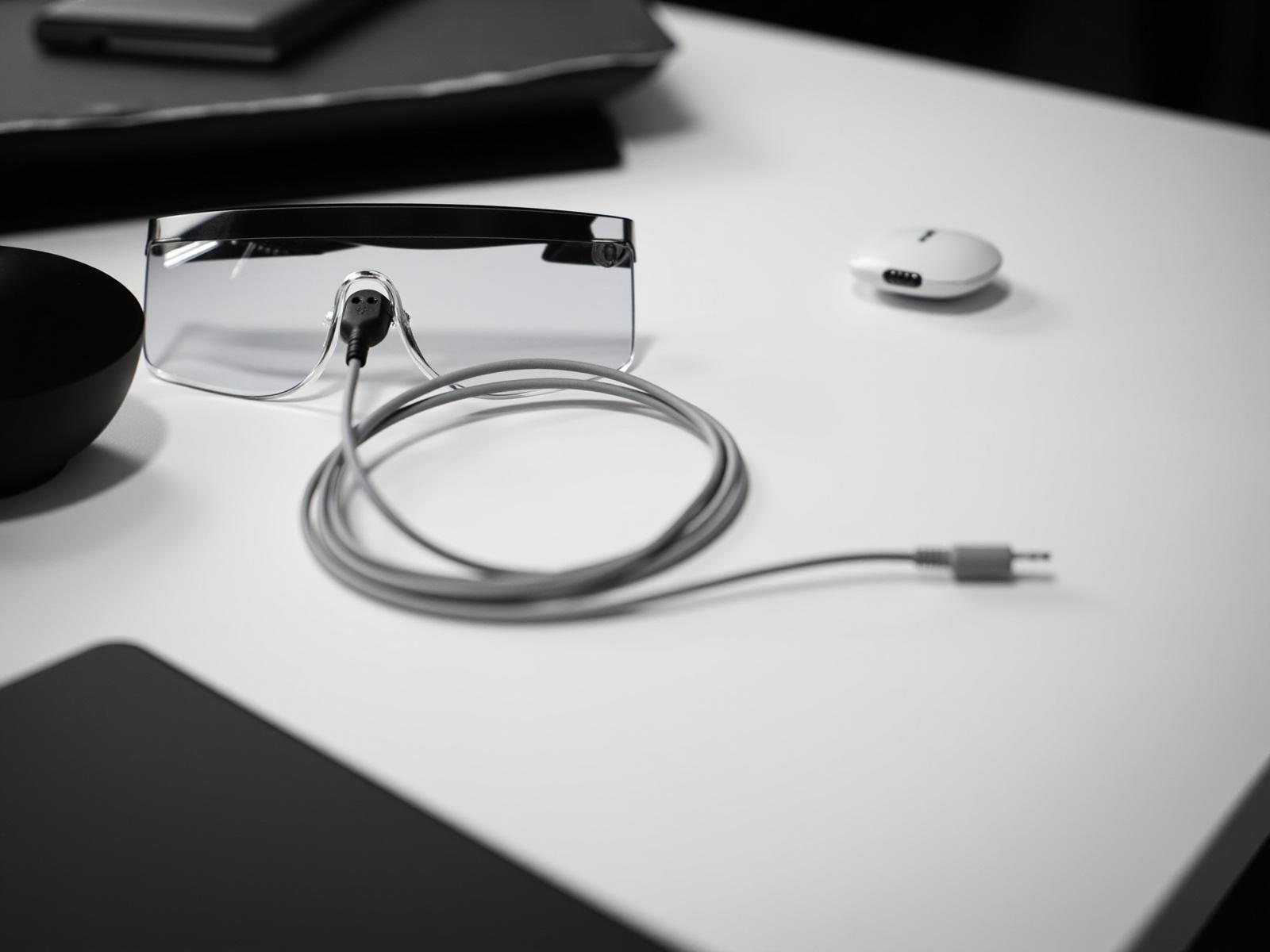
Five published rows and the document each one needs
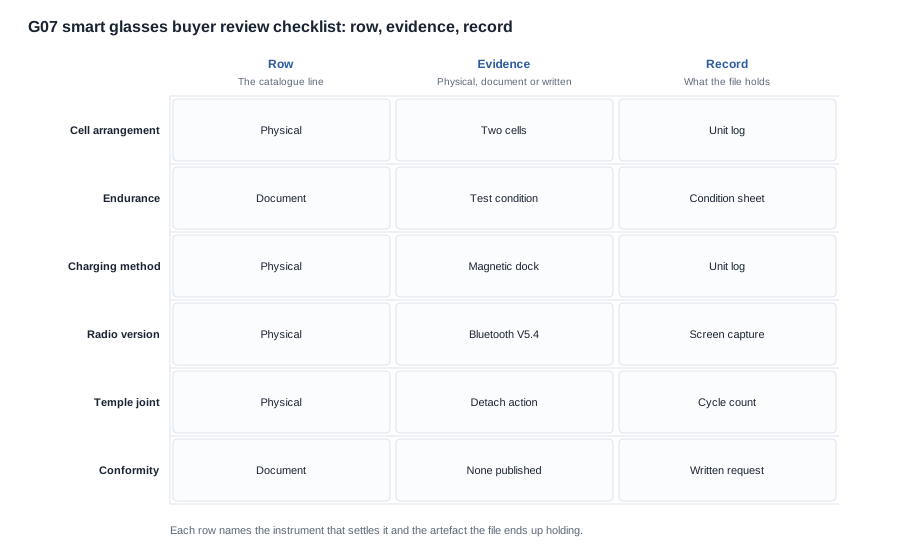
Five of the standard rows on this model's page carry a different evidentiary burden from one another. Treating them identically is what turns a review into a formality, because four of the five can be checked with a document and one only with a physical unit.
Row one: the cell arrangement
The catalogue prints two 55 mAh cells. A document that confirms the arrangement settles what is inside the housing; a physical check settles what is in the delivered carton. These are different questions and the record should not blur them. Because the same arrangement appears on four audio models, a note confirming "two cells" without a model reference is worth very little, and every document collected should carry the model designation in full.
Row two: the endurance figure
About six hours is a rating without a published condition, and no document in the catalogue attaches one. The document worth requesting is a test description: the starting state, the workload, the radio and ambient conditions and the endpoint, as discussed in the battery life analysis for the G07. A summary sheet without a sample size or a tolerance can support a qualified listing claim but not a warranty position, and the review should record which of those two the supplier has actually provided.
Row three: the charging method
Magnetic charging is the one row on this page that is unambiguously observable. Dock the unit, observe the connection, and the claim is settled for the unit in hand. What the observation does not settle is the counterpart — the catalogue publishes no charging-case row for the G07, no case capacity and no box-contents list, so the review should record what actually ships in the carton rather than assume a case.
Row four: the radio version
Bluetooth V5.4 can be confirmed from the device menu on a paired phone, and that check is worth doing because the radio version is shared across most of the audio group and is therefore easy to inherit from a neighbouring model by mistake. A screenshot is the right artefact. What the check cannot settle is the audio behaviour underneath: no codec, profile or transmission detail is published for any audio model.
Row five: the feature line
The ultra-slim note and the detachable temple sit on one catalogue line, and they are of different evidential kinds. The slimness is a design descriptor with no measurable companion — no temple length and no frame weight are published — so it is verified by handling and by photography rather than by measurement. The detachable temple is verified by operation, as the previous section describes. Conflating the two, or checking only the easier of them, is the most likely way for this model's review to pass without having tested anything meaningful.
The four questions the sheet cannot answer
Four items on a first-article sheet are routinely attempted and routinely wrong, because the unit in front of the reviewer appears to answer them when it does not.
The first is endurance as a guarantee. A unit that runs for a stated period under a stated workload produces one observation. The sheet records the workload, the date and the observed figure; it does not convert that into a tolerance, because a tolerance is a supplier commitment and only the supplier can set one. The second is sound quality. With no published acoustic figures for this model, a listening session supports a description of the session rather than a specification, and a channel that writes a descriptive phrase into a spec column will later be held to it as though it were a figure.
The third is weight. A measured unit weight is useful and is not the same thing as a published model weight; the sheet should state which one it holds, and a range-wide figure must never be derived from a single measurement. The fourth is conformity. A certificate is issued against a product and a production process, and a sample sitting in a buyer's office can demonstrate neither. The sheet records that the request was made, what came back and what remains outstanding.
Where a reviewer feels the need to fill one of these four lines, the correct action is to leave it open and name the party responsible for closing it. An open line with an owner is a manageable position; a filled line that nobody can defend is a liability waiting for the first dispute.

Turning the sample notes into an acceptance record
Notes are not a record. A review that produces a set of observations in a notebook, or a set of photographs in a chat thread, has produced evidence that a supplier can dispute and a channel cannot audit. The record is a document with a structure, and the structure is what makes it usable in a claim, an audit or a dispute six months later.
The record structure
Six fields make a workable acceptance record for this model. The unit identity, with a serial number or an internal lot code that ties back to the delivery. The date and the inspector, so that a later question has an author. The specification comparison, listing each published row and the observed result against it, with the evidence type recorded for each row — physical, documentary or written. The defects, coded rather than described in prose, because a coded defect can be counted across a shipment and a described one cannot. The photographs, numbered and referenced from the record. And the disposition: accepted, accepted with a note, or rejected.
The two fields that are usually left out are the evidence type and the disposition, and they are the two that make the record worth keeping. Evidence type tells a reader how much weight a given line carries; disposition tells a reader what the organisation decided and on what basis.
The defect codes a channel needs
A short code list, agreed with the supplier before the shipment rather than after the first claim, prevents most of the argument that follows. For this model the codes that matter most concern the temple joint — release, reseat, retention, transit damage — because they are the ones the published line creates and the ones the catalogue says nothing about. Codes for charging contact alignment, finish and packaging damage complete the set. The general point is that a code list agreed in advance is a quality control instrument, while a code list invented during a dispute is an argument.
The sign-off and the retention period
A record that is not signed does not bind anybody, and a record that is not retained cannot support a claim once the shipment has moved on. The practical approach is to sign the first-article record before the production shipment is released, and to keep the file for at least as long as the defect window the supplier has accepted. Where the supplier has not accepted a defect window, that is itself a gap worth raising in the written request, because the limitations of this model and the published rows for the G07 both feed into what a defect window can reasonably cover.
The G07 review sheet a buyer can send with the order
The sheet below is written to be attached to a purchase order rather than kept internally, and that is the point of it. A review protocol that only exists inside one buyer's head produces inconsistent results and cannot be handed to a quality team, an incoming-goods clerk or a second supplier.
The sheet as it can be attached to a purchase order
Eight sections. Unit identity and delivery reference. The specification comparison, with the seven published rows and an evidence type against each. The temple joint protocol, with the cycle count and the retention result. The timed endurance session, with the workload stated and the observed figure recorded beside the published rating, clearly marked as an observation of one unit. The physical measurements, including frame weight and any temple dimensions taken. The charging check, with the carton contents recorded as delivered. The documents received, with the date each arrived. And the disposition, with the signature.
The two lines we cannot fill in
Two lines of the sheet stay empty until the supplier supplies something the catalogue does not carry, and we will not fill them with estimates. The first is conformity — no certificate number and no test report exist for this model in our documentation, so the sheet records the request and the response rather than a status that the supplier has not issued. The second is the acoustic set — no driver, amplification, frequency or leakage figure is published for this model, so the sheet records the questions rather than a number. The common buyer questions for this model and the cost terms of this model cover the same two gaps from the asking side.
How a failed check should be handled
A failed check is not automatically a rejected shipment, and the handling rule should be written down before the first failure occurs. The workable rule is that a failure inside the joint protocol is a first-article stop — the production shipment is held, because the defect is in the mechanism the product is differentiated on, and shipping into a market on an unresolved mechanism creates returns that are hard to defend. A failure in the documentation track is a commercial hold, because the documents can usually arrive later without physical rework. A failure in the appearance track is a normal quality control disposition, handled against the acceptance criteria already agreed.
On the G07, our position is narrow and we do not widen it: the catalogue publishes seven rows, one of them describes a detachable temple, and everything else a buyer needs for this model has to be produced by inspection, by document or by written request. The buyer review checklist for the G07 smart glasses is that production step written down, so that the acceptance record for G07 smart glasses says what was actually observed rather than what was assumed.
Companion pages
- Published rows for this model — what each of the seven settles
- Limits of the published set — where the silences sit
- The endurance rating — condition against figure
- Document status — the request that opens a file
- Cost elements — the commercial blanks
- Questions and their sources — sorted by what closes them
- Geometry and dimensions across the range — the dimensional side of the audit


