

The G07 smart glasses publish about six hours of rated use, and that figure is the number most likely to be copied between documents, dropped into a product page and turned into a service commitment that nobody in the chain actually agreed to. The number comes from a catalogue page that prints five standard rows: a radio version of Bluetooth V5.4, a pair of 55 mAh cells, magnetic charging, a ceiling of two hours or less, with a rated use of about six hours. Read as a ranking, the G07 looks like the short-run model inside its own cell tier. Read as what it actually is — a rating with no published test condition attached — it is a line item that a procurement file has to resolve before a channel puts it in front of a customer.
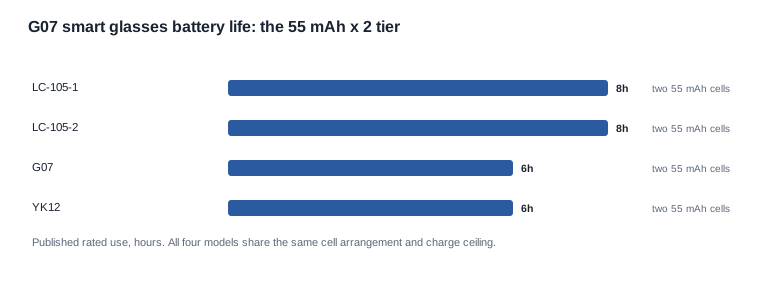
Four audio models in the catalogue share the G07's cell arrangement: the YK12 and the G07, and the LC-105-2 and the LC-105-1. Their published endurance is not one number. The LC-105-1 and the LC-105-2 print roughly eight hours. The G07 and the YK12 print about six. The 55 mAh × 2 tier therefore spans about six to eight hours on the catalogue's own figures, and the two models sitting at the six-hour end publish identical electrical rows. What separates them is a single line of catalogue text: the G07's page carries an ultra-slim note and a detachable temple, while the YK12's page carries a surround-sound descriptor and a slim-temple descriptor. The G07's page publishes no acoustic descriptor of any kind.
That leaves one answerable question, and it is the question this article exists to frame: on what basis can a buyer put "about six hours" in writing and have it survive an audit by a quality team, a distributor or a market regulator? The answer involves three things the catalogue does not print — a starting state, a workload and a stop condition — and the rest of this article works through each of them, then converts what is missing into a written request that can be attached to a purchase order rather than left in a chat thread.
G07 smart glasses battery life: the six-hour band and the twin it shares with
A procurement manager does not read a catalogue page line by line; they read it as a matrix and then interrogate the cells that matter. For the G07, the matrix has a shape that is unusual in this range and worth describing precisely, because the shape is the whole reason the six-hour figure needs a written condition behind it.
The four-model cell group is not one endurance band
The G07's cell row — two 55 mAh units — is shared with exactly three other audio models. Across those four, the catalogue prints two different endurance figures: about eight hours for the LC-105-1 and the LC-105-2, and about six hours for the G07 and the YK12. Every other standard row is identical across the group as well: a charge ceiling of two hours or less, magnetic charging, and Bluetooth V5.4.
So a buyer who sorts the audio range by cell arrangement and then assumes the tier carries a single runtime claim will be wrong by two hours for half the group. The range note on battery life across the audio models exists because this exact grouping is where range charts get built, and range charts are where the assumption gets made.
Two things follow for the G07, and they point in opposite directions. First, the six-hour figure is not an outlier in the sense of being unexplained by the cell arrangement — the arrangement permits either figure, and the catalogue itself prints both across the group. Second, and this is the part that has to be repeated to every downstream writer, the G07 is one of the two models whose published endurance figure is about six hours on the 55 mAh × 2 arrangement. It is not the only one, and a listing that says "the only model in the range rated at about six hours" is stating something the catalogue does not support.
The twin: where the G07 and the YK12 stand on the same rows
Compare the G07 against the YK12 line by line and the electrical half of the comparison is a tie. Both publish a radio version of Bluetooth V5.4, a pair of 55 mAh cells, magnetic charging, a charging ceiling of two hours or less, and about six hours of rated use. The catalogue then gives each of them one feature line, and those two lines are not the same: the G07's line reads as an ultra-slim note plus a detachable temple, and the YK12's line reads as a surround-sound descriptor plus a slim-temple descriptor.
This is worth dwelling on because it is where a lot of buyer-side errors originate. A line copied from the YK12's page onto a G07 product sheet produces a document that cites a surround-sound descriptor the G07 page never printed. It sounds plausible — the two models sit next to each other in the same cell group with the same runtime — and it survives internal review because the surrounding numbers all check out. The tell is that the acoustic phrase arrives without a matching row anywhere in the source.
For the battery question specifically, the practical consequence is this: the G07's six hours cannot be explained away by saying "the other model with the same cells does something different", because the other model with the same cells does the same thing electrically. The difference between them is mechanical, not electrical. That leaves three candidate explanations — a different power draw from the detachable temple design, a different power draw from the ultra-slim profile, or a different test workload — and the catalogue publishes none of them.
Why the tier spans six to eight hours without publishing a condition
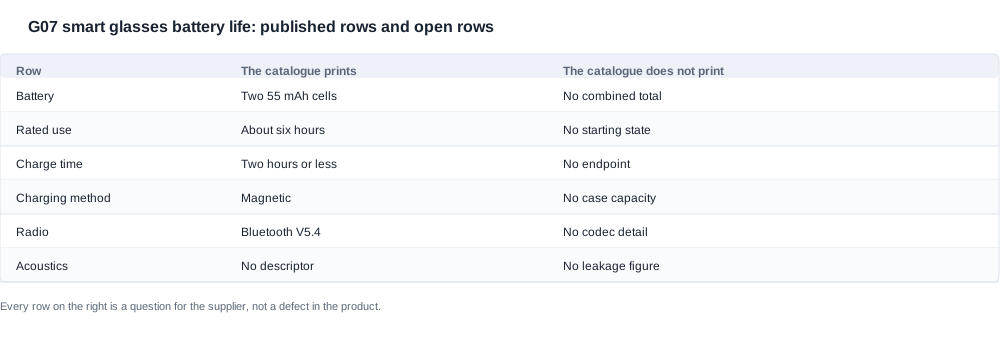
It is worth stating the boundary of the evidence clearly. The catalogue prints rated-use figures for all of its models. It does not print, anywhere in the catalogue text, a test protocol for those ratings: no starting state, no volume level, no codec, no signal source, no ambient condition, and no definition of what "about" means at either end. This is not a gap peculiar to the G07. It is a property of how the document is written, and it applies with equal force to the eight-hour figure on the LC-105-1 and the LC-105-2.
That matters for how a buyer should treat the numbers. A rating without a condition is not false and it is not reliable in the strict sense either. It is a statement of the kind of figure a supplier is prepared to stand behind in general use. The moment it is carried into a contract, a warranty position, a shift-scheduling assumption or a customer-facing comparison, it acquires a meaning it never had — and the meaning it acquires is usually the one the downstream reader wanted.

Where the G07's endurance row ends and the test condition begins
Separating the published figure from the condition it would need is the single most useful thing a procurement file can do with this model. The G07's page ends at the number; everything that would make the number portable begins immediately after it.
What a rated-use figure normally rests on
An endurance rating is the output of a test with five defined inputs. The first is the starting state of the cell — whether the test begins from a full charge, and how "full" is determined. The second is the workload, which for a Bluetooth audio product means at minimum a volume level, an audio source, a codec and a duty cycle between playback and standby. The third is the radio environment, because a device in a congested 2.4 GHz band will spend materially more power on retransmission than one in a quiet room. The fourth is the ambient condition, since a cell's available capacity falls with temperature and the range of a wearable is exactly the kind of product that spends its day outdoors. The fifth is the stop condition — whether the test ends when the audio stops, when the battery reports empty, or when a user would actually have removed the device.
Publish all five and the resulting figure is portable: another buyer can run the same test and get a comparable number, and a quality team can reproduce a complaint. Publish a number without them and the figure is a single observation that can be repeated approximately and defended loosely.
The five things the G07's page does not say
Set out concretely, the G07's endurance row is silent on all five inputs above, and the order in which a buyer should close them is not arbitrary. Start with the starting state, because a figure measured from a full charge and one measured from a part charge are different claims, and a buyer who does not know which is being quoted cannot compare it against anything. Next comes the workload: six hours of continuous playback and six hours of intermittent use are different propositions from a deployment point of view, and only one of them can be scheduled.
Third is the radio condition, and here the criteria are operational rather than technical. The figure has to be adjusted for a dense office or a retail floor, because that is where the product spends its day. Fourth is the ambient condition, which matters in any warm market where the product may be used outdoors. Fifth is the endpoint of the measurement, because a run that ends when the device reports empty and a run that ends when a wearer would have taken it off cannot be quoted as the same number.
The acoustic rows sit outside that sequence, because they do not refine the figure, they explain the draw: no driver size, no amplification figure, no frequency response and no leakage value for the temples is published for this model. That omission matters more here than it would elsewhere, since a temple that separates from the frame is a second object with its own acoustic behaviour, and no document in the catalogue describes it.
None of this makes the six hours wrong. It makes the six hours a rating rather than a specification, and the decision a buyer faces is whether to accept a rating for the listing and a condition for the contract, or to hold the listing until a supplier supplies one. Either choice is defensible. Leaving it undecided is not, because an undecided figure gets written onto a page by whoever drafts it first — and a checklist that names the owner of the six-hour claim is what stops that.


Reading two 55 milliampere-hour cells without inventing a total
The G07's cell row reads as two 55 mAh units, which is the form the catalogue uses for every dual-cell model in the range. There is a calculation available from that row, and there is a strong argument for refusing it, and this section is about the second thing.
What the catalogue prints and what arithmetic adds
The catalogue publishes the capacity of each cell together with the number of cells. It does not publish a combined figure. In the G07's case, a buyer could add 55 and 55 and arrive at 110 mAh of installed capacity, and that number is arithmetically correct in the trivial sense that two 55 mAh cells hold 110 mAh in total.
The difficulty is not the arithmetic. The difficulty is what happens to the number once it is written down. A total capacity written in a specification table reads as a published attribute, and downstream buyers will treat it as one: they will benchmark it against the 180 mAh installed in the K01 and the K02, or against the 290 mAh in the camera models, and they will do so without noticing that the source document never printed a total for any model. The comparison then becomes a comparison of our derivation against their reading of a catalogue, and it is not a comparison anybody is on equal footing in.
The same trap exists in the other direction. A buyer who sees "55 mAh × 2" in a spreadsheet and reads the cell column as 55 will under-rate the product by a factor of two, which is worse than the derivation error because it silently disadvantages a model that is in fact well equipped.
Why a derived total is not a published capacity
Three arguments make the case for keeping the derivation out of specification tables and inside analysis prose. The first is evidential: our own document does not contain the number, so any table containing it contains something a buyer cannot verify against a primary source — and a buyer who later goes to the catalogue, finds no total printed on any page, and concludes that our document was padded. The second is comparative: totals across the range are only meaningful when every total in the comparison was derived the same way, and the catalogue publishes cell-level values for some models and single values for others, so a derived column silently mixes two different kinds of number. The third is contractual: a figure that appears in a specification table becomes a figure the buyer can hold us to, and a derived number cannot be defended by a supplier who never wrote it.
Inside prose, the same derivation is fine as long as it is labelled. Writing that the G07's two cells come to 110 mAh in total, and marking that as our own arithmetic rather than a catalogue value, does the job: it lets a reader use the number while making the source of the number visible.
Using the cell count in a battery-selection argument
The cell count still does useful work even when the total is withheld. Two cells in a slim temple is a packaging fact that affects how the device can be balanced, and it affects what a service organisation can assume about whether a battery failure is a single-cell event or a pack-level one. The G07's detachable temple raises a second-order version of that question — whether the removable temple carries any of the cells, or only the electronics — and the catalogue does not say.
For selection purposes the cell row is best read as a class marker rather than a quantity. It tells a buyer which models share a battery architecture, which in turn tells a buyer which models can share a charging accessory, which in turn tells a buyer which models can share a spare-parts plan. On that reading, the G07's group is the four-model 55 mAh × 2 cluster, and the runtime question that follows is the one this article has been about all along.

What a buyer should request to make the six hours defensible
The six hours cannot be made more precise by re-reading the catalogue, because the catalogue does not print the conditions that would allow that precision. It can be made defensible by asking for them in a form that can be attached to the order, and the request has to be specific enough that a supplier can answer it without arranging a new test programme.
Eight items that close most of the runtime gap without a new laboratory programme
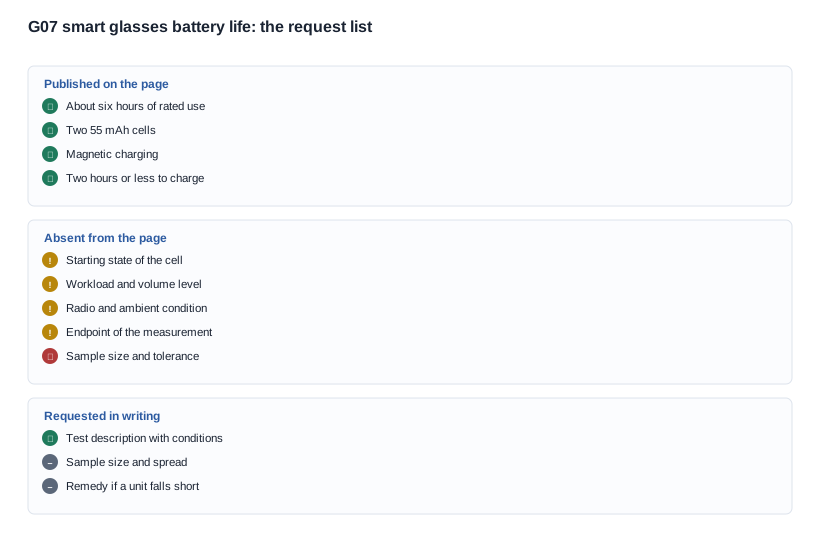
Eight items close most of the gap. The first is the starting state: whether the published rating was measured from a fully charged cell and how the cell was judged full. The second is the workload: volume level, source type and codec used in the measurement. The third is the duty cycle: continuous playback or a stated mix of playback and standby. The fourth is the radio condition: the environment in which the measurement was taken, including whether it was a controlled bench or a live office. The fifth is the ambient condition and the temperature at which the test was run. The sixth is the endpoint: whether the run ended at the battery-reported empty state or at a functional cutoff. The seventh is the sample basis: how many units were measured and whether the published figure is a typical value, a best-case result or a guaranteed minimum. The eighth is the tolerance: what spread the supplier accepts around the published figure, and what happens if a shipment falls outside it.
None of these eight requires a new laboratory programme. Every one of them is a description of how an existing figure was obtained, and a supplier who has run the test has the answers.
The evidence that converts a rating into a specification
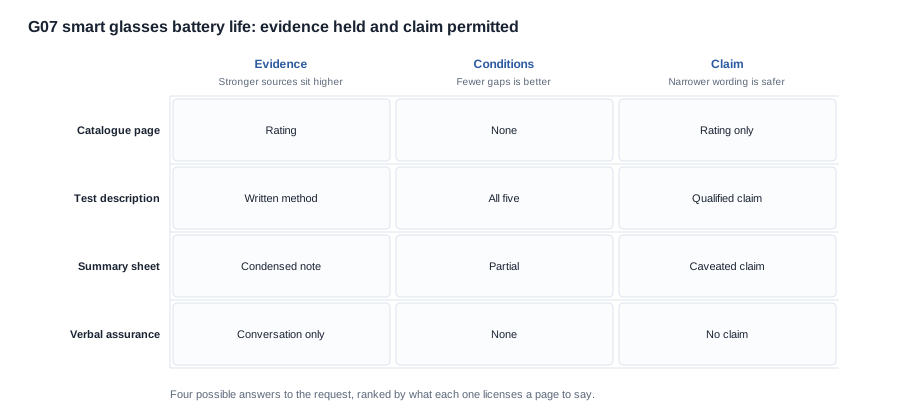
What arrives is usually one of three things, and the buyer should know in advance which one they are holding. The strongest is a written test description — a document that states the conditions, the sample size and the tolerance, and that can be attached to the purchase order as an annex. The middle form is a summary sheet with the key conditions and no sample basis, which is enough to write a qualified listing claim but not enough to write a warranty position. The weakest is a verbal assurance that the figure "is about right in normal use", which is worth recording as a conversation note and worth nothing as a specification.
The middle form is where most real buying sits, and the qualification it supports is worth stating in advance because it is easy to forget later: with the workload and the radio condition documented but no sample size and no tolerance, a channel can honestly write that the rated use is about six hours under the supplier's stated test conditions, and cannot honestly write that every unit delivers six hours. The buyer review checklist for this model treats the battery line as one of the items that needs a document rather than an observation.
Red flags in a battery response
Four response patterns should stop a buyer. The first is a response that restates the catalogue figure without adding a single condition — it adds no information and creates a false impression of documentation. The second is a response that replaces the rating with an anecdote about how long a unit lasted in the factory. The third is a response that attaches a figure to a different model, which is easy to do when several models share a cell arrangement and which has to be checked by model name in every answer received. The fourth is a guarantee offered in a form the catalogue cannot support, such as a guaranteed runtime in writing without conditions attached; that converts an unstated assumption into an explicit obligation, and it is the worst of the four.
The G07 battery life question a channel should answer before the listing goes live
Before any G07 listing goes live, one question has to have an answer in the file: what exactly does the six-hour figure mean, and who signed it. Everything else on the page can be assembled from the catalogue. This one cannot.
The sentence a channel can defend today
A defensible listing claim, on the published evidence alone, runs like this: the G07 publishes a rated use of about six hours on two 55 mAh cells with magnetic charging and a charge ceiling of two hours or less, and the catalogue publishes no test condition for that rating. That sentence is short, it is quotable, and it is entirely traceable to the catalogue. It is also weaker than the sentence most channels want, which is the trade the buyer is making consciously.
The claim that should not be published, because the catalogue does not support it, includes any wording that puts the G07 alone in its runtime class, any wording that moves the eight-hour figure from the LC-105-1 or the LC-105-2 across to the G07, and any wording that attaches an acoustic descriptor to this model. The published specification rows for the G07 are the document a copywriter or a sub-editor should be given alongside the draft.
Where the position stops
Two further boundaries apply to anything a channel publishes about the G07's runtime. The first is that a charge ceiling of two hours or less is a ceiling, not a point estimate, and it says nothing about the endurance of a charging case or about the interruption a shift incurs while the device charges — the catalogue publishes no case row for this model at all, which the charging options note for the range sets out in full. The second is that the range's own published limits are documented separately, and the limitations attached to this model are the right reference for what the catalogue does not publish at all.
The position is short and does not need to grow, and we do not publish a test condition for the six-hour figure, so we do not treat it as a guarantee. The G07 is one of the two audio models whose published rated use is about six hours on the 55 mAh × 2 cell arrangement; the other is the YK12, whose feature line differs while its electrical rows do not. The catalogue attaches no test condition to either figure, and the six-hour number on G07 smart glasses should therefore be published as a rating with its conditions attached — not as a guarantee, and not as a figure that belongs to this model alone.
Read next
- Limitations of the G07 — the silences and what each one blocks
- Specification rows for the G07 — seven entries, itemised
- The LC-105-1 endurance row — the sibling on the same cells
- Comparing battery life across models — building a range chart that survives review


