

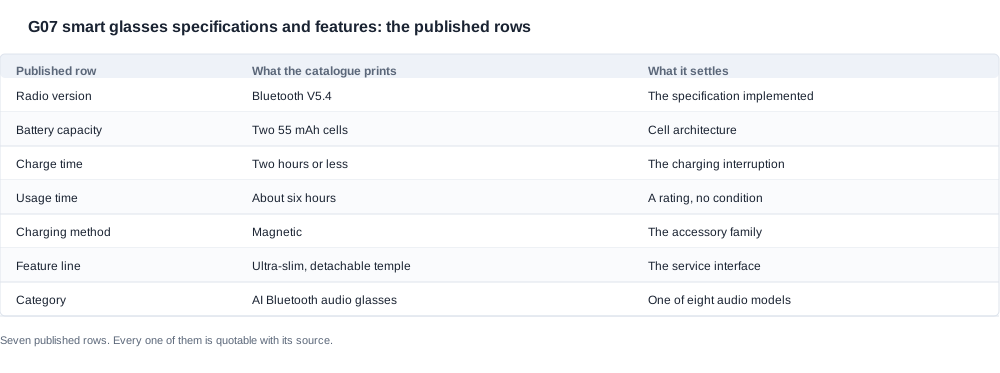
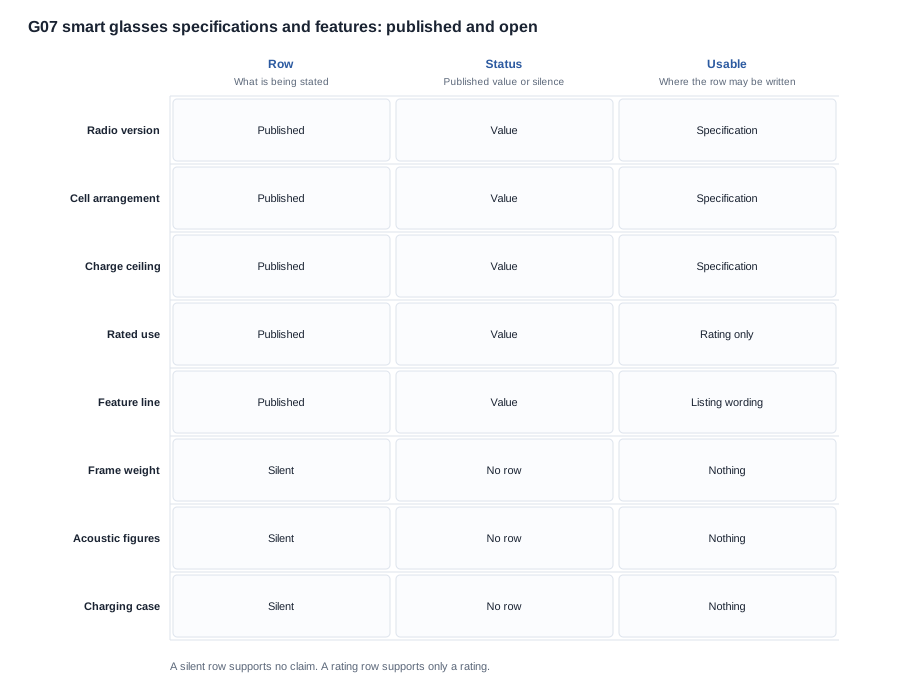
The G07's catalogue page is short and complete at the same time. It publishes five standard specification rows and one feature line, and every one of the seven is a usable fact that can be written into a specification, a comparison or a listing. What the page does not publish is everything that would turn a fact into a claim: no weight, no dimension, no acoustic figure, no microphone figure, no charging-case row, no endurance condition, no ingress marking and no certification line.
That combination is worth working through carefully. A short page is not a thin one when every line on it is exact, and the risk on a page like this is not that a reader is given too little but that a reader adds too much — that a figure from a neighbouring model is imported, that a design descriptor is read as a performance statement, or that a published rating is written into a listing as though it were a guarantee.
This page itemises the seven published rows and states what each one settles. It reads the two design entries as catalogue entries rather than as marketing. It names the rows that this model does not publish and explains what each absence blocks. It places the G07 among the eight audio models. And it draws the line between the features a customer-facing page may state and the ones it may not.
G07 smart glasses specifications and features: the published rows one at a time
Five rows carry the electrical identity of the model and one row carries its mechanical identity. Taken together they are the complete published specification for the G07, and each one settles a different part of a buying decision.
The five standard rows and what each one settles
The radio row publishes Bluetooth V5.4. That settles the version of the Bluetooth specification the radio implements, and it is shared with six of the other seven audio models, so it identifies the model as current within the group rather than as unusual. The cell row publishes two 55 mAh cells. That settles the cell architecture and, with it, which models can share a charging accessory and a parts plan. The charge-time row publishes a ceiling of two hours or less, which bounds the charging interruption without promising a duration.
The endurance row publishes about six hours of rated use, and it is the row that requires the most care, because the catalogue attaches no test condition to it. The charging row publishes the magnetic method. Between them, those five rows describe a device that is current on radio, conventional on cells and charging, and that carries a runtime figure which is a rating rather than a specification.
The sixth row, and the vocabulary it uses
The feature line is the sixth published item, and it reads as an ultra-slim note paired with a detachable temple. Both are catalogue entries, and the discipline that matters is reading them as entries rather than as claims.
An ultra-slim note is a design descriptor with no measurable companion anywhere in the catalogue: there is no temple length, no temple profile figure and no frame weight published for this model, so the word cannot be converted into a number by any legitimate route. A detachable temple is a structural statement about an interface, with no joint specification, no spares supply arrangement and no behaviour description attached to it. Both are facts, and both are the kind of fact that a buyer can state and a customer can read, without either being turned into something the document does not support.
The arithmetic a reader should not do
One calculation is available from the published rows and should be kept out of any specification table. Two 55 mAh cells hold 110 mAh in total, and that number is arithmetically correct — but it is our derivation, not a published value, and the catalogue prints a total for no model at all. Inside analysis prose it is usable provided it is labelled as a derivation; inside a specification table it reads as a published capacity, and a buyer who goes to the catalogue, finds no total on any page and concludes that the document was padded.
The same applies in the other direction. A reader who sees the cell row and treats it as a single 55 mAh cell understates the model by half, and that error is harder to catch because the printed value is technically present in the document.
The ultra-thin note and the detachable temple, read as catalogue entries
Two entries on this model's page describe its shape, and both are routinely read more strongly than the document allows. Reading them correctly is not pedantry; it is the difference between a listing that can be defended and one that cannot.
What "ultra-slim" is and is not
Within the audio group, exactly one page carries a slimness descriptor of its own, and it is this one; the YK12's line names a slim temple in the same field, which is why the two descriptions should not be treated as interchangeable. What the descriptor establishes is a design intent that the supplier chose to publish. What it does not establish is a dimension, a profile angle, a material, a weight, or a comparative ranking — there is no published measurement of slimness anywhere in the catalogue, for this model or for any other.
The practical consequence is that a slimness claim in a listing can be a paraphrase of the catalogue entry and nothing more. It cannot be a number, and it cannot be a claim that this model is the slimmest in the range, because the catalogue publishes no basis on which such a ranking could be drawn.
What "detachable temple" is and is not
The detachable temple is a stronger entry than the slimness note, because it describes something a buyer can act on. It establishes that the temple separates from the frame. It does not establish how the release works, whether the unit operates while the temple is detached, how many cycles the joint survives, whether a replacement can be obtained, or whether the temple is supplied with the unit or sold as a spare.
The scope of the entry is equally specific. Within the eight audio models, this is the only detachable temple published. Two camera models elsewhere in the catalogue publish a detachable inner frame, which is a different part on a different class of product, so a claim about this model has to carry the audio scope rather than being written as a statement about the whole catalogue.
How to use the two together without over-reading
The two entries work as a pair because they describe the same object from two directions: a slim temple that separates from the frame. What that pair cannot produce is a specification, a measurement or a performance statement, and a listing that combines the two into a sentence about lightness or durability has crossed from a published row into an inference.
The disciplined use is narrow and it is still valuable. The pair tells a buyer that the model's service proposition is structural rather than electrical, that the temple is an interface rather than a trim element, and that the accessory and spares plan for this model will not look like the one for a fixed-temple product. The buyer review checklist for the G07 covers the operation that confirms the joint, and the charging options for this model explains why a detachable temple belongs in the spares plan rather than in the accessory plan.
The four most common carry-over errors
Four carry-over errors account for most of the mistakes seen in specification sheets for this model, and each is worth naming because each looks harmless in isolation.
The first is the imported weight: a figure is taken from a neighbouring model because the group is treated as homogeneous, and a document that no longer matches its own source is produced. The second is the imported feature, in which an acoustic descriptor published on a sibling page is written onto this one. The third is the upgraded rating, where a published figure is restated as a target or as a minimum because the language of the specification asked for a minimum. The fourth is the inherited protection, in which a marking published on another product is attached to this one because it would help the listing.
The common feature of all four is that the resulting sentence looks reasonable and that nobody can tell from the sentence alone that it is unsupported. None of them is caught by a reader checking plausibility rather than provenance, which is why the check has to be mechanical: every figure in a specification is either quoted from a named row or removed.
One further habit prevents most of the four. Writing the specification directly from the catalogue page, with the page open, rather than from a summary somebody else wrote, removes the whole class of errors at its source.

The rows this model does not publish, and why each one matters
A page of seven rows leaves a lot unsaid, and the unsaid rows fall into a pattern: physical, acoustic, accessory, commercial and documentary. Each absence blocks something specific, and the useful question is what.
The rows a listing page needs most
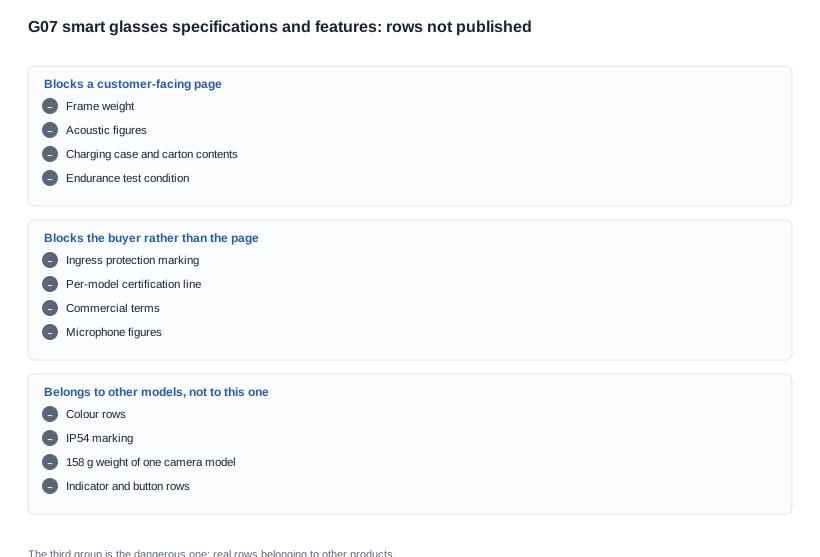
Four absences block a customer-facing page more than the rest. Without a frame weight, a page cannot state a physical property of the product, and a channel cannot compute freight per unit from a published figure. Without acoustic figures, a page cannot describe sound at all, since this model's feature line concerns the temple rather than the sound. Without a charging-case row, a page cannot describe what is in the box, because the catalogue publishes no box-contents list either. And without an endurance condition, a page cannot turn about six hours into a statement about how long the product works in use.
The remaining absences block the buyer rather than the page: no ingress marking, so nothing may be claimed about water or dust resistance; no certification line, so nothing may be claimed about conformity; no commercial terms, so nothing may be claimed about supply or warranty.
Rows that exist elsewhere in the catalogue and must not migrate
The catalogue contains rows that belong to other models, and the risk on a short page is that a row is carried across. Colours are published on two camera models and nowhere in the audio group. The only protection marking in the document, IP54, is published on two camera models. The only weight in the document, 158 g, belongs to one camera model and describes its eyewear body including the battery and the camera but excluding its folding case. The indicator-light and button-control rows appear on the AR glasses page, and no touch row is published for any model in the catalogue. Camera resolution rows belong to the camera group, which this model is not part of.
None of these may be written into a G07 specification, however reasonable any of them looks for a product of this type. The range note on frame geometry and clearance and the weight comparison across the audio range both work through what the audio group does not publish.
The difference between absent and excluded
One distinction has to survive the drafting process. Absent means the catalogue prints no row for this model, so the item is open. Excluded means the catalogue states that the model does not have something, so the item is closed. Only one model in the whole catalogue carries an explicit exclusion of a charging case, and the G07 is not it; the catalogue simply publishes no case row for it.
The consequence for a specification is direct. An absent row becomes a question with an owner and a date. An excluded row becomes a sentence that is finished, and a sentence that is finished can be written into a listing without further support.

A drafting checklist for the listing copy
Before a G07 listing is published, six checks take a few minutes and remove most of the risk.
Check that every figure on the page appears in the catalogue page for this model, and nowhere else. Check that the runtime is written as a rating and carries its source. Check that no physical, acoustic, accessory, protection, conformity or commercial claim has crept in. Check that the detachable temple is described in the catalogue's own terms, and that no claim about the joint, its durability or its spares has been added. Check that no sentence implies a ranking against another model, since the range's rows do not support an order. And check that the page says what it does not know, in one line, rather than leaving the silence to be read as a negative.
The last of those is usually skipped and saves the most work later, because a customer who asks about the missing acoustic figures can be given the answer straight away rather than being told to wait for a reply that will take a week.
The criteria behind all six are simple enough to state: every claim on the page traces to a published row for this model, and every silence on the page is visible to the reader. A page built that way can be defended by the person who wrote it and by nobody else, which is the correct division of responsibility.
Where the G07 sits among the eight audio models
The G07 is one of eight AI Bluetooth audio models in the catalogue: the LC-105-1 and the D11, the K01 and the LC-105-2, the D12 and the K02, and the G07 and the YK12. Position within that group is easiest to read in groups rather than in a ranked list.
The four groups
Two models publish 90 mAh × 2 cells, about eight hours of rated use, magnetic charging and Bluetooth V5.3: the K01 and the K02. Two publish a single 100 mAh cell, about seven hours, Type-C charging and Bluetooth V5.4: the D11 and the D12. Two publish 55 mAh × 2 cells, about eight hours, magnetic charging and Bluetooth V5.4: the LC-105-1 and the LC-105-2. And two publish 55 mAh × 2 cells, about six hours, magnetic charging and Bluetooth V5.4: the G07 and the YK12.
Three of those eight models publish a feature line — the D11, the G07 and the YK12 — and the other five have no feature row on their catalogue pages at all. The G07 is therefore in the smallest published group on runtime and in the smallest group on feature lines, and that combination is what makes it a screening candidate rather than an obvious choice.
The two models this one ties with
Within its own group the G07 is tied on every electrical row, and the separation comes from the feature line alone: this model names an ultra-slim build with a detachable temple, while the YK12 carries a surround-sound line of its own, and neither of the two prints a weight, an acoustic figure or a case row, so the remaining questions are identical for both.
That is a narrow but real position, and it should be described narrowly. The G07 is one of the two models that publish about six hours on the 55 mAh × 2 arrangement, and it is the only audio model publishing a detachable temple. The G07 against the YK12 sets the two side by side, and the YK12 against the K01 is the useful counter-example to any assumption that matching rows imply matching products.
The comparisons worth running
Three comparisons are worth the effort for a buyer considering this model: against the LC-105-1, which shares the cell arrangement and the charging method and differs on endurance; against the K01, which differs on radio version, cell arrangement and endurance; and against the D12, which differs on cell count, charging method and endurance. The G07 against the LC-105-1 and the buyer brief for the G07 both work through how those comparisons should be framed, and the audio model buying guide covers the wider set.
The G07 features a listing may state, and the ones it may not
The purpose of a specification page is to be usable. This section converts the seven published rows into the two lists a channel actually needs.
A permitted list
A customer-facing page for this model may state: Bluetooth V5.4; two 55 mAh cells; a charging time of two hours or less; magnetic charging; a rated use of about six hours, as published; an ultra-slim temple; a detachable temple. Each of those is printed in the catalogue for this model, and each can be written with its source attached. A page may also state the model's category — AI Bluetooth audio glasses — and its place among the eight audio models in the range.
A prohibited list
A page may not state: a frame weight, a dimension, a battery total, an acoustic characteristic, an ingress protection, a charging case or case capacity, a microphone figure, a certificate or conformity claim, a test report, a price, a minimum quantity, a production window, a warranty term, or a runtime guarantee. Each of those would be a claim the published documentation does not carry, and several of them would be claims about a different model.
The prohibited list also covers the two forms of drift that are hardest to spot. A runtime guarantee is prohibited even when the number is correct, because the catalogue attaches no condition to it. An inherited row is prohibited even when the model in question exists in the range, because this model does not publish it.
The phrasing that keeps a rating honest
One piece of phrasing does most of the work: state the rating as a rating, with its source. "A rated use of about six hours as the catalogue prints it, with the test condition to be confirmed" is longer than the bare number, and it is the reason the number survives a technical review.
On what a G07 listing may say, our position is therefore simple. We do not publish the model's weight, its acoustics, its protection marking, its case, its certificates or its commercial terms, and we do not publish them for any other model in the range. What we publish is the published specification rows, the limitations of this model and the certification position, so that a channel writing G07 smart glasses copy can quote a row rather than describe a product, and can answer the customer who asks what the specifications actually are.
Read alongside
- The endurance row in detail — the rating behind the number
- Screening method for this model — how the rows are used
- First-article checks — the physical protocol
- Document position — the request that opens a file
- The accessory programme — the carton
- Silences and facts — the two kinds
- Cost structure — the commercial side
- The buying guide for the range — wider context
- Geometry and dimensions — the dimensional side
- Weight across the range — the freight line
- The LC-105-1 rows — the sibling
- The YK12 rows — the other model in the group
- YK12 against the K01 — a worked comparison
- A brief for this model — the screening method


