

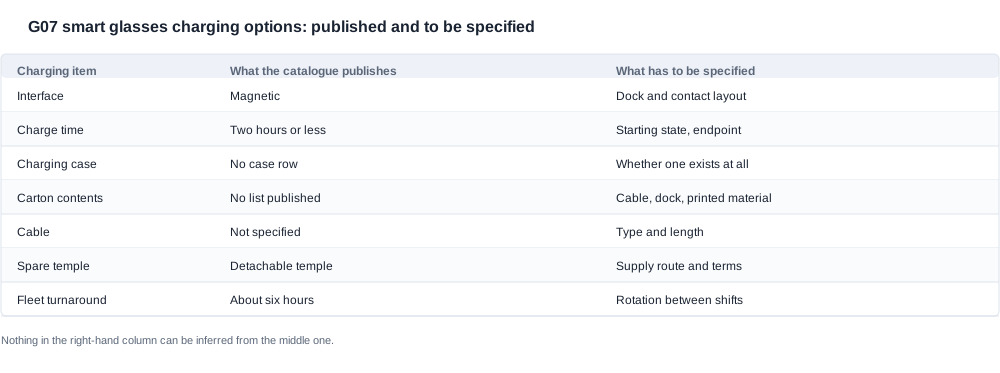
The G07 publishes a charging method, two cells and a charge ceiling. It publishes nothing at all about the object a customer holds in order to charge the product. The method is magnetic. The cells are two 55 mAh units. The ceiling is two hours or less, and the rated use is about six hours. What is absent is any counterpart row: no charging-case row, no case capacity, no case interface, no case weight, and no box-contents list for the model at all.
That absence has to be handled precisely, because the two possible sentences about it are not equally defensible. "The catalogue publishes no charging-case row for the G07" is a statement about documentation, and it is exactly true. "The G07 has no charging case" is a statement about hardware, and nothing in our documentation supports it. A buying team that writes the second sentence into a specification because it assumed the first one has a fault in it will find out at the worst possible moment, usually at artwork approval or at the first carton audit.
What follows sets out what the published rows do settle, what has to be asked for in writing before a carton is designed, and how the detachable temple — which is a real published feature and a common source of confusion — belongs in a parts plan rather than in a charging plan. No price, order minimum or delivery window is published for the G07, so nothing here is a commercial commitment; it is a specification programme.
G07 smart glasses charging options: magnetic charging and the question of the object
Magnetic charging is the row the catalogue prints for this model, and it is worth separating what that row settles from what it merely names, because a channel building an accessory programme has to work from the first and not the second.
What the method row settles and what it does not
What the method row settles is narrow and useful: the unit is charged by magnetic contact rather than by a wired connector at the temple. That single fact determines several downstream items without any further information. It means the charger is a physical object specific to this charging method rather than a generic cable. It means the charging contact is a visible point on the product, which has implications for handling, for transit protection and for the way the unit is presented in a carton. And it means the model belongs to one of the two charging programmes present in the audio range, which matters for anyone stocking more than one model.
What the row does not settle is everything about the charger itself: what it looks like, what it is powered from, how long its lead is, whether it is a dock or a puck, whether it carries any electronics beyond the magnet, and whether it stores any energy of its own. None of that is printed for this model, and none of it is printed for any other audio model either.
The three levels of a charging programme
A charging programme for a channel is usually built at three levels, and the catalogue supports the first and is silent on the other two. The first level is the interface: the method row, which for the G07 is magnetic. The second level is the accessory set: what physically ships with or alongside the product. The third level is the operating routine: how many units are on charge at once, how the units are rotated through a shift, and what happens when the fleet needs to be topped up in the middle of a working day.
The catalogue gives the G07's level one. Level two has no box-contents line for this model, so it is a question. Level three depends on the endurance figure, which is a rating of about six hours without a published test condition, and on the turn-around time implied by a ceiling of two hours or less. A programme built on those two published rows alone will have gaps in it, and the gaps sit exactly where the operational risk is.
Why a ceiling is not a turnaround time
Two hours or less is a ceiling. It says the charge does not take longer than two hours; it does not say how long the charge takes, because the catalogue publishes no starting state and no endpoint for the measurement. It is also not a statement about interruption: a unit that needs two hours to charge cannot be in service while it does so, and any shift plan built on the assumption that a unit returns to service quickly will be wrong in a way that only shows up in operation.
The operational figure a channel actually needs is the time from taking a unit off the charger to returning it to service, under a stated workload, from a stated starting point. That number has to come from the supplier or from a measured sample, and until it does, the ceiling is all there is to plan with.

Whether a charging case is a published part of this model
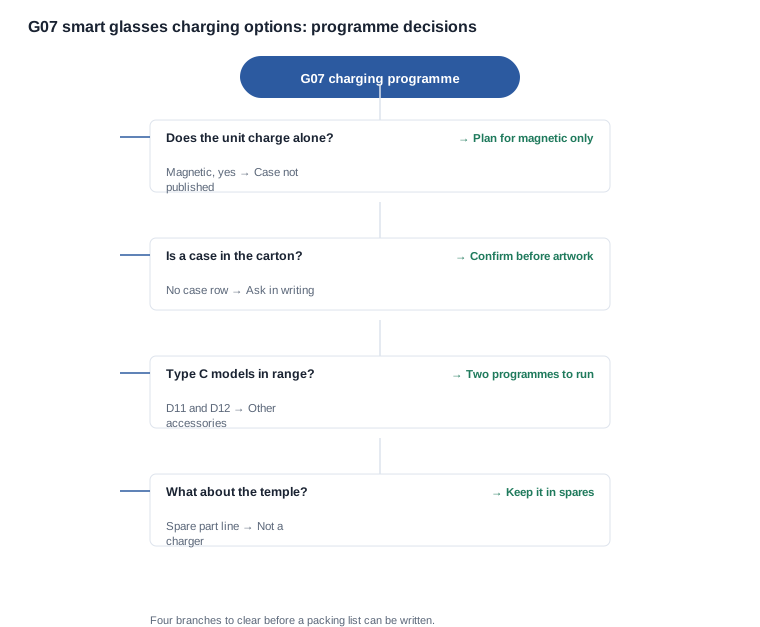
The question comes up in almost every buying conversation about this model, usually because the audio range contains both magnetic and Type-C products and somebody has assumed that a case is part of the standard kit. The position has to be stated in the right terms, and the right terms are about the catalogue rather than about the product.
The three states a case row can be in
Across the full catalogue, a charging case appears in three distinct states, and distinguishing them is not pedantry — it changes what a buyer should ask for. In one state the catalogue publishes a case and its capacity. In a second, it publishes the existence of a case but not its capacity. In a third, it publishes no case row at all, which means the documentation is silent rather than negative.
No state in the catalogue supports a sentence of the form "this model has no case", because no model is published that way. That includes the audio models, whose silence is silence in exactly the same way. The third state is where the G07 sits for the audio group: the catalogue publishes no charging-case row for the G07, and nothing follows from that beyond the fact that a buyer cannot cite a case for it.
Where the audio models sit in that scheme
None of the eight audio models publishes a charging-case row. The case rows in the catalogue belong to the camera models, where five publish a capacity — three at 1400 mAh, one with two published capacities, one with a folding case at 1200 mAh — two publish a case whose capacity is not published, and four carry no case row — the S7 and the V06, and the V03 Pro and the V03 — and no model in the range is published as having no case.
That distribution matters for a channel because it means the audio programme and the camera programme are not the same programme. A channel that stocks both has to manage two case situations at once, and a buyer moving between the two groups will find that the case question is settled in one group and completely open in the other.
The question to ask, and the answer to record
The request is short and it should be asked in writing, in the same message as the accessory list. Does a charging case exist for the G07, and if it does, what is its capacity, what interface does it use, what is its weight, and does the unit charge from the case or only from a dock. If no case exists, the request asks instead for the charger configuration: dock, cable, or both, and what each ships with.
The answer has to be recorded in the same terms the catalogue uses, so that the file stays honest. "No charging-case row is published for the G07" is the correct entry today. "The G07 has no case" is not, and if a supplier later confirms that a case exists, the file has to be updated rather than defended.

The detachable temple as a spares line, not a charging line
The G07's one feature line names an ultra-slim build and a detachable temple. The second half of that is the most commercially consequential phrase on the page, and it is regularly mis-filed. A detachable temple is not a charging accessory. It is a spare part, and it belongs in the parts plan.
The two separable objects in this model
For programme purposes the G07 contains one separable object and one separable interface, and they behave differently. The separable object is the temple, which can come away from the frame. The separable interface is the magnetic charging contact, which comes apart from the charger every single time the unit is placed on it — a normal operation rather than a fault condition.
Collapsing those two into one concept produces an accessory plan that is wrong in a specific way. If the temple is treated as an accessory, it will be counted into the accessory bill of materials, given a slot in the carton and a position on the packing list. But a temple is a service part: it is ordered when something breaks, it has a lead time, it has a defect rate, and its supply is a production question rather than a packaging question. The buyer review checklist for this model treats the joint as the physical check it is, and the limitations of the G07 sets out what the catalogue does not say about it.
What a spares line costs and what it must contain
A spares line for a detachable temple has four elements, none of which the catalogue publishes. The mechanism of supply: whether a replacement temple is supplied loose, whether it is a service-kit item, and whether it is subject to a minimum order of its own. The commercial terms, which for a channel are a question rather than an answer in our documentation. The documentation that travels with a spare, which has to match the shipped product and its production period. And the defect and obsolescence treatment, since a temple supplied from a different production run may not be interchangeable with the unit in the field.
The last element is the one that catches channels out. A temple that fits the first production run and not the second turns a spares line into a warehouse problem, and the symptom appears months later, in a returns analysis, with no obvious cause.
The mistake of folding spares into the accessory plan
The mistake is not a large one, but it is expensive in the aggregate and it is easy to make, because both objects physically sit in the same carton at the start of the unit's life. The symptom is a parts plan that has no line for a temple, because the temple was counted as packaging, and a service channel that discovers this when the first replacement is needed rather than when the plan is written.
The correction is a simple separation in the file. The accessory plan covers what ships with the unit and what the customer or the warehouse holds. The spares plan covers what replaces a part after the unit has left the warehouse. The G07 needs both, and only one of them is visible on the catalogue page.

The charging programme questions to settle before the carton is designed
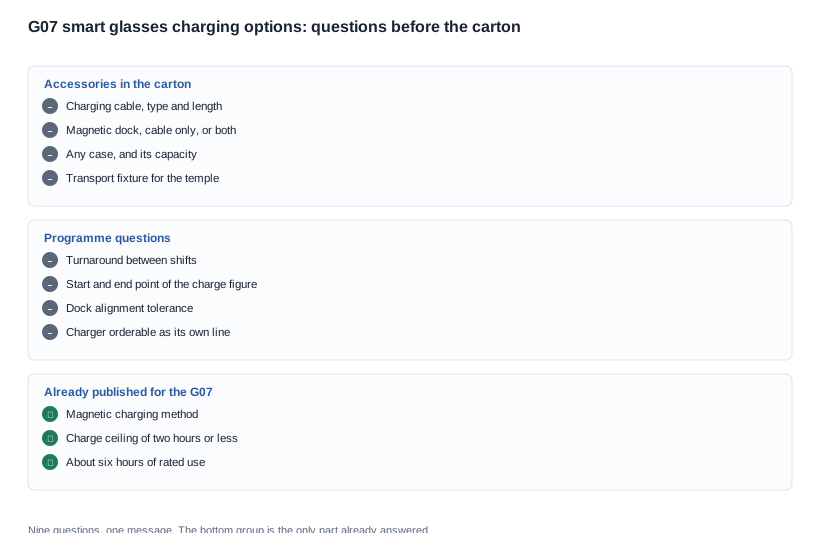
Artwork approval is the natural deadline for the accessory list, because the carton has to state what is in it, and the packing list has to match. Nine questions cover the programme for this model, and they can all be sent in one message. A buyer evaluating a supplier on this model can use them as a checklist: how many of the nine come back as documents rather than as assurances.
The nine questions
The first asks what physically charges the unit: dock, cable, both, and whether the cable is detachable from the dock. The second asks the input side — what the charger is powered from and what the lead length is. The third asks whether any case exists and, if so, its capacity, interface and weight. The fourth asks what else is in the carton: printed material, a case for the temple if one exists, and any tooling or fixture used for transport.
The fifth asks what a unit draws while charging, and the sixth asks the starting state and endpoint of the published charge figure, so that the ceiling can be converted into a working number. The seventh asks how a fleet should be rotated, which is a question about the endurance figure and its condition rather than about the charger. The eighth asks what the replacement route is for a temple and whether a spare can be shipped independently of the product. The ninth asks whether the charger is a separately orderable line, which is the question that decides whether a channel can hold stock of it.
Why the carton is the right deadline
The carton is where the accessory question becomes unavoidable, because the packing list, the carton artwork and the declared contents have to agree. A programme that reaches artwork approval with the accessory list open will either print something that is wrong or print nothing and accept the operational consequence later.
The same deadline has a second benefit: it is early enough to change the answer. Every one of the nine questions is easier to answer before a production run than after one, and at a lower cost, because the cost of a packaging change after tooling is a different order of magnitude from the cost of a line on a packing list.
What changes when the range carries two methods
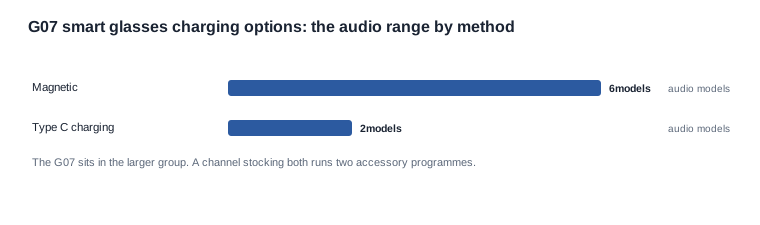
Two of the eight audio models charge over Type-C, and six charge magnetically, which means a channel stocking more than one audio model runs two accessory programmes rather than one. The G07 belongs to the larger of the two. The operational consequence is that a buyer cannot standardise on a single charger across the audio range, and a channel whose commercial model depends on one accessory per model has to think about whether that standardisation is worth losing.
That question is a commercial one, and it belongs with the audio model picking guide and with the G07 selection screen rather than with a charging decision. For the G07 itself, the published row is unambiguous: magnetic charging, a pair of 55 mAh cells, a charge ceiling of two hours or less, and a rated use of about six hours.
Putting G07 charging requirements into a request for quotation
A request for quotation that treats the charging programme as an open set of requirements produces a quotation a buyer can act on. One that treats it as settled produces a quotation that cannot be compared with anything.
The four blocks of the request
The request should be structured in four blocks. The criteria for a usable quotation are simple: every accessory line named, every open question closed, and every commercial term attached to the line it applies to. The first states what is published and cites the rows, so that the supplier can see immediately which parts of the question are already answered and which are not. The second states the requirements themselves: the accessory set, the case question, the turn-around expectation and the spares route. The third asks for the programme documents — the charge figure with its conditions, and the packaging specification. The fourth asks for the commercial treatment of the accessory lines and of the spare.
A comparison note for a channel running both methods
A channel that stocks the magnetic models and the two Type-C models is not comparing two chargers; it is running two accessory programmes with different failure modes. The magnetic programme depends on a physical contact that has to stay clean and aligned, and on a dock that has to be positioned and stored correctly, which puts a consumable and a handling discipline into the operation. The Type-C programme depends on cables, which are consumables and which fail in a familiar way.
Neither observation is a published fact about any model in the range, and neither should be written into a specification as though it were. They are operating notes a buyer can use to decide how much stock to hold and how accessories are handled. The catalogue's contribution to that decision is small and precise: for the G07 it is the method row, and for the two Type-C models it is the interface row.
The question to put to a supplier is therefore not which method is preferred, but which accessories are separately orderable and in what quantity. A channel able to hold the charger as its own stock line can manage the two programmes independently. A channel that cannot has to treat every unit as one bundled object, and that changes the accessory logic of the whole range.
What the supplier must not leave implicit
Two things in particular should not be left to the usual reading. The first is the assumption that a magnetic product ships with a magnetic charger; the catalogue prints a method, not a kit, and the kit is a separate line in the quotation. The second is the assumption that a spare temple can be ordered in the same lead time as the product; a service part with its own supply route is a different commercial object, and the quotation should show it as one.
On the G07's charging documentation, our position is that the published rows end at the interface. We do not publish a case capacity, a carton contents list, an accessory part number or a spare-parts term for this model, because none of those exists in our documentation, and we will not present an assumption in the place of a published figure. The published specification rows for the G07 are where the known rows are set out, the range note on charging options covers the wider programme, and the shipping weight note is the right place to look at what an accessory set does to a freight calculation. On the question of who this model is for, the buyer brief for the G07 sets out the screening method, and the K01 brief covers the model this one shares a cell arrangement with.
In the same set
- The accessory programme for the range — wider context
- Screening this model — the selection method
- First-article checks — the joint in person
- The gaps on this page — what is not published
- The published rows — what is known


