

How do I check an FCC ID online? It takes about ten minutes per unit, and it is worth more than every other document a supplier can hand over, because an identifier is the one piece of certification evidence that can be resolved independently by the buyer rather than accepted on trust. The method is: take the identifier from the product label or from the supplier's paperwork, resolve it in the Federal Communications Commission's equipment authorisation records, and compare what the record says against what is physically in the box.
Before the method, the position that applies to this range. The catalogue publishes no FCC identifier, no per-model certification row, and its text contains no reference to CE, FCC or RoHS anywhere across the twenty-eight published entries. There is a company-level export-certification page whose content is images rather than text, carrying ten patent certificates — eight appearance-design patents and two utility-model patents — and that page is not a per-model compliance statement. So the honest answer has three parts. Published: the hardware rows for every model, and the existence of a company-level export-certification page. Not published: any FCC identifier, any certification scope, any test-report reference, and any per-model compliance position for any of the twenty-eight entries. Ask the supplier: the identifier for the exact configuration being ordered, the authorisation instrument type, the label artwork, and the written compliance scope.
A buyer who is told "our products are certified" has been given a statement. A buyer who has resolved the identifier has been given a fact, and the fact can be re-checked at goods-in without asking the supplier anything.
How do I check an FCC ID online: the method and what it settles
What an FCC ID is made of
The identifier is structured, which is useful because a malformed one is detectable without any lookup at all. It is built from two parts: a grantee code identifying the organisation that holds the authorisation, and a product code identifying the particular equipment within that organisation's portfolio. The two are joined into the single string printed on the label, and both halves can be read separately on the record once the string has been resolved.
The grantee code is the part that carries the legal weight. It identifies the party responsible for the equipment's compliance in the relevant market, and the code is assigned to a company rather than to a product. When a buyer finds that the grantee code on a label belongs to an organisation with no relationship to the supplier, the check has already produced its answer, and everything after it is confirmation.
The fields on the authorisation record
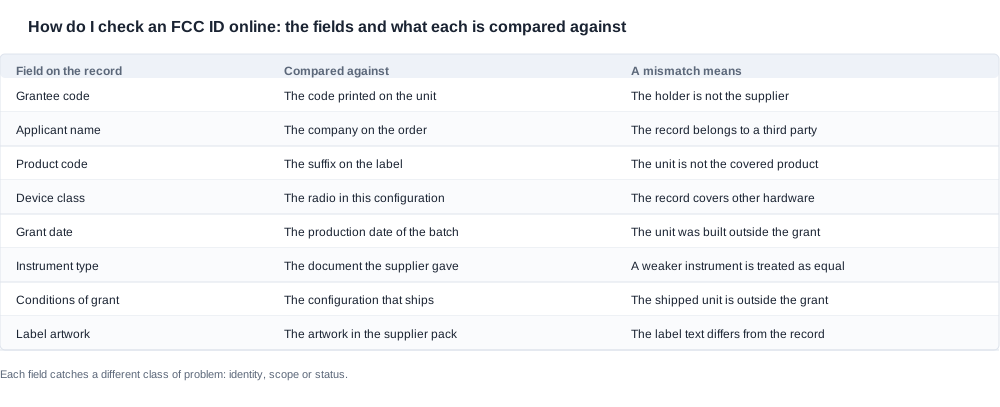
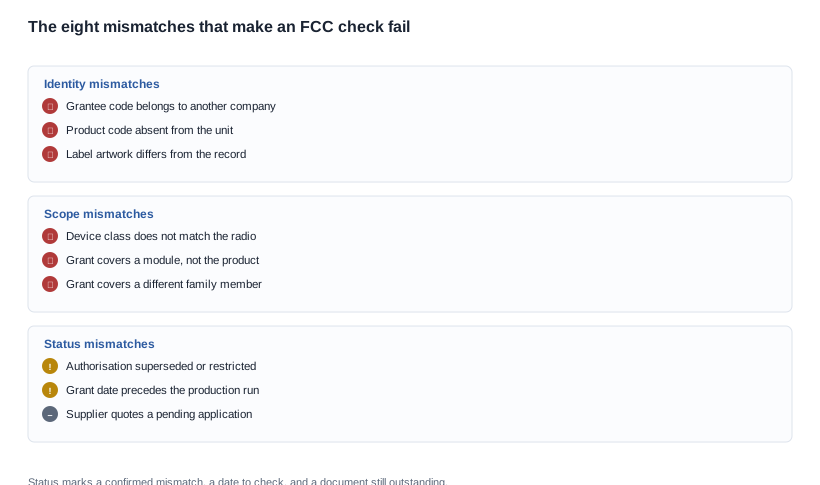
A resolved record carries a set of fields that a buyer can compare one by one against the unit and the paperwork. This is the practical heart of the method, because each field catches a different class of problem: an identity problem, a scope problem or a status problem.
The comparison is done field by field rather than as a single judgement. The grantee code is compared against the code printed on the unit. The applicant name is compared against the company named on the purchase order. The product code is compared against the suffix on the label. The device class is compared against the radio actually fitted in the configuration being bought. The grant date is compared against the production date of the batch. The instrument type is compared against the document the supplier handed over. The conditions attached to the authorisation are compared against the configuration that will ship, and the label artwork supplied by the supplier is compared against the artwork in the record.
When all of those comparisons line up, the buyer holds something specific: this identifier, held by this company, covers this device class, under this instrument, with these conditions, on this date. When one of them does not line up, the buyer has found the reason not to proceed, and has found it before the purchase order rather than after the consignment.
What to do when a check fails
A failed check is not a dead end, and the order in which a buyer responds to it determines how much it costs. The first move is to write down exactly which field failed and against what it was compared, because a finding recorded in that form can be put to a supplier as a question rather than as an accusation. The second move is to ask for the evidence rather than for an explanation: the label artwork, the end-product authorisation, the grant document, or the current status of an application. Most failures in this category are a document-selection problem rather than a compliance problem, and the correct question is which document the supplier should have supplied.
Three outcomes are possible, and a buyer should decide the response to each before the request goes out. If the supplier produces the missing evidence within the review window, the check closes and the finding is logged. If the supplier cannot produce it, the buyer has two commercial options — proceed without the claim and remove the compliance wording from the listing, or stop and treat the absence as a condition of the order. If the supplier indicates that an application is in progress, the third option applies, and the correct handling is to remove the claim from the listing until the authorisation exists, because a pending application is not an authorisation and a listing that asserts one is a statement the buyer cannot support.
What a buyer should never do is carry an unresolved identifier into a purchase order because the product is otherwise attractive. The identifier is the part of the file that can be checked independently, and a check that was started and then abandoned leaves the buyer with neither the assurance nor the knowledge of which it is.

The three authorisation instruments and why the difference decides the outcome
Certification, Declaration of Conformity and Certification of Similarity
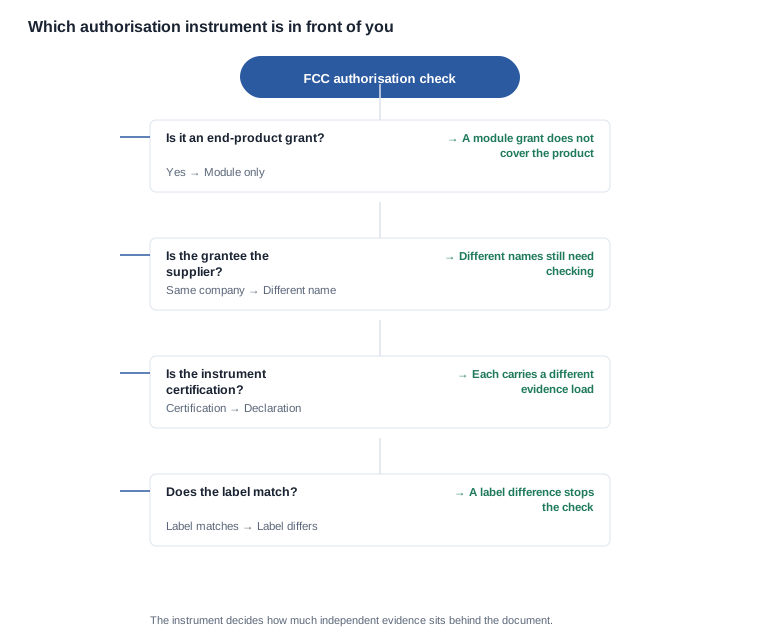
Not every authorisation is the same instrument, and treating them as interchangeable is the second most common error after not looking at all. A certification is granted after an examination of the equipment and the supporting test evidence, and it is the strongest of the three because it rests on a review rather than on a declaration. A declaration of conformity is made by the party itself, on the basis of its own assessment against the applicable requirements and its own test evidence, and it is legitimate but it places the verification burden on the buyer. A certification of similarity covers equipment that is substantially identical to something already authorised, and it is the one most often misapplied.
For a buyer, the practical difference is how much independent evidence sits behind the document. That matters in a dispute, in an inspection by a market-surveillance authority, and in the event of an interference complaint from another operator, which is when the authorisation is examined directly rather than taken on trust.
Why an authorisation for a module is not an authorisation for the product
The single most common way a supplier produces an identifier that cannot support the claim is to supply the authorisation of a chipset or module that is fitted inside the product. That record is real, and it belongs to a different legal object: the module. An end product that integrates a module generally needs its own authorisation covering the finished configuration, or a label scheme that places specific conditions on how the module is integrated.
The distinction matters commercially because the integration is where the radio behaviour of the finished product is actually determined — the antenna, the enclosure, the layout, the power supply, the firmware that drives the transmitter. A record that covers the module says nothing about those. When a supplier's paperwork contains a module identifier, the correct request is the end-product identifier for the configuration being ordered, and if none exists, that is a finding rather than a paperwork problem.
The same logic applies within a product family. An authorisation issued for one model does not cover a sibling model with a different enclosure, a different antenna or a different radio configuration, however similar the two look on a shelf. A buyer who is offered an identifier "for the range" is being offered something that does not exist.

The dates that have to line up
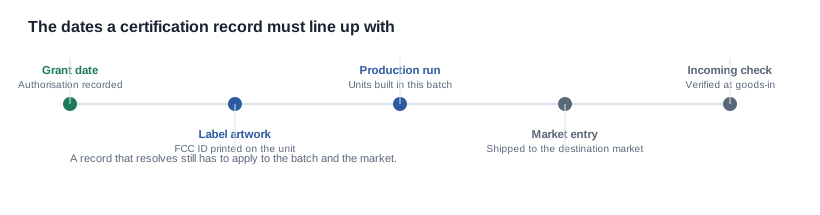
A record that resolves is not automatically a record that applies. The grant date has to sit in a sensible relationship with the production run and with the date the goods reach the market, and this is where a long-running production programme creates its own exposure. A supplier whose authorisation was granted years earlier may have changed the radio module, the antenna or the firmware since, and the record will not show that because the record does not track product changes.
The practical control is to date-stamp the check and to repeat it. A certification file is not a document that is filed once and left; it is a set of records that has to be re-verified at intervals and re-verified whenever the product changes in a way that touches the radio. The supplier's own change-control position is therefore part of the question, and it belongs in the request schedule: what changes require a new authorisation, and who tells the channel when one happens.

Extending the check beyond the radio: the EU declaration and the battery file
The FCC identifier is one line in a compliance file, and a buyer who checks only that line is checking the easiest part. Three further items are usually in scope for a smart glasses product, and each is verifiable in a different way.

The EU Declaration of Conformity
For placement in the European market, a manufacturer's own EU Declaration of Conformity is the document that carries the claim, and the details worth checking are specific: the harmonised standards the manufacturer says were applied, the identity of the product the declaration covers, the date, and the signature of a named party. A declaration that lists no standard, or that names a standard family without a part number, cannot be checked against anything. The Radio Equipment Directive (EU) 2014/53/EU governs the radio and connected-product requirements, and the EMC Directive 2014/32/EU governs the electromagnetic compatibility side; a declaration should make clear which one it addresses for a given product.
The CE marking itself carries no evidence. It is a self-affecting mark, and the burden of substantiating it sits with the party placing the product on the market. A buyer who is asked to rely on the marking is being asked to rely on nothing.
The UN 38.3 summary
For anything containing a lithium cell, the battery file is a separate matter from the radio file and is often the one that is incomplete. The test summary belongs to the cell, and where a product ships with a charging case, the case is a separate assembly with its own cell. The assembly structure behind all of that is described in does the charging case need its own report, and the observation that transfers across is this one: a buyer cannot derive the transport position from a capacity figure, because the transport calculation needs the rated voltage and the chemistry, and neither is published for any model in this range.
The label artwork
The third item is the one suppliers forget to send and buyers forget to ask for: the artwork of the physical label. The label carries the identifier, the grantee name and the statement of responsibility, and its placement on the device is itself regulated in some device categories. The artwork sent by the supplier should be compared against the label in the box at goods-in, and against the record. A label that omits the identifier, or that carries one that does not resolve, is a finding about the production run and not only about the paperwork.
Keeping the file current after the first shipment
A certification file is not closed by a single check, because the things it describes can change while the channel is trading. A supplier may change the radio module, the antenna, the enclosure material or the firmware, and the authorisation record does not track any of those changes. A product that was compliant when it was sourced is not automatically compliant on the fourth production run, and the gap between those two states is where the exposure sits.
The control that closes the gap is a re-verification interval set against the production plan rather than against the calendar, plus a change-notification route agreed in writing with the supplier. Before you order, establish what the supplier is required to tell you when the radio-relevant configuration changes, who in your organisation receives that notice, and what happens to the units already in the channel when it arrives. The questions to ask are short and the answers are worth having: which changes require a new authorisation, how far ahead is the notice given, and is an intermediate build authorised between the old grant and the new one.
The same discipline applies to the documentation around the radio rather than to the radio itself. The catalogue records no firmware version and no update policy for anything in the range, so a behaviour observed on a sample has to be filed against a build identifier that the buyer records. A buyer who cannot name the build has a claim that cannot be re-checked, and a re-check is exactly what the next incoming inspection will try to do.
The request schedule that produces a document worth checking
Every request underneath is framed so that the reply can be checked instead of taken on trust. The order matters: the identifier comes first because it unlocks everything else, and the label artwork comes last because it is the only one that can be confirmed at goods-in.
- The identifier for the exact configuration. Published: none; the catalogue carries no FCC identifier for any model. Not published: the identifier, its grantee code and its product code. Ask: the identifier, printed on the physical label, for the named model and configuration — not for the family and not for the range.
- The authorisation instrument. Published: none. Not published: whether the authorisation is a certification, a declaration of conformity or a certification of similarity, and what evidence sits behind it. Ask: the instrument type and the basis of it, in writing.
- The applicant identity. Published: none. Not published: whether the grantee code belongs to the supplier, to a manufacturer, or to a third party. Ask: the identity of the grantee and the relationship between the grantee and the contracting party.
- The device class and the covered radio. Published: the catalogue publishes no Bluetooth version for any of the eleven camera models, and publishes V5.3 or V5.4 across the audio and sport tiers. Not published: the device class, the frequency bands, and the transmitter configuration covered by the authorisation. Ask: the class and the bands, checked against the configuration being ordered.
- The end-product question. Published: none. Not published: whether the identifier covers the finished product or a module inside it. Ask: written confirmation that the identifier is an end-product authorisation for the configuration, and if it is not, the end-product identifier.
- The label artwork and the placement. Published: none. Not published: the label content and where it sits on the device. Ask: the artwork file and the placement instruction, so that goods-in can be checked against it.
- The EU Declaration of Conformity. Published: none; the catalogue text carries no reference to CE. Not published: the standards applied, the product covered, the date and the signatory. Ask: the signed declaration for the named configuration, with the standard part numbers listed.
- Change control and re-issue. Published: neither a firmware version nor an update policy appears for any model. Not published: what changes require a new authorisation, and how the channel is told. Ask: the change-control position and the notification route, with the re-verification interval stated.
Three supplier answers in this category are worth naming in advance, because each of them looks like progress and is not. The first is a promise of a future document — "the certification is in progress" — which is a statement that no authorisation exists today. The second is a document for a related model, offered because it is available now; it has to be checked for whether the configuration matches, and if the enclosure or the antenna differs, it does not. The third is a statement that the product "complies with all applicable regulations", which is a compliance claim rather than an authorisation and cannot be resolved against any record.
The surrounding buyer-side file sits in the certification verification checklist and in smart glasses certification checklist, with the FCC-specific detail in FCC compliance and FCC compliance checklist. The radio-side qualification is a separate system and a separate trap, covered in Bluetooth SIG certification and Bluetooth SIG certification buyer checklist, and the certificate position for the camera tier is in AI camera glasses certification. The verification question that comes before any of this is in smart glasses MOQ supplier verification.
Related reading
- The FCC-side detail for a buyer file — FCC compliance
- The checklist version of the same material — FCC compliance checklist
- The radio qualification that is a different system — Bluetooth SIG certification
- Where the radio qualification sits against FCC — Bluetooth SIG certification buyer checklist
- The certificate position for the camera tier — AI camera glasses certification
- Where the lithium side of that file is covered — the case and its own documentation
- The general buyer-side file — smart glasses certification checklist
- The reference page for procurement verification — certification verification checklist
Send the model, the configuration and the destination markets, and we will tell you which certification documents to request and how to verify each one independently.


