

Smart glasses for travel charging is a bill of materials, and the count that decides whether the kit works is the number of interface families it carries, not the number of devices in it. The catalogue publishes three charging methods across 28 models — a magnetic method on seventeen, a Type-C port on seven, and no published method at all on four camera models — and every one of the 28 publishes a charge time of two hours or less, or about one hour for the D17 and the ZH12. That means charge time is the one travel problem this category has already solved. The unsolved problems are the weight, the declarations and the item count, and all three are decided before the traveller leaves. This page is written for the brand manager and channel buyer who puts a kit into a bag, and it treats the charging kit as a specifiable product rather than a bundle of cables. The questions to ask before you order are short, and the total cost of the kit is decided by them.
Smart glasses for travel: the bill of materials instead of a cable
Who is buying, and what the itinerary does to the kit
A brand product manager is deciding whether the product ships with a charging kit at all, and if so what is in the box. That decision is a packaging decision with a regulatory tail: whatever is in the box has to be counted, declared and documented. Their exposure is a launch delay caused by a documentation question on a spare battery that was assumed to be a consumable.
A channel buyer supplying travel retail or an airline or travel-retail operator is building a bundle that is sold and re-sold, and every item in the bundle travels more than once. Their exposure is a returns rate caused by the bundle rather than by the device: a kit that arrives without the right cable produces a return that nobody can diagnose from the product.
A procurement manager for a fleet that travels — a sales team, a field service team, an inspection team — is buying devices that spend their working life in transit rather than on a desk. Their exposure is a device pool that loses charge state between assignments, because every handover on the road is an unlogged handover.
The common thread is that a travel kit is disassembled and reassembled constantly, and every reassembly is an opportunity for a cable to be left behind, a case to be left in a hotel room, or a device to arrive at the next leg with an unknown charge state.
Why charge time is the least of the three travel constraints
Because the charge time is published and it is short. Twenty-six of the 28 models publish a charge time of two hours or less, and the D17 and the ZH12 publish roughly one hour. An overnight stop is therefore sufficient for any model in the range, and a travel plan that treats charging as the hard problem has misidentified it.
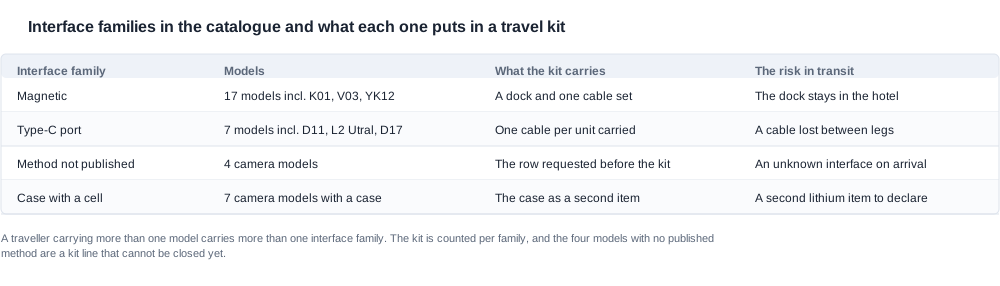
What does not travel well is the interface. A magnetic dock is a desk accessory: it is heavy relative to a cable, it is useless in a hotel room, and it is the item most likely to be left behind at the end of a trip because it has no obvious next use. A Type-C port is a cable, and cables are cheap, light and easy to replace, but there are several of them in the range and a traveller carrying three model families carries three cable sets. Four camera models publish no charging method at all, so the cable line for those four cannot be priced until the factory answers.
The third constraint is weight, and it is the one with no published answer at all. The catalogue publishes exactly one unit weight in the whole range: 158 g for the MT6 glasses themselves, including the 265 mAh cell and the camera, and excluding its folding charging case. The case weight is not published. So for the twenty-seven other models, a travel buyer who needs to state a carried weight per item has no catalogue row to quote and has to request one per model.

Three interface families, and the kit line each one creates
The magnetic family and the dock problem
Seventeen models publish a magnetic method, including the V03 and the V06, the S7 and the K01, and the MT5 and the K02, and the KY06, the LC-105 pair, the G07, the YK12 and the YKC02. For a desk deployment that is the easiest method to dock. For a travel kit it is the heaviest, because the dock is a discrete object with no use away from a desk.
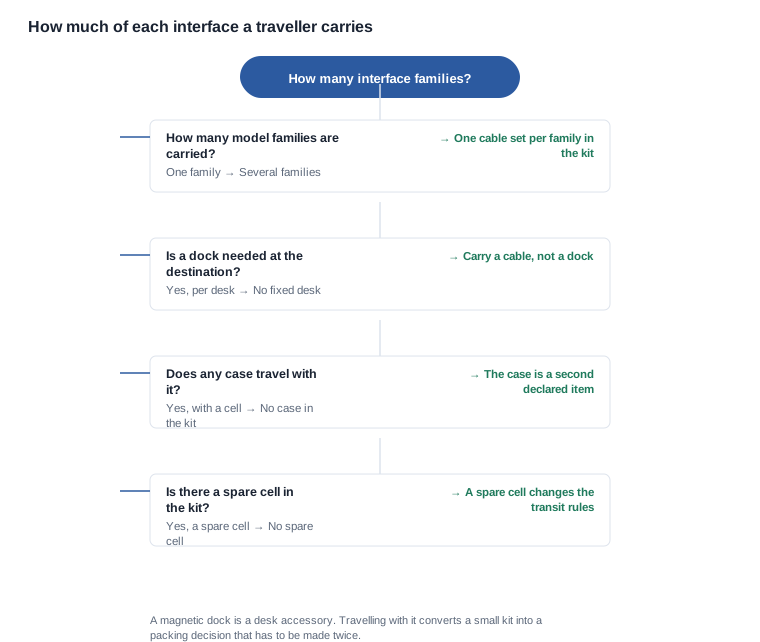
The practical consequence is a rule that is worth writing into the product specification: the travel kit carries cables, and the dock stays with the desk or with the base. A buyer who follows that rule removes an entire accessory line from the packed kit, and with it an accessory line from the freight calculation and a declaration from the travel paperwork. The charging hardware options are set out at charging solutions.
The magnetic interface also carries the one unpublished row that matters most in transit. A magnetic contact is a physical interface with a life, and the catalogue publishes no contact material, no service life in insertion cycles and no indicator behaviour. In a travel kit those contacts are handled more than in a desk deployment, because every leg means a pack, unpack and dock cycle. The row has to be requested before the kit is specified, because the spare-contact ratio is a line on the bill of materials and one of the usual red flags in a first-order review.
The four camera models with no published method
Seven models publish a Type-C port: the D12 and the V03 Pro, the L2 Utral and the ZH12, and the D11 and the D17 and the bone-conduction model on the last page of the catalogue. One cable covers all of them, which is the reason the Type-C family is the easiest of the three to pack.
The four camera models that publish no charging method are the CY05 and the L1 Pro, and the MT6 and the CY03. All four publish a cell configuration, a charge time, a runtime band and a case capacity, and none of them publishes a charging interface. This is a gap, not a category: the models exist, they charge somehow, and the row simply is not carried in the catalogue.
For a travel kit this is a line item that cannot be closed yet. The buyer has three options, and only the first is safe. Ask the factory for the charging method on those four models and price the kit from the answer. Or exclude those four models from a travel-bundled configuration until the answer arrives. Or bundle them with a generic cable and accept that the interface may not fit, which is the option that generates the return.
Counting lithium items, not devices
The cell configurations, and what the catalogue does and does not publish
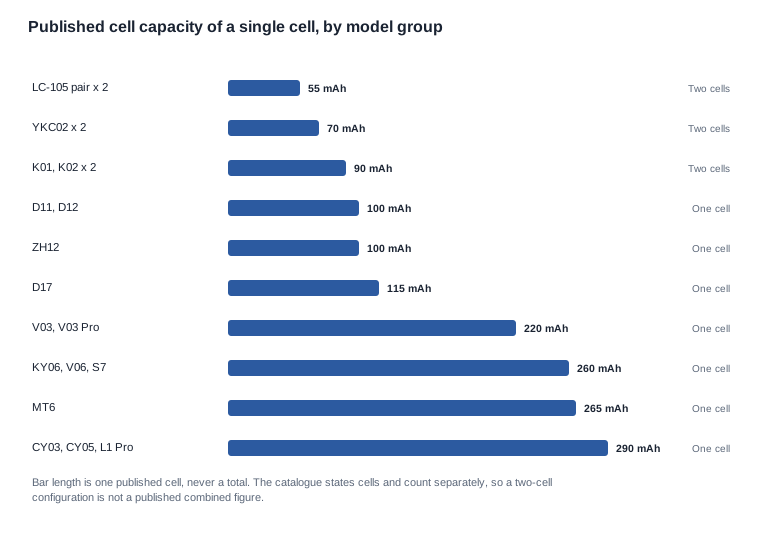
The catalogue publishes cells and cell count separately. Within the audio tier, the LC-105-1 and the LC-105-2 carry 55 mAh per cell across two cells and the K01 and the K02 carry 90 mAh across two. The YKC02 is a sport model rather than one of the eight audio models, and it carries 70 mAh across two. The single-cell models carry 100 mAh on the D11, the D12 and the ZH12, 115 mAh on the D17, 220 mAh on the V03 and the V03 Pro, 260 mAh on the S7 and the KY06, and the V06, 265 mAh on the MT6, and 290 mAh on the L2 Utral and the L1 Pro, and the CY05 and the CY03.
The rule that follows from this is worth stating because it is the easiest number to get wrong in a specification sheet. The catalogue publishes a cell figure and a cell count, and it does not publish a combined total. A two-cell configuration is therefore not a published 110, 140 or 180 mAh product, and a specification that writes a total has converted a derived figure into an apparent catalogue claim. Derived totals are fine in an analysis as long as they are labelled as derived; they are not fine in a specification, a listing or a contract.
For a travel buyer the cell count matters for a reason that has nothing to do with endurance, and it is the criterion most often left out of a travel specification. Each cell is a lithium item. A two-cell device is two items for the purposes of a transport document, and a spare cell is a third. The kit is counted in cells, not in products, and the difference between a one-cell and a two-cell model is the difference between one declaration and two.
The case as a second declared item
Seven camera models publish a charging-case row. Five of them publish a capacity: the L1 Pro and the CY05, and the CY03 — each at 1400 mAh, the L2 Utral at 900 mAh or 1400 mAh, and a folding 1200 mAh case on the MT6. The KY06 and the MT5 publish a case row without a capacity. The catalogue publishes no case row at all for the V03 Pro and the V03, and the V06 and the S7, so what the box carries for those four is an open item.
In a travel kit a case is not an accessory. It is a second lithium item with a cell in it, it is a second thing to lose in a hotel room, and it is the item with the largest unknown weight in the whole bundle — the catalogue publishes no case weight for any model. A buyer who bundles a case without requesting its weight is shipping an unknown into an allowance calculation, and the allowance is the constraint that decides the product configuration in the first place. How to evaluate a bundle therefore starts from the packing constraint rather than from the device.
The remaining declarations sit with the batteries themselves, and a kit that has been through supplier due diligence has a declaration for each of them. Every cell in the kit needs a transport file that covers it, and the documentation requirement is per configuration rather than per product, which is why the case, the spare cell and the device are three separate lines in the paperwork rather than one. The requirements are set out at battery transport.
How to assemble and check the travel kit
Five steps, each with a completion standard
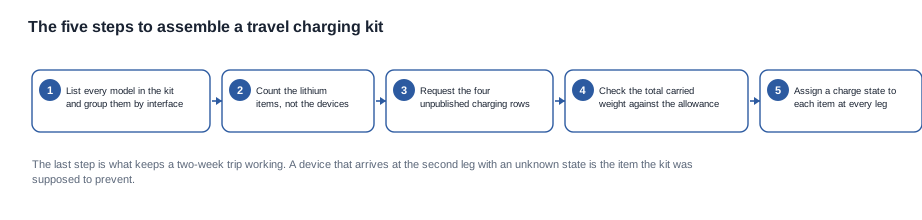
- List and group. Write down every model in the kit and group them by charging interface, not by product family. The completion standard is a kit table in which each model appears once and each interface family has a line against it.
- Count cells. Count the lithium items in the kit — device cells plus case cells plus any spare cells — and match that count to the transport documentation. The completion standard is a number that the transport file can be checked against.
- Request the gaps. Ask for the charging method on the four camera models that publish none, the contact material and service life for the magnetic family, the unit weight of every model in the kit including its case, and the weight of the case on its own. The completion standard is a written answer per item.
- Check the weight. Add up the carried weight of the kit against the allowance the channel actually ships to, using the requested weights rather than an estimate. The completion standard is a figure that reconciles to the packing list.
- Assign a state. Decide what is logged at every leg — which device is in which state, which case is with which device — and write it into the travel procedure. The completion standard is a named field in the travel log rather than an assumption.
The kit checklist and the declarations
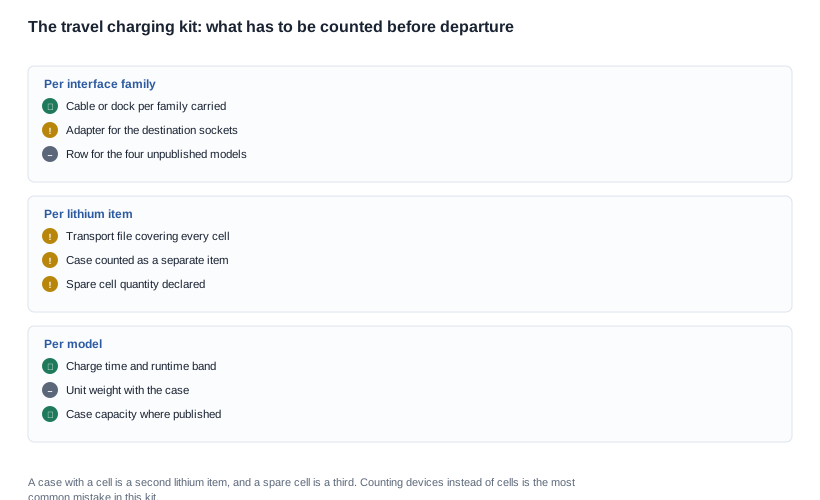
The checklist divides by who owns the risk. The published rows — charge time, runtime band, case capacity, charging method — are the ones to confirm against the catalogue, and they are the ones a bundle specification gets wrong when it is written from a reseller sheet rather than from the catalogue. The lithium rows are the ones that catch a launch: the transport file has to cover every cell in the kit, the case has to be counted as its own item, and the spare cell quantity has to be declared rather than assumed.
The model rows are the ones that catch a shipping problem: the unit weight with the case is the figure an allowance is calculated from, and for every model except the MT6 it has to be requested. The adjacent checks are at testing smart glasses charging and at charging for beginners, and the runtime arithmetic is at battery life.
Where travel charging arrangements fail
The kit was counted in devices rather than cells. It is the most common of the pitfalls in this category, and the easiest to fix before the paperwork is printed. The symptom is a transport document that covers the product and not the second cell in a two-cell model, or a spare cell that was never declared. The root cause is that the catalogue publishes cells and count separately and the bundle specification collapsed them into one number. Prevention is to count cells and to check the count against the file.
A combined capacity was written into the specification. The symptom is a listing or a datasheet quoting a total the catalogue does not publish. The root cause is that 55 mAh per cell across two cells was converted into a 110 mAh claim. Prevention is to publish the cell figure and the cell count separately, exactly as the catalogue does, and to label any total as a derived value.
The dock travelled and the cables did not. The symptom is a device that cannot be charged at the second accommodation because the dock is in the first bag. The root cause is that the kit was assembled from the catalogue's method list rather than from the itinerary. Prevention is a rule that the travel kit carries cables and the dock stays at the base.
A case was bundled without a weight. The symptom is a packed kit that is heavier than the allowance calculation predicted, with the excess coming from an item nobody weighed. The root cause is that the catalogue publishes no case weight for any model. Prevention is to request the case weight separately and to add it to the packing list as its own line.
The four camera models with no published method were bundled with a generic cable. The symptom is a return at the first charge, from a bundle that looked complete on paper. The root cause is that the interface gap was resolved by assumption. Prevention is to exclude those models from a travel bundle until the row arrives, or to hold the bundle until it does.
No state was assigned at the legs. The symptom is a device that arrives at the third leg with an unknown charge and a device that is swapped out for no recorded reason. The root cause is that every handover on the road was treated as informal. Prevention is to write the leg fields into the travel procedure and reconcile against them.
| Travel failure | Root cause | Preventive action |
|---|---|---|
| Transport file misses a cell | Kit counted in devices | Count cells, match the file |
| Unpublished total in a listing | Cell count collapsed into a total | Publish cells and count separately |
| Dock left in the first bag | Kit built from the method list | Cables travel, dock stays |
| Packed kit over the allowance | Case never weighed | Request the case weight |
| Return at the first charge | Interface gap resolved by assumption | Hold the bundle until the row arrives |
| Unknown state at the third leg | Informal handover on the road | Write the leg fields into the procedure |
What we publish about travel charging, and what we do not estimate
The boundary we hold: a travel charging kit is a specification with three parts — the interface lines, the lithium count and the weight — and all three can be closed with the same written request. We publish the charging method for 24 models, the charge time for all 28, the runtime band for all 28, the cell configuration for every model exactly as the catalogue states it, the charging-case row and capacity where they are published, and the single 158 g whole-unit weight for the MT6 glasses, excluding its folding case.
What we will not do is publish a combined capacity for a multi-cell configuration, a case weight for any model, a unit weight for any model beyond the MT6, a charging method for the four camera models whose row is absent, a contact material or service life, or a transport certification for any cell. We will not present a derived total as a published figure, in a specification or in a listing, and we will not state that a model is certified for transport when the catalogue carries no such row.
What we will do is take the model list, the itinerary, the destination markets, the transport mode and the packing constraint, and tell you which interface lines the kit creates, how many lithium items it contains, which rows still have to be closed, and what the travel documentation has to cover. The product families are at camera and audio smart glasses and sport smart glasses, the charging hardware is at charging solutions, and the scenario entry point is travel.
What to send us next. Send the model list, the number of travellers, the trip length, the destination markets, the transport mode and the weight allowance. We will return the interface lines, the lithium count, the list of rows still open, and the documentation the kit has to carry.
Related reading
- Which product families exist — camera and audio smart glasses and sport smart glasses
- The charging hardware — charging solutions
- The transport requirements — battery transport
- The charge checks — testing smart glasses charging
- The entry point for this scenario — travel
Tell us the model list, the itinerary and the packing constraint, and we will tell you which interface lines the kit needs and which rows still have to be closed.


