
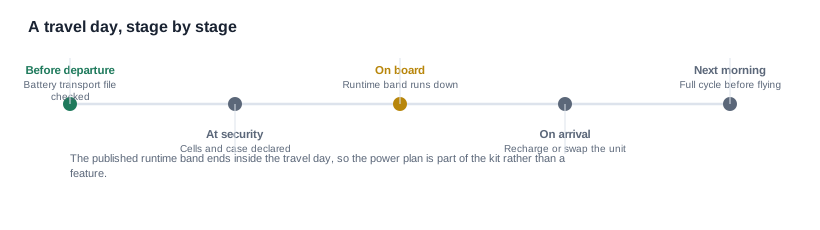
Smart glasses for travel is decided by the length of the trip rather than by the quality of the device, and the published runtime figures make the arithmetic uncomfortable. A travel day — airport to arrival — runs well past the point where the camera and audio models in this catalogue are rated to last. The top published runtime in the camera tier is about eight hours, the top published runtime in the audio tier is about eight hours, and the sport tier peaks at the same figure. Only one longer figure exists anywhere in the catalogue, the roughly twenty hours on the three children's models, and that is a low-duty reminder figure rather than a travel figure. A buyer who selects on runtime for this segment will conclude that no model in the range is adequate, and a buyer who then adds a case and a second unit without pricing the consequences will conclude that the segment is expensive. Both conclusions are correct and both are avoidable.
Smart glasses for travel: the trip is longer than every camera runtime
The travel buyer is not the same buyer as the office buyer or the running buyer, and the difference shows up in the question order. An office programme asks what the device does in a room. A travel programme asks what the traveller has to carry, what has to be declared, what happens when the day runs long, and what the customer does with the kit when they get home. None of those is a specification question and all of them are commercial questions.
The first constraint is duration. The published runtime band across the camera tier is five to eight hours for the S7 and the V06, and the V03 and the V03 Pro, six to eight hours for the KY06 and the MT5, and about seven hours for the MT6 and the L2 Utral, the L1 Pro and the CY03, and the CY05. The audio tier runs from about six hours on the G07 and the YK12 to about eight hours on the K01, the K02 and the LC-105 pair. Every one of those figures assumes a duty cycle the catalogue does not state, and no runtime in the range carries its test condition, so a buyer cannot even convert the figure into a travel-day number.
The practical consequence is that the endurance decision is not a model decision. It is a decision about how the traveller crosses the hours: a charging case, a second unit, a power bank from the traveller's own kit, or a shorter day of use. The catalogue can tell the buyer which models ship a case and at what published capacity. It cannot tell the buyer how many hours a case adds, because no case runtime is published and no charge time is published for a case.
The second constraint is what crosses a border. Every configuration in the range ships a lithium cell, and the configurations that ship a case ship a second one. The transport documentation has to describe the exact cell and the exact case, and the rules that apply to those items differ by carrier and by jurisdiction. The requirement is set out at battery transport, and the point for a travel buyer is that the case is a document, not just an accessory.
The third constraint is loss. Travel is the highest-loss environment in the category, and the devices most likely to be lost are the ones that are easiest to leave behind — a case, a cable, a separate unit. The catalogue publishes one weight in the entire range: 158 grams for the MT6 glasses body, including the cell and the camera and excluding the foldable charging case, whose own weight is not published. Every other model's weight is unpublished, so a travel kit cannot be specified by weight and has to be specified by what it contains.
Who is buying and which travel programme this is
A brand owner is deciding whether the travel line is a device line or a kit line, and that decision determines whether the case, the cable and the insert are part of the product or part of the accessory list.
A procurement manager is deciding which configurations can carry a travel day on the published rows and which need a documented power plan, and is assembling the transport and conformity file that has to exist before the first shipment crosses anything.
A channel buyer is deciding what the listing promises about a day out, and the honest answer is that the runtime promise has to be tied to the case configuration rather than stated on its own.
The interface decision a traveller actually makes
The charging interface is usually treated as a preference. In travel it is a packing decision, and the catalogue is unusually explicit about it because it publishes an interface for almost every model.
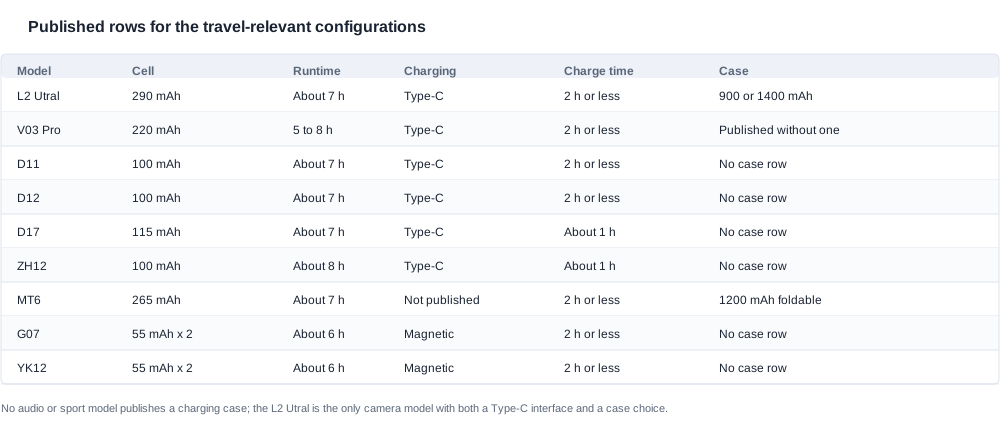
Seven models publish a Type-C charging interface: the V03 Pro, the L2 Utral, the D11, the D12, the D17, the ZH12 and the bone-conduction entry. Seventeen publish magnetic charging, and four publish no charging method row at all — the CY05 and the CY03, and the L1 Pro and the MT6, all four of which do publish a case capacity.
For a traveller, the two interfaces behave very differently. A magnetic model needs its own charging base, which is another object to pack and another object to lose. A Type-C model reuses a cable the traveller probably already carries, and in a segment where the traveller is already managing a phone, a watch and a power bank, one more cable is a smaller ask than one more base.
There is a sharper version of the same argument for the two fastest-charging models in the catalogue. The D17 and the ZH12 publish a charge time of about one hour, and every other model in the range publishes two hours or less. The D17 publishes 115 mAh and about seven hours; the ZH12 publishes 100 mAh and about eight hours. Neither publishes a camera, and neither publishes a charging case, so the fastest-turnaround configuration in the range is also the leanest one to pack.
The one camera configuration that publishes a Type-C interface and a case
The V03 Pro and the L2 Utral are the only two camera models in the catalogue that publish a Type-C charging interface, and they differ in the way that matters for travel. The V03 Pro publishes 8 megapixels, a 220 mAh cell, a five-to-eight-hour rated use, flexible temples, photochromic lenses, three published colours and a two-hour-or-less charge time — and the catalogue publishes it explicitly without a charging case. The L2 Utral publishes 13 megapixels, a 290 mAh cell, about seven hours, a two-hour-or-less charge time, a Type-C interface, and a charging case offered at 900 mAh or 1400 mAh.
On the published rows, the L2 Utral is therefore the strongest travel camera configuration in the range: it is the higher resolution tier, it shares the traveller's cable, and it is the only camera model where the case capacity itself can be used as a commercial tier. A buyer building a travel line should start there, and should treat the choice between the 900 mAh and the 1400 mAh case as a price-ladder decision rather than an accessory decision.
The photochromic lens configuration on the V03 Pro deserves a specific warning rather than a general one. A photochromic lens is a product feature that is frequently written up as a performance, and the catalogue publishes no darkening range, no response time, no temperature dependence and no test method for it. A travel listing may name the lens configuration; it may not state how fast it darkens or how dark it gets, because those are characterised figures and none is published.
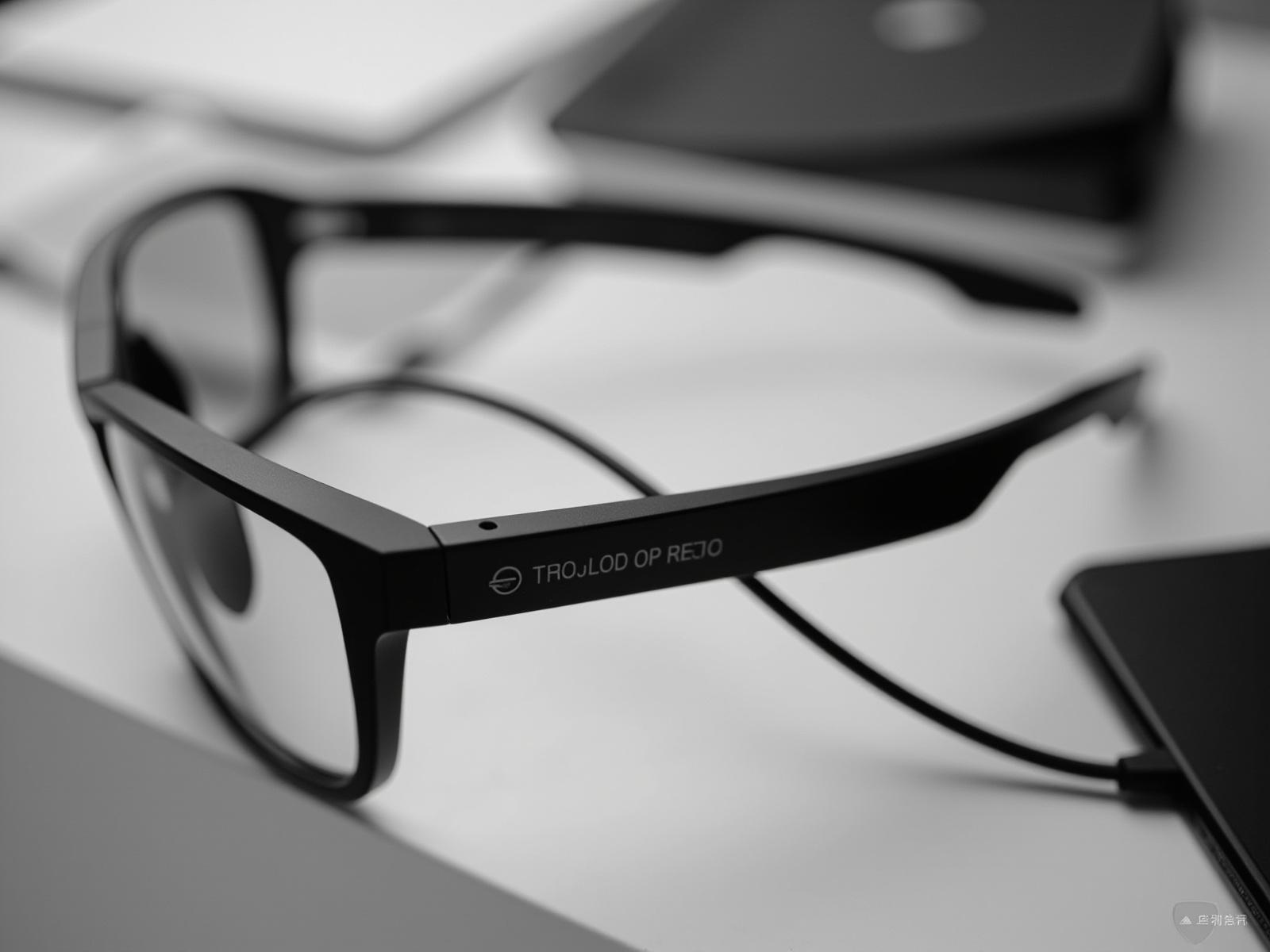
A charging case is a second declared cell, not a free accessory
The charging cases in this catalogue are published on the camera models only, and their positions are worth stating precisely because the distinctions are easy to lose.
Five models publish a case capacity: the L1 Pro and the CY03, and the CY05 — each at 1400 mAh, the L2 Utral at a choice of 900 or 1400 mAh, and the MT6 at a 1200 mAh foldable case. Two models publish that a case exists but not its capacity: the KY06 and the MT5. Three camera models have no charging-case row at all: the V03 and the S7, and the V06. And the V03 Pro has no charging-case row.
No audio model and no sport model publishes a charging case anywhere in the catalogue. That is a structural fact about the range rather than an omission, and it means the case-led travel tier is a camera-tier product. A buyer who wants a travel kit with a case is choosing a camera platform and accepting the camera's compliance and documentation burden.
The transport consequence follows directly. A case is a second lithium item with its own capacity, its own declaration and its own evidence in the transport file, and it is present on every shipment whether or not it is used on the day. A buyer who plans a case-led travel tier has to decide, before the order, whether the configuration being shipped is the one whose transport file exists — and the answer is a per-configuration answer, not a per-platform answer, because the V03 Pro is published without a case and the V03 has no case row at all.
The travel kit is the product the channel sells
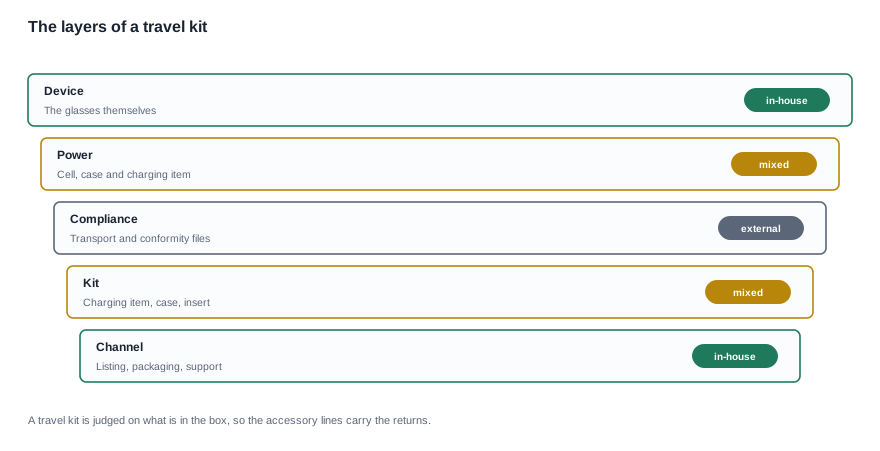
Travel is one of the few segments where the accessory set, not the device, is what the customer evaluates. A traveller opening a kit has to find the device, the cable or the base, the case if there is one, and an insert that tells them how to charge it, how to pack it and what to do at a border. If any of those is missing, the kit reads as a cheap kit, and the review that follows is about the kit rather than about the device.
That makes four decisions the buyer's, and they are the ones a travel listing is actually made of.
The charging item. A Type-C device needs a cable; a magnetic device needs a base. Publishing the base instead of a cable is a decision with a cost, because it adds a bulk item and it is the item most likely to be left in a hotel room. This is where the interface decision from the previous section converts directly into a packaging decision.
The case or no case. The four case positions in the catalogue are four different commercial answers, and a travel kit usually wants one of them rather than a choice. The L2 Utral's 900 or 1400 mAh choice is the only case capacity in the range that can be used to build two price points from one platform, and it is the reason that configuration is worth a closer look for a travel line.
The insert. A travel insert has to carry the charging instruction, the packing instruction and the cell-declaration instruction, because those three are the questions a traveller will actually have and none of them is in the box otherwise. This is a printing line item with a return-rate consequence, not a nicety.
The loss and swap story. A kit that tells the customer what to do when the device is lost or the case is left behind will get fewer "it arrived incomplete" returns than one that does not, and the instruction costs nothing to print.
Qualifying a travel configuration and where the order value sits
Travel qualification has four parts, and the order of them matters because the commercial decision comes before the technical one.
| Criterion | How it is read from the published row | The line it has to meet | What a soft answer looks like |
|---|---|---|---|
| Runtime against the longest day | The rated figure on the model's own row | A named case or swap point for the remainder | "All-day battery" with no figure |
| Charging item | The charging method row for that model | A cable the traveller already carries | Both interfaces claimed for one model |
| Case position | The charging-case row, or its absence | A named capacity or a stated absence | "Comes with a case", with no capacity |
| Declared cells | The transport file for the exact configuration | A file naming the cells and the case shipped | A file for the platform, not the configuration |
| Duration of use on one charge | The rated runtime and the test condition | A condition stated, or a measurement on a sample | A rating quoted as a travel day |
| Weight of the kit | The published weight, where one exists | A measurement per configuration | A category average carried across models |
- Fix the trip profile. Days away, hours of continuous use, indoor or outdoor, and whether the customer carries the device for the whole journey or only for part of it. The completion standard is a written profile, because the runtime band is meaningless without it.
- Build the power plan. The published runtime against the longest day, plus the published case capacity against the remainder. The completion standard is a plan naming the model, the case and the swap point.
- Assemble the transport file. The exact cells, the exact case, and the per-model conformity records, at certification checklist and battery transport. The completion standard is a file that names the configuration actually shipped.
- Build the kit proof. The packaging artwork showing the device, the charging item, the case if any, and the insert. The completion standard is an artwork proof, checked against the configuration on the purchase order, at samples.
The two questions that decide a travel shortlist fastest
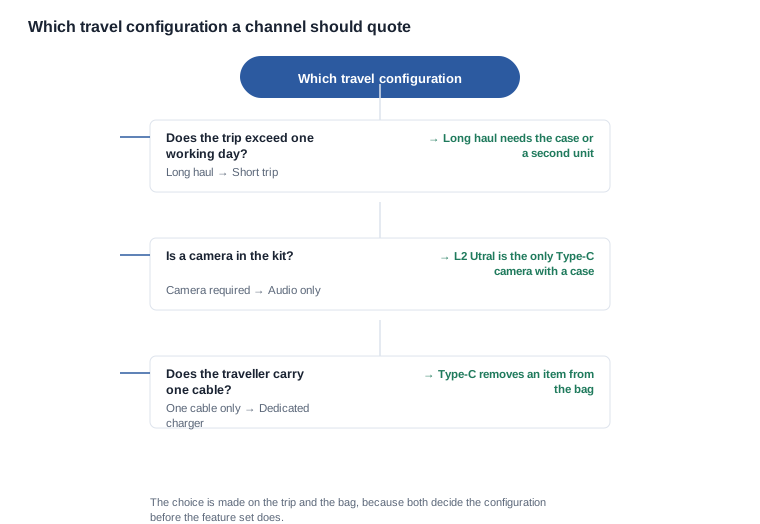
Before the technical qualification, two questions remove most of the range and take two minutes to answer. The first is whether the kit needs a camera at all. If it does not, the entire camera tier is out, and so is the entire case-led proposition, because no audio model and no sport model publishes a charging case — which leaves the buyer choosing between a magnetic configuration that needs its own base and a Type-C configuration that reuses the traveller's cable. The second is whether the trip can be carried on one charge. If it can, the case decision reduces to a baggage and a documentation decision rather than an endurance decision, and the leanest kit in the catalogue becomes viable.
Both questions should be asked before the quotation rather than after it, because both of them change the platform, the accessory list, the documentation burden and the minimum order quantity at once. A buyer who asks them last has already costed a configuration they are not going to buy.
The clause language is at contract terms, the commercial structure of a first order is at pricing, and the published rows behind the runtime and charging decisions are at battery life. The scenario entry point is smart glasses for travel, the seasonal note that changes the plan is at travel seasonal considerations, and the preparation step is at training for travel. The camera family is at AI camera glasses and the audio family is at Bluetooth audio glasses.
Four things to ask in a first enquiry answer most of it. Which model designation is quoted for this order, and what that model's published row carries. Which charging item ships with it. Does the configuration ship with a case, and at what published capacity. Which cells are declared in the transport file for the exact configuration.
Three commercial blocks carry more weight here than elsewhere in the range. The case minimum order quantity decides the case-led tier, and it is the line most often quoted without a number. Tooling and certification are quoted apart, because certification cost and lead time follow whatever the schedule and the body that runs it require, and a buyer who cannot see the split cannot model the break-even volume of a channel with a documentation lead. The pilot is worth paying for, because a supplier who will run the travel-day test against production units and supply the notes so the result can be re-judged converts a demonstration into an acceptance criterion, and in a travel kit the difference between a complete kit and an incomplete one is visible in the first week of returns.
Concretely, we publish the charging methods, the charge times, the cell configurations, the rated runtimes, the resolution tiers, the charging-case capacities and positions and the published feature rows exactly as the catalogue states them, and we publish the absence of a per-model weight beyond the MT6's 158 grams glasses body, a runtime test condition, a case runtime, a charge time start state and end point, a video specification and a per-model certification with the same prominence. We will not convert a rated runtime into a travel-day guarantee, we will not describe a photochromic lens by a darkening figure the catalogue does not publish, and we will not present a stills pixel tier as a capture specification.
What we will do is take the trip profile, the channel, the price band and the markets, and tell you which published rows apply to the configurations that can carry the trip, which claims the documentation supports, which cells have to be declared for the exact configuration, and which criteria belong in the purchase order.
What to send us. Send the trip profile, the channel, the price band and the markets, and we will return the configurations that cover the trip on the published rows, the kit each one needs, and the file that has to exist before it ships.
Related reading
- The point where the scenario starts — smart glasses for travel
- The camera family — AI camera glasses
- The audio family — Bluetooth audio glasses
- The battery requirement — battery transport
Tell us the trip profile and the channel, and we will return the configurations that cover it and the kit each one needs.


