
Smart glasses for travel are sold as a device and a set of assumptions, and the assumptions are what a buyer has to price. The assumption that costs the most is that a traveller can improvise the power and the protection once the destination is reached. A brand buyer specifying this category for a travel channel therefore has a narrow and unglamorous job: decide which accessories sit inside the model, which sit in the box, and which the traveller has to source separately, then make sure the published documentation supports each of those three claims. The short answer is that four accessory lines earn their place in a travel configuration, two of them are model-specific rather than universal, and one accessory — the charging case — is not an accessory at all but a second lithium cell that belongs in the transport file. Nothing in that answer is a comfort argument. Every line is decided by a published row or by a row we do not publish.
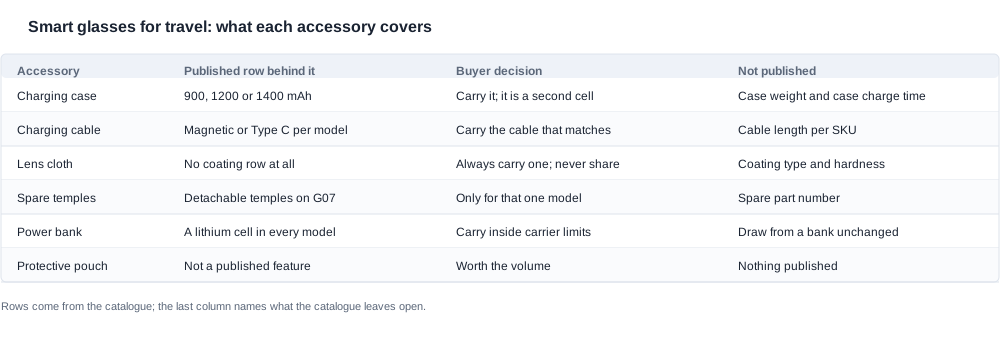
Smart glasses for travel: what the accessory kit is really buying
The accessory list is not a packing list. It is the second half of the product specification, and in this category the two halves are published at different levels of completeness. The catalogue publishes the device rows with real precision — a cell capacity for every model, a charge time for every model, a charging interface for most of them, a case capacity for five camera models — and it publishes almost nothing about the objects that surround the device. No cable length, no case weight, no packed weight, no coating type, no spare part number. A buyer who treats that silence as "standard" is writing a specification by assumption, and the specification is then inherited by every channel that carries it.
The buyer who has to make this decision
The reader is a buyer at the brand, a channel buyer or a product manager assembling a travel line, and the decision in front of them is the bill of materials for the SKU rather than the device itself. They are usually two stages past the catalogue: an initial shortlist has been made, a channel has asked for a kit, and the question now is what goes in the carton and what the product page is allowed to promise about it. The fear underneath it is mundane and specific: a traveller in a transit market finds that the case does not charge the frames, or that the cable in the box does not fit the interface row, and the resulting support contact is attributed to the brand rather than to the configuration.
The second reader is a channel buyer who does not own the product specification but owns the packaging. For that buyer the accessory decision is a freight decision before it is a functional one, because a case adds volume to every unit and a soft pouch adds almost none.
Why two kits with the same device cost different amounts
The accessory set is where a travel product's two price points are built, and it is also where the price difference stops being explainable. A configuration with a 1400 mAh case carries a second cell, a larger carton, a different freight calculation and a different transit file from a configuration without one. The device rows are identical across the two. That is why a quotation comparison in this category has to be broken down by configuration before it is compared at all — the unit price difference between two quotes is frequently a packaging difference, and treating it as a supplier margin is the first mistake.
The second reason the kit changes the cost is the rows the catalogue does not publish. A case is the only accessory in the range with a real capacity figure, and it is the only one whose weight is left open. A case in a pocket for a full day is a weight decision that nobody has made explicitly, because the figure to make it with does not exist. The honest position is to treat that as a request to the supplier, not as a typical value.
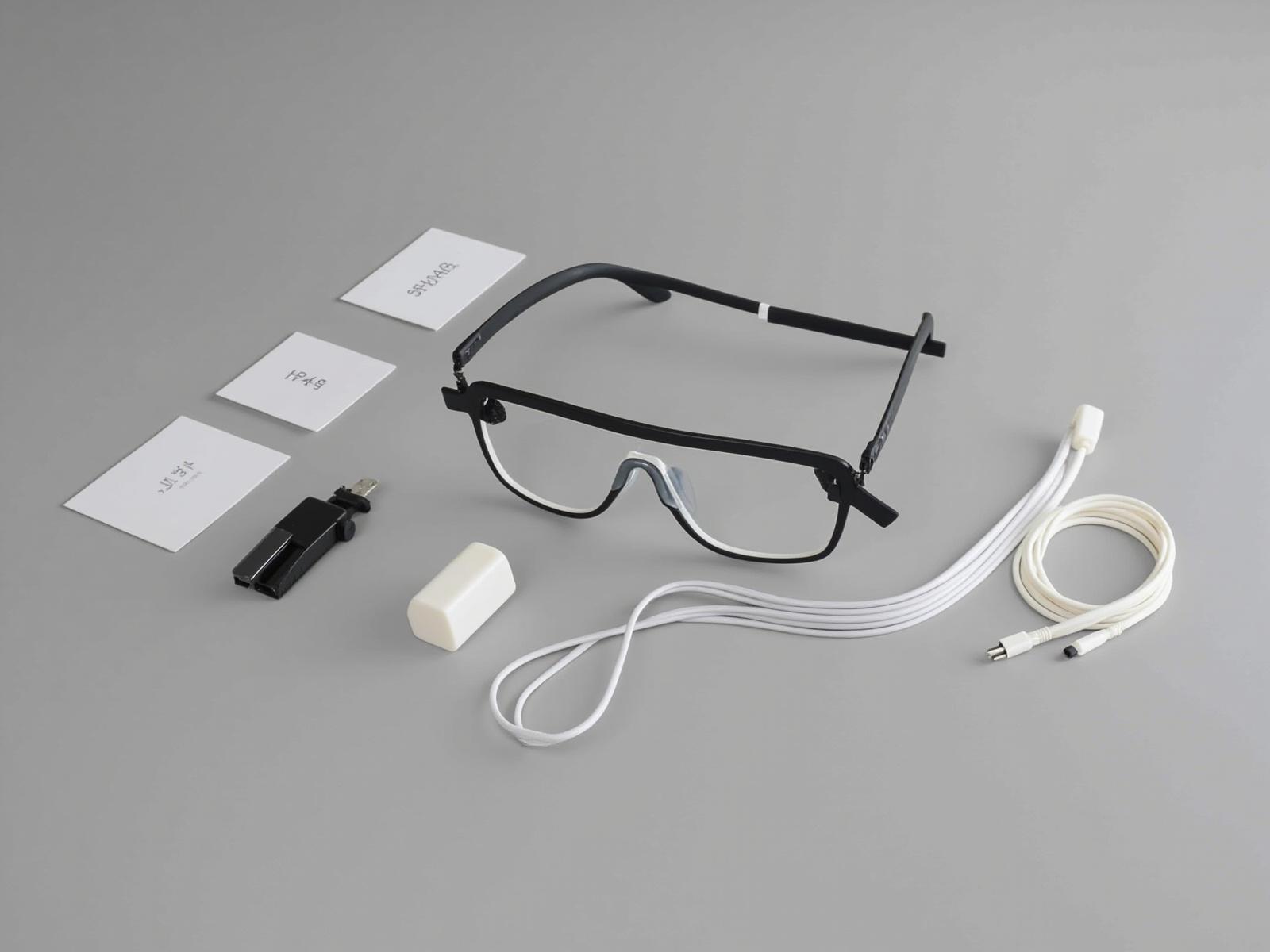
The three accessories that decide a trip
Three lines carry most of the travel decision. They are also the three where the published documentation and the commercial requirement pull in opposite directions, which is why they deserve the most attention in a specification.
The charging case and the power budget it sets
Case capacity is the only accessory figure the catalogue publishes, and it publishes it for five camera models: 1400 mAh on the L1 Pro and the CY03, and the CY05, 900 or 1400 mAh as a configuration choice on the L2 Utral, and 1200 mAh on the MT6's foldable case. Two further camera models, the KY06 and the MT5, publish a case row without publishing a capacity, and the S7 and the V06, and the V03 publish no case row at all. The V03 Pro is published explicitly without one. Those are four different states, and a specification that collapses them into "some models have a case" has already lost information that a buyer needs.
The commercial significance is that a case is the difference between a device that works for one long working session and a device that works for a full day with gaps. The published rated runtimes on the camera models sit between five and eight hours, and the audio models between six and eight, so a travel day with a socket-free afternoon is outside the published band. That is an argument for the reserve, and it is not an argument for a specific configuration until the trip profile is known.
The caution is a transport one, and it belongs in the buyer's own file rather than on the product page. A case is a lithium cell. It travels in a bag under passenger rules, it has to be declared in the carrier's own way, and the transport file for a cased configuration is not the same document as the transport file for a bare device. The second caution is that the case has a charge time that the catalogue does not publish for any model, and a case that takes an unknown time to recharge is a scheduling variable in a travel kit rather than a detail.
The cable that has to match the interface row
The catalogue splits the charging interface three ways, and the split is not obvious from a product photograph. Magnetic charging appears on seventeen models, Type-C on seven, and four camera models — the L1 Pro, the MT6, the CY03 and the CY05 — publish no charging interface row at all, carrying only the pixel, battery, charge-time, runtime and case rows. A buyer who bundles a Type-C cable with a model whose interface is unpublished has made a decision about a row that does not exist.
That matters commercially because the cable is the cheapest line in the kit and the most expensive line in the support log. A Type-C device recharges from a cable the traveller already owns, which removes an object from the pack and removes one failure point at the start of a trip. A magnetic device needs its own dock or its case, and once the case is already in the bag the spare cable stops being worth supplying. The travel packing decision and the accessory decision are the same decision, and they have to be made together.
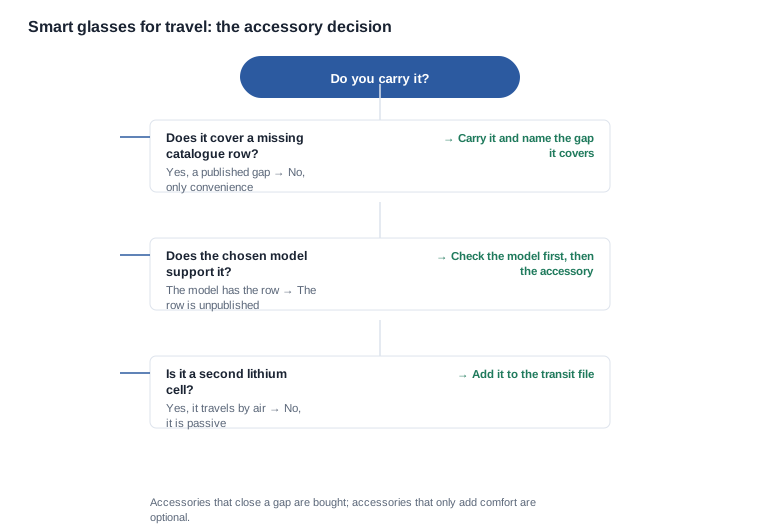
The cloth, and why the missing coating row is the reason
The lens cloth is the least interesting object in the list and the one whose justification is entirely a published gap. No lens material and no coating is published for any model in the range. That gap has a commercial edge to it: a coated surface can be hazed by a solvent wipe in a way that no specification in the catalogue would let anyone detect afterwards, because there is no published tolerance to compare it against. A dry cloth on a dry lens, never shared, is the only method that is certain not to create the problem it is meant to remove.
The photochromic line makes the gap sharper still. The V03 Pro is published with photochromic lenses, and the catalogue's electrochromic entry is described as electrochromic without a model designation. Neither entry publishes a response time, a depth of change or a light transmission range. A buyer listing a photochromic model for travel therefore cannot write a claim about how quickly the lens darkens, and the absence of that claim is the reason the cloth is a line item rather than a nicety.
The accessories that belong to one model rather than to every trip
Two accessory lines are model-specific, and one of them is model-specific in a way that is easy to miss because the catalogue states the feature on the device row rather than in an accessories section.
Spare temples and the one detachable model
Detachable temples are published on the G07, which also publishes slim temples. The V06 and the S7 publish a detachable inner frame, which is a different part and does not create the same spare-parts question. A spare temple for the G07 is therefore a defensible line for a kit that carries that model, and the spare part number and its availability are not published. The rule for a buyer is to ask for the part number before the first order rather than to promise the traveller that a broken temple can be replaced abroad.
The power bank and the carrier's rules
A power bank is the obvious answer to a day without a socket, and it is the answer with a rule attached: every model in this range carries a lithium cell, so the reserve a traveller carries is itself subject to passenger limits on capacity, state of charge and carriage method, and it cannot be recharged in flight. Whether the device draws from a bank at the same rate as from a wall is not published, which is an argument for testing with the bank that will actually travel rather than with the one on the desk.
The pouch and the freight line it sits in
A soft pouch is lighter than a case, protects the lenses from keys and grit, and is the line most often left out of a specification. Its commercial weight is on the freight side: it is the cheapest way for a channel to add perceived protection without adding a cell to the carton. Nothing about it is published, because it is not a catalogue feature, and that makes it easy to specify and easy to ship.

Turning the kit into an order line instead of a free extra
The accessory decision becomes real when it becomes an order line with a supplier request behind it. A kit that is bundled "free" cannot be inspected, cannot be costed, cannot be replaced and cannot be returned, and every one of those consequences lands on the channel that bundled it.

What to ask the supplier, and what each answer closes
The requests below are short because the catalogue has already closed most of the questions. Each one is a row that exists in the range and is either published or missing.
- The case row for the exact model designation, including whether a capacity is published for it. Completion standard: one line per model, and an explicit "no case row" where that is the published state rather than a blank.
- The case charge time and its input, because a case is a second product with a second specification. Completion standard: a figure with the condition, or a written statement that the row is not published.
- The packed weight of the shipped configuration, not the unit weight alone. Completion standard: one figure per SKU including the case and the cable.
- The cable type per model, with the length, because the length is a packing decision as well as a function one. Completion standard: a cable list that matches the interface row for every shipped model.
- The spare part number and availability for any model whose catalogue row publishes detachable temples. Completion standard: a part number or a written statement that no part is available.
- The bundled accessory list per SKU, as a document rather than a conversation. Completion standard: a list that the packaging can print and the inspector can apply.
Where the kit is negotiable and where it is not
The cell configuration, the charging interface, the structural features and the case capacity where it is published are settled before a negotiation begins, and so is the nature of the tooling cost, which is amortised across the first order and quoted as a separate line rather than folded into the unit price. The room that exists is in the minimum order quantity tiers, in whether the supplier will run the accessory test against production units rather than engineering samples, in whether a case is included at one capacity or offered as a choice between two, in the cable length and the bundled cloth, in the pouch and the carton print, in whether the spare temple is stocked at all, and in splitting a first run into two deliveries against a staged payment. For a travel line, the two terms worth arguing hardest are the case configuration and the bundled list, because they are the two that determine what a traveller finds in the box.
The returns consequence, which is where an unbundled kit ends up
A kit that is not written into the order is a kit that cannot be checked at goods-in, which means the first sign of a problem is a customer complaint rather than an inspector's finding. That reverses the cost of the problem: an inspection finding is resolved against a pass line, while a complaint is resolved against the brand's reputation and, for a travel channel, against the review score of the listing. The line that decides the cost is therefore the bundled list, and it is cheap to make explicit and expensive to discover later.
A second consequence sits with the returns counter. If the case is bundled and the case is what a traveller loses, the channel has to decide whether a missing case ends the unit or the order. Nothing in the catalogue answers that, because case availability as a service item is a channel policy rather than a product specification. Writing the answer down before the launch costs a paragraph; leaving it to the returns desk costs a policy per agent.
A composite travel launch, and where the kit went wrong
Consider a brand launching a travel line into two markets with a channel that asked for a "complete travel kit" in the carton. The device decision had been made from the published rows: a camera model with a 1400 mAh case. The failure was not technical. The case was in the carton, but the carton did not state the case capacity, so the product page had nothing to say about it; the cable bundled was a Type-C cable, and the interface row for that model was magnetic, so a traveller with no shop open charged a device that could not be charged; and the packed weight was never requested, so the freight quotation and the duty on the returned unit were both calculated on a figure nobody held.
The three artefacts that would have caught all of that are ordinary: a bundled list per SKU, a cable list matched to the interface row, and a packed weight per configuration. None of them required a new product decision, and each of them would have been in the order as a line. This is a composite of situations in this category rather than a client project, and no customer is involved.

The kit document set, and what it has to carry
Before a deposit, a travel kit has three documents attached to it: the accessory request and its answers, the bundled list per SKU, and the inspection criteria that an incoming inspector can apply to the carton. The three lines below are what the checklist is checking.
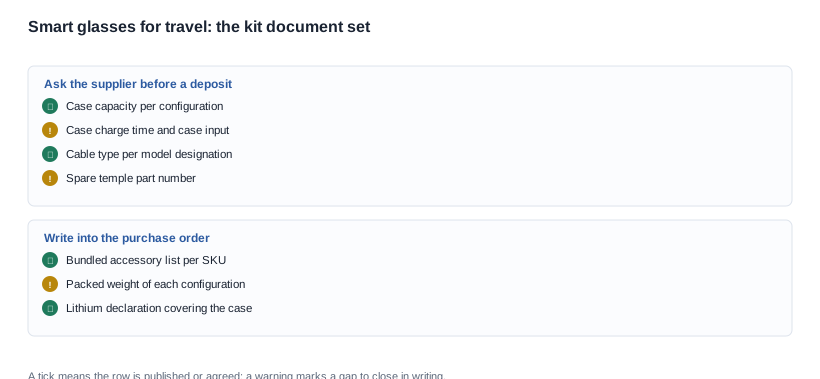
The rows behind a kit, and the answers we cannot give
To put it plainly — we publish the rows a travel kit is planned from: the cell capacity and the charge time for every model, the charging interface wherever it is published, the case capacities where the catalogue states them, the structural features that are published including the detachable temples on the G07 and the detachable inner frames on the V06 and the S7, the photochromic configuration on the V03 Pro, and the resolution class for the camera models. We will also tell you plainly that four camera models publish no charging interface row and three publish no case row, because that is procurement information rather than a weakness.
What we do not publish and will not estimate: the coating type and hardness, the photochromic response figures, the spare part number and its availability, the packed weight of any configuration, the case weight, the case charge time, the cable length per SKU, the spare temple specification, and the unit weight of every model except the MT6, where the catalogue publishes 158 g for the glasses whole unit with the battery and camera included and the foldable case excluded. We will not quote a typical case weight, and we will not present a demonstration of a charging sequence as a specification.
What we will do is take the models under consideration, the trip profiles, the destination markets and the channel, and tell you which accessory lines apply to which model, which of the six lines above is load-bearing for that trip profile, which published gaps each accessory is compensating for, and what to put in the purchase order. The product families are at AI camera glasses and Bluetooth audio glasses, the packaging and shipping document set is at the first-order shipping checklist, the transport requirement is at battery transport, and the scenario entry point is smart glasses for travel.
What to send us next. Send the models under consideration, the trip profiles, the destination markets and the channel, and we will return the accessory lines that apply to each model, the published rows behind them, the request list for the rows that are not published, and the bundled list per SKU that the order and the carton can both use.
Related reading
- Where the scenario starts — smart glasses for travel
- The families in the range — AI camera glasses and Bluetooth audio glasses
- The transport requirement — battery transport
- The first-order document set — shipping checklist
- The case weight question — does a charging case add much weight


