

Smart glasses for travel: the trip agents decide the whole instruction
A travel product meets everything the trip brings, in the wrong order, and the customer handles it in a hurry. Dust and road film arrive first and are wiped off with a sleeve. Salt spray arrives at the coast and is left to evaporate. Sunscreen arrives on the hands, goes onto the temples, and is transferred onto the lens when the frame is pushed up. Fingerprints arrive every time the device is taken out of a bag to check a map, which on a trip is dozens of times a day. Then the whole routine is deferred for three days and performed in a hotel bathroom at midnight with whatever is on the desk, because the thing that was actually needed was never a procedure. It was an item in the bag and a place in the kit where the item was supposed to be.
For a buyer, that sequence produces a specific and unusual commercial problem. The customer is not going to complain. They are two thousand kilometres away, they are not in the market any more, and the unit they are carrying has a slightly hazy lens that they will only notice when they look at a sunset. So the cost of a travel return is not the refund. It is the review, the lost repurchase, and the second unit that never gets sold because the first one put the brand in a negative light on a platform where the competitor is sitting one row below with a lens that still works.
That is why the design question for a travel product is not "what should the customer wipe the lens with". It is which agents a trip actually brings, and what in the kit makes the instruction enforceable when the customer has forgotten it exists. The two decisions that follow from that are the negative list — the agents that must never touch the lens — and the storage position, because a lens placed face-down in a bag or on a car roof is damaged without any agent being involved at all. Both are packaging decisions, and both are made by the buyer long before the customer ever goes anywhere.
Who is reading this and what they are holding. The reader is a brand-side buyer, a channel buyer or a product manager specifying a travel or commute product for a travel retailer, a marketplace listing or a corporate travel programme. What they are holding is a price band, a target market, a list of trip profiles and a returns reserve that was set for a general consumer channel and has never been tested against a customer who is 900 miles from home when the problem appears. The task in front of them is to decide what the kit contains, where the item lives, what the packaging forbids, and how the return condition standard allocates responsibility for a lens that was exposed to an agent the packaging never named.
What the catalogue publishes for a travel product. For the eleven camera models it publishes a resolution class, a cell capacity, a charge time, a rated runtime, a charging interface, a colour count, and on five of them a charging-case capacity. It publishes the IP54 marking on the V06 and the S7 and no test report behind it. It publishes no lens material, no coating, no surface treatment, no abrasion or chemical resistance figure, no per-model unit weight beyond the single 158 g whole-unit figure for the MT6, no field of view and no video specification. The camera models publish no Bluetooth version either. The practical consequence for a travel programme is that every instruction a customer receives about the lens has to be written by the buyer, from a specification the buyer has to request in writing, because there is no published row to write it from.

The trip agents and the storage position, and what the catalogue does not settle for smart glasses for travel
The four agents a trip brings
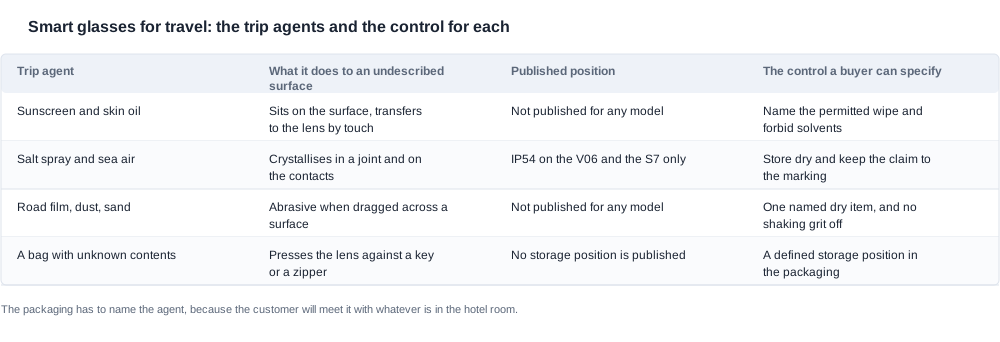
| Trip agent | What it does to an undescribed surface | Published position | The control a buyer can specify |
|---|---|---|---|
| Sunscreen and skin oil | Sits on the surface, transfers to the lens by touch, needs a solvent to remove | Not published for any model | Name the permitted wipe and forbid solvents outright |
| Salt spray and sea air | Crystallises in a joint and on the contacts, and draws moisture into a seam | IP54 on the V06 and the S7 only, no report | Store dry, wipe contacts, and keep the claim to the marking |
| Road film, dust and sand | Abrasive when dragged across a surface, and it gets into the joints | Not published for any model | One named dry item, and a rule against shaking grit off |
| A bag with unknown contents | Presses the lens against a key, a pen or a zipper | No storage position is published | A defined storage position in the packaging |
These four are the ones that matter, and they are ordered by how much damage they do per unit of exposure. Sunscreen is first because it is the only one that a customer will deliberately put on the frame and then transfer onto the lens, and because removing it usually requires a solvent, which is precisely the intervention that permanently damages an undescribed coating. Sand is second because the reflex response to grit is to wipe, and wiping grit across a lens is how a particle becomes a scratch. Salt is third because it works slowly and quietly in the joints. The bag contents are last in the list and first in the reasons a lens is scratched, because a lens face-down against a zipper is a mechanical event rather than a chemical one, and no amount of careful wiping prevents it.
The storage position as a packaging decision
The published case capacities in the range are 1400 mAh on the CY05 and the CY03, and the L1 Pro, 900 or 1400 mAh as a configuration choice on the L2 Utral, and 1200 mAh on the MT6's foldable case. The KY06 and the MT5 ship with a case whose capacity is not published, and the catalogue publishes no charging-case row at all for the V03 Pro and the V06, and the V03 or the S7. So "the case" is not one row in the catalogue; it is three different answers, and a travel programme has to settle one per configuration rather than assume a case exists, because the kit weight, the battery declaration and the number of loose items in the hand luggage all follow from it.
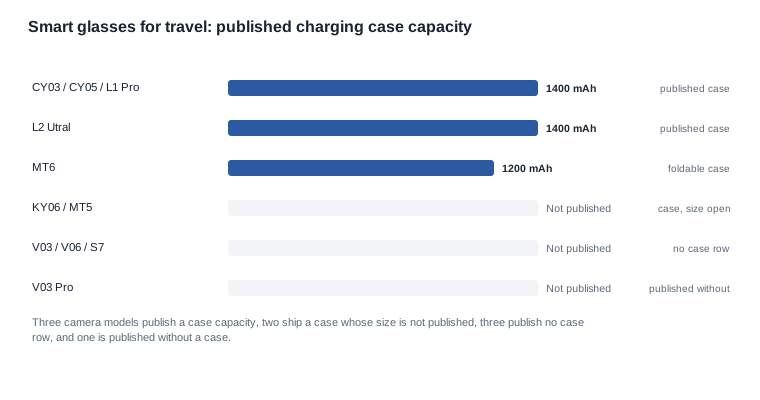
The chart above is the honest version of the case question. Three camera models publish a case capacity. Two ship a case whose size is not published, so a buyer who includes them in a travel kit is declaring a second lithium cell of unknown size. Four publish no case row at all, so whether a case exists for them is a question to ask rather than a fact to rely on, and the catalogue prints nothing about the case position in either direction, which is exactly why the travel kit has to be specified per model. A buyer who writes a travel kit that assumes a case is present, without asking, is designing a packaging that will be wrong in one direction or the other.
A case in a travel kit is also a transit problem, and a different one from a freight consignment. A battery that travels inside a container with paperwork is a freight declaration. A battery that travels in a customer's hand luggage, through several borders, on different carrier rules, is a personal-device declaration, and the documentation the customer sees is the documentation the brand supplies. The requirements for the freight side are at battery transport, and a travel programme needs the supplier's position on what a customer is told to do at a border before the first shipment rather than after the first incident. The same rules do not apply to a case in a customer's checked bag, and the confusion between the two is common enough to be worth resolving in writing.
Choosing the travel control that matches the trip profile for smart glasses for travel
A travel programme is not one product. It is a set of trip profiles with different exposures, and the control that suits one of them is waste in another. The decision tree below is written so that a buyer can pick the branch that matches the trip rather than the branch that matches the catalogue.
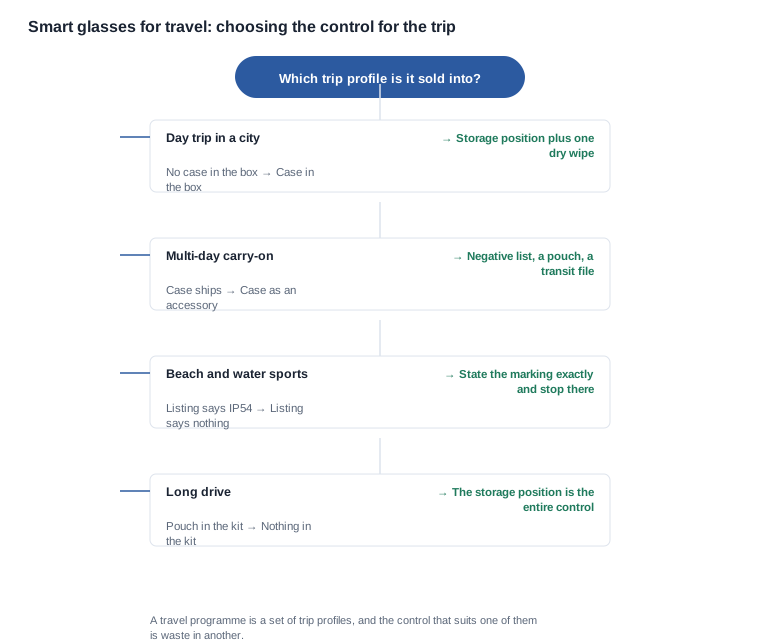
The trip profiles, and what each one costs to get wrong.
- The day trip in a city. A commute or a day out. The exposures are fingerprints, pocket lint and a bag against a table. The control that matters is a defined storage position and one dry wipe; a case is optional here, and the buyer should not pay for a second lithium cell in every unit of a commuter SKU.
- The multi-day trip with a carry-on. Salt, sunscreen and hotel surfaces. The control is the negative list, a pouch that keeps the lens separated from the bag contents, and a case only where the days away from a socket are the deciding factor. The transit file has to cover the case, and the case has to be offered at a capacity that matches the trip.
- The beach and water-sports trip. The harshest profile, and the one where the IP54 marking on the V06 and the S7 is the only published ingress statement available. It is a catalogue attribute with no third-party test report behind it, so the listing and the packaging have to say exactly what the marking says and stop there. A customer who submerges the unit and then claims "waterproof" is a customer the brand loses in public.
- The drive. A long journey in a car, where the device spends hours on a dashboard and a lens is placed face-down on a seat. The storage position is the entire control, and it has nothing to do with chemistry.
What the trip profile decides that the model does not. The profile decides whether a case ships, whether the insert needs a negative list or a storage rule or both, and whether the negative list has to name sunscreen and repellent by name. It also decides what the return condition standard has to allocate: a lens marked by a trip is a consumer error if the packaging named the agent and the instruction was supplied, and a product failure if the packaging named nothing. A travel listing whose packaging says nothing about sunscreen is a listing that has pre-agreed to pay for every sunscreen claim it receives.
A fourth profile is worth planning for because it is the one with the longest tail: the business traveller who uses the device across several countries in one week. For that buyer the relevant artefacts are not the wipe and the pouch but the per-model documentation set, the transit file that covers the configuration as shipped, and the model designation table that makes a unit traceable when it is left in a hotel safe. The material and coating background is at materials and ergonomics, and the kit decision for the scenario is at travel accessories.

The deferred clean: why the instruction has to survive being unread in smart glasses for travel
A travel routine will be deferred. That is not a training problem, it is a structural one: the device is in a bag, the trip is busy, and the moment at which a lens is wiped is the moment the customer notices it, which is often the moment they are trying to photograph something. The instruction therefore has to be designed on the assumption that it will be read once, in a hurry, and possibly not at all — and that a customer who never reads the instruction will still do something to the lens.

The sequence, in the order it has to work.
- Separate first. The pouch or the case keeps the lens away from bag contents before any wipe is needed, so the mechanical exposure is designed out rather than instructed away.
- Dry before wet. Sand and grit are removed with a dry item and no pressure, because the alternative is dragging a particle across the surface.
- Then the permitted wipe, used for sunscreen, fingerprints and skin oil, with the item named and the frequency stated.
- Then the contacts, which pick up sand and salt in a way a desk device never does and which fail silently.
- Then the storage position, which is a closing action rather than an opening one, because a wiped device that is then placed face-down has gained nothing.
Why the contacts matter more in travel than the lens does. The lens degrades gradually and visibly; the contact fails suddenly and invisibly, and a device that will not charge is a device that stops being used. Both the device contacts and the case contacts pick up grit and salt on a trip, both are cheap to wipe, and both produce a complaint that arrives as a hardware fault. A travel support script that asks one question before it dispenses a replacement closes a measurable share of those tickets, and the cost of the script is one paragraph in the manual.
The point of designing for deferral is that it changes what the buyer pays for. A kit built for a customer who follows instructions gets a wipe and a pouch. A kit built for a customer who forgets gets a wipe that lives in the pouch with the lens, so that using the item and keeping the lens separated are the same gesture. That is a packaging design change, not an instruction change, and it is the difference between an instruction that works and an instruction that was printed. The broader procedure for the scenario is at how to clean smart glasses for travel, and the product range is at AI camera glasses.

Cross-border and review consequences when a smart glasses for travel kit is wrong
The sunscreen claim that arrives after the flight. Symptom: a review describing a permanently hazy lens, written by a customer who is no longer in the market. Root cause: the packaging named no agent, so the customer treated sunscreen as a normal surface and used whatever was in the hotel room. Control: a negative list that names sunscreen, repellent and salt spray, and a permitted item that removes them without a solvent.
The bag abrasion that the customer never mentions. Symptom: a return that arrives with no stated reason and a lens marked by a zipper. Root cause: no storage position in the packaging. Control: a defined position, a pouch, and a packing instruction that appears in the same place as the wipe so the two are used together.
The case declared at the wrong size. Symptom: a device held at a border, or a customer told to dispose of a spare cell that the brand's own documentation had covered at a different capacity. Root cause: the transit file was requested against a different configuration from the one shipped. Control: freeze the bill of materials before the file is requested, and request the file against the frozen configuration.
The review that names the brand rather than the product. Symptom: a public complaint where the complaint is about a lens rather than about the device, with the brand's name in the title. Root cause: no return condition standard, so the outcome of a marked lens is negotiated at the point of return rather than decided in advance. Control: a written standard with a visual reference, agreed with the supplier, plus a refit price per unit so the outcome is affordable.
The unit that stopped working on day four and was never recharged. Symptom: a customer who concludes the product is unreliable because the battery died, when the contacts were full of grit. Root cause: no contact step in the routine. Control: the contact step on the insert and in the support script, and a count of the tickets it closes.
The instruction in the wrong language for the market. Symptom: a traveller who cannot follow the insert, in a market where the listing is in one language and the packaging in another. Root cause: the insert artwork was inherited from another market. Control: the insert is part of the packaging specification, per market, and it is a line in the quotation rather than an afterthought.
A customer who bought a second unit from a competitor. Symptom: a brand with a first-order customer base and no repeat rate. Root cause: the first unit was fine, and the problem was that the customer never wiped it. Control: the measurement below, and a decision to keep or drop the consumables in the bill of materials on evidence.
The criteria a travel buyer applies, and the questions to ask. Before you order, the questions to ask a supplier are short, and the red flags are unremarkable on their own. The problems start when a figure arrives without the condition that produced it.
- Which models are in the travel shortlist, and does a case exist for each of them? A model published without a case and a model published with no case row are two different answers, and both of them are answers a supplier should be able to give in writing.
- What is the lens material and the coating, and what is the prohibited-agents list? If the supplier has no answer, the instruction has to be restrictive and the listing has to avoid the word "scratch-resistant".
- What does the packaging say about storage, and what is the per-unit cost of the kit? The total cost of the kit is the wipe, the pouch, the film and the insert, and it is a line in the bill of materials that nobody should discover after the artwork is printed.
- Does the transit file cover the configuration as shipped? Ask it with the case in it, and check how to verify the answer against the issuing body's own register.
- What is the return condition standard, and what is the refit price per unit? Without both, a marked lens becomes a negotiation with a customer who has no intention of returning to your store.
- What is the model designation on the unit, and how is it traceable to the paperwork? A device that has been through a border should still be traceable to the document set it shipped with.
How to evaluate the answers you get back. A useful answer states the condition before the number, names the model, and distinguishes a published row from a measured one. A soft answer looks like a family-level figure, a case capacity generalised across models, or a claim about a lens surface that no document supports. A buyer who writes those answers into the order has converted an open row into a settled one, and the checklist above is the shortest form of that conversion.
Where the cost per return lands. A travel return costs a refund, a return shipment, a restock and a replacement unit. What it does not cost is the review, because a review is not a cost that appears on an invoice — it appears as a lower conversion rate on the listing for every later customer, which is the only place it hurts. That is the line item a travel buyer should put next to the refit price when the channel manager asks why the travel SKU needs a kit at all.
What to measure on the first shipment. Three numbers, all from your own data. The share of returns whose reason text mentions softness, haze, smudging or fogging rather than a crack. The share of "it will not charge" tickets that were closed by the support script asking one question. And the count of returns that carried a negative-list complaint, which is a measurement of the packaging rather than of the device. Split the first two by whether the unit shipped with the kit, exactly as a running programme would, and the two channels' answers will not be the same.
Publishing limits for smart glasses for travel, and what to send us
The short answer: the travel kit is a packaging decision, and a travel instruction is a prohibition list. We publish the camera tier's resolution tiers, cell capacities, charge times, rated runtimes, charging interfaces, case capacities and colour availability exactly as the catalogue states them, and we publish the IP54 marking on the V06 and the S7 as a catalogue attribute with no third-party test report behind it. We publish the absence of a lens material, a coating specification, an abrasion or chemical resistance figure, a per-model frame weight beyond the single 158 g whole-unit figure for the MT6, the field of view, the video specification and a runtime test condition with the same prominence, because a buyer writing a travel instruction needs to know which rows are settled and which are still open for a supplier to answer.
What we will not do is publish a wipe recommendation for a lens whose material and coating we have not been given, or describe the absence of a charging-case row for the S7 and the V06, and the V03 as though those models had no case. We will not extend the IP54 marking to the models where no rating is published, and we will not estimate a frame weight for a model whose weight the catalogue does not publish, or carry the MT6 figure across to a different platform. Where the catalogue carries a company-level export certification page rather than a per-model certification row, we say so instead of letting a buyer assume a model-specific conformity record exists in our file.
What we will do is take the trip profiles, the markets, the channel and the price band, and return the kit and storage position each configuration should carry, the published rows that cover it, the transit file that has to cover the configuration as shipped, and the claims the listing can make without overreaching. The scenario entry point is smart glasses for travel, the compliance route is at certification checklist, the clause language is at contract terms, and the commercial structure of a first order is at pricing.
What to send us. Send the trip profiles you are selling into, the markets, the channel and the price band, and we will tell you which published rows apply, which case configurations exist for the models you are shortlisting, what the prohibition list and the storage position should cover, and which questions have to be answered in writing before the packaging is signed. If the first shipment has already gone out, send the return reasons instead and we will tell you which of them a packaging change can remove.
Related reading
- The scenario's starting point — smart glasses for travel
- The catalogue range — AI camera glasses
- The kit decision — travel accessories
- The transit requirements — battery transport
Send us the trip profiles and the markets, and we will say what the travel kit and the storage position should contain.


