

The YK12 is one of eight audio models in this catalogue, and its published row is deliberately thin. It gives you two 55 mAh cells, a charge time of two hours or less, magnetic charging, roughly six hours of rated use, Bluetooth 5.4, and two feature descriptors — Surround Sound and a Slim Temple. Nothing else. No weight, no ingress rating, no microphone row, no touch row, no per-model certification line.
That row describes one specific build. It does not describe the build you will receive.
So the useful way to approach yk12 smart glasses how to customize is to accept a simple constraint up front: the catalogue gives you a base configuration, and every customisation decision you take produces a document the published row does not cover. The interesting question is not whether something can be changed. For most things on this platform the answer is a qualified yes. The question is which decision belongs to whom, and what written evidence you will need for each one before the order is placed.
Three layers of authority sit behind every option you will be offered, and buyers routinely flatten them into one list. Separating them is what turns a stack of features into a sequence you can actually manage.
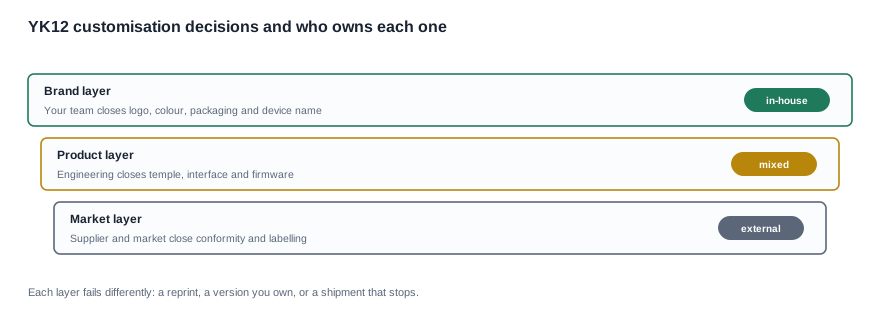
YK12 customization starts with who owns each decision
The brand layer — decisions your own team can close alone
Logo, colour, packaging artwork and the Bluetooth device name sit in this layer. They need no mould, no new electronics and no supplier-side engineering, which is exactly why they get settled first in most briefs and why they are the easiest things to change late. Each one still needs a closed loop, because "we can do logos" is not a specification.
The evidence you want for each brand-layer decision is narrow and concrete: the artwork method and placement, the finish the colour is matched against, the number of packaging versions per market, and the exact string that will appear in the Bluetooth device list. Each of those is a sign-off, not a discussion. If a buyer cannot name the person who signs the artwork approval, the decision is not closed yet.
There is a second reason this layer matters commercially rather than cosmetically. A logo that is printed or plated onto the temple and a logo that has to be moulded into the temple are different engineering tasks with different costs and different lead times. The brand layer decides which one you are asking for, and the factory layer answers with the tooling consequence. Buyers who leave this unspecified end up paying for the more expensive interpretation of an ambiguous request.
The product layer — decisions engineering owns and each one leaves a version behind
Temple geometry, the system and interface, and firmware behaviour belong here. None of them is a branding request, and none of them is free. Every one of them changes what the factory builds, and every one of them creates a configuration that is no longer the catalogue configuration.
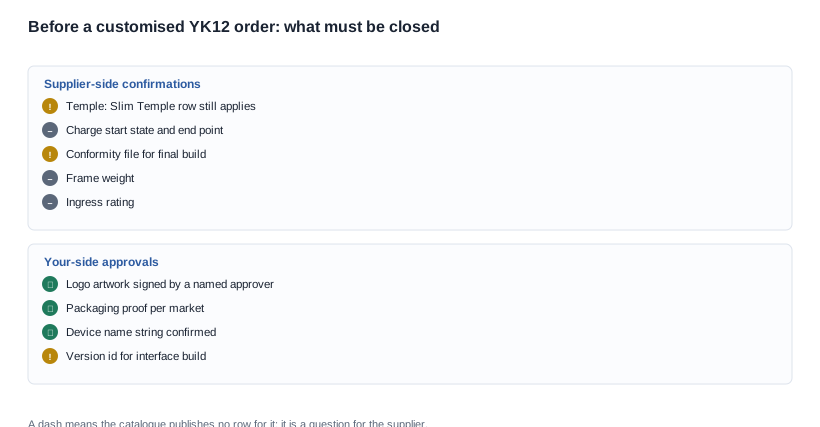
The YK12 makes this concrete. The catalogue publishes Slim Temple as a feature descriptor for this model, alongside Surround Sound. That descriptor describes the temple of the base build — its geometry and its relationship to the two 55 mAh cells that give the model roughly six hours of rated use. A temple change is therefore not an isolated visual request: it interacts with the published Slim Temple descriptor and with the cell arrangement that the descriptor sits on top of. Before a buyer specifies a new temple profile, they should know whether the Slim Temple descriptor still describes the result. If it does not, the published row has stopped applying to the product, and the specification has to be rewritten rather than annotated.
The same logic applies to the interface and to firmware. A customised interface is a software artefact with an owner. If you plan to sell the same product into more than one market, or to refresh it in a year, the real question is not what the customised build looks like at handover — it is whether the customised build can still receive later platform updates, and whether reverting to a stock build remains possible. That update path is a factory-side fact, and it is worth more to you than the interface artwork itself.
The market layer — decisions nobody volunteers, because they belong to the destination
The market layer is where conformity, labelling, radio documentation and the compliance text on your packaging live. It is also the layer the catalogue says least about. Nothing in the written catalogue names CE, FCC or RoHS, and no certification row is published against any individual model. The single thing the catalogue does carry is an export certification sheet at company level, and it is pictures rather than text: ten certificates in all — eight appearance-design patents alongside two utility-model patents.
That gap is the single most useful fact on this platform for a buyer, because it tells you precisely what to request. You are not looking for a certification claim; you are looking for the technical file behind the model as it will actually ship in your configuration. Ask for the conformity assessment for the final build, not for the catalogue model. If your customisation touches the temple, the firmware or the radio configuration, that is the document which has to be re-checked for your market, and the party who confirms it should be named in the agreement.
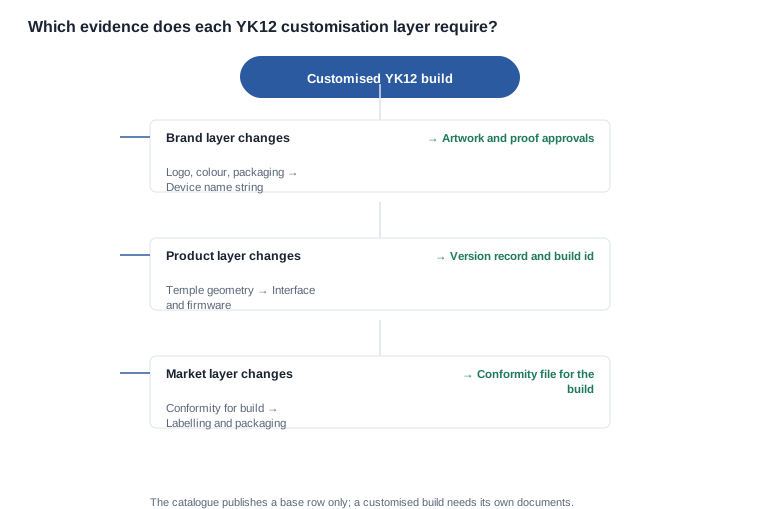
The three layers fail differently, and that is what makes the separation worth keeping. A brand-layer mistake is a reprint. A product-layer mistake is a version you now maintain alone. A market-layer mistake is a shipment that stops at the border. Because the consequences differ that sharply, the right time to raise each of them also differs: brand decisions can wait for a sample, product decisions cannot wait for a sample because the sample is the first artefact of them, and market decisions cannot wait for anything at all.

The seven customization levers, and which of them touch tooling
Buyers consistently ask about the same seven levers on this platform. The catalogue does not publish a customisation menu — it publishes a base configuration — so treat the list below as the standard set of questions, and treat the tooling column as the thing to confirm, not as something already established.
| Customisation lever | What actually changes | Does it create a version? | The evidence to request |
|---|---|---|---|
| Logo | Marking method and placement on the temple | No | Artwork approval sheet and placement drawing |
| Colour | Finish or plating against the base build | Possibly | Approval sample against the base finish |
| Packaging | Retail box, insert, barcode, compliance text | No | Signed artwork proof per market |
| Temple geometry | The published Slim Temple descriptor | Yes | Written confirmation the descriptor still applies |
| System and interface | On-device presentation and language | Yes | Version number and update path |
| Bluetooth device name | The string shown in the device list | No | Exact string, characters supported, approval proof |
| Firmware | Device behaviour and feature set | Yes | Build identifier and platform update entitlement |
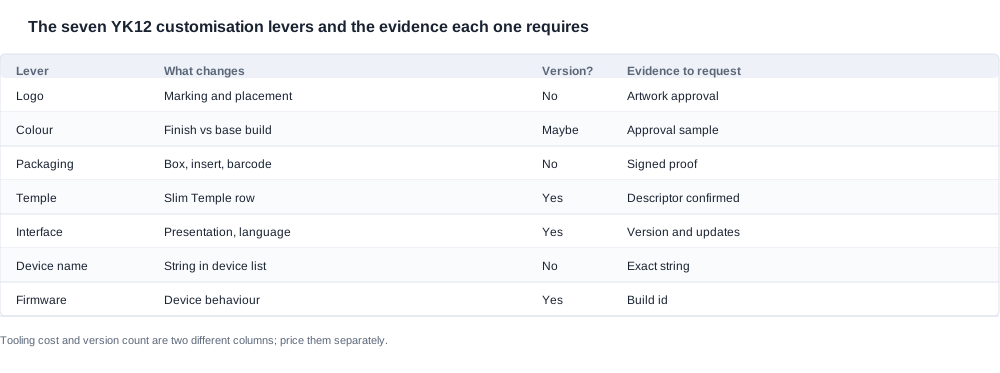
Two things in this table decide your cost, and neither of them is the number of levers you choose.
The first is tooling. A logo, a colour change on an existing finish, a packaging artwork change and a device-name change can all be applied without opening a new tool. A temple geometry change is a moulding change on a visible structural part, and it carries with it the question of whether the published Slim Temple descriptor still describes the product. The right way to price this is one lever at a time, with the tooling consequence stated separately for each, rather than as a single bundled figure that hides which item is expensive.
The second is versioning. A product with a customised interface, a customised device name and customised firmware is a different software product from the catalogue one, and it is one that only your team can maintain. Three levers are cheap in tooling and expensive in management precisely because each one leaves you owning a version. If your channel plans multiple markets from a single platform build, the version count is the number that matters to you, not the tooling count.
The order these two columns are read in is also the order they should be committed in. Fix the hardware tier first — logo, colour, temple — because those drive tooling and lead time. Fix packaging next, because it is cheap to change now and expensive to change after the compliance text is printed. Settle the device name and the interface while the version count is still one. Commit firmware last, because it is the lever most likely to need more than one round and the one most likely to affect your conformity position.
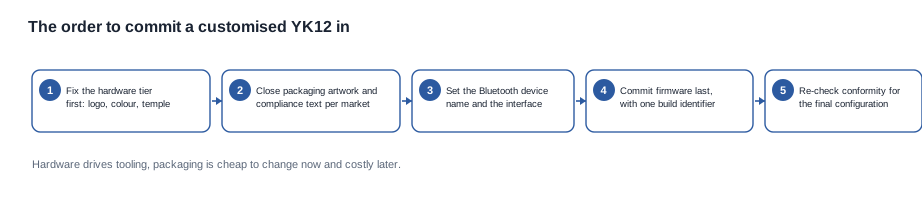
The YK12's own published figures give you a second reason to sequence carefully rather than in parallel. Two 55 mAh cells, magnetic charging, a charge time of two hours or less and roughly six hours of rated use describe a package that is sized around the temple as published. Any change to that temple is a change to the package the catalogue measured. We do not publish the frame weight for any model in this range, so you cannot compute the effect yourself — which is precisely why the approval sample and the written confirmation both matter, and why a verbal assurance that a temple change is "no problem" is worth less than a signed one.

What the published YK12 row covers, and what it stops covering
Buyers often read a published specification row as a warranty on the delivered product. On this platform it is not, and the gap widens the moment customisation begins. It is worth being precise about where the boundary sits.
The row does cover the base build. The YK12 publishes two 55 mAh cells, magnetic charging, a charge time of two hours or less, roughly six hours of rated use, Bluetooth 5.4, and the Surround Sound and Slim Temple descriptors. Note what that row does not include: a starting state for the charge, a termination criterion for it, a capacity figure for any charging case, a frame weight, an ingress rating, a microphone specification, a touch control row and a per-model certification entry. The catalogue publishes no touch row for any model. There is no ingress rating on this model — the IP54 marking appears on two other models in this range and on no others.
The row stops covering the product the moment you change it. That is not a caveat we are adding; it is the normal consequence of what a published row is. A specification row describes the configuration that was measured. Once the logo method changes, or the temple changes, or the firmware changes, the row still describes the configuration that was measured, and the delivered product is a different configuration that somebody has to describe. The practical consequence for a procurement team is that the published row can be used as the baseline for a technical agreement, but it cannot be used as the baseline for a conformity agreement covering a customised build.
The charge time has a second limitation that is easy to miss. Every model in this catalogue publishes a charge time, and on this platform that figure is a ceiling — two hours or less — with the starting state of the cell and the point at which the charge is considered complete both unpublished. Two hours or less is an upper bound, not a promise of two hours, and it is not interchangeable with a claim that the charge completes in under two hours. If your shift pattern depends on the product being ready between two fixed points in the day, the number you need is not in the catalogue; it is a question about the starting state and the termination criterion, and it belongs in the agreement rather than in a specification sheet.
Customisation adds documents rather than removing them. The output of a well-run YK12 customisation is not just a product. It is a configuration record, a firmware build identifier, an artwork approval set, a packaging proof per market, a conformity file for the final build, and a written update path for the customised software. A buyer who has budgeted for the product but not for these six documents will discover the gap at the most expensive possible moment, which is usually the week before a production run.
That is also why the question of what happens on the next order is worth asking early. If the first run is a customised build, the second run has to reference the same configuration record and the same build identifier. If the factory cannot reproduce a previous custom configuration from a record, then the customisation is not a product, it is a one-off, and the economics of the second order will not resemble the first.

Questions to put in the quotation for a customised YK12
A quotation that answers the following does not need a second round of clarification. A quotation that does not answer them will produce one anyway, with a fee attached. These are the questions whose answers change what you are buying.
- For each of the seven levers separately, what is the tooling consequence and what is the charge, stated per item rather than as a bundle?
- Which levers create a new version, and what is the version identifier for each of them?
- Does a customised firmware build continue to receive the platform updates that the stock build receives?
- Is a stock build restorable after delivery, and what does that require?
- Does the Slim Temple descriptor still apply to the temple specified in this order?
- What is the starting cell state and the termination criterion behind the published charge time?
- Which conformity document covers the final configuration as it will ship in my market, and which party confirms it?
- What is the defect responsibility split between the factory and the distributor for a customised build?
- How is a repeat order configured to reproduce the previous custom build, and what record is used?
- What is the warranty position on a customised build, and does it differ from the standard build?
Two of these deserve emphasis because they are the ones most often answered vaguely. Question 5 determines whether the product you are buying still matches the published description of the YK12 — the Slim Temple descriptor is in the catalogue row, and a temple change is the one lever that can quietly invalidate it. Question 7 is where the certification gap lives: the catalogue carries no CE, FCC or RoHS reference in its text and no per-model certification row, so the request has to be for a document tied to the configuration you are buying.
The remaining question worth asking is one about timing rather than content. Ask what the factory needs from you, and when, for the build to proceed on schedule. The answer will name specific artefacts — artwork files, a firmware branch, a packaging proof, a signed specification — and the dates attached to them will tell you more about the real lead time than any number quoted up front. A lead time that assumes simultaneous delivery of four supplier-side inputs is not a lead time; it is a schedule with an unstated dependency on your own team.
Red flags in a quotation that has not answered the questions
Three patterns show up repeatedly in quotations for customised audio platforms, and each of them is worth challenging before you order. The first is a single bundled customisation fee covering all seven levers. Bundling hides the one lever that actually drives tooling cost, and it makes it impossible to remove a lever you later decide you do not need. The second is a stock-build conformity statement attached to a customised order — the published row describes the configuration that was measured, so a conformity claim that references the catalogue model rather than the final build is not evidence about the product you will receive. The third is a firmware commitment with no build identifier attached, which sounds technical but in practice means there is no way to reproduce the delivery on a repeat order.
A fourth pattern is quieter and costs more: silence on the update path. If the answer to whether the customised build continues to receive platform updates is a general assurance, it is worth asking what happens to your interface if the platform moves. A supplier who cannot answer that is describing the handover, not the product lifecycle, and the total cost of the customisation only becomes visible once somebody has to carry it.
The due diligence checklist is short. Before you order, confirm that every lever has its own line, that every version has an identifier, that the conformity statement names the final configuration, and that the update path is written rather than assumed. These are the criteria that separate a quotation you can repeat from one you can only re-run.
How to choose between a stock build and a customised one
The question is not which option is better; it is how to choose between them. A stock YK12 arrives as the configuration the catalogue describes: two 55 mAh cells, magnetic charging, a charge time of two hours or less, roughly six hours of rated use, Bluetooth 5.4, and the Surround Sound and Slim Temple descriptors. Nothing about that build has to be re-documented, and for a single market with a standard device name it is almost always the cheaper route.
Customisation earns its place when one of three conditions holds. If the brand has to be visible on the product at the point of sale, a logo decision is unavoidable — but a logo is a marking change, not a reason to open every other lever. If you sell into more than one market, the packaging and the device name may have to differ, which makes the version count the thing to price rather than the tooling. If your channel requires a feature or an interface the catalogue build does not provide, then firmware is in scope and the update path stops being optional.
The shortlist question is therefore which of the seven levers you are genuinely opening, and what to ask about each one separately. The trade-off is asymmetric, and it is the reason to decide early. A customisation added later costs more than the same customisation added first, because the configuration record, the artwork set and the build identifier all have to be re-established. A lever removed early costs almost nothing. That asymmetry is the strongest argument for writing the full seven-lever list into the brief on the first order, even when only two of them are active — so that the ones you defer are deferred deliberately rather than by accident. It is also the argument for negotiating the per-lever breakdown before the first order rather than after it, because after the tooling has been opened, the breakdown stops being a question you have any leverage on.
Where we draw the line on YK12 customisation
The position is narrow, and we would rather state it than let a buyer assume it.
We can tell you which levers exist on this platform, which of them change the object rather than the behaviour, and which of them create a version you will own. We can tell you that the published YK12 row gives Bluetooth 5.4, two 55 mAh cells, magnetic charging, a charge time of two hours or less, roughly six hours of rated use, and the Surround Sound and Slim Temple descriptors.
We will not quote tooling costs we have not confirmed, we will not promise that a customised firmware build inherits the conformity position of the stock model, and we will not fill in a frame weight or an ingress rating to make a temple change sound safer than it is. Where the catalogue is silent — on weight, on the touch row, on the charge termination criterion, on per-model certification — we will say so and turn it into a question for the supplier rather than a guess.
Our standard route for this is the OEM and ODM customisation process, which sets out how a specification is built and confirmed before anything enters production. If you want the published YK12 configuration without changes, the model page is YK12 smart glasses, and the wider platform is Bluetooth audio glasses.
Related reading
- The published rows this article builds on — what to check before ordering the YK12
- Where this model sits in the audio range — YK12 battery and runtime
- The conformity question this platform leaves open — customisation and certification impact
- How a first order is evaluated — sample evaluation
Send the market, the quantity and the specific changes, and we will tell you which of the seven need tooling, which create a version, and in what order they have to be committed.


