
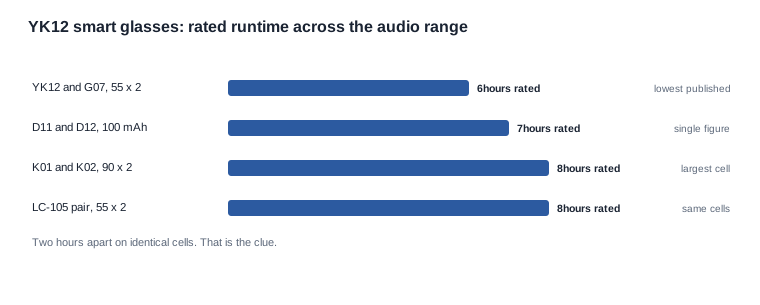
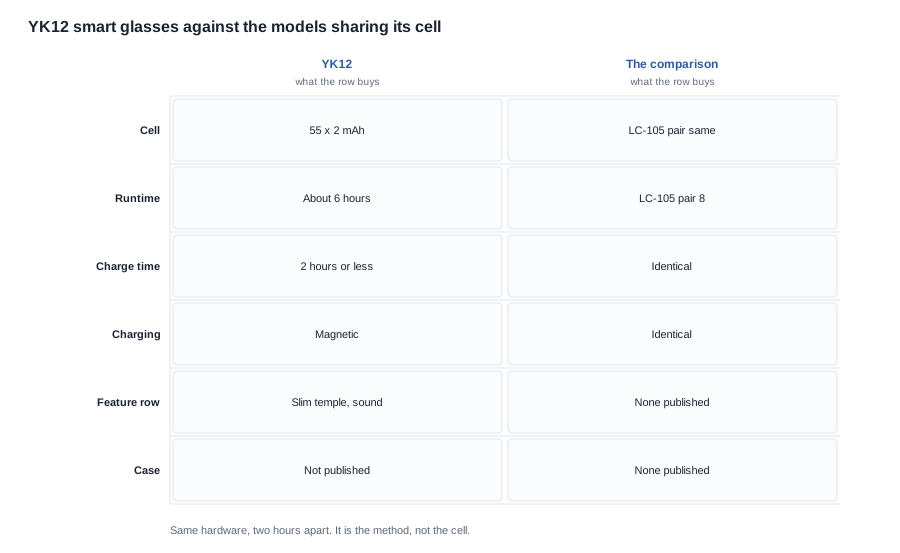
The YK12 smart glasses publish two 55 mAh cells and roughly 6 hours of endurance, which is the lowest published figure in the audio range on the smallest published cell configuration. The same cells, the same charge time and the same charging method produce 8 hours on the LC-105 pair. That two-hour gap, on identical hardware, is the most useful thing in this model's documentation, and it points at the missing test condition rather than at a slower product.
This page is written for the buyer who is about to build a range on these figures, and for the buyer who is about to put one of them on a product page. Both of those activities go wrong in the same way, and the way they go wrong is visible in the catalogue itself. Everything below is either a way to use the published row correctly or a way it gets misread.
YK12 smart glasses battery life: the published row, and the comparison it forces
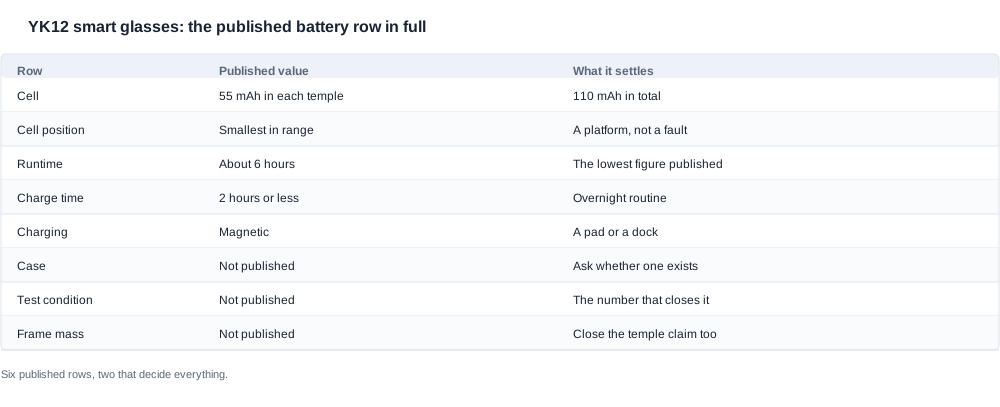
55 mAh in each temple. 110 mAh in total, the smallest published energy configuration in this range, shared with the LC-105 pair and the G07.
About 6 hours. The lowest published endurance figure in the range.
2 hours or less to charge. Identical to every other model in the audio range.
Magnetic charging. A pad or a dock in the box, and the case capacity is not published for this model.
Now put the LC-105 pair next to it. Same cells, same charge time, same charging method, and 8 hours. A two-hour difference on identical hardware cannot be a design difference in any meaningful sense, because the electronics are the same, the cell is the same and the charging path is the same.
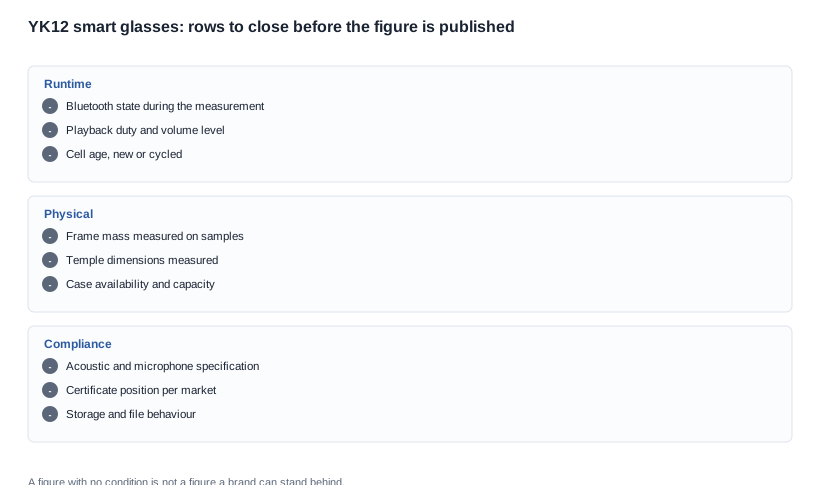
The most probable explanations are all measurement conventions. One figure taken with continuous playback and the other with intermittent use; one taken with a fresh cell and the other with a cycled one; one taken with the Bluetooth link active and one with it idle; one taken at a playback volume the other was not. None of those is published for any model in the range, which is why the gap is informative rather than confusing — it proves the figures describe a duty cycle and a method rather than describing a battery.

What the figure is legitimately for, and what it is not
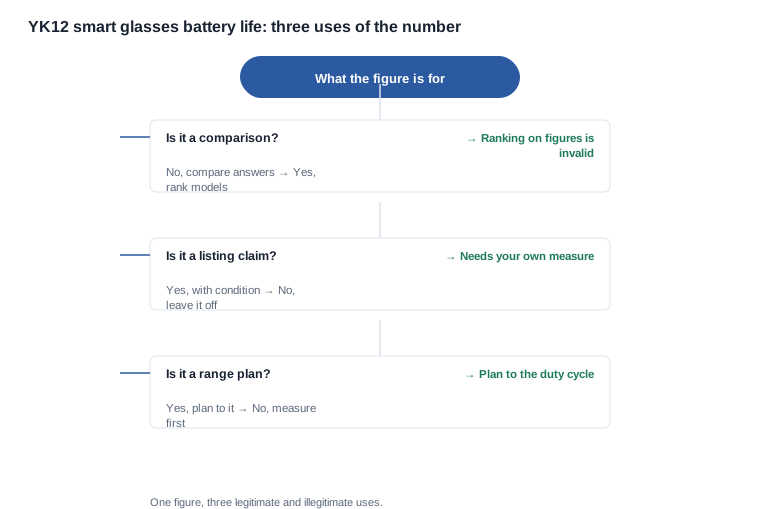
Three legitimate uses, and one illegitimate one, and they get confused constantly.
Legitimate: planning the range. A buyer building a range needs to know roughly where this model sits, and approximately six hours is enough to answer that question at the planning stage. The audio range battery picture shows the same pattern across the camera group, where the figures arrive in three different shapes — a point and two different ranges — with no condition attached to any of them.
Legitimate: asking suppliers a comparable question. The figure is not a comparison, but it is an excellent prompt. Asking every supplier what their condition was converts six incompatible numbers into six comparable answers, and the answers are what a shortlist should be scored on.
Legitimate: setting the customer's expectation, internally. Planning a top-up routine, a dock location and an accessory strategy requires an order of magnitude, not a precision. Six hours is enough to plan a dock and not enough to publish.
Illegitimate: ranking models against each other. This is the failure the two-hour gap makes visible. A buyer who ranks this model below the LC-105 pair has ranked a measurement convention rather than a product, and the ranking will reverse the moment either supplier describes its condition. It is worse than useless in a due diligence file, because it looks like analysis and survives no scrutiny from anyone who asks a second question.
A fourth temptation, which is the one that costs money. Treating the published figure as the basis for a range-wide runtime table on the brand's own product pages — the camera family produces figures in three different shapes, the audio family produces two, and neither family publishes a condition for any of them. A consolidated table built from those figures is arithmetically tidy and commercially dangerous, because it invites a customer to compare a number from one measurement profile with a number from another. A table that cannot survive a customer asking "under what conditions?" should not exist, and that test is fast: read each cell aloud and ask whether its condition is stated anywhere on the same page.
And the version of this that shows up in a tender. A procurement manager asked to justify a runtime figure to an internal stakeholder will reach for the largest number available, because the largest number is the easiest to defend internally. On this model the largest number is not published, and the honest answer is that the figure is a rating without a condition. Supplying a figure without its condition is not a shortcut; it is a disclosure failure that will be found later, at the point where somebody relies on it.
The measurement protocol that produces a defensible number
Three questions, asked identically to every supplier on the shortlist. Was the Bluetooth link paired and active throughout the measurement, or was the device disconnected during idle periods. What was playing, at what volume, continuously or intermittently. And was the measured sample the production configuration on a new cell or on a cycled one. Identical wording matters more than it looks: suppliers answer what they are asked, and a vaguely worded question produces a vague answer that cannot be compared to anything.
Then measure it yourself, because your figure is the only one you can publish. Take a sample, charge it fully, confirm the state it starts in, and run the duty cycle your customer actually keeps — not a stress test and not an idle test. Record the conditions beside the number. A figure with a condition attached to it is defensible on a product page; a figure without one is a marketing claim with a technical costume.
The protocol, stated as a repeatable procedure. One sample, fully charged, starting state recorded. One duty cycle defined in advance from the customer's behaviour. One end point, defined as the point where the product is no longer usable for the customer's task rather than the point where it switches off. That last definition is the one most protocols omit, and it is the one that determines whether two suppliers' numbers describe the same event.
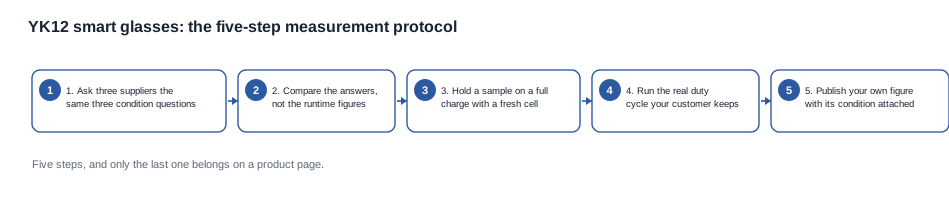
And the sample-stage version, which is cheaper. If a buyer will not run a full protocol, the minimum useful version is a single timed run on one sample in the customer's duty cycle, recorded with the conditions, used internally and never published as a specification. That is still better than copying a figure, because it is a fact about the product in front of the buyer rather than a claim inherited from a catalogue row.
The cost of getting the end point wrong, which is the step most protocols skip. Two suppliers can run the same duty cycle and report different figures purely because one measured to the point where the product switches off and the other measured to the point where the customer's task stops working. Those are different events with different durations, and a discrepancy between them looks like a product difference when it is a definition difference. Define the end point in terms of the customer's task rather than the device's behaviour, write it into the protocol before the run, and use the same sentence in every supplier request.
And what to do with three runs that disagree. Repeat the measurement rather than averaging. A spread across three runs on the same sample is a finding about the measurement, usually indicating an uncontrolled variable in the environment rather than a fault in the product. Report the range, publish the condition, and note the uncontrolled variable — a figure with a stated spread and a stated condition is more credible than a single clean number, and buyers find that counter-intuitive until they have been burned by a single clean number.
Who should run it, and when. The supplier should run it during sample approval, because that is when a disagreement is cheap. The brand should run it again at goods-in inspection on the production tranche, because cell batches vary and a figure established on a sample cell does not automatically transfer. Two runs at two points in the supply chain cost less than one complaint traced back through a return.

Why six hours is a duty-cycle answer rather than a design answer
The cell is the smallest in the range, and the runtime is the shortest, and those two facts together invite the wrong conclusion. The conclusion the catalogue invites is that this model is the weak one. The more likely reading is that the two models sharing this cell were measured under different profiles, and that one of the two figures reflects a conservative test while the other reflects a favourable one.
The frame weight compounds the gap. The design feature on this model is the slim temple, and a slim temple is a weight-related claim — which means the number that would substantiate the feature is exactly the number that is missing, because the frame mass is not published. The weight comparison across the audio range explains why a proxy from another model cannot be used, and the sizing and comfort analysis covers what a sizing claim would need.
So the two gaps are the same gap. The runtime figure cannot be compared without the test condition, and the temple claim cannot be substantiated without the mass. Both are closed by one afternoon with a scale and a timer, and a buyer who spends that afternoon gets two answers for the cost of one.
The charging accessory is the third gap, and the commercial one. A case capacity decides the packed weight, the freight class and the customer's weekly routine, and none of it is published for this model.
Why a dock changes the runtime question rather than answering it. A dock on the desk is a top-up opportunity and not an endurance solution, and the distinction decides what the customer experiences. A customer who takes the frame off at lunchtime and puts it back on the dock recovers part of the day; a customer who takes it off and puts it in a drawer recovers nothing. The published six hours therefore describes two different products depending on where the dock lives, and a brand that knows where the dock will live knows which of the two it is selling. That is a packaging and unboxing decision as much as a specification decision, which is why it belongs in the same conversation.
And the same reasoning applies to a channel with no dock at all. A marketplace customer who receives a frame with a dock in the box and no reason to place it will return it or ignore it, and the runtime proposition quietly evaporates. Buyers targeting that channel should establish whether a dock can be sold as a separate accessory line with its own minimum order quantity, or whether the accessory has to be bundled, because the accessory choice determines whether the six-hour figure describes a usable product or an unusable one.
The charging options analysis covers the accessory economics across the range, and a buyer whose channel proposition depends on the dock should establish the capacity before packaging is designed rather than after.

What the runtime figure is worth commercially, and what to negotiate
The commercial value of a runtime figure is smaller than a buyer expects, and that is useful to know early. A figure decides whether a customer's day works, and it does so before the purchase rather than after it, which means it belongs in the product page and in the range plan rather than in a negotiation. It does not set the price, it does not decide the freight class, and it does not appear on a purchase order. Treat it as a listing and planning input, not a commercial term, and the disappointment of not being able to negotiate it disappears.
What is actually negotiable on this model, and in what order. Start with the minimum order quantity and the lead time for the configuration intended, because those two determine whether the launch plan works at all. Then the dock as a bundled or separate accessory line, with its own minimum order quantity, because that decision changes the accessory economics and the unboxing. Then unit price and volume tiers across a bulk order. Then packaging specification. Then delivery splitting, so a first tranche can be validated before the balance ships. Then payment terms with nodes tied to a pre-shipment inspection rather than to shipment. And last, the warranty period with a stated response time and the return terms for defective units.
The line that cannot move. Certification cost and lead time are determined by the programme and by whoever runs the test rather than any conversation. Tooling is frequently amortised across a first order while certification cost is per product family, and asking which one you are being quoted matters because the two are frequently bundled into a single line that hides which is which. Certification cost is not negotiable; the schedule around it often is, and the schedule is where the leverage sits on a lead-time-bound launch.
The trade-off worth pricing rather than assuming. A brand that ships with a dock in the box pays for it in freight weight, in a battery transport document and in a second lithium cell in the parcel. A brand that sells the dock separately keeps those costs out of the shipped configuration and puts them into an accessory line the customer may never buy. Neither answer is universally better: the bundled route serves a marketplace customer who would not reorder an accessory, and the separate route serves a channel with reorder discipline. Run it as a total cost comparison on the shipped unit and pick the one that matches the channel.
Ask for each of the three in one written request, because a request list gets three answers and a sequence of calls gets one paragraph. And record the answers in the technical file for this SKU rather than in an inbox, so that the next person to work on the range is not reconstructing them.
The due diligence that belongs with the figure. A technical file review covering certificate numbers, issuing bodies, validity periods and a covered model schedule that names this model rather than the platform. A sample order sized to the duty cycle the customer keeps rather than to the number of units needed for a demonstration. And a pre-shipment inspection with pass lines written before production — packed unit weight, accessory count against the packing list, and the charge state on arrival. Those three, plus the measurement protocol above, are what turn a catalogue figure into something a brand can stand behind.
Verification steps, and where we stand
Six things to close before the figure goes on a product page. The runtime test condition, asked in identical words to every supplier. Whether the measured sample was the production configuration on a new cell. Frame mass and dimensions, measured. The charging case capacity, and a measured packed unit weight. The acoustic and microphone specification. And the certification position for this model in each destination market.
Two questions worth asking before the other four. First: is the approximately six-hour figure taken with the Bluetooth link active, and if so is that how the customer's product behaves? Second: is the figure taken with continuous playback or with intermittent use? Those two answers between them decide whether this model suits the customer's day, and they cost nothing to ask.
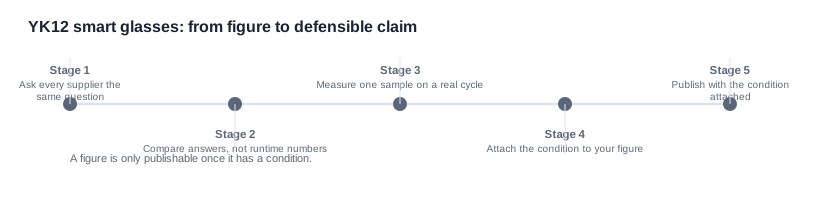
Where we stand. Our position is that the 6-hour figure is usable as a manufacturer rating and useless as a comparison, and that a buyer who reads it as this model being slower than the LC-105 pair has read a measurement convention rather than a product. We will publish the figure, we will not present it as a working day, we will not rank it against the neighbouring models, and we will not quote a weight, a case capacity or a certificate number that the documentation does not contain.
What that means practically for a range plan. Treat this model and the LC-105 pair as one platform with two merchandising positions rather than as a fast model and a slow model. Ask both suppliers the same condition questions, compare the answers, and run one measurement on a sample before deciding which figure belongs in the range plan and which belongs on the shelf. The range decision survives either answer; a listing built on the copied figure does not.
The published YK12 specification list is the honest baseline, the method for comparing runtime figures covers the procedure in full, and the YK12 how it compares page sets this model against the whole range.
Related reading
- What this model publishes — YK12 smart glasses specifications and features
- The range-wide comparison — YK12 smart glasses how it compares
- The method behind a defensible number — how to compare smart glasses battery life
Send us the application and the expected daily use, and we will tell you which published figures apply to your case and which have to be measured on a sample.


