

A travel deployment is bought against a trip, and the trip is not a day. It is a sequence of segments — a security queue, a cabin, a border desk, a long transit afternoon, a hotel wall — and each segment asks something different of the device and each one can end the trip. Measuring a result in this category therefore means two things at once, and they are the two things that are easiest to get wrong in opposite directions: the battery has to survive the day on the ground, and the paperwork has to survive the border. The first is settled by published rows; the second is not published anywhere and is the document that actually decides whether the shipment arrives.
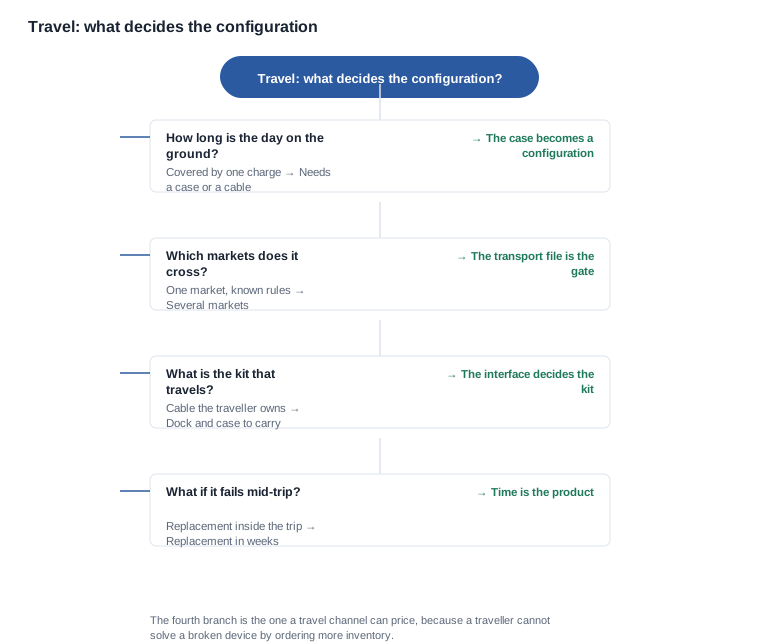
Smart glasses for travel: what the trip and the border decide
A travel buyer is not buying a device for a wearer who will be sitting still. They are buying a device that has to be powered down at a checkpoint, carried through a terminal, run or not run through a long transit, and charged in an unfamiliar place at the end of it. The published rows describe the device at rest; the trip describes the device in motion, and the two produce different requirements. The measurement question in this category is therefore not "how long does it last" but "how long is the longest segment without a charge opportunity, and what is the document that lets it cross the border with a cell in it".
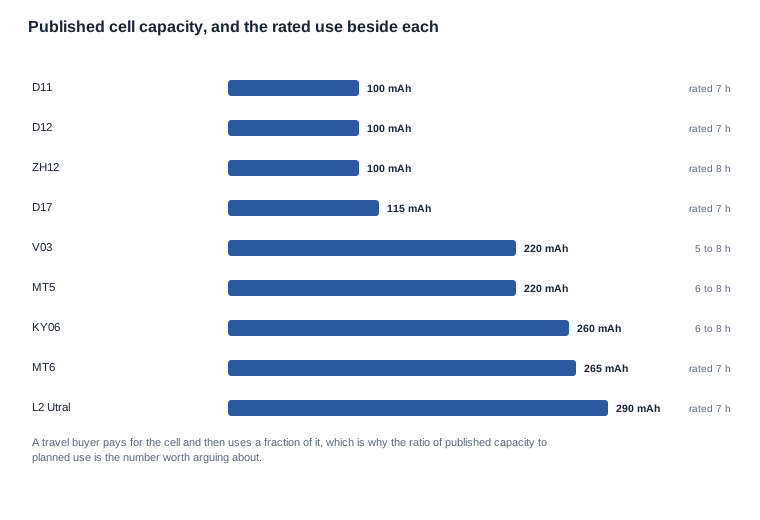
Three conclusions follow, and each of them is a decision that has to be made before the order rather than after the first shipment. First, the cell capacity and the rated use have to be read against the trip profile rather than against a generic day, and the ratio matters: a travel buyer frequently pays for a large cell and a high resolution class and then uses a fraction of both, because the camera is heavy in a bag and the battery is a constraint rather than a feature. Second, the transport file is the gating document in this category, and the rules attach to the battery rather than to the product, which means a device can be perfectly legal as an electronic product and still be a problem as a carried cell. Third, and unlike every other scenario in this range, the commercial product is time: a replacement route measured in hours rather than in weeks is worth paying for, because a traveller who loses a device at an airport cannot solve it by ordering more inventory.
Who is reading this. The reader is a brand-side buyer, a channel buyer or an e-commerce seller deciding whether to open a travel line, usually for a channel that already sells travel accessories and has an existing customer who asks for this product. The task in front of them is to turn the observed customer behaviour into a configuration that a factory can quote, and to identify which parts of the trip the configuration has to survive. The fear underneath the enquiry is a shipment that is stopped at a border because the documentation did not cover the configuration that was shipped, and a returns problem that was never priced because the accessory set was decided at the last minute.
What the catalogue publishes for a travel line. The audio models publish a cell capacity, a rated use, a charge time, a charging interface and a connectivity version: the D11 and the D12 carry 100 mAh, about seven hours of rated use, a Type-C interface and Bluetooth 5.4; the K01 and the K02 carry two 90 mAh cells, about eight hours, a magnetic interface and Bluetooth 5.3; the LC-105-1 and the LC-105-2 carry two 55 mAh cells with about eight hours, and the G07 and the YK12 carry the same two cells with about six hours and a magnetic interface; the D17 and the ZH12 in the sport family carry 115 mAh and 100 mAh with a Type-C interface and roughly one hour of charge time against two hours or less elsewhere. The camera models publish the same set of rows, with the resolution class, the case capacity where it is published, and a rated use between five and eight hours. What none of them publishes is a frame weight beyond the single 158 g whole-unit figure for the MT6, a field of view, a video specification, a stabilisation behaviour, a storage behaviour, a thermal behaviour, an operating temperature range, a runtime test condition or a standby draw.
The trip envelope, and the three gaps in it
The table below breaks a trip into the segments that actually constrain the configuration. The third column is what the catalogue settles; the fourth is what a buyer has to ask for, and the two right-hand columns are where the money is lost.
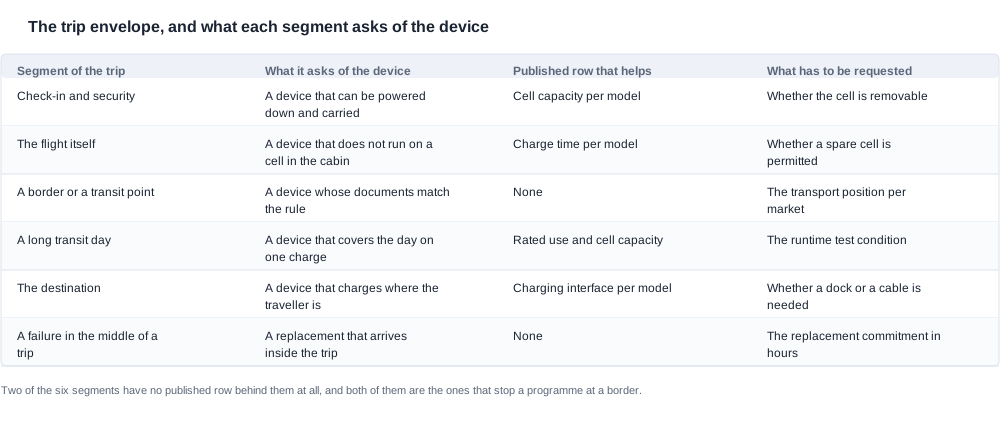
| Segment of the trip | What it asks of the device | Published row that helps | What has to be requested |
|---|---|---|---|
| Check-in and security | A device that can be powered down and carried | Cell capacity per model | Whether the cell is removable |
| The flight itself | A device that does not run on a cell in the cabin | Charge time per model | Whether a spare cell is permitted |
| A border or a transit point | A device whose documents match the rule | None | The transport position per market |
| A long transit day | A device that covers the day on one charge | Rated use and cell capacity | The runtime test condition |
| The destination | A device that charges where the traveller is | Charging interface per model | Whether a dock or a cable is needed |
| A failure in the middle of a trip | A replacement that arrives inside the trip | None | The replacement commitment in hours |
The charging interface decides the kit that travels, and the kit is what gets lost. A Type-C model recharges from a cable a traveller may already own, which is one fewer object in a bag that has to survive a trip. A magnetic model needs a dock or a case, and the case then becomes a second lithium cell that has to be declared for transport, carried and charged, and recovered at the other end. The D11 and the V03 Pro, the D12 and the D17, and the L2 Utral and the ZH12 publish Type-C. The MT5 and the S7, and the V06 and the KY06, and the V03 publish a magnetic interface. The CY05 and the CY03, and the L1 Pro and the MT6 publish no charging interface at all, and for a travel line that is a question with a deadline attached, because the dock, the cable and the artwork all follow from the answer.
The case row is a trip-logistics question, not an accessory question. Seven camera models ship with a case, and five of them publish a capacity: 1400 mAh on the CY03 and the CY05, and the L1 Pro, 900 mAh or 1400 mAh as a configuration choice on the L2 Utral, and 1200 mAh in the MT6's foldable case. The KY06 and the MT5 are described with a case whose capacity is not published. The catalogue publishes no charging-case row at all for the V03, the V06 or the S7, and it publishes the V03 Pro explicitly as a model without one. For a traveller, a case is either a second charge in the bag or a second object to lose, and the decision has to be taken per segment rather than per product.
The two gaps that are not in the catalogue at all. The standby draw is unpublished for every model, and a travel device spends a large part of its life powered and idle in a bag at an airport, so the number that decides whether a single charge covers a travel day is not published. And the published runtime rows carry no test condition, so a rating cannot be converted into an hours-of-availability figure for a specific itinerary without the condition. The published rows and what they leave out are at battery life, and the charging decisions built on them are at charging solutions.
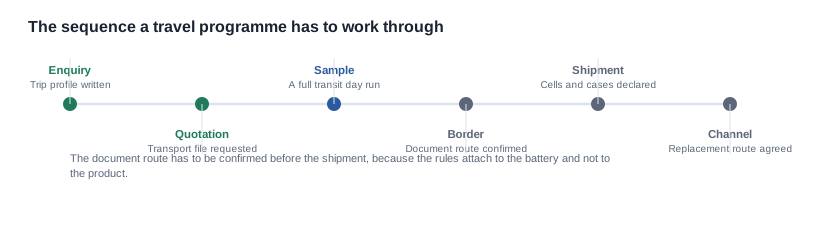

The transport file is the gating document, not the certification file
The mistake in this category is to treat the compliance file as a formality and the transport file as a formality of the same kind. They are not the same kind, and the difference is worth stating in a sentence a buyer can repeat to a supplier: transport rules attach to the cell, not to the product. A device can be a perfectly ordinary electronic product for every market it is sold in and still be a documentation problem in the hands of a traveller, and the documentation that matters is the battery transport file for the exact configuration being shipped, including the case.
Three questions settle the position, and all three have to be answered in writing before the programme ships. The first is what the destination and the carrier require for a battery-equipped device, per market, because the requirements are not identical across the routes a traveller uses. The second is whether the file covers the configuration being shipped — the case in particular, because a case changes the file and the artwork and the freight weight together. The third is what the model designation on the unit is and where it is checked, because a designation that does not match the paperwork is the cheapest defect to prevent and the most expensive one to discover in a customs hold. The requirements themselves are at battery transport, and the certificate-checking procedure is at certification checklist.
The transit durability requirement is the fourth question, and it is the one most often left implicit. A device spends a trip in a bag: dropped, compressed under a seat, pushed through a tray, carried on a cold platform and then left in a hot vehicle. The catalogue publishes no impact rating, no hinge specification, no frame material and no lens material for any model, so there is no published basis on which to write a durability requirement — which means a buyer who wants one has to specify it, and a supplier who wants to meet one has to be asked what the construction is. The requirement should be written against the actual route rather than in the abstract: what the device is exposed to, how many times it is likely to be handled, and what a failure would cost at that point in the itinerary. That last part is what turns durability from an engineering preference into a commercial line, because a device that breaks in a bag on day three is a different cost from one that breaks on day one.
What the catalogue does and does not say about certification. The catalogue contains no per-model certification row and no CE, FCC or RoHS text at all; the export certification page it carries is a company-level page, and the text layer of the whole document names no standard of that kind. The scope of certification for a specific model is therefore a document request, not a published attribute, and a buyer who needs it for a market asks for it per model in the quotation. This is different from a claim the supplier could have made and chose not to, and it is worth saying so explicitly, because the difference decides whether a buyer is waiting for a document or waiting for a decision.

Time is the product: the commercial terms of a travel channel
The shortlist a travel buyer builds before the order. The criteria that decide it are the longest segment of the itinerary against the published rated use, the number of markets against the transport documentation available, the charging interface against the kit the traveller already owns, and the replacement commitment against the length of the trip. The red flags in a travel specification are a runtime with no condition, a cell quoted without saying whether it is removable, a case included without a capacity, and a replacement route expressed in weeks. When to move a model up the shortlist is when the trip profile can be covered by one charge and the transport position is confirmed in writing for every market on the route; when to move it down is when the trip crosses a market whose rules the supplier cannot answer for, because that gap does not close during the season. The total cost of a travel line is the unit price plus the accessory set plus the replacement provision, and the third term is the one usually missing from the first quotation.
The commercial feature of a travel channel is not the unit price, and it is not the specification either. It is that a traveller who loses a charger, breaks a temple or arrives with a dead device two hours before a flight cannot be helped by inventory sitting in a warehouse in another market. A supplier who can commit to a replacement route measured in hours, and who sells the accessory set separately so a traveller can buy a cable without buying a new device, has solved a problem the buyer cannot solve with a bigger order. That is worth paying for, and the right way to buy it is to ask what the replacement commitment is in hours, what it costs, and what happens at a weekend.
The other three terms worth arguing for. The accessory set sold separately, with its own minimum order quantities and its own price list, because a travel channel will be asked for a cable and a case as standalone purchases and the alternative is that the customer buys a second device. The battery transport file, and specifically who pays for the work of getting it to cover the exact shipped configuration, because a file that does not cover the case is a file that has to be reworked. And the price tier at which the pilot units are taken, because a travel line is usually launched into a channel whose demand is unproven and the tier that moves is the one that shifts risk back to the factory rather than to the buyer.
The terms that are settled before the negotiation starts. The cell configuration, the charging interface, the charge time, the rated use, the case architecture and the resolution tier are all determined by the product, and the certification cost and its lead time follow the process and the testing body. The tooling cost is usually amortised across the first order and quoted as a separate line rather than folded into the unit price, and it is worth asking which of the two a buyer is being shown, because the two are frequently bundled into one line that hides which is which. The clause language for the replacement commitment and the document schedule is at contract terms, and the commercial structure of a first order is at pricing.
The demand argument should end in a configuration. Every claim about what the customer wants should terminate in a configuration attribute, a quantity and a price, because that is the only form a factory can deliver and the only form that can be compared between two quotations. A demand signal that does not terminate in a configuration is a marketing claim waiting to become a returns problem, and the specific failure is a listing that describes a capability no orderable build supports.
The four questions that belong in the first round. What do the destination and the carrier require for a battery-equipped device, per market? What is the charge endurance across a long transit day, with the condition stated? How quickly can a replacement reach a traveller, in hours rather than in weeks? And can the spare accessories be bought separately? A buyer who asks all four in the first round is establishing which quotation is complete, and a comparison only works between quotations that answer the same questions.
What we publish for travel, and what we will not estimate
The working rule we apply: we publish the rows a buyer can order from, and we mark the rows that are open rather than filling them with a typical figure from somebody else's general data. For a travel line that means the charge times, the charging interfaces, the case capacities, the cell capacities, the published connectivity versions and the rated runtimes where the catalogue publishes them, across the audio models, the sport models and the eleven camera models.
What we do not publish, and will not estimate: the frame weight of any model except the single 158 g whole-unit figure for the MT6, the sensor part, the field of view, the video resolution and frame rate, the stabilisation behaviour, the storage behaviour, the thermal behaviour, the standby draw, the operating temperature range, the runtime test condition, the charging method for the four camera models whose rows do not carry one, and the bluetooth version for the camera series. A buyer choosing on image quality in this category is choosing on a resolution number and finding out the rest in the edit, and a buyer planning a trip on a runtime figure is planning on a rating with no condition behind it. Both of those are open rows, and an open row is a question to a supplier rather than a number to print.
What we will do is take a use case, a configuration and a market, and tell you which parts are settled, which are open, and which have to come from a sub-supplier. We will also tell you which segment of the trip each open row belongs to, because the segments are not equally urgent: the transport position is a gate, the runtime condition is a planning input, and the accessory set is a commercial decision. The product range is at AI camera glasses, the scenario entry point is smart glasses for travel, and the long-term behaviour of a product in this category is covered at long-term use for content creators and at product recommendations for running.
What to send us next. Send the trip profiles you are actually seeing, the markets involved, the models you are comparing, the accessory set you have in mind and the target volume, and we will return the configuration each trip profile implies, the published rows that cover it, the documents that have to be attached to the order before the shipment, and the terms worth negotiating hardest.
Related reading
- How the scenario opens — smart glasses for travel
- The product range and its published rows — AI camera glasses
- The charging decisions the runtime rows support — charging solutions
- The transport file that gates the shipment — battery transport
Send the trip profiles, the markets and the accessory set, and we will return the configuration each trip implies and the documents that gate the shipment.


