

Smart glasses battery life smart glasses how to measure has a large answer, because every published runtime in this category is a rated figure, and a rated figure is a number with its conditions removed. The measurement itself is not difficult. Deciding what to measure is, and that decision is a publishing decision rather than a laboratory one, because the workload you select becomes the workload a customer will hold you to. Six variables have to be fixed before the timer starts, and if you fix them, the result is a number you can defend in a customer dispute, in a listing, and in a supplier negotiation.
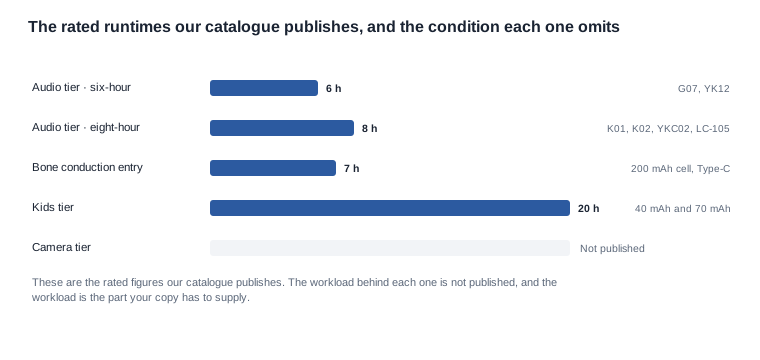
Our catalogue publishes a runtime for every model and a test condition for none of them. The published figures run from about six hours on some audio models to about twenty on the kids range, and they are all the same kind of claim: an outcome with the method removed. That is the gap this article closes, and it is a procurement gap rather than a technical one.
Smart glasses battery life: a rated figure with the conditions removed
The short answer, in three sentences
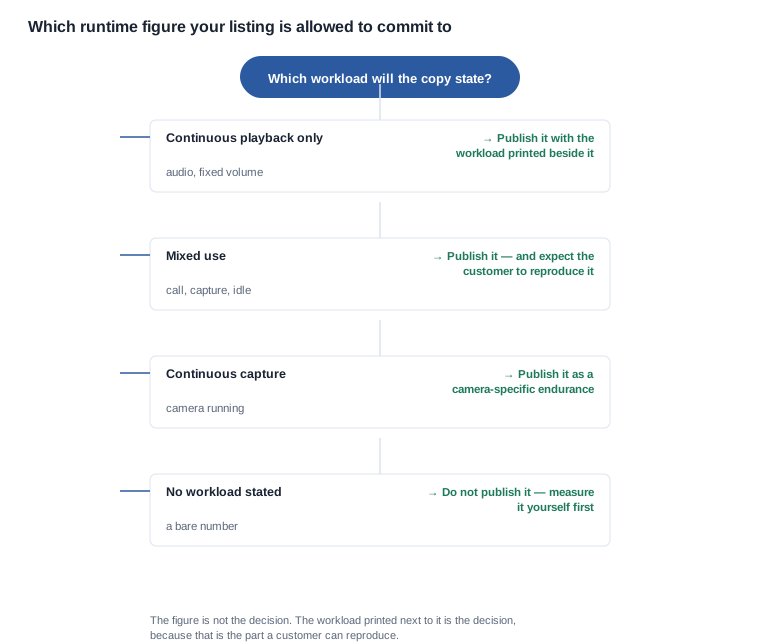
Name the workload above all other variables, because a measurement of one workload is a measurement of that one and nothing more. If your customer will mix calls, audio and photography, then the only figure worth publishing is the mixed-use figure, and a continuous-playback number is a laboratory artefact that your copy should not carry. If your channel is a single-workload channel — a guided tour unit that records all day — then a workload-specific figure is the honest one to publish, and you should say which workload it is.
The buyer checking a rated figure against reality
A buyer running a runtime measurement is usually doing one of three things, and each of them is decided by a different person with a different appetite for risk.
The buyer checking a supplier's rated figure against reality. They hold a sample, a catalogue number and a channel plan. The comparison they are trying to make is between two suppliers whose figures differ, and the reason the comparison fails is that neither figure states its workload. Their fear is not that the product is bad. It is that the product is fine and the number is wrong, which is worse, because then there is no complaint to fix.
The buyer establishing a number for a listing. They hold a price band and a copy deadline. The risk here is legal and commercial rather than technical: a figure published without a condition is a promise, and a promise the customer can reproduce and contradict is a return rate.
The buyer answering a complaint. They hold a customer ticket that says the product does not last as long as the page says, and they hold the page. This buyer needs a measurement that a second person could repeat, because the outcome may have to settle a refund, a batch rejection or a supplier claim.
The three use cases differ in their weighting, and they produce different protocols. The first wants a ratio against the published figure. The second wants a repeatable figure with a stated condition. The third wants a measurement that survives being read by the other side.
Where the runtime number comes from, and why it moves
Runtime is not a property of the cell alone. It is an outcome of the cell, the power-management firmware, the display, the radio, the audio stage, the camera and the workload, working together in a thermal environment. A supplier who changes the charging circuit or the power-management firmware can change the endurance without changing any of the components a buyer would inspect, which is why runtime belongs in the change-control list rather than in the sample inspection sheet.
That is also why two suppliers quoting the same category can differ by a factor of two on a like-for-like comparison, and why the difference is not evidence of a better product. It is evidence of a different measurement, a different workload, or a different claim. The buyer's negotiating room is not in the unit price. It is in the number of workloads the supplier is willing to commit to in writing, in the sample count behind each figure, in the acceptance criteria that make a failing lot refusable, and in the notice obligation that catches a silent power-management change.

The four workloads, and the thresholds that separate a defensible figure from a bare number
Send this table to every supplier in the same form, one request per row, and ask for the answer to every row in writing. The third column is the tell: it shows whether the answer came from a measurement the supplier ran on this model, or from a cell datasheet somebody else handed them.
| What to ask the supplier for | The pass line | What a soft answer sounds like |
|---|---|---|
| Runtime, with the workload | A figure plus the workload it was measured under | "Up to 8 hours" |
| Runtime, with the audio volume and pairing state | The volume level and whether the device was paired | A bare figure |
| Start condition | Fully charged, and the method used to get there | "Fully charged" |
| End condition | Shutdown, or the point at which the device becomes unusable | "Until the battery runs out" |
| Ambient temperature | A stated range, not a nominal | "At room temperature" |
| Sample count and method | The number of units, the number of days, and the instrument | "Tested internally" |
| Rated figure versus measured figure | A derating factor, and the workload behind it | A factor with no method |
| Cell capacity and the model it belongs to | A published mAh figure for the exact model | A family figure |
| Model designation | A published designation for the exact configuration | A series name only |
The workload is the number
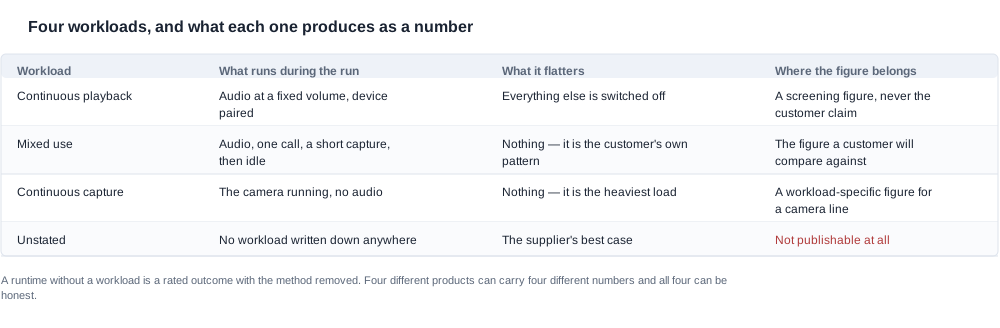
Continuous playback is audio playing at a fixed volume with the device paired. It is the easiest to reproduce and the most flattering, because nothing else is drawing power and the radio is idle between bursts. It is a legitimate figure and it is almost never the figure a customer experiences.
Mixed use is a few minutes of audio, a call, a short capture, and the device idle in between. It is what a customer does, and it is where a rated figure and a lived experience diverge most. If your channel is general consumer, this is the figure that will appear in a complaint.
Continuous capture is the camera running with no audio. It is the heaviest load in the range, it is the one that matters for a content line, and it is the row on which the camera tiers are expected to separate from the audio tiers. A camera product quoted on a playback runtime is quoting the wrong workload for its own use case.
Unstated is the fourth workload and it is the most common. A figure with no workload attached cannot be published, cannot be compared and cannot be used in an acceptance criterion, because there is nothing to test.
The end condition is worth choosing carefully
Shutdown is the obvious end condition and it is the wrong one for a return-rate decision. The useful condition is the point at which the device becomes unusable while it is still drawing power. A frame that shuts down cleanly at the end of its life and a frame that starts dropping frames, refusing to pair and behaving errably at a low state are different products, and the second one generates support contacts rather than returns. Support contacts cost more than returns and they arrive sooner.
Temperature has to be a range, not a nominal
Battery behaviour is temperature dependent in both directions, and a summer test and a winter test are not comparable. A figure quoted at a single nominal temperature is a figure that describes one afternoon in the factory. If your channel spans a wide temperature range, the measurement needs a temperature dimension rather than an assumption, and the published figure needs to carry it.
Repetition is what turns a measurement into a result
Three units over three days, or one unit over three days, tells you whether the number varies at all. If it does, that variation is the finding, and it is very often the finding that explains a customer complaint. A supplier who quotes a single unit on a single day has quoted an anecdote, and the correct response is not to reject it but to ask for a second unit.
The instrument and the observation method belong in the record
If the observation is "the device no longer plays" rather than "the battery reading reached the end of its stated range", say so. An approximate observation with a stated method is better than a precise claim with no method, because the first one can be repeated by a colleague and the second one cannot be repeated by anyone.
A warning about comparing figures across suppliers
None of these numbers is directly comparable until the workload, the start condition, the end condition, the temperature, the sample count and the observation method all match. Two figures that share a workload and differ in sample count are still not comparable, because a single-unit run has no spread. If you are building a comparison table across suppliers, the missing condition is not a footnote — it is the reason the table is wrong.
Turning a catalogue runtime into your own measured figure
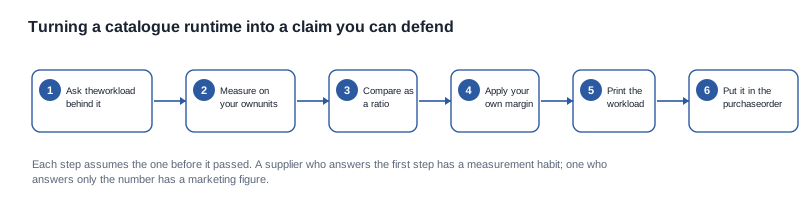
1. Reset the device before the test, every time. Otherwise the run starts from whatever state the last user left it in, which on a demo unit is a state nobody is ever going to describe to you.
2. Start from a fully charged unit and say how it was charged. A device charged in its case and a device charged over a Type-C port can begin the test in slightly different states, and a device that has been sitting on a charger for a week may not be at the same point as one charged an hour ago.
3. Do not measure on the day the sample arrives. A device that has been in transit and stored is not in the same state as one that has been used daily for a week, and the second state is the one a customer will compare against. If you only have one sample and it arrives today, measure it twice: once on arrival, and again after a week of normal use.
4. Record the ambient temperature at the start and at the end. A run that crosses a temperature boundary is a run with two conditions inside it, and you should discard it rather than average it.
5. Compare the measured figure with the rated figure as a ratio, not as two numbers. A measured figure close to the rated one means the rating is fair and the copy can use it, with the workload printed next to it. A measured figure materially below it means the rating was measured under a workload your customer will not reproduce, and the honest fix is to publish the workload rather than to publish the number without it.
6. Apply your own margin, and do not expect anyone to publish one for you. A margin is a commercial decision about your own return rate and your own support cost. A supplier who offers a derating factor without a method is offering a number they have not measured, and asking for the method behind it is the correct response.
7. Keep the case measurement separate. If you want a case figure, measure the case as its own product and publish it as its own product. A case that recharges a frame is a second object with its own capacity, its own charge time and its own routine.
8. Write the protocol into the purchase order. A criterion that lives in an email is not binding. A criterion in the purchase order is an acceptance standard, and a lot that fails it is a lot you can refuse.
Five ways a runtime programme breaks after the purchase order
A seven-hour rated figure is compared with a mixed-use expectation and the product is called defective. The symptom is a cluster of returns whose description says the product stops too early. The root cause is that the workload was not stated on either side, so the comparison is between two claims rather than two measurements. The prevention is to put the workload next to every figure you quote, internally and externally, and to publish the workload in the copy.
A measurement is made on the case and reported as the product's endurance. The symptom is a figure on a listing that is roughly twice what the customer experiences. The root cause is that the frame and the case were treated as one object. The prevention is to measure and report them as two products with two figures and two routines.
The behaviour at the end of the charge is discovered by customers. The symptom is support contacts that describe the product becoming erratic rather than stopping. The root cause is that the end condition was shutdown only, so the degraded phase was never observed. The prevention is to record the point at which the device becomes unusable as a separate observation, and to treat erratic behaviour as a finding rather than as noise.
A supplier quotes a derating factor and it turns out to be a guess. The symptom is a warranty position that cannot be defended when a distributor asks how the figure was derived. The root cause is that a factor with no workload, no temperature and no sample count behind it was accepted. The prevention is to ask for the method, and to measure your own if there is none.
The measured figure varies run to run and nobody knows which one to publish. The symptom is a copy review that keeps changing its mind. The root cause is one unit on one day. The prevention is to repeat the protocol, and if the variation is material, publish the range rather than the best reading or the average.
The power-management firmware changes and the endurance moves. The symptom is a return rate that drifts upward on a product that has not changed in any way a customer would describe. The root cause is that the cell, the charging circuit and the power-management firmware were treated as components nobody watches. The prevention is a notice obligation before any of the three changes.

What the runtime claim is worth commercially, and what to write into the order
Negotiable, and this is where the effort belongs. The number of workloads the supplier will commit to in writing is a negotiated number, and it is worth more than a unit price concession because it determines what your copy may say. The sample count behind each published figure is a negotiated number. The acceptance criteria that make a failing lot refusable are a negotiated number. The margin between the rated figure and the measured figure is yours to set, but the supplier's willingness to be measured against it is negotiable. Delivery terms are a separate negotiation from the price: ask for a first shipment that releases against an approved runtime measurement rather than against a date, because a runtime figure nobody has measured is the only failure in this category that arrives after the invoice.
Not negotiable, and worth saying so early. Certification cost and certification time are a fixed cost per product family and a queue at the test laboratory; the elapsed time is set by the laboratory, not by your order size. A one-off charge for tooling is usually amortised across the first order, and the questions worth asking are over what volume it is amortised and what happens to the tooling if the programme is discontinued. Also not negotiable is the cell itself: a supplier who will not change the cell, the charging circuit or the power-management firmware is telling you the endurance is fixed, and the programme should be built around that fact rather than against it.
Documents to request before the deposit. The rated runtime with the workload and the volume it was measured under. The cell capacity for the exact model designation. The charging time and the charging method. The certificate numbers with the issuing body and the validity dates. The model designation written on the quotation itself, character by character.
Clauses to write into the contract. The cell capacity and the rated runtime as line items, with the workload attached to each. The acceptance criteria for the sample, referencing the workload and the end condition. A clause requiring notice before any change of cell, charging circuit or power-management firmware. A clause requiring that the published figure and the workload appear together in the documentation pack. And a clause on who bears the cost when a lot fails the acceptance criteria.
A worked scenario: a channel buyer with three supplier quotations
Six decisions stand between a runtime figure and a product page, and every one of them is made before the first sample is signed off rather than after the first complaint.
Assume a mid-size channel buyer building an audio line for a general consumer market, comparing three suppliers whose published runtimes read six, seven and eight hours. The binding constraint is not price. It is that the buyer has been asked to publish a runtime figure on the listing, and the previous supplier's figure turned out to be a continuous-playback number that a customer complained about within a week.
The first step is the workload, not the number. The buyer writes down what the product does in the customer's hands: audio for most of the day, a call most days, the camera used occasionally. That is a mixed-use workload, and the buyer writes "mixed use" on the comparison sheet before looking at any supplier's number again.
The second step is the request. All three suppliers receive the same request: the runtime with the workload, the volume, the start condition, the end condition, the temperature range, the sample count and the instrument. Two of them answer with a number and a workload. The third answers with a number, a workload and a sample count, which is the answer that tells the buyer this supplier has a measurement habit.
The third step is the measurement. The buyer measures two units of each candidate against the mixed-use protocol, over several days, at a recorded temperature. The measured figures do not reproduce the published spread exactly, and one candidate measures materially below its rated figure. That candidate is not rejected on the measurement; it is rejected on the fact that it cannot produce the number, which means the published figure was produced under a workload the channel will not reproduce.
The fourth step is the commercial structure. The buyer negotiates the per-model minimum against a committed configuration count rather than a unit count, moves artwork approval earlier than usual so the workload can be printed beside the figure, and holds a retention against the documentation package so the workload statement arrives with the goods.
The fifth step is the copy. The listing carries the measured mixed-use figure with the workload printed beside it, and the six-hour audio figure is not printed at all, because the channel has no customer who plays audio for six hours and nothing else. The programme has one number instead of three, and that number is the one a customer can reproduce.
The decisive decisions were all made before the sample order, and none of them was about the hours.
What our published runtime rows stop at, and what we will do with your measurement
The rated runtimes are published exactly as the catalogue states them, and the catalogue states no test condition for any of them. We will not invent a condition, and we will not apply a derating factor to a figure we have not measured under your workload, because a derating factor is a commercial decision about your own return rate rather than a technical constant, and a supplier who offers one without a method is offering a number they have not measured.
We will also not publish a figure that was measured on a sample in transit and stored, because that state is not the state a customer will compare against. And we will not publish a workload-specific figure for a model on which we have not run that workload ourselves.
What we can do is check your measurement against the published rows for that model and tell you whether the result is consistent with the rated figure, what that implies for the copy, and which of the six variables the published figure already fixes for you. The measurement discipline is under smart glasses battery life and power, the cost side is in battery life cost factors, the scenario mapping is in battery life for different use cases, and the comparison method is in how to compare battery life.
Three actions to take before the samples ship
Write down the workload before you write the requirement. One line: what the product does, for how long, and what else is running. If that line is "audio all day with a call at lunch", you have a mixed-use case and the workload is written. If it is "the camera records continuously", you have a capture case and the figure belongs to a capture claim.
Send the document request as a list, not as a question. Nine rows, in the table above, in one email, before the samples ship. A supplier who answers all nine has a measurement habit; one who answers two is telling you something you need to know before the deposit.
Send us your measurement and the six decisions behind it, and we will tell you how it compares with the published figure. Give us the model, the workload, the volume, the start and end conditions, the temperature and the sample count, and we will check it against the rows for that model and tell you whether the copy can carry the number you have.
Related reading
- Turning a measurement into a document — battery life case study template
- The way the comparison is run — how to compare battery life
Send us your measurement and the six decisions behind it, and we will tell you how it compares with the published figure.


