

Two quotations for the same smart glasses model can differ by a third and describe the same product, and the reason is almost never the cell. The cell is one element of a subsystem that also contains the protection circuit, the charge controller, the fuel gauge, the charging interface, the case where the product ships with one, the calibration step on the line, and a share of the compliance and tooling cost that gets spread across the first order. A buyer who treats the battery as a single line in a bill of materials cannot explain a price gap, cannot negotiate a price gap, and cannot tell whether the cheaper quotation is cheaper or simply thinner. This article takes the battery subsystem apart and shows where the money sits inside it, which costs move when the volume moves, and which costs are fixed the moment the platform is chosen. It covers the structure of the cost. The decision about what to spend it on belongs to a separate piece of guidance on this range.
Smart glasses battery life: one fifth of the bill of materials
The first mistake in reading a smart glasses quotation is to treat the battery as one line called "battery" with a capacity and a price. That line does not exist in a real bill of materials. What exists is a set of items with different suppliers, different lead times, different qualification requirements and completely different behaviour under a change of volume, and they are bundled together in a quotation because the factory prefers to present a single number.
The catalogue makes the split obvious, because the range contains models that differ from each other in exactly this area. The eleven camera models carry cells between 220 mAh and 290 mAh, and some of them ship with a charging case that is a second product with its own cell, its own tooling and its own compliance file. The audio models carry much smaller cells, some of them two of them, and none of them carries a case. The children's rows publish a runtime of around twenty hours on 40 to 70 mAh cells, which is a different engineering proposition again. These are not variations on a theme. They are different battery subsystems, and they cost differently for reasons that have nothing to do with the cell alone.
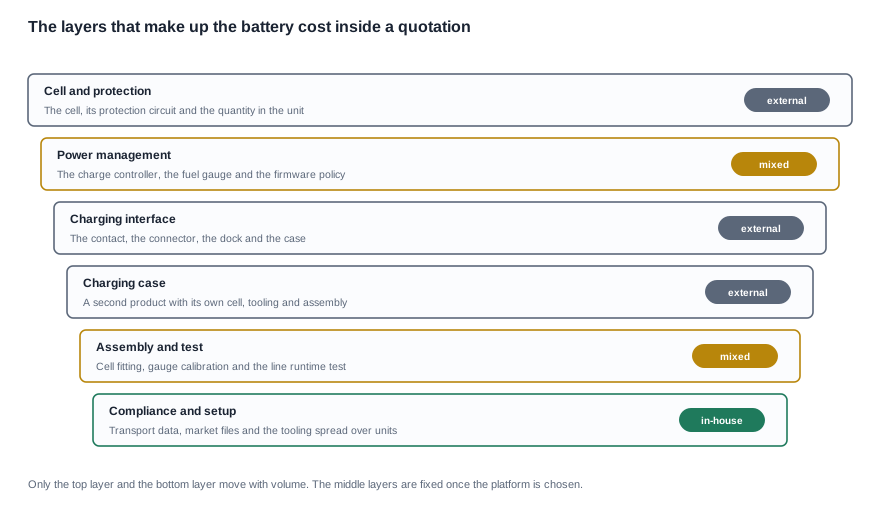
The stack above is the structure of the subsystem as it appears in a real costed bill of materials. Only the top layer and the bottom layer respond to volume. Everything between them is fixed once the platform has been chosen, which is the single most useful thing to understand about battery cost: you cannot reduce it by ordering more, you can only reduce it by changing the design, and the design change is expensive in tooling.

The cell: where capacity turns into money
The cell is the element buyers instinctively watch, and it is the element where the intuition is least reliable. Two cells with the same nominal capacity can differ in price by a wide margin, and the reason is rarely the capacity figure.
Why two cells with the same rating cost different amounts
A cell is priced on its chemistry, its rated capacity, its discharge profile at the temperature the product will actually run in, its physical format, its cycle life rating and, decisively, on whether the factory has qualified it. The last of these is the one that moves the price most and the one that is least visible in a quotation. A cell from a supplier the factory has already audited, with a qualification file the factory can show a certification body, is a known quantity. A cell from a supplier who is new to the factory is an unknown one, and the factory prices the unknown accordingly until the qualification work is done and the volumes have proved the part.
The practical consequence is that a quoted price difference between two factories on the same model may not be a price difference at all. It may be that one of them has completed the qualification work on that cell and the other has not, and that the second factory's price contains an allowance for a risk that the first factory has already retired. The question that settles it is not a price question: it is a question about which cell part number is in the bill of materials, who supplies it, and whether the factory holds a qualification record for it. Those three answers are usually available inside a day.
The second source, and what it is worth
Almost every mature factory in this category holds a second source for the cell, and that fact has commercial value which is difficult to price but easy to observe. A second source protects the programme against a supply interruption, and it protects the buyer against a single factory quietly changing the part without re-running the tests. It also gives the buyer something to negotiate with, because a factory with two qualified sources on the cell has a weaker position on the cell price than one that does not.
Whether the second source is genuine is a question to ask before you order rather than after the first shipment. The signs are specific: the part number is written into the purchase order rather than left as a factory choice, a substitution is treated as a change that reopens the paperwork, and the factory can tell you what would have to be re-tested if the second source were used. A factory that answers that last question by saying nothing needs re-testing will tell you that the qualification is thinner than its quotation implies.
The published cell capacities across our range give a buyer the scale of this decision. The range runs from 40 mAh on the smallest children's rows to 290 mAh on the camera models, with the audio models clustered between 55 mAh and 115 mAh. That spread is not a continuous choice. It reflects the platform decisions that were made for each family, and moving within it is a design change rather than a procurement change.
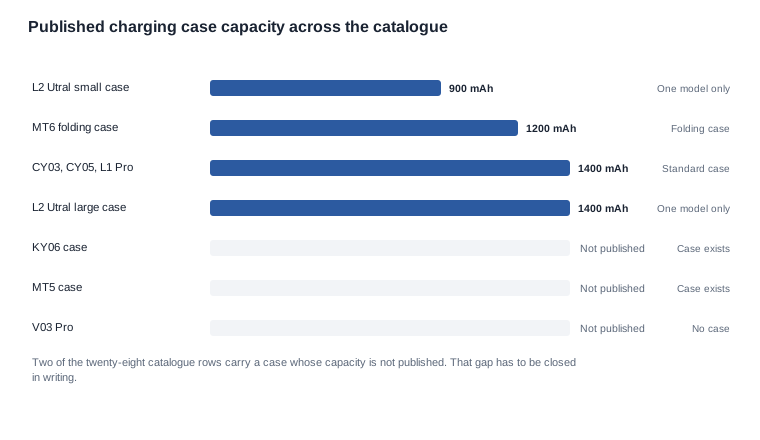
The chart shows where the case capacity is published and, just as importantly, where it is not. Two of the catalogue rows carry a charging case whose capacity is not published, and four camera models publish no charging-case row at all — the V03 Pro and the V06, and the V03 and the S7. A case whose capacity is not published is a case whose cost cannot be compared, because the buyer cannot tell whether a quotation is pricing a 900 mAh case or a 1400 mAh one.
Power management and the firmware that decides the ceiling
The second element of the subsystem is the one that produces the runtime figure in the first place, and it is the element most often treated as free. The protection circuit, the charge controller and the fuel gauge are small components in value terms, but they determine how much of the cell's charge the product can actually use, and they determine whether the product reports its charge honestly.
The fuel gauge is the part with the commercial consequence. The published runtime for a model is a rating, and a rating depends on the end point at which the unit stops doing its job. If the gauge is configured to hold back a reserve, the usable capacity is lower than the cell capacity, and the difference shows up as a runtime that is shorter than the cell arithmetic predicts. If the gauge is configured to allow a deep discharge, the usable capacity is higher, the cell ages faster, and the cycle life figure falls. Neither of those configurations is wrong; they are different answers to a question that has to be asked and written down: what is the reserve, and where does the end point sit.
The firmware policy belongs in the same conversation, because it is what turns a cell and a gauge into a runtime figure. A policy that keeps the radio connected continuously, or that runs the camera at a higher frame rate than the specification requires, or that keeps a sensor active in a state where it is not needed, all of them reduce the achievable runtime without changing a single component. This is why two units with identical bills of materials can have different runtimes, and why a buyer comparing quotations has to ask what the runtime policy is rather than assuming it matches the specification.
None of this is published for any model in the range. The gauge accuracy, the reserve, the end point and the runtime policy are all in the same category as cycle life: they exist, they are set by somebody, and they are not on the product page. The charge time is the one row in this group that is published — ≤ 2h on most models and ~1h on the two Type-C sports models — and it is published without the starting state or the end point, which is what leaves it in the category of a figure you cannot compare against a break in a shift. They are also exactly the items that a supplier's engineering team can answer in a single meeting, so the cost of obtaining them is an hour rather than a negotiation.

The charging case: a second product with a second bill of materials
Where a model ships with a charging case, the case is the most expensive and the most under-estimated element of the battery subsystem, and the reason is administrative as much as technical. It is a second product with its own cell, its own enclosure tooling, its own assembly line slot, its own quality control checks, its own packaging artwork, its own transport documentation and its own place in the box.
What the case adds to the quotation
The direct cost of a case is the cell, the enclosure, the electronics and the assembly. The indirect cost is larger and is the part that catches buyers out. The case needs its own tooling, and tooling is a one-off charge that is normally amortised across the first order rather than recovered at the first unit price. The case needs its own minimum order quantity, and where the case is bought as an accessory rather than shipped in the box, the quantity can be a fraction of the unit quantity, which pushes the tooling amortisation per case up sharply. The case needs its own quality control, and a case that fails its top-up count is a defect that returns as an accessory rather than as a unit. The case needs its own compliance file, because a second lithium cell travelling in the carton changes the transport declaration, and the testing for that is a per-configuration cost that does not amortise the way unit volume does.
The MT6 makes the last point concrete, and it is the only model in the range with a published weight figure: 158 g for the glasses body including the 265 mAh cell and the camera, with the folding case at 1200 mAh and the weight of the case itself not published. The published weight covers the unit and excludes the case, which is exactly the relationship a buyer should be watching, because the case is the element that makes the box heavy.
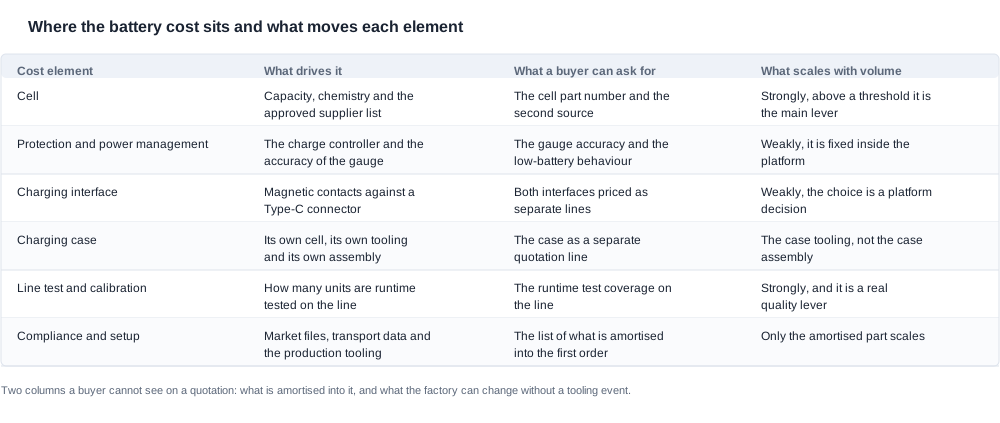
The table sets out each cost element, what drives it, what a buyer can ask the supplier for, and — the column that is usually missing from a quotation review — what scales with volume. That last column is the one that decides whether a quotation is comparable. Two factories quoting the same model at different unit prices may be quoting different things entirely: one may be amortising the case tooling across a large first order and the other across a small one, and the difference will appear as a unit price gap that has nothing to do with the battery.

The battery costs that scale with units and the costs that do not
A buyer reading a quotation line by line is searching for one thing above all else: which of these costs moves when the quantity changes. The answer separates the negotiation into two parts, one of which is productive and one of which is not.
The productive part is the cell, the interface components and the assembly labour. These scale with volume, they respond to a quantity break, and they are where a price tier or a bulk order quote actually helps. A quotation with a price tier for ten thousand units and a tier for fifty thousand is telling you that the factory expects the cell and the assembly to move, and it is offering you the break accordingly.
The unproductive part is the tooling, the compliance work and the firmware and gauge configuration. These do not scale with volume in the way a buyer hopes, because the one-off elements are one-off and the engineering elements are already paid for by the platform. A factory that reduces its unit price by ten per cent at fifty thousand units has usually moved the cell and the assembly and nothing else, and the tool remains on the books for the life of the programme.
There is a fourth element of the structure that a buyer should price before the first order, and it is the one that never appears in a quotation at all: the cost of the returns that a weak battery subsystem creates. A unit that runs short in the field comes back, and the cost of that return is the unit, the freight, the inspection time, the replacement unit and the disruption to the operator. In a programme with a high field cost per unit, that number can exceed the entire value of the battery saving a buyer negotiated. It is worth asking the factory for their own defect rate on the cell configuration you are quoting, and for the rate on the configuration they sold most of, because the difference between those two figures is the price of the battery decision.
There is a fifth element, and it is the one with the largest hidden cost. The cost of a change. If the battery subsystem is changed after the platform is frozen — a different cell, a different interface, a different case, a different gauge configuration — that change carries its own engineering cost, its own test programme and its own compliance work, and in some cases it carries a new tooling charge. A buyer who negotiates a lower unit price and thereby accepts a thinner battery subsystem is often buying a future change request rather than a saving. The question to ask the supplier is what a change to the cell would cost and how long it would take, and a factory with a mature platform will answer it quickly, because the answer is a standard procedure on their side.

The build-up above is the order in which the elements arrive in the final number. The first two are the ones that get amortised, the next three are the recurring ones, and the last is the commercial layer that turns the arithmetic into a price. It is worth asking for this build-up in writing rather than for the unit price alone, because it is the only way to establish which of two quotations is thinner.
Turning a battery cost structure into a quotation you can compare
The practical procedure is short. Before comparing two quotations on the same model, ask each supplier for five things, and compare them in this order.
- The cell part number and the identity of its manufacturer, together with whether a second source is qualified.
- The gauge configuration, the reserve and the end point of the runtime measurement.
- The charging interface, and whether the interface is inside the quoted configuration or an option on it.
- The case, as a separate quotation line, with its own capacity, tooling, minimum order quantity and lead time.
- The list of what is amortised into the unit price, and over what quantity.
Each of those five is a question a factory can answer, and each of them removes one of the ways in which two quotations for the same product can differ without either of them being wrong. A quotation that answers all five can be compared to another that answers all five. A quotation that answers none of them cannot be compared to anything except the sample you were sent.
The final step is the one that keeps the comparison honest over the life of the programme. Record the build-up against the lot and the production window, and repeat it at the next order. Two quotations for the same model at two points in time will differ, and without the build-up you cannot tell whether the factory has improved, whether the cell market has moved, or whether something in the configuration has quietly changed.
A supplier who cannot answer the five questions is not disqualified by that alone, and it is worth separating the two situations. A factory building a new platform may genuinely not have a qualified second source and may not have a written runtime policy, because neither has been needed yet. That is a legitimate answer and it is also a signal that the first order carries more risk than a mature platform does. A factory with an established production line that cannot produce the cell part number, the gauge configuration and the amortisation list is telling you something else, and the useful response to both cases is the same: build the answers into the purchase order as items the supplier has to confirm, so that the second order has a baseline to be measured against.
The total cost of the battery decision is therefore not the difference between two unit prices. It is the difference between two unit prices plus the difference in what each configuration returns, plus the difference in what it costs you to change it later. That is the calculation worth doing before you order, and it needs the build-up to be worth doing at all.
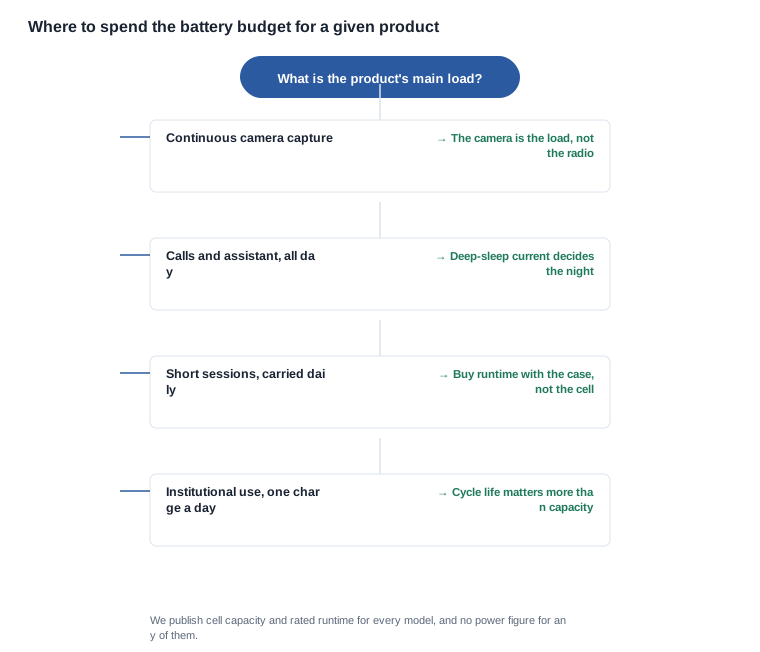
On battery cost, a narrow one and we will state it plainly. We publish the cell capacity and the rated runtime for every model, the charging interface for the twenty-four models that carry one, and the charging case capacity where the catalogue states one. We do not publish component costs, cell part numbers, gauge configurations, tooling charges or unit prices, because those change with the order and because quoting a typical figure for a cost element is a figure nobody can verify. What we will do is read a quotation against the structure above and tell you which of the five lines is thin in it, and what you would need to ask for to close the gap.
Send us the model, the quantity, the target market and the two quotations, and we will work through the build-up with you. The measurement side of every published figure is set out under smart glasses battery life and power, the interface decisions sit under charging solutions, the measurement method is in how to test smart glasses battery life, and the documentation side of a programme is in battery life case study template. The decision about how to spend the budget is a separate question, covered in battery life cost against performance, and the vocabulary used across all of it is set out in charging glossary.


