

Smart glasses for field work: the scenario where a kit is a rate
The short answer. A field kit is the only kit in this catalogue that is used up rather than carried. The device goes back to the base at the end of a shift; the wipes do not; the contact wipe does not; the spare unit stays at the base; the charging point stays in the vehicle. That asymmetry is the whole of the procurement decision, and a buyer who specifies a field kit as a bundle of items in a box has specified the wrong unit of account. The kit has to be written as a rate: how many consumables a crew uses in a shift, how many spares the base holds against a failure, how many charging points a vehicle carries, and how often all three come back for replenishment. Four of those five counts are not in the catalogue and never will be — they come from the buyer's own operation — so the specification has to measure them during a pilot rather than assume them. A kit specified on the published configuration rows and on an observed consumption rate is a kit that can be re-ordered for the second year; a kit specified on a guess is a kit that runs out mid-shift, in a vehicle, with a crew waiting.
Who is specifying the kit, and what they are defending. The reader is a brand buyer, a channel buyer or a solution architect specifying a device for a crew that works on sites, in vehicles or outdoors. The decision in front of them is not a product evaluation; it is an operational one, with a commercial tail. What is being defended is the uptime of a crew. A device that is flat at the start of a shift is not a customer service issue, it is a crew standing idle or a job that is re-visited, and in a maintenance or inspection contract that cost is charged back to the buyer. Behind that sits the second thing being defended: the rate. A consumable that runs out on a Thursday costs a trip to a supplier; the same consumable that is reordered on a measured weekly rate costs a purchase order.
Why two field kits for the same device can cost very different amounts. The published electrical rows across this range are close together, so the divergence between two quotations is rarely the battery. It is the charging architecture, because the interface decides whether a vehicle carries a dock, which is an installed asset that has to be placed and kept in service, or a cable, which is a consumable that can be replaced at a base. Our catalogue splits the charging method three ways across the twenty-eight models: seventeen are magnetic, seven publish a Type C interface, and four publish neither a charging method nor a charging port row — the CY05 and the L1 Pro, and the CY03 and the MT6, each of which does publish a charging-case capacity. For a fleet buyer, that difference is an installation and a maintenance line rather than a per-unit line, and it is why the D17 and the ZH12, published with a Type C interface and roughly one hour of charging, behave very differently in a vehicle from the magnetic models. The interface decisions are at charging solutions, and the per-device charging plan is at charging for field work.
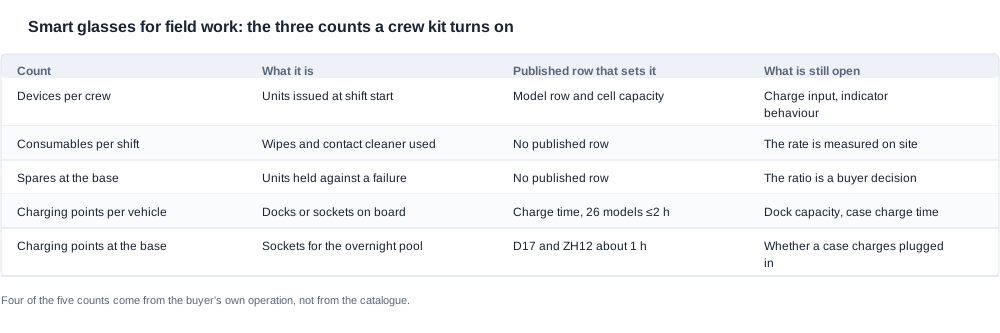
The counts a field kit actually turns on
Five numbers decide whether a field kit works, and only one of them is in the catalogue. Writing them down before the quotation is what separates a kit that can be re-ordered from one that has to be renegotiated every quarter.
The first count is the devices per crew, and the published row behind it is the cell and the runtime. The sport camera models that suit the exposure profile best, the V06 and the S7, publish 260 mAh cells and runtimes of five to eight hours. The camera models built for a case, the CY05 and the CY03, and the L1 Pro, publish 290 mAh and about seven hours, and they are the only models in the camera family that ship with a 1400 mAh case as a fixed part of the configuration. The MT6 publishes 265 mAh, about seven hours and a 1200 mAh folding case. The KY06 publishes 260 mAh and six to eight hours with a case whose capacity is not published, and the MT5 publishes 220 mAh and the same six to eight hours with a case whose capacity is also not published. A shift longer than the published runtime needs a second charging point, and that is a vehicle decision, not a device decision.
The second count is consumables per shift, and nothing in the catalogue informs it. The consumables in this category are a wipe for the lens and a contact wipe for the charging contacts, and both are consumed on site. Neither has a published rate, a published service life or a published quantity per shift, because the rate depends on the environment and on the discipline of the crew, and both are the buyer's own numbers to measure. The lens material, the coating, the frame material and the surface treatment are not published for any model in the range, which is the second reason the rate has to be measured rather than derived: a consumable chosen against an unpublished surface specification is a consumable chosen on a guess.
The third count is the spares held at the base, and the ratio is a decision rather than a figure. No replacement rate, no failure rate and no defect rate is published for any model, and the catalogue carries no drop, ageing or ingress test report at all, so the base pool size is a bet on the buyer's own history. A pool of spares with no failure data behind it is expensive; a pool of none is a crew standing idle. The honest way to set it is to run the pilot at a defined pool size and adjust from the observed failures, and to write the adjustment rule into the contract rather than leaving it to a conversation.
The fourth and fifth counts are the charging points, in the vehicle and at the base. Twenty-six of the twenty-eight models publish a charge time of two hours or less, and the D17 and the ZH12 publish roughly one hour, which is short enough to complete inside a handover window. But a charge time is not a charging point: how many units a vehicle can top up at once, how long the contact takes to seat, and whether a case charges the device while it is plugged in are all unpublished, and the first two decide how many docks the vehicle carries. A vehicle that carries one dock for a four-person crew has made a queue.
What the exposure profile does to the model choice, and what it does not. Only two models in the entire catalogue carry an ingress marking, the V06 and the S7, and both are sport camera models. The marking covers splashing water and a dust protection level; it does not cover immersion or a sustained downpour, and no third-party test report is published behind it. A kit insert that says "waterproof" makes a claim the documentation cannot carry, and a crew in a downpour is the customer who tests it. The digit reading is at IP ratings, the handling side is at field work handling, and the comparable pack for a different operation is at packing for security. The product range for this deployment is at AI camera glasses, and the scenario entry point is smart glasses for field work.
The replenishment loop, and the four points where it breaks
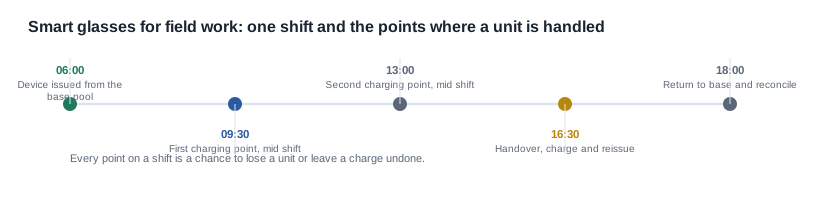
A field kit is not a pack; it is a loop, and the loop has four handovers. Understanding them is what turns a one-off issue into a procurement system that can be re-ordered on a rate.
- The issue. Units, consumables and a charge plan leave the base at the shift start. What leaves has to be counted, because what is not counted does not come back, and a device that does not come back is a device that is bought again.
- The consumption. The wipe and the contact wipe are used during the shift, and the contact wipe is used at a point that is easy to skip — the charging contact is exactly the part a dusty crew has least reason to think about, and it is the part whose fouling produces a gradual failure rather than a sudden one.
- The return. The device, the case and the remaining consumables come back. This is the handover at which a loss becomes visible, and it is the handover that a field operation usually has no procedure for.
- The replenishment. The base counts what came back, compares it with what went out, and places the consumable order against the observed rate rather than against a forecast.
Where the loop breaks, in the order it usually breaks. The first break is consumption without a record: the crew uses the wipes, the wipes are not counted, and the reorder is a guess that is either short or excessive. The second break is the return without a reconciliation: the device comes back, the case does not, and because both are small the difference is not noticed until the pool is short. The third is a contact that is never serviced because the contact wipe is in the vehicle rather than in the crew's hand, and the failure surfaces on a morning when the unit will not charge. The fourth is a reorder placed against the wrong minimum order quantity, which is a purchasing decision that sits in the kit file rather than in the purchasing file and is therefore made by nobody.
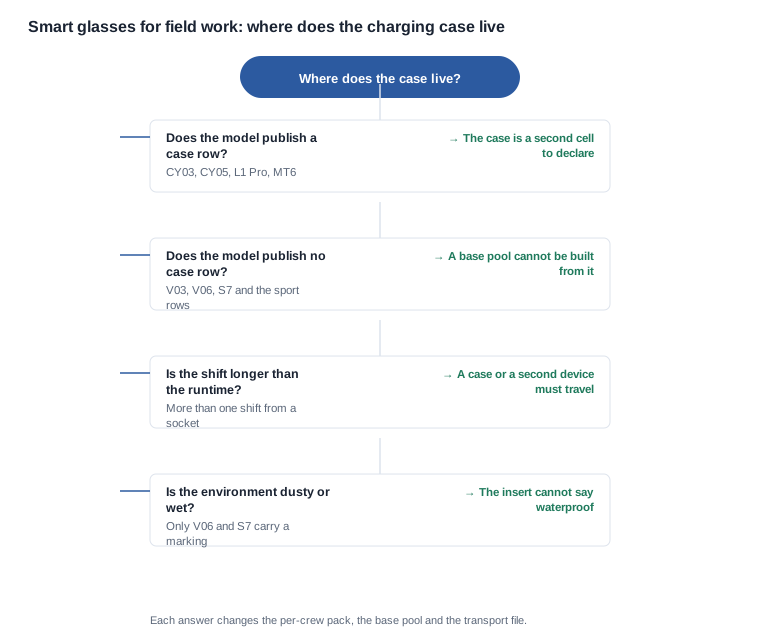
The case is a fourth object in the loop, and it is the one that costs the most to ignore. A case is a second lithium cell, so it has to be declared for transport; the requirement is at battery transport. For a crew, the case is usually a decision to exclude from the per-device layer: it is volume in a vehicle, a second object to issue and track, and a second thing to lose, and a base-held pool serves the same function with better control. But the exclusion only works on the models where the catalogue publishes a case at all, and that set is narrow: five camera models publish a capacity, two more publish a case without a capacity, and four publish no case row at all — the V03 Pro and the S7, and the V03 and the V06. A base pool built on a model with no case row is a pool that does not exist, and a per-device case on such a model is a custom accessory with its own price and lead time.

The file that makes a field kit quotable
A field kit cannot be quoted from a brochure, because most of what determines its cost is a rate the buyer owns. What the supplier has to supply is the published rows and the written answers; what the buyer has to supply is the observed rate. Each request below has a completion standard.
- The bill of materials per configuration and per kit layer, with the consumables separated from the orderable accessories. The completion standard is a document that the packing station, the forwarder and the operations team can each use without asking a third question.
- The published rows for every model in the set, copied rather than summarised. The completion standard is the model, the cell, the runtime, the charge time, the interface and the case position, and the completion standard is met only when the case position is one of the four published states rather than a phrase.
- The charge input, the charge-time starting point and the indicator behaviour, per model. None of the three is published for any model, and each is one the vehicle plan depends on. The completion standard is a written answer per model, not a family answer.
- Whether a case charges the device while it is plugged in, and the case's own charge time. The completion standard is a yes or a no with the test method described, because that answer decides whether the base needs a socket per case or a socket per device.
- The charging point specification for every vehicle and base location — power, dock or cable, the number of positions, and the physical protection of the contact. The completion standard is a plan with a count, not an intention.
- The lens material, the coating and the surface treatment, in writing. The completion standard is a statement per model, because it is the statement that makes the wipe instruction specific and the "waterproof" line impossible to print by accident.
- The battery transport file for the exact configuration, including the case where a case is in the set. The completion standard is a document reference naming the configuration, because a declaration written for one cell does not cover a doubled cell and a case changes the count again.
- The model designation table, matched to the unit, with every certificate number checked at certification checklist. The completion standard is that the designation on the unit resolves to the paperwork, which is also what makes a lost unit traceable across a fleet.
- The agreed incoming inspection criteria, applied to a stated sample of the production lot, covering the configuration string, the insert content, the carton artwork and the accessory count. Quality consistency across lots is covered at quality consistency.
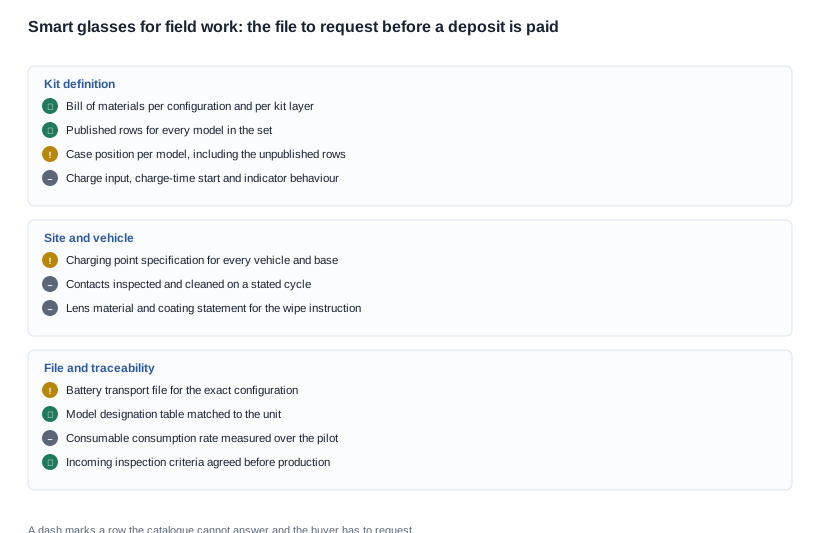
Documents to request before a deposit is paid. The bill of materials per configuration and per layer, the published rows per model, the case specification, the written charging answers, the charging point plan, the lens and coating statement, the battery transport file, the packaging artwork proof, the model designation table, the agreed incoming inspection criteria, and the consumption rate from the pilot. For clause language go to contract terms, and for the commercial structure of a first order go to pricing.

Where the negotiating room is in a field kit
What cannot be moved, because it is fixed before the commercial conversation starts. The cell configuration, the charging interface, the charge time, the runtime ceiling and the case architecture of any given model are published rows and are not negotiable. The certification cost and its lead time follow the process and the testing body rather than the order size. Tooling and mould cost is a third category and the one most often bundled: tooling is normally amortised across an order while certification cost follows the product family, and a single blended line hides a cost that repeats on every future order next to one that does not. Ask which line the quotation is charging, because the answer decides how the second order is priced.
The consumable rate is the negotiation that pays fastest. A wipe and a contact wipe cost a few cents per device and change nothing else in the operation, which is exactly why they are the first line to be cut when a budget tightens and exactly why they are the line with the fastest payback. The quantity to negotiate is the quantity per device per shift and the restock interval, not whether they are included. A buyer who fixes the interval from an observed rate gets a reorder that is right rather than a reorder that is large.
Whether a case is issued per device or held at the base is a procurement decision with a compliance tail. Held at the base, the case is a pooled asset that is counted and that can be declared once for the pool; issued per device, it is a second object on every crew member and a second item on every return. The two arrangements have different costs and different transport files, and the choice belongs in the kit structure rather than in the box.
Whether the supplier will provide a kit template is worth asking, because the operations team will run the kit, not the purchasing team. A template that states the layers, the counts and the return procedure is a document the buyer's own staff can execute, and it removes the ambiguity that shows up at the fourth handover of the first month. Minimum order quantity tiers, logo and lens tint, packaging including the insert, and the split of a first run into two deliveries against a staged payment are all negotiable as well, and the split delivery suits a crew rollout that expands in stages.
The commercial terms worth putting in the order. The published rows for each model in the set. The bill of materials per configuration and per layer. The consumption rate and the reorder point that goes with it. The charging point plan with its count per vehicle and per base. The case position per model and the pool arrangement. The battery transport file for the exact configuration. The incoming inspection criteria and the point in the flow at which they are applied, which is the point at which the payment node sits. The warranty period with a stated response, and the treatment of a unit returned with a missing accessory, which is the most common dispute in a fleet that issues accessories. The building blocks are at MOQ, lead time, payment terms and production capacity.
A worked example, and what we publish about it
A worked example. Take a European maintenance contractor running two crews of four, working from two vehicles, on sites that are dusty and occasionally wet. The first decision is the model, and the exposure profile narrows it: only the V06 and the S7 carry an ingress marking, both are sport camera models, and both publish a removable inner frame, so a crew that shares a device between two face sizes does not need two devices. The second decision is the kit, and the rate is where the money is: the consumables are ordered per crew per shift against a rate observed over the first four weeks, and the contact wipe is placed in the crew's hand rather than in the vehicle, because the failure it prevents is gradual and the return point is the charging contact. The third decision is the case, and the V06 and the S7 publish no case row at all, so the base pool is built from spare units rather than from cases, which also keeps the transport file simple. The fourth decision is the charging points, and because a charge time of two hours or less has to complete inside a handover window, the vehicles carry the count that the handover allows rather than the count that the crew size suggests. The outcome is a kit with three rate-based lines instead of a bundle, and a second year that can be re-ordered on the same numbers.
What we publish, and where we stop. We publish the sport family's resolution tiers, rated runtimes, cell capacities, charge times, charging interfaces, structural features and colour availability exactly as the catalogue states them, and we publish the absence of the sensor, the field of view, the video specification, the storage behaviour, the frame and lens material, a per-model frame weight, an operating temperature range, a cycle life rating and a runtime test condition with the same prominence. The resolution classes are published: eight models publish an 8 MP camera and three publish a 13 MP camera, and no sensor part number is published for either. A case capacity is not a number of additional hours, so we do not present it as one, and we do not call any product tested to IP54, because the catalogue publishes no test report behind the two markings it carries.
What to send us. Send the shift length, the environments, the number of devices, the number of vehicles, the number of base locations and the markets, and we will tell you what each kit layer should contain, which published rows apply, which four counts are yours to measure, and which questions have to be settled before the order rather than during the first month. The scenario entry point is smart glasses for field work.
Related reading
- The opening point of the scenario — smart glasses for field work
- The product line-up — AI camera glasses
- How charging works — charging for field work
- The comparable pack — packing for security
Tell us the shift length and the number of vehicles, and we will say what each kit layer should contain and which counts are yours to measure.


