
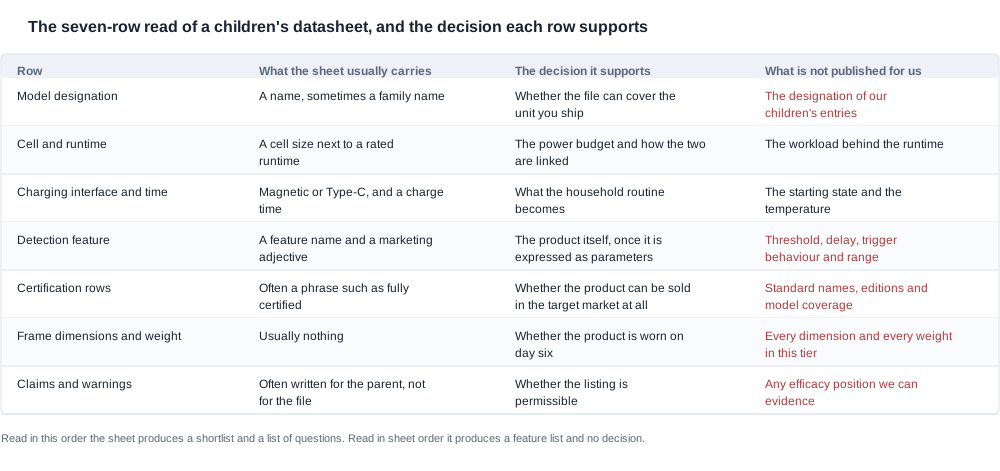
A children's product datasheet is read in a fixed order, and the order is not the order of the sheet. Kids eye protection glasses technology smart glasses how to read a datasheet is a seven-row read in which the first row is the model designation, the second is the cell and runtime, and the seventh is everything the sheet does not contain. Read in that order, the sheet produces a shortlist and a list of questions; read in sheet order, it produces a feature list and no decision.
One thing has to be stated before the rows, because it governs how the output is used: we make no claim covering eye-protection, vision or health performance for any product, and we advise any buyer building a listing in this category to do the same. A children's product carries a documentation and safety obligation, and the correct positioning is a compliant, well-made device with named functions — not a benefit claim about eyesight. A benefit claim in this category is a compliance problem in several markets and a liability in all of them, and it is worth deciding that before the copy is written rather than after it is reviewed.
Our catalogue entries for this tier publish a 40 mAh battery for the two models with the lens-based electronic atomiser feature, charging in two hours or less, roughly twenty hours of runtime, magnetic charging, and posture and distance detection. The A07 publishes Bluetooth 5.4 with a 70 mAh cell and the same charge and runtime figures. Certification is not published for any of them.
Kids eye protection glasses technology: the first row is an eligibility gate
What the seven rows actually produce
Kids eye protection glasses technology smart glasses how to read a datasheet is seven rows, and the output is two lists: what the sheet actually evidences, and what has to be established elsewhere. The first row decides whether the product can be sold in the target market at all, the second decides the power architecture, and the seventh — the rows the sheet does not carry — decides whether the product will be used. In this category the certification rows are a gate rather than a comparison: they do not make one product better than another, they decide whether either can be sold.
Who is reading the sheet, and what they are holding
A buyer reading a children's datasheet is usually opening a new line, or adding a product to a range that already has a certification package, and holds the sheet, a target price, a size range and a market list. What they do not hold is the certification file, and the reason is that in this category it is genuinely expensive and genuinely slow.
The deeper structural problem the read has to surface is this: a product can be built on an adult platform, inherit a feature set, and be sold into a children's channel with a documentation package that does not cover it. Nobody in the chain has done anything wrong. The point at which it fails is the shelf, or the customs inspection, or the parent's complaint.
That is why the first row is the designation and not the cell. A cell capacity cannot be compared across a family, but a designation can be checked against a file, and a file either covers the unit you are shipping or it does not.
What the children's buyer is trying to avoid
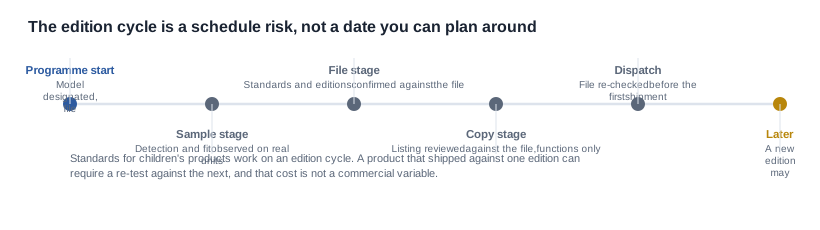
A product that cannot be sold in the target market. In the European Union the frameworks that apply to children's products, including EN 71, and in the United States ASTM F963 and the Consumer Product Safety Improvement Act, work on an edition cycle where a new edition can require retesting a product that has already shipped.
A detection feature that is really a set of unstated parameters. The presence of detection is published. The threshold, the delay, the trigger behaviour on repeated events and the range are the product.
A product the child will not use. A twenty-hour runtime is irrelevant if the device is removed in an hour, and fit is the variable that decides that. It is also the variable that decides whether a returns problem is a fit problem or a battery problem, and those two have opposite fixes.
A claim in the listing that the file does not support. The most expensive sentence in this category is one about eyesight, and it is also the shortest to remove.
The thresholds that decide whether the product can be sold at all
These are the rows to request when the sheet does not carry them. Send them in the same form to every supplier, because a comparison where the questions differ is not a comparison.
| Row to request | The pass line | What a soft answer sounds like |
|---|---|---|
| Standards applied, with edition numbers | Named standards and the edition each test used | "Fully certified" |
| Model designations the file covers | A list that includes the exact model you are ordering | "Covers our range" |
| Detection threshold, with the unit | A measurable value and the unit it is expressed in | "Adjustable sensitivity" |
| Detection delay after the trigger | A figure, and the behaviour on a repeated trigger | "Real-time alerts" |
| Detection range and the test method | A stated range with the method used to establish it | "Works within the room" |
| Runtime measurement condition | The load, the interval and the ambient condition | A bare figure |
| Frame dimensions and weight | Both published, with the size range covered | Not offered |
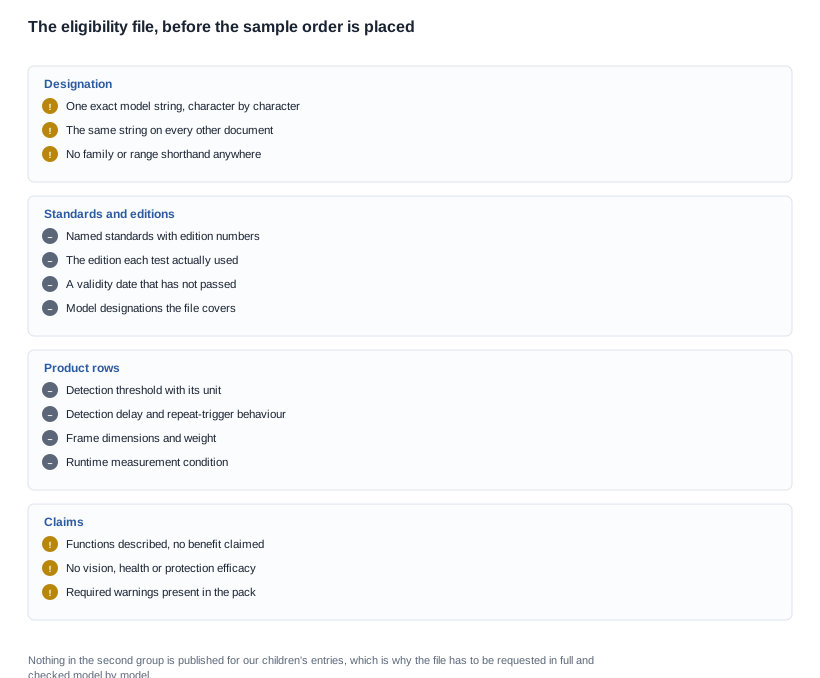
| Model designation, character by character | One string, matching every other document | A series name only |
Read the model designation character by character
A designation that does not match across documents is a traceability failure, and in a children's category it surfaces sooner than it does elsewhere, because the file is the gate rather than a supporting document. Our own catalogue carries the same problem: one entry is printed as "L2 Utral" with a note that "Utral" seems to be a typographical rendering of "Ultra", and the same page lists two variant names, "Utral" and "Pro Max", with no statement of which configuration each belongs to. Copying a designation across a purchase order, a label and a certificate carries every one of those open points with it.
Read the certification rows as an eligibility gate rather than a comparison row
It does not make one product better than another. It decides whether either can be sold. A supplier who cannot name the standard and the edition cannot tell you whether the file is still current, and a supplier who says "fully certified" has told you nothing at all — because every product in the category is sold with that phrase, which is exactly why it carries no information.
The edition number is the part buyers most often skip, and it is the part with the schedule risk attached, because standards in this category work on a revision cycle.
Read the detection parameters as the product, not the feature
A threshold expressed as a number with a unit can be tested on a sample and compared across suppliers. A threshold expressed as a quality — "more accurate" — cannot be tested at all, and usually means the supplier has not measured it. The same applies to the delay after a trigger and to the behaviour when the condition repeats, which is where a feature designed for a single event usually turns into a nuisance in a household.
Read the cell against the runtime, and infer the load profile
A 40 mAh cell with a roughly twenty-hour runtime, or a 70 mAh cell with the same runtime, tells you the load profile differs between models, because otherwise the cell size would not change while the runtime stayed put. That is a useful inference from a thin sheet, and it is exactly the kind of thing a datasheet reader should be doing rather than copying a number.
Read the rows the sheet does not carry as the finding
Frame weight, dimensions, ingress protection, sensor specification and material composition are all absent from a children's sheet, and for a product used by a child for a school day the first of these is a primary decision variable. In our entire catalogue, unit weight is published for one model only — 158 g for the MT6 — and no weight, dimension or size range is published for the children's tier at all.
Walking the file from the designation to the listing
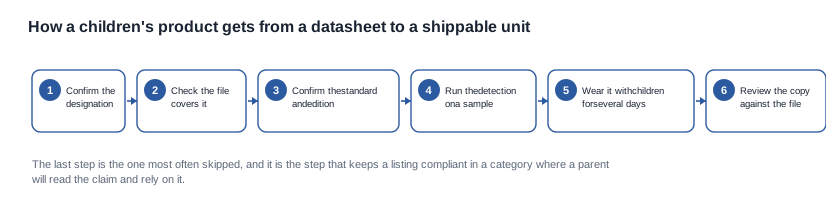
1. Match the designation on the sheet against the certificate numbers and the model list on the file. If they differ, stop. A document that cannot name the product cannot cover it.
2. Check the certificate numbers against the issuing body's public register. Confirm the model designation, the standard and edition, and the validity date. It takes minutes and it is the check that catches an inherited family-level document.
3. Ask for the detection parameters in units. Anything that cannot be expressed with a unit cannot be tested, and anything that cannot be tested cannot be put in an acceptance criterion.
4. Run the detection on a sample, in the room the product will actually be used in. Record the trigger distance, the delay and the behaviour when the condition is triggered repeatedly. These three observations become the acceptance criteria for the feature, and they cost nothing to make.
5. Test the charging routine in the real household pattern. Whether the device is charged when it is needed, and what happens if it is left charging unattended overnight, is a design property you can only learn by running the pattern.
6. Compare the documentation received against the units received, by model designation. Not the product, not the family — the model. A unit whose designation is not on the file is a unit you cannot ship.
7. Have the listing copy reviewed against the file before publication. A benefit claim about eyesight in a children's listing is a compliance problem in several markets, and the copy should describe functions, materials, charging and certification.
8. Re-check the file before the first dispatch, not only at the start. Editions move, and the gap between the review date and the shipment date is where an expired file catches you.

Where a children's programme stalls
Two products are compared on the sheet and the result is a tie, so the cheaper one is chosen. The symptom is a range launch with no differentiation. The root cause is that the published rows for this tier are nearly identical across models, so the only remaining discriminator is unit cost. The prevention is to recognise the tie as a signal that the decisive rows are missing, and to go and get them.
A product is certified as a family and a private-label unit inherits the assumption. The symptom is a shipment stopped at customs or a listing withdrawn. The root cause is that similarity between the factory's model and the branded model was treated as coverage. The prevention is to ask which designations the file names and to make the answer a condition of the purchase order.
The detection feature fires in the demonstration and gets switched off at home. The symptom is a feature that is enabled for the first week and then disabled. The root cause is that the threshold was never measured in the real environment. The prevention is to test the trigger distance and the delay in the real room, record both, and set the acceptance criteria from the result.
A child removes the product after a short session and the return is attributed to the battery. The symptom is a returns cluster with a battery description. The root cause is that the fit was never tested, so the runtime was irrelevant. The prevention is to run a multi-day trial with the actual children, and to record day six rather than day one.
The listing copy implies a benefit the documentation does not support. The symptom is a claim that nobody can evidence when a parent or a regulator asks. The root cause is that the copy was written from the category name rather than from the certification file. The prevention is to have the copy reviewed against the file and to keep the claim set to functions.
A new edition of a standard is published after the programme has shipped. The symptom is a re-test request arriving from a compliance reviewer rather than from a customer. The root cause is that the edition was recorded at qualification and never scheduled for re-checking. The prevention is to record the edition on the file and to set a re-check obligation, so the cost of catching it falls on the party that can act on it.

What the documentation gap is worth at the first order
Negotiable, and this is where the effort belongs. A children's line is often the first order for a brand in a new category, which is where the supplier has the most incentive to be flexible. The packaging and insert design, including the market labels, the language of the documentation pack and the required warnings, is a low-cost negotiation that carries no tooling implication. Where this category's timing can be staged is against the certification milestone: ask for the first shipment to release against a reviewed file rather than against a date, so that a file which does not cover the shipped designation stops the goods rather than the customer. The minimum order quantity, the number of colourways and the per-colour minimum are all negotiable, and the per-colour minimum matters more in this tier than elsewhere because each colour is a configuration in the file. The payment node structure, with a retention against the documentation package, protects the buyer on the failure that costs most in this category, which is a shipment that arrives with a file that does not cover it. Whether the supplier will produce the file in a form your own compliance reviewer can read is worth asking directly, and it costs nothing to ask.
The safety file and the materials behind it are settled before the order is negotiated. A new edition of the standard can require retesting a product that has already shipped, which makes the edition cycle a retest risk rather than a commercial lever, and the material and component evidence the file rests on has to be visible to somebody other than the supplier. Ask which laboratory the material testing came from and whether the report can be read by your own reviewer — if the file cannot be looked at by anyone but the supplier, it is not a document, it is a claim.
Documents to request before the deposit. The certification file references with standard names, edition numbers and model designations. The detection parameters with units. The runtime measurement condition. Frame dimensions and weight. The certificate numbers with the issuing body and the validity dates.
Clauses to write into the contract. The exact model designations covered by the certification file, attached to the purchase order. The acceptance criteria for the sample, referencing the detection observations and the wearing trial. A clause requiring notice before any change of firmware, detection threshold default, frame material or supplier of a safety-relevant component. A clause requiring the file to be re-confirmed at the edition in force on the shipment date, and a clause allocating the cost of a re-test caused by an edition change. And a clause that puts the cost of a unit whose detection behaviour differs from the agreed threshold back on the supplier.
A worked scenario: a brand opening a children's line with an existing file
A brand that already has a certification package in two markets is deciding whether a children's designation can be added to it, and the five steps below are the order in which that question gets answered.
Assume a brand that already sells an adult line with a certification package in two markets, and is considering adding a children's model. The binding constraint is not price. It is that the brand does not want to ship a product whose file turns out to cover the adult designation only.
Step one is the eligibility check, before any sample order. The brand asks which designations the existing file names. The answer names the adult model and not the children's one, which is the expected answer and still the most important fact in the project, because it converts the certification question from an assumption into a priced line.
Step two is the requirement, written per market. The brand writes the standard and edition it needs per destination market, and it does not use the category phrase that every supplier uses. The request goes to the supplier with the children's designation attached, and the reply either produces a schedule or produces a refusal, and both are useful answers.
Step three is the detection parameters. The brand asks for the threshold in units, the delay in seconds, and the behaviour on a repeated trigger. A supplier who can answer all three is a supplier who has a product rather than a marketing description, and the values become the acceptance criteria for the sample.
Step four is the sample session. The brand runs the detection in the room the product will be used in, records the trigger distance, the delay and the repeat behaviour, and runs a multi-day trial with the actual children so that day six is recorded rather than day one.
Step five is the copy and the file review. The copy describes functions, materials, charging and certification, and makes no statement about eyesight. The brand has the copy reviewed against the file before publication, and the file re-checked against the edition in force at the shipment date.
Step six is the commercial structure. The brand negotiates a delivery split against the certification milestone, and holds a retention against the documentation package.
The decisive decisions were all made before the sample order, and the first of them cost one email.
What our children's rows publish and what stays Not published
We publish the children's models' electrical rows — the 40 mAh and 70 mAh cells, the charge time of two hours or less, the roughly twenty-hour runtime, magnetic charging, Bluetooth 5.4 on the A07, and the presence of posture and distance detection — and we say plainly that the detection parameters and the certification status are Not published. We publish no frame weight, no dimension and no size range for this tier, and we will not fill a children's datasheet read with plausible thresholds or a certification claim, because in this category an invented number becomes a safety statement on a product page that a parent will rely on.
We also make no outcome claim about eye-protection, vision or health for any of our products, in any market, and we will tell you plainly that a read built on the published rows alone cannot be completed, and that the rows which complete it are the ones you have to obtain.
If you send the two products and the destination markets, we will tell you which questions decide the comparison and which we can answer from our own data. The background is under kids eye care technology, the gaps are set out in what the spec sheet does not tell you, the documentation side is in kids certification requirements, the range is at kids smart glasses, and the compliance boundary is under child product compliance.
Three requests for the children's file
Ask the eligibility question first, in writing, with the designation attached. Which model designations does the file name, which standards, and which edition. Everything else in this category is downstream of that answer.
Ask for the detection parameters in units. Threshold, delay, range and repeat behaviour. Four numbers, and each one either exists or does not.
Send us the two datasheets and the destination markets, and we will tell you which questions decide the comparison. Where our own documentation runs out we will say so in the same answer, so that a blank row is not read as a weakness of the product.
Where the reading method comes from
Send the two datasheets and the destination markets and we will tell you which questions decide the comparison.


