

Smart glasses for cycling: the first line a channel checks before selling
Cycling is the only application in this catalogue where the product is used while the customer has both hands committed and attention narrowed to a moving line of traffic. A channel that sells smart glasses for cycling therefore inherits an exposure that has nothing to do with the hardware: the moment a customer says the device distracted them, or that a case stayed in the photograph, or that the battery died mid-ride, the question moves from the factory to the channel that made the claim. The first decision in setting up such a channel is not which model to buy. It is what the channel is going to refuse to say.
That decision is commercially expensive to get right and cheap to get wrong. A channel that sells an unsupported claim carries the returns; a channel that publishes a narrow, defensible claim set can scale the same hardware in the same marketplace with a lower return ratio than a broader competitor. The rule that follows from this is the one that shapes everything below: the claim set comes first, the configuration comes second, and the customer instruction comes third — and none of the three can be drafted after the purchase order.
The exposure a cycling channel inherits
Three things distinguish this channel from every other application category, and each one becomes a line on the purchase order.
The first is distraction. The device sits in the customer's field of view while the customer is managing a bicycle. Nothing in our catalogue measures that interaction, and no published row addresses it, so a channel cannot claim that the product is safe to use in traffic in any form. What a channel can do is restrict what the product is sold for: recording the ride, or capturing a hands-free reference for a training plan, and explicitly not for live interaction while riding.
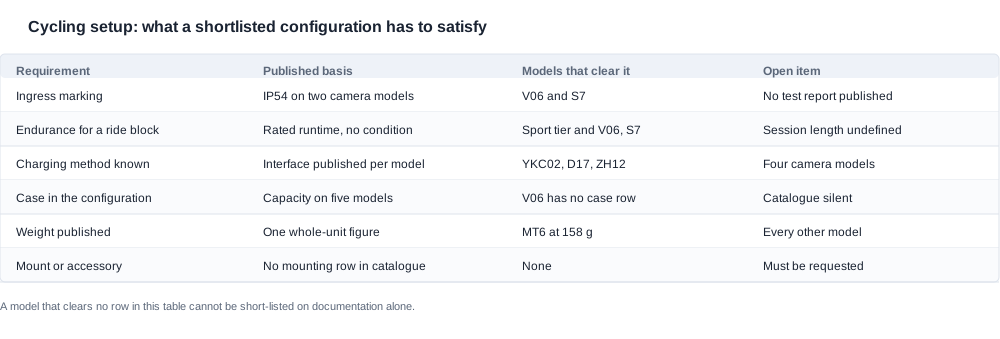
The second is weather. Of the twenty-eight models in the range, only two carry an ingress marking: the V06 and the S7, both camera models, both marked IP54, which covers splashing water and a dust protection level and does not cover immersion or a sustained downpour. No third-party test report is published behind that marking. Every other model in the range is unmarked, so a cycling channel has exactly two models it can make an ingress statement about, and it has to make it in exactly those words.
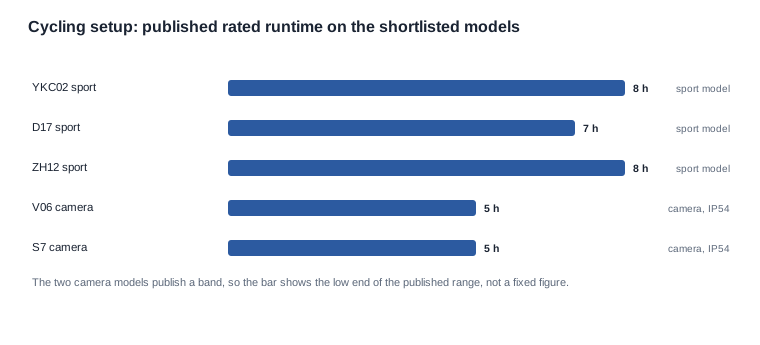
The third is endurance measured against a ride, not against a day. The rated runtimes published for the models a cycling channel would consider sit between about 6 and 8 hours, and none of them carries a published test condition. A channel that publishes "8 hours" as a riding-day figure is publishing a number whose condition it cannot state, and a customer who rides longer than the battery lasts will say so publicly.
Ingress marking, endurance, and the sport models
The shortlist for a cycling channel is short enough to write down, and it splits into two groups with different jobs.
The sport models are the YKC02, the D17 and the ZH12, and they are the endurance option. The YKC02 publishes a 70 mAh times two cell configuration, a magnetic charging method, Bluetooth V5.4 and a rated runtime of about 8 hours. The D17 publishes a 115 mAh cell, a Type-C charging method, a charge time of roughly one hour and a rated runtime of about 7 hours. The ZH12 publishes a 100 mAh cell, Type-C charging, roughly one hour of charging and a rated runtime of about 8 hours. The D17 and the ZH12 are the only two models in the entire range that publish a charge time of about an hour rather than two hours or less, which is the practical advantage of that pair on a trip where charging opportunities are planned rather than assumed.
The camera models with an ingress marking are the V06 and the S7, and they are the imaging option. The V06 publishes a 260 mAh cell, a magnetic charging method, a charge time of two hours or less and a rated runtime band of 5 to 8 hours. The S7 publishes a 260 mAh cell, magnetic charging, a charge time of two hours or less and the same 5 to 8 hour band, at a 13 MP resolution class where the V06 is published at 8 MP. The catalogue publishes no Bluetooth version row for either of them, and it publishes no such row across the camera models, so the radio version on a shortlisted pair has to be confirmed with the supplier rather than read off this list. The catalogue publishes no charging-case row for either of them, which means the case is not part of the configuration and the pack has to be built around the cable alone.
The configuration set that survives a cycling channel's own review
A channel that reviews its own shortlist against a written set of rules will usually arrive at fewer models than it started with, and that reduction is the commercial value of the exercise. A configuration reaches the shortlist only when the catalogue supports the claims, the charging method is known, the endurance can be stated with its band, and the customer can be told what to do when the device is not in use. Four of those five conditions are documentary, and the fifth is a drafting decision.
What clears the configuration gate. A model with a published charging method, because a channel that cannot name the interface cannot specify the cable or the pre-ride charge routine, and cannot write the instruction card. A model whose ingress marking can be stated exactly as published, or whose absence of a marking can be stated exactly as published. A model whose runtime can be written as a band rather than a single figure, or whose single figure is close enough to the ride length to be worth quoting. And a model whose case status is documented — a published capacity, a case with an unpublished capacity, or a catalogue that publishes no case row at all — because the pack decision is where the transport file is decided.
What does not clear it. Any of the four camera models whose charging method the catalogue does not publish: the MT6 and the CY03, and the L1 Pro and the CY05. Those are attractive models on paper, and the MT6 in particular is the only model in the range with a published whole-unit weight of 158 g, which includes its 265 mAh battery and its camera and excludes its foldable 1200 mAh charging case. A channel that wants the MT6 has to ask the supplier for the charging method in writing before it can put the model on a shortlist, because the pack cannot be specified around an interface nobody has confirmed. The MT5 and the KY06 ship with a case whose capacity is not published, which is a different open item and a smaller one.
The three rules a cycling channel has to write down before it launches
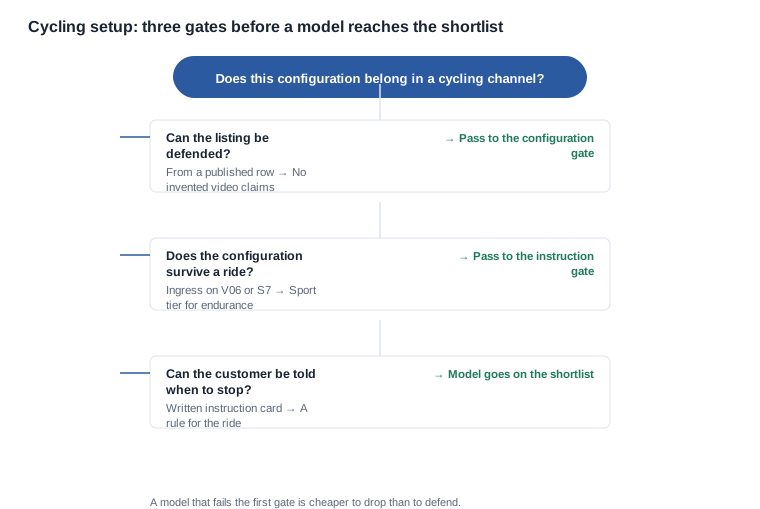
Three written rules, agreed before the first unit is packed, are what separate a channel that scales from a channel that accumulates complaints. They are short, they are specific to this application, and each one has an artefact behind it.
Rule one: the claim set
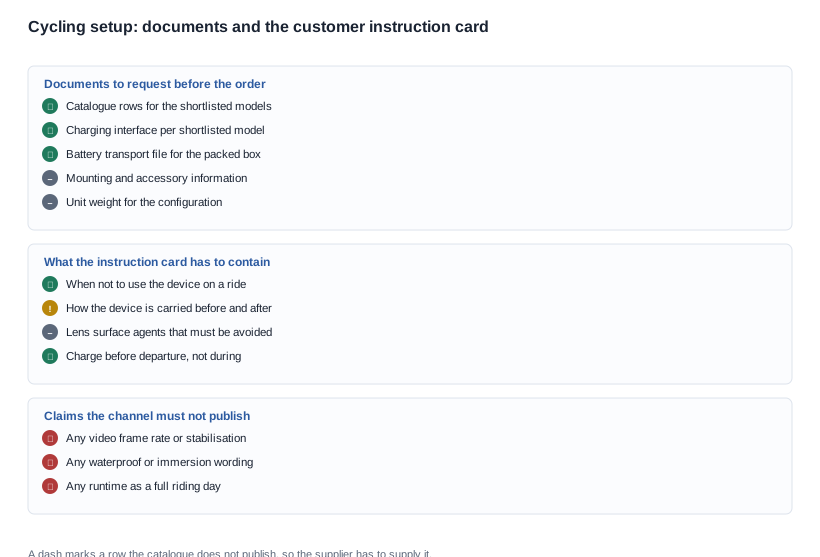
Every sentence the channel publishes traces to a published catalogue row or to a measurement the channel has run. For this application that means the resolution class, stated as published — 8 MP on the V06, 13 MP on the S7 — and the ingress marking on the same two models, stated as IP54 covering splashing water and a dust protection level, and never as waterproof. It means no frame rate claim, no stabilisation claim and no low-light claim, because none of the three is published for any model in the range. It means the runtime written as a band with its condition, or the condition without the number.
Rule two: the configuration gate
A model goes on the shortlist only when its charging method is published, its case status is documented, and the session length the rating has to survive is decided in writing. The session length is a channel decision rather than a catalogue fact, and it is the decision that connects the hardware to the ride: a channel serving commuting rides of 45 minutes can work with a published band whose low end is 5 hours, while a channel serving full-day routes needs to know how the unit is charged at the halfway point, and the catalogue publishes no answer to that.
Rule three: the customer instruction
The channel ships a printed instruction with the unit, and that instruction states when the device is not to be used. It says to charge before departure rather than during a ride, it says how the unit is carried before and after the ride rather than left in a pocket or on a saddle, and it names the lens surface agents that have to be avoided. The lens material and the coating are not published for any model in the range, so the instruction has to be restrictive rather than generous, and the restriction is what protects the channel's return ratio as much as it protects the customer's lens.
How a cycling configuration is verified before it becomes a channel listing
Verification here is shorter than in most categories, because the number of published rows a cycling listing can carry is small, and each one has to be checked rather than assumed. The output of the verification is not a report; it is a set of acceptance criteria the channel can apply to the delivery that follows, and a rule set the channel can show.

The measurement set and its completion standard
Four measurements are worth running on a cycling configuration, and none of them requires laboratory equipment. The first is a charge-cycle measurement on two units from the same batch, from a stated starting state, with the charging interface recorded — which is only possible on a model whose charging method is published, and that constraint is the reason the configuration gate comes first. The second is a session measurement: the unit is used for the channel's stated session length, and the result is recorded as a pass or a fail against the published band, not against the catalogue's best case. The third is a surface test on the lens, using the agents the instruction names, because the coating is not published and the instruction's restrictions have to be shown to be survivable rather than merely written. The fourth is a storage check, because the camera models do not publish their storage or overwrite behaviour and a channel that shoots for a full day needs to know what happens when the store fills.
Each of the four ends in a written result with its conditions attached, and each result becomes one line in the incoming inspection criteria. A measurement that never becomes a criterion is a demonstration, and it stops protecting the channel the moment the second delivery arrives.
Documents to request before a cycling order
The request list for a cycling configuration has six items. The catalogue rows for the shortlisted models, on one sheet, so that every published figure in the channel's copy has a source. The charging interface per shortlisted model, which is a published row on some and an open question on four. The battery transport documentation for the packed configuration, which has to cover the case if a case ships, because a case is a second lithium cell and the requirement is set out at battery transport. The mounting and accessory information, which the catalogue does not publish for any model and which a cycling channel has to obtain because the accessory decision changes the pack contents and the return reasons. The unit weight for the configuration, which is unpublished for every model apart from the MT6. And the model designation table that maps what is printed on the unit to what appears on the paperwork, so that a substitution at goods-in is caught before it reaches a customer.
The clause language for these documents is at contract terms and the commercial structure of a first order is at pricing. The adjacent material in this application cluster is the cycling product recommendations, the cycling channel template, and the cycling training procedure, which belongs in the same instruction set rather than in a separate document.

Where cycling channels lose money, and which terms stay open
The losses in this channel are concentrated in three places: a claim that has to be withdrawn, a configuration that had to be replaced, and an accessory that turned a refund into a technical question. The terms that stay open sit in the same three places, and the reason is structural — a cycling configuration is mostly a set of published rows plus a small number of bought items, and the bought items are where the negotiation lives.
Failure modes that surface as a safety question
A customer who filmed the ride and lost the file. The symptom is a lost afternoon and a public complaint about storage. The root cause is that the camera models publish no storage or overwrite behaviour, so the channel had no basis to set expectations. The prevention is the storage check, and a channel-level wording that does not promise unlimited capture.
A channel that sold the IP54 marking as waterproof. The symptom is a customer who submerged the unit and returned it. The root cause is that the marking covers splashing water and a dust protection level, and the wording was compressed into a single word. The prevention is to publish the marking's scope next to the marking, and to write "waterproof" into the list of phrases the channel never uses.
A channel whose battery died on a long route. The symptom is a refund attributed to the product. The root cause is that a runtime band with no published condition was sold as a riding day. The prevention is to publish the band and the session length, and to put the pre-departure charge into the instruction card.
A unit that stayed in the photograph. The symptom is a complaint about the camera itself rather than about the device. The root cause is that the channel specified no storage position and no carrying rule. The prevention is a printed storage position in the pack and a carrying rule in the instruction.
A model that arrived with the wrong cable. The symptom is a first ride with no charge. The root cause is a configuration built on a model whose charging method is unpublished, or a pack assembled without reference to the interface row. The prevention is the configuration gate and a bill of materials fixed in writing.
A channel that could not answer a safety question. The symptom is a support contact with no internal answer, and a slow response that the buyer perceives as evasion. The root cause is that no rule set existed. The prevention is the three rules written down before launch, so that support inherits them.
How to evaluate a supplier for this channel
A cycling channel is a repeat-order buyer, which means the supplier evaluation that matters is the second one, not the first. Before the first order, due diligence is mostly a document check: does the factory answer the charging-method question in writing, does the factory produce the transport file for the exact packed configuration, and does the factory accept the channel's acceptance criteria into its incoming inspection rather than treating them as a courtesy. After the first order, the evaluation is about process: the defect rate on the channel's own criteria, the consistency of the cable and the pack contents between deliveries, the lead time against the order book, and whether the factory's quality control answers a complaint with a measurement rather than with an opinion.
Three procurement terms are worth writing into the first request because they determine whether the relationship survives the first reorder. The minimum order quantity decides whether the channel can hold two shortlisted models on one purchase order, which is the cheapest way to run a comparison between the S7 and the YKC02 without doubling the stock commitment. The lead time for a configuration with a printed instruction card is longer than for a standard pack, because the artwork has to be approved, and a factory that quotes the standard pack lead time is quoting a pack the channel cannot sell. The payment terms decide how much of the risk the channel carries on the first run, and a staged payment against a split delivery is the structure that makes an early packaging mistake recoverable rather than total. Beyond those, a factory audit, a capacity confirmation and a written quality control plan are the terms a brand owner or a distributor will eventually ask for, and it is cheaper to negotiate them into the first agreement than to introduce them at the reorder.
The commercial room on a cycling configuration
The architecture of the model is fixed: the cell configuration, the charging interface, the ingress architecture, the camera module and the case architecture are set before the commercial conversation starts, and certification cost and lead time are fixed in character because they are laboratory and regulatory costs. Tooling is fixed in substance, quoted as a separate line, and negotiable in its amortisation base and its timing.
The room sits elsewhere, and in this channel it is unusually valuable. Whether the supplier will state the charging method in writing for the four camera models where the catalogue is silent is a small request with a large consequence, because it unlocks four models that would otherwise be unquotable. Whether a case is included at a published capacity — 1400 mAh on the CY05 and the L1 Pro, and the CY03, 900 or 1400 mAh as a configuration choice on the L2 Utral, or the foldable 1200 mAh case on the MT6 — is the cheapest way to build two price points from one platform, and it also decides the transport file. Whether the supplier supplies mounting or accessory information as part of the first order is the difference between a pack a channel can specify and a pack it has to improvise. Whether the supplier funds a baseline measurement on the production batch is the document that answers the first complaint. Whether the instruction card is printed by the supplier with the channel's rules on it, or by the channel, is a packaging decision worth settling because it decides who owns the wording. Minimum order quantity tiers, and whether two shortlisted models can share one purchase order. Logo, lens tint and packaging artwork, including the kit contents. Splitting a first run into two deliveries against a staged payment. The pilot tranche of an order, which for this channel is the cheapest way to put a claim set in front of real riders before a full volume is shipped.
A worked example. Assume a cycling channel launching in a marketplace where returns are visible to every shopper. The first move is the claim set, and it is deliberately narrower than the marketing plan: the resolution class of whichever model is chosen, the IP54 marking on the V06 or the S7 with its scope written next to it, and no runtime figure at all in the headline. The second move is the shortlist, and it takes the S7 at 13 MP with the IP54 marking, the YKC02 as the endurance option for long routes, and the D17 where the roughly one-hour charge time matters more than the extra hour of runtime. The third move is the session length decision, written as 90 minutes for the commuter model and a full day with a midday charge for the long-route model, because that decision is what the pre-departure charge instruction has to match. The fourth move is the pack, which for the S7 and the YKC02 contains a cable, a printed storage position and the instruction card, with no case, because the catalogue publishes no case row for either of them and the pack must not imply a second lithium cell that does not exist in the configuration. The fifth move is the evidence set, which is four measurements — charge cycle, session, lens surface and storage — written as acceptance criteria before the first delivery. The outcome is a channel whose every published sentence has a source, and whose support team can answer a safety question on the first attempt.
What a cycling buyer can hold us to
We publish the rows a buyer can order from, including the rows that limit what can be sold into a sensitive application. For this channel that means the resolution class, the cell configuration, the charging time, the case capacities where they are published, the rated runtime, the charging interface where the catalogue publishes it, the ingress marking on the V06 and the S7 stated as a catalogue attribute with its scope, and the 158 g whole-unit weight on the MT6 with the exclusion of its foldable case stated alongside it.
What we do not publish and will not estimate: the sensor, the field of view, the video resolution and frame rate, the stabilisation, the low-light behaviour, the storage and overwrite behaviour, the capture latency, the thermal behaviour, the operating temperature range, the cycle life rating, the runtime test condition, the charging method on the CY05 and the L1 Pro, and the CY03 and the MT6, the mounting and accessory information, and the unit weight on every model apart from the MT6. No product in our catalogue can be put forward as IP54-tested, since nothing published sits behind that marking, and for the models that carry no rating at all we decline to guess at the coverage a rating would have given.
What we will do is take the route lengths, the ride profile, the channel, the market and the price band, and tell you which published rows apply to which model, which claims the listing can carry without evidence, which models cannot be configured until the supplier answers on the charging method, and which criteria belong in the purchase order.
What to send us next. Send the route lengths, the session length you intend to promise, the channel, the market and the price band, and we will return the shortlist with the published rows for each model, the claim set the documentation supports, the pack contents that configuration implies, and the inspection criteria to write into the first purchase order.
Related reading
- The scenario's opening — smart glasses for cycling
- The shortlist material — cycling product recommendations
- The channel template — cycling channel template
- The training procedure — how to train smart glasses for cycling
Tell us the route lengths and the market, and we will return the shortlist and the claim set the documentation supports.


