

Photochromic smart glasses: the protocol comes first
A customer can disprove a light-responsive lens in ten seconds, on a windowsill, in daylight, without any equipment and without any complaint form. That single asymmetry sets the shape of this article: for almost every other specification in the range, a buyer's evidence problem is a documentation problem, and for a photochromic lens it is a demonstration problem. The specification you publish has to survive being tested by a stranger in a shop.
The decision, in three sentences. If your programme includes a light-responsive lens, the sample test is the only evidence you will have, because we publish no photochromic performance figure of any kind for any model in the range — so run the six tests in this article on a unit that is not the demonstration unit, write the observations down before you discuss them, and convert them into acceptance criteria before the production order. If the lens is powered rather than passive, the behaviour when the cell is flat is part of the product and has to be specified, not discovered. If your channel cannot demonstrate the effect at all, remove the lens from the configuration rather than describing a feature the shopper will never see.
Who is running the test, and what it has to produce. The reader here is usually opening an outdoor or sport line, or adding a lens option to an existing camera platform, and holds a sample, a product page draft, a target price and a channel. What they will not hold is any lens figure, and the reason is structural rather than evasive: lens performance data sits with the lens maker, and the assembly factory usually receives it as a component sheet. The evaluation therefore has to produce two things — a written protocol that another buyer could repeat, and a set of observations that can be attached to the purchase order as acceptance criteria.
What our catalogue actually offers in this technology. There is a lens configuration listed on the V03 Pro, an 8 MP camera platform with a 220 mAh cell, charging in two hours or less, a rated runtime of five to eight hours, Type-C charging, flexible temples, three published colour options and a photochromic lens listed as a configuration. And there is a dedicated electrochromic entry, published at Bluetooth V5.4, a 100 mAh cell, a charge time of two hours or less, roughly seven hours of rated runtime, magnetic charging, and with no model designation at all. That last fact is the one that decides schedules, because a product without a formal SKU cannot be correctly listed on a certificate, correctly packaged, or correctly described at customs.
Where the cost of a lens programme sits. The lens itself is the visible line and it scales with volume. Everything the lens drags in behind it is fixed: on a powered route, a cell, a driver circuit, a control path and a firmware function; a charging interface, which on our dedicated entry is magnetic; a case, which changes packaging, shipping weight and the battery transport paperwork; and above all a specification commitment from the lens maker, which carries a minimum volume of its own. Two quotations that look like a fifteen per cent gap on unit price can be a two-times gap on the whole programme once the setup and the re-validation are counted.
The mechanism question, and why it decides the protocol rather than the product
The retail word covers at least two different products, and the buyer who treats them as one will build a test that measures the wrong behaviour.
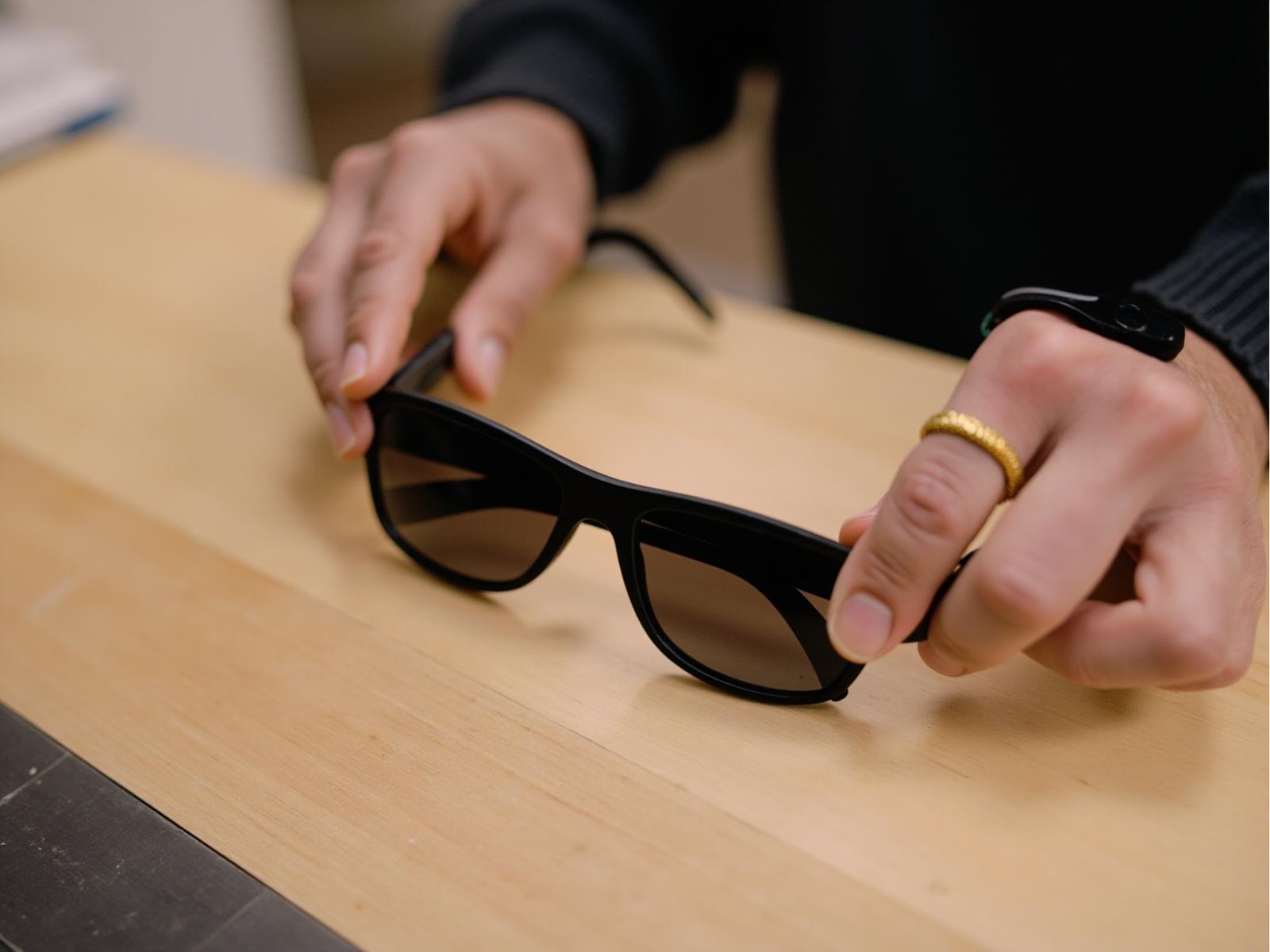
A passive lens reacts to the light that reaches it. A powered lens is driven, and how it is driven changes what it does. Hold the lens in front of a window before anything else: a passive lens darkens because of the ultraviolet in the light reaching it, and a powered lens does something else, depending on whether it is sensing and driving the tint or reacting to a photodetector. The observation is cheap, takes a minute, and it tells you whether the rest of the protocol applies at all.
The mechanism is also the first line of the request for quotation. Ask every candidate the same question in the same words — powered, passive or hybrid, and if powered, how the drive works and what happens with no power — and write the answers side by side. A supplier who answers "photochromic lenses" has not answered, and a buyer who compares two products on switching time without knowing the mechanism is comparing a mineral lens with an electrically driven one and will draw a false conclusion from the difference.
The flat-battery behaviour is part of the product, and it is the row nobody asks for. A powered lens on a 100 mAh cell with roughly seven hours of rated runtime has an end-of-day state. What does the customer see at the end of a long day — a clear lens, a dark lens, a half-driven lens, or a lens with a visible artefact? A supplier who answers this in writing is telling you they have specified the product. Silence on the subject means the behaviour is undefined and will be discovered by customers.
The camera interaction is a second undefined row in the same category. If the configuration carries a camera, what happens to exposure while the lens changes state — during a transition, and in the moment the transition completes? Our V03 Pro configuration combines a light-responsive lens with an 8 MP camera platform, and we publish nothing about the interaction between them, which means the buyer has to raise it explicitly before the artwork is written.
The nine rows to request in writing, and the threshold that separates a measured supplier from a relayed one
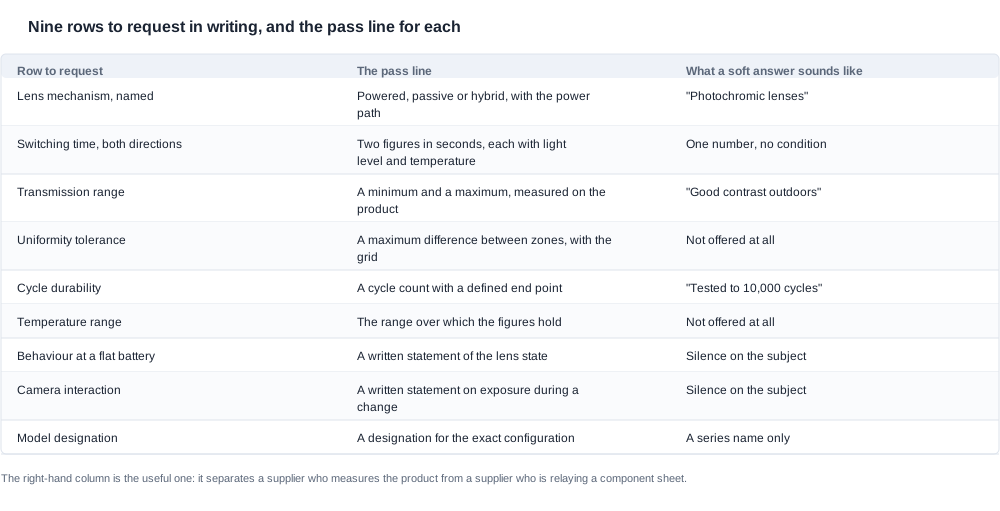
Send these nine questions before the sample ships, in identical wording to every candidate. The right-hand column is the useful one: it separates a supplier who measures the product from one who is relaying a component sheet.
| Row to request | The pass line | What a soft answer sounds like |
|---|---|---|
| Lens mechanism, named | Powered, passive or hybrid, with the power path described | "Photochromic lenses" |
| Switching time, darkening and clearing | Two figures in seconds, each with a stated light level and temperature | One number, no condition |
| Transmission range | A minimum and a maximum, measured on the product | "Good contrast outdoors" |
| Uniformity tolerance across the lens | A maximum difference between zones, with the grid and points | Not offered at all |
| Cycle durability | A cycle count with a defined end point and pass criterion | "Tested to 10,000 cycles" |
| Temperature range of the behaviour | The range over which the figures hold | Not offered at all |
| Behaviour at a flat battery | A written statement of the lens state when the cell is empty | Silence on the subject |
| Camera interaction | A written statement on exposure during a state change | Silence on the subject |
| Model designation | A published designation for the exact configuration | A series name only |
The thresholds in plain language
A switching time without conditions is a marketing number. The three conditions to insist on are the direction of travel, the initiating light level and the temperature. A time measured from bright sunlight to indoor light is not comparable with one measured from indoor to sunlight, and neither is comparable with a figure measured at 35 degrees against one measured at 5. Until the conditions are stated, two numbers in the same row are two different measurements, and the comparison between them is meaningless.
The depth of the dark state decides whether a sunglasses positioning was ever available. The minimum transmission governs how dark the lens goes; the maximum governs whether the product is usable indoors without the customer wanting to take it off. A tint percentage alone gives you one half of the range and leaves the half that decides your positioning unstated. The threshold to hold is a range with the units and the method stated, and it has to include the clear state, because a seller quoting only the darkened figure has quoted only the part that looks good on a beach.
A uniformity tolerance is what stops a good lens being rejected at first article. A centre reading is easy and nearly useless, because customers notice edge-to-centre variation before they notice an average, and they notice it in a photograph of their own face. The threshold to hold is a maximum difference between zones, measured on a stated grid, agreed before the first article rather than discovered at it. A tolerance set afterwards is a tolerance that has already been missed.
A cycle count without a failure criterion is a quantity. The threshold to hold is a transmission level at which the lens is considered failed, written by the buyer and applied by both parties, so that a warranty can be set against it later.
The temperature range is almost always quoted wider than it is useful. The honest question is not whether the lens functions in January but how slowly it responds on a cold morning, because a customer in February is standing in exactly that condition. If the range is not published, say so in the copy rather than implying one.
The model designation is what makes the paperwork possible at all. A product without a formal SKU cannot be correctly listed on a certificate, correctly packaged, or correctly described at customs — and the cost of fixing that after artwork is approved is a whole artwork round.
Running the six tests, and what each one is actually establishing
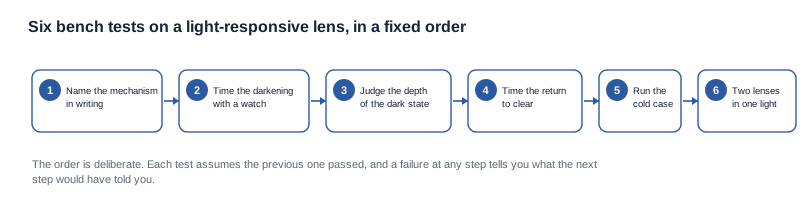
The order below is deliberate: each step assumes the previous one passed, and a failure at any step tells you what the next step would have told you.
Test one, the mechanism, behind a window. The cheapest test in the set, and it establishes whether the rest of the protocol is even applicable. Confirm the answer in writing before you proceed, because the observation and the answer may disagree, and the disagreement is itself a finding.
Test two, the darkening time, with a stopwatch. Note the light source, the ambient level and the temperature. Write down what you observed before you discuss it with anyone, because a number discussed afterwards becomes a number you are looking for.
Test three, the depth of the dark state. Hold the lens against a light source and assess the transmission, or use a light meter if one is available. An approximate observation with a stated method beats a precise claim with no method, and it is the method that makes the observation usable later.
Test four, the clear state. Bring the lens back into normal indoor light, time how long it takes to return, and record how completely it returns. This is the test customers judge most harshly: a customer who expects a mineral lens reads a powered lens that does not fully clear indoors as a fault, and the return arrives with a description that says nothing about a defect.
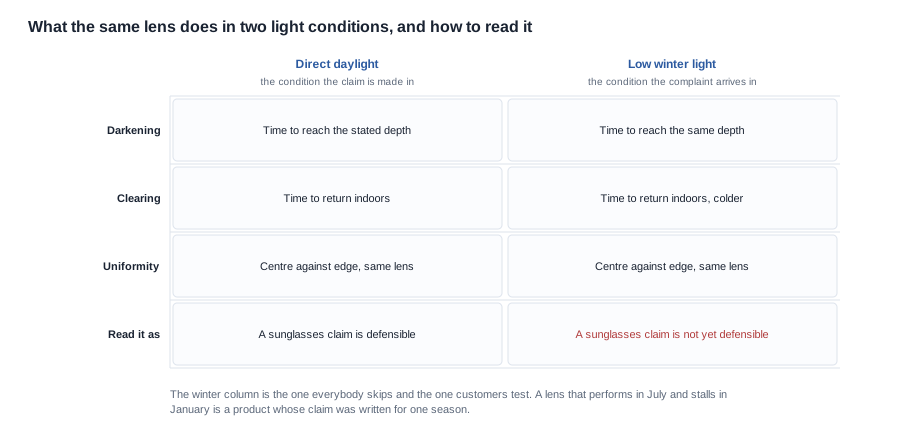
Test five, the cold case. Put the unit in a cold environment before the sample goes back in the box, and repeat the darkening and clearing observations. A parked car in summer and a winter morning are different conditions, and this is the test that everybody skips and the one that decides the January complaint.
Test six, two lenses side by side, in the same light. If you have two samples, place them together and look for a difference in depth or in speed. If you have one, hold it in front of a printed chart and look for a difference across the lens area. A printed chart is enough for a first reading, and it is much better than nothing.
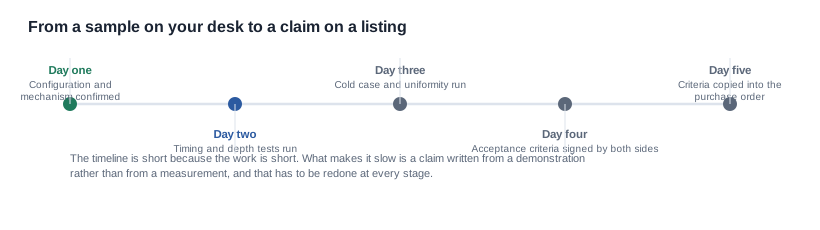
Then write every observation into a specification line. Each observation becomes a line in the specification for the first article, with the conditions attached, and each line is a number or a description you can hold a supplier to. A protocol designed afterwards is a description; a protocol designed before the sample arrives is a specification.
What to record with every result. The model designation and configuration of the unit, whether the unit was the demonstration unit, the light source and the ambient level, the temperature, the time of day, the method used, the tester, and the date. A light-responsive observation without the light source is an opinion, and an opinion cannot be attached to a purchase order.
What these six tests cannot establish. They establish the behaviour of one unit, on one day, in your conditions. They do not establish consistency across a production run, they do not establish the behaviour of the shipped configuration if the lens is substituted, and they do not establish the compliance position in a market, which comes from documents rather than from a sample.
Five ways a photochromic programme goes wrong, and the early warning for each
The customer reports that the glasses do not work, and no defect is found. The symptom is a return with a description that mentions daylight and nothing else. The root cause is that the customer expected a passive mineral lens and read the powered lens's behaviour as a fault. The prevention is to fix the claim wording before the product page is written, and to let the copy say what the mechanism does rather than what the customer hopes for.
Two products are shortlisted on switching time, and they are not the same technology. The symptom is a comparison that makes no sense to a third party, usually because one product clears far faster than the other. The root cause is that the mechanism was never established, so a technology difference was read as a performance difference. The prevention is to make the mechanism question the first line of the request for quotation, in identical words to every supplier.
The lens darkens evenly at the centre and unevenly at the edge, and the supplier says it is within tolerance. The symptom is a visual quality complaint from a customer who photographed themselves. The root cause is that no uniformity tolerance was written into the specification. The prevention is to set the tolerance in the request for quotation and to put it in the acceptance criteria for the sample.
A winter product is quiet about the cold case, and the complaint arrives in January. The symptom is a seasonal cluster of returns with no summer equivalent. The root cause is that the temperature condition was never tested. The prevention is to run the cold case before the sample order and, if the range is not published, to say so in the copy.
The programme is a month late and the cause is a document rather than a factory. The symptom is a launch date that slips while the factory reports the units are ready. The root cause is that the model designation was requested last, so the artwork, the technical file and the customs description all waited on it. The prevention is to ask for the identifier in the first email and to treat the date as derived from it.

The commercial terms, and the two things a lens programme cannot negotiate
The combination count is the negotiation with real leverage. A photochromic option across four colourways is four new combinations, not one, and each combination carries its own minimum, its own artwork and its own stock. Committing to a combination count rather than a unit count is what actually moves the price, and it is the number a factory wants fixed early.
The lens specification is negotiable as a document, and agreeing it before the quotation is worth more than negotiating the unit price afterwards. The specification is where the switching times, the transmission range, the uniformity tolerance and the temperature range live, and it is the document that becomes your acceptance criteria. A supplier who will agree a specification before the order has saved you the argument later.
Packaging and insert design, including the market labels and the care instructions, is a low-cost negotiation with no tooling implication. Each language is another artwork round, and each round is a week on the critical path, so the number of rounds included is worth more than the price of the box.
Delivery splitting against a sample-approval milestone is usually granted more easily than a price concession, and in a lens programme it protects the buyer on the failure that costs most: a lot whose lens behaves differently from the approved sample.
Payment node structure is a standard area. A deposit, a balance on inspection before shipment, and a retention held against the documentation package protect the buyer on the failure that matters, which is a product arriving with paperwork that does not cover it.
Two things are not negotiable in a lens programme and should be treated as schedule inputs. The first is certification cost and certification time: the cost is per product family, the elapsed time is set by the test laboratory and the review queue, and pressing on either produces a longer schedule rather than a shorter one. The second is the lens itself. A supplier who will not change the lens, the coating or the tint range is telling you the product is fixed, and no negotiation turns an electrochromic lens into a passive one.
The documents to request before the deposit. The model designation written on the quotation. The certificate numbers with the issuing body and the validity dates. The declaration of conformity for the exact model designation. A written statement of the lens mechanism and of the behaviour at a flat battery. The lens figures with their conditions, or a written statement that they are not published. And the material documentation for the lens module, per material.
The clauses to write into the purchase order. The lens specification and the exact model designation, attached to the order. The acceptance criteria from the six tests, with the conditions and the sample size. A clause requiring notice before any change of lens, coating, tint range or frame material, because each of those invalidates the configuration the paperwork covers. A clause setting the warranty against an agreed failure criterion rather than a cycle count. And a clause naming who bears the cost when the sample does not meet the acceptance criteria.
A worked bench test on two samples
The scenario below is invented for the sake of the reasoning: it is not a client project, and it shows the order of steps rather than an outcome.
Assume an outdoor brand with three colourways that is adding a light-responsive lens option to an existing camera platform, shipping into three markets, and preparing a spring line. The constraint that matters is not the lens; it is that the brand's own listing reviewer rejected a claim in the previous cycle because the supplier's datasheet had no measurement behind it, and the brand does not want to repeat that.
The first decision is the mechanism, and it is made from the request for quotation rather than from a sample. The brand asks all three candidate suppliers the same question in the same words, and the answers split the field. One candidate cannot name the mechanism behind its lens and is removed from the shortlist at that point, which costs the brand nothing and saves it a sample round.
The second decision is the demonstration, on a unit that is not the demonstration unit. The brand buys one unit of each remaining candidate, places it next to a mineral lens the team already owns, and photographs both in the same light at the same moment. The result shows the tint is visible in a photograph, which is the test that matters, because the brand's product photography will show the lens. The brand records the protocol and the observation in a single page, and that page becomes the source of the copy.
The third decision is the paperwork, requested by number. The brand asks for the certificate numbers per configuration and finds that the family-level document names the platform rather than the lens configuration. That is a real gap, and it converts the model designation into a precondition rather than an administrative detail. The brand makes the designation a condition of the first order and puts a re-issue obligation into the contract.
The fourth decision is the cold case, before the sample goes back in the box. The brand runs the unit in a cold environment and records what it does. The observation is not as strong as the daylight observation, and the brand therefore writes the copy narrowly: the lens adapts to light conditions, without a claim about sunglass depth, because no transmission range was available to support one.
The fifth decision is the commercial structure. Three colourways with a lens option is three new combinations, so the brand negotiates the per-configuration minimum on the basis of a committed combination count rather than a unit count, moves the artwork approval earlier than it normally would because the lens configuration has to appear on the box, and adds one artwork round for the feature demonstration.
The result is a narrower claim, three combinations instead of a matrix, and a schedule with one identified precondition rather than four unowned risks. The decisive decisions were made before the sample order, and not one of them was about the lens itself.
The lens rows we publish, and the four we cannot
On light-responsive lenses, the position is specific: we publish the mechanism and the electrical rows and we publish nothing at all about how the lens performs, because every figure we could print would be an estimate rather than a measurement. We would rather tell you that four decisive rows are unavailable than fill them with a plausible value. We publish no photochromic performance figure of any kind for any model in the range. We publish no switching time, no transmission range, no uniformity tolerance, no temperature range, no cycle durability figure, no lens model designation and no camera-interaction behaviour, and we will not estimate any of them.
For the V03 Pro configuration we publish the camera resolution, the cell, the charge time, the runtime, the charging interface, the temple type, the colour options and the presence of a photochromic lens as a configuration. For the dedicated electrochromic entry we publish the Bluetooth version, the cell, the charge time, the rated runtime, the magnetic charging interface and the fact that the lenses are electrochromic. The reason is specific rather than cautious: a plausible-looking switching time on a product page becomes a claim the customer will test on a windowsill, and a claim that fails is a return rather than a specification.
We will also tell you plainly that the six tests do not settle everything. The production-side control — a reference unit, a defined test frequency and a third-party report on the finished product — is a different thing, and it is what a retailer's technical team will eventually ask for.
Three things to settle before a lens configuration is approved
Send the mechanism question first, in writing, to every candidate. Whether the lens is passive or active, and what it does with no power, decides the product and the whole test programme. Everything else is downstream of it.
Send the nine rows above as one list and treat a figure without conditions as absent. Remove it from the comparison table rather than propagating it into one, because an unusable figure in a comparison table is the most expensive kind of empty cell.
Send us the environment, the use case and the destination markets, and we will say which of the six tests is decisive for that combination. The mechanism is described under photochromic lens technology, the rows are in photochromic spec sheet explained, the gaps are in what the spec sheet does not tell you, and the buying errors are in photochromic buying mistakes.
Where the test method comes from
Tell us the environment and the use case and we will say which of the six tests is decisive.


