
We publish no photochromic performance figure for any model in our range, and our catalogue offers two routes — a lens configuration on the V03 Pro camera platform, and a dedicated electrochromic entry with no model designation. Both routes have traps, and the traps are not the ones a product page would suggest. Photochromic smart glasses buying mistakes to avoid is eight of them, split into four about what the lens is and four about how the lens is bought and sold, because the second group is where the money goes and it is the group buyers tend to skip.
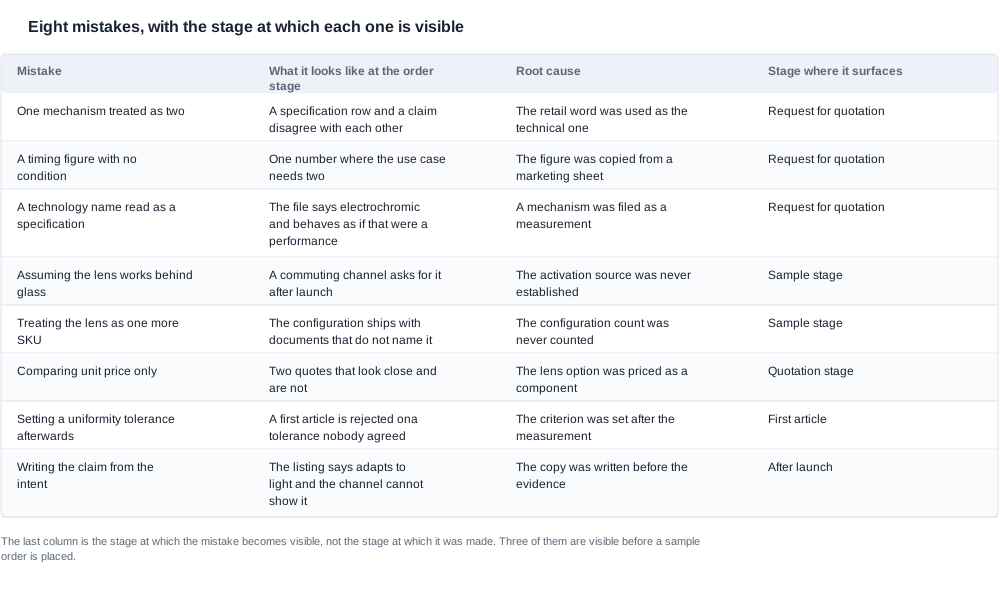
Photochromic: the expensive mistakes sit at order stage
The reason these mistakes cluster at the order stage is that the lens decision is presented as a choice between options and it is actually a change to a product. A colour is an option. A lens is a component with a mechanism, a power path, a material declaration, a set of measurable behaviours and a claim attached to it — and a programme that treats it as a colour change discovers each of those one at a time.
The buyer usually arrives with a quotation, a target price and a market list, and the structural thing they will not hold is the fact that the lens decision reaches into the technical file, the artwork, the instructions, the labelling set and the claims. That is why the eight mistakes below are written the way they are: each one names a symptom you will recognise, the root cause underneath it, and the point at which it becomes expensive.
The two routes our catalogue offers, and why they are not variants
The dedicated entry publishes Bluetooth 5.4, a 100 mAh cell, charging in two hours or less, roughly seven hours of rated runtime, magnetic charging, and electrochromic lenses. There is no model designation, and there is no switching time, no transmission range, no uniformity figure, no temperature behaviour, no cycle durability and no coating detail.
The V03 Pro configuration is a camera platform in the 8 MP class with a 220 mAh cell, a rated runtime of about five to eight hours, Type-C charging, flexible temples, three published colour options, and a photochromic lens listed as a configuration.
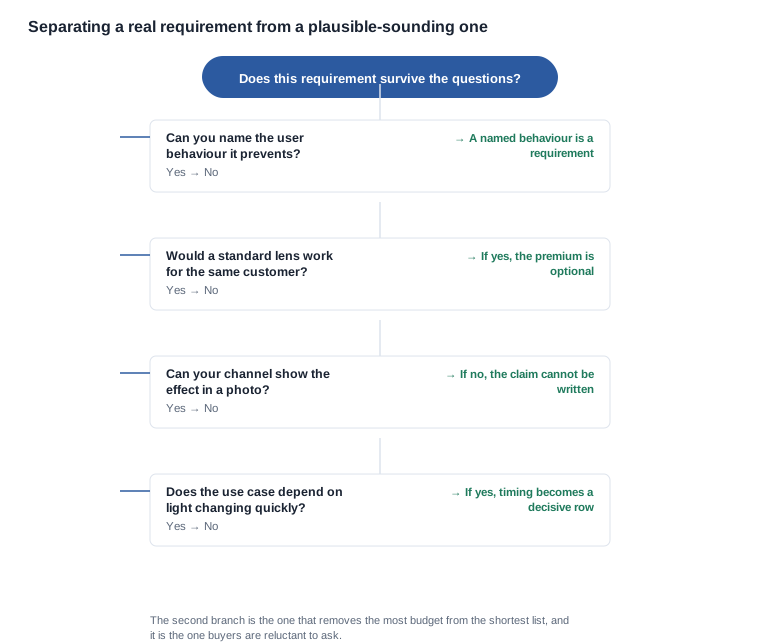
These are two different products whose difference runs through the whole programme. One is a light-responsive product in its own right; the other is a camera platform with a lens option attached. Buying the second because the first exists is a mistake with a schedule attached, and it is worth separating before anything else is decided.
Four mistakes about what the lens is
Mistake one: treating two mechanisms as one product
Symptom: the specification and the claim quietly disagree with each other, and nobody can say which is right. Root cause: the retail word was used as the technical word, or the other way round. A product whose literature says photochromic while its documentation describes an electrically driven lens will produce a customer who expects a mineral-lens behaviour and a compliance file that describes something else.
The distinction is not cosmetic. A passive ultraviolet-reactive lens needs light to darken, so it activates at a reduced level behind glass and its performance moves with temperature. An electrically driven lens responds to a signal, so it brings a power path, a control connection, a defined state and a flat-battery behaviour with it. A hybrid that still needs ultraviolet for its full range carries the passive weakness and the active burden at the same time.
Prevention: ask the mechanism question in writing before anything else, put the answer on the quotation, and let every downstream document inherit it. If the answer is not in writing, it is not a specification and it cannot be defended.
Mistake two: accepting a timing figure with no condition
Symptom: a single number where the use case needs two, or two numbers that cannot be compared with a competitor's. Root cause: the figure was copied from a marketing sheet or from a neighbouring model whose conditions happened to be convenient.
Darkening and clearing are different behaviours with different timings, and a lens that darkens quickly and clears slowly is a good morning product and a poor evening one. A single figure covers both and settles neither. A figure without a light level and a temperature is not comparable with anything, including another figure from the same supplier, because a measurement taken under an artificial source and one taken in daylight are not the same measurement.
Prevention: ask for two figures, each with its conditions, and treat a single number as a measured one direction rather than as a complete answer. Where a supplier genuinely cannot state the conditions, the figure has to come off the comparison table rather than be propagated into it.
Mistake three: filing a technology name as a specification
Symptom: the technical file contains the word electrochromic where a behavioural row should be, and the file is internally consistent and entirely empty. Root cause: a mechanism was recorded where a performance belonged.
This is the most common documentation error in this category, and it is easy to miss because the file looks complete. Every row is filled, every row is accurate, and no row tells the buyer anything about how the product behaves. The consequence is a programme that believes it has a specification and a channel that believes it has a claim, with nothing in between.
Prevention: treat the mechanism as a field of its own in the specification, never as the value of a performance field, and add the empty rows visibly. A buyer who knows a row is missing can act on it. A buyer who thinks the row exists has nothing to do.
Mistake four: assuming the lens works behind glass
Symptom: a customer in a vehicle reports that the lens does not darken. Root cause: the activation source was never established, so the behaviour behind a windscreen was assumed rather than asked about.
This is a specification question rather than a use-case question, and the distinction matters because a specification question has a written answer and a use-case question has an opinion. For an ultraviolet-reactive lens, the glass filters the light the lens depends on, so the behaviour in a car is not a scaled-down version of the behaviour outdoors — it is a different behaviour. For an electrically driven lens, the behaviour in a car depends on the control behaviour, which is a product decision.
Prevention: if the channel includes commuting or driving, the windscreen case goes into the specification and into the copy, and it is answered with a written statement or a measurement rather than with a reassurance.
Four mistakes about how the lens is bought and sold
Mistake five: treating a lens option as one more stock keeping unit
Symptom: the configuration ships with paperwork that does not name it, and the first sign is a customs query or a marketplace rejection. Root cause: the configuration count was never counted, so a lens option was treated as a variant rather than as a new product.
A configuration change is a product change. The declaration of conformity, the model list on each certificate, the labelling set, the artwork, the instructions and the sample all change with it. Four colourways with a lens option is four new combinations, not one, and each combination carries its own minimum order quantity as well as its own documents. Buyers consistently estimate this as a single extra line and are wrong by the number of colourways.
Prevention: make the exact model designation a condition of the purchase order, count the combinations explicitly, and negotiate the per-configuration minimum against a committed combination count rather than a unit count.
Mistake six: comparing two quotations on unit price
Symptom: two quotes that look close and are not, and the gap is explained after the order rather than before it. Root cause: the lens option was priced as a component, while in practice it is mostly fixed programme cost.
The visible part of the cost is the lens module, and it scales with units. The part that does not scale is everything the lens drags into the product: the cell, the driver circuit, the control path, the firmware function, the charging interface and the packaging it forces. And the part that is not in the quotation at all is the specification itself — a named lens carries a commitment, and a commitment carries a minimum attached to it. Two quotations that look like a modest gap on unit price can be a very different gap once the setup and the re-validation are counted.
Prevention: compare the total programme cost, not the line item, and get the lens specification agreed before the quotation is issued rather than negotiated after it. The negotiation capital is worth more spent on the specification than on the unit price.
Mistake seven: setting the uniformity tolerance after the measurement
Symptom: a first article is rejected on a tolerance that nobody agreed to, and the schedule slips by a production slot. Root cause: the criterion was set after the measurement rather than before it.
A centre reading is nearly useless, because a user notices edge-to-centre variation before they notice an average. The tolerance has to be a maximum difference between defined zones, measured on a stated grid, and the grid has to be defined before the first article is produced. A tolerance set afterwards has already been missed, which is the definition of a tolerance rather than a standard.
Prevention: write the uniformity criterion into the request for quotation, with the grid and the measurement points, and carry it into the acceptance criteria for the first article unchanged.
Mistake eight: writing the claim from the intent
Symptom: the listing says the lens adapts to light conditions and the channel cannot show it happening, and the premium is invisible in the marketplace. Root cause: the copy was written before the evidence existed.
The distinction between a description of intent and a performance claim is the distinction between a sentence that cannot be tested and a sentence that will be tested by a customer on a windowsill. Adapts to light conditions is defensible for either mechanism. Darkens in a stated number of seconds is a performance claim that needs a condition behind it, and a sunglass depth claim needs a transmission figure behind it.
Prevention: test whether the channel can demonstrate the effect in a photograph before the product page is written, and write the copy from what the demonstration shows. If the effect cannot be shown, the claim should not be written, and the price should not carry a premium for it.
What each mistake costs, measured in schedule rather than money
Money is the wrong unit for these mistakes because the price of each one falls on a different line and the lines are not comparable. A wrong unit price is recoverable at the negotiation. A wrong configuration count is a documentation cycle. A wrong tolerance is a production slot. A wrong claim is a listing withdrawal, and it is the only one of the four that cannot be corrected quietly.
The three mistakes visible before a sample order is placed
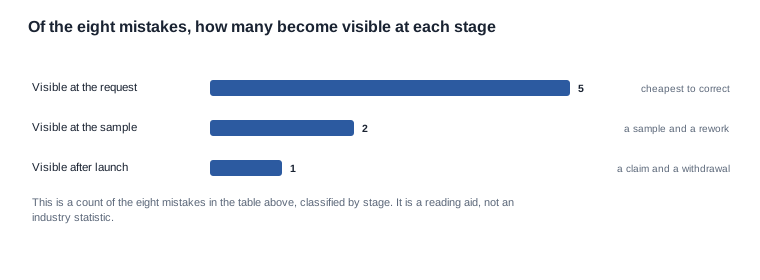
Three of the eight are visible at the request-for-quotation stage, and they are the three with the largest downstream cost. Mistake one, because the mechanism answers determine the material file, the power budget, the test protocol and the claims. Mistake five, because the configuration count determines the documentation workload and the artwork schedule. Mistake eight, because the claim determines what the artwork can carry and what the instructions have to say.
Two more are visible at the sample stage — the windscreen case and the uniformity tolerance — and they are visible only if the protocol was written before the sample was measured rather than after. A protocol written afterwards describes what happened.
The remaining three are visible later and are the most expensive to correct for a different reason: they are all cases where a decision was taken correctly at the time, on information that was incomplete. The mechanism was correct for a product with no camera, and then a camera was added. The lens option was correct for one colourway, and then three more were added. The claim was correct for a channel that could demonstrate the effect, and then the channel changed. In each case the recovery is a re-review of the file rather than a fix, and the cost is a review cycle that was not in anybody's plan.

How to recover from each mistake, and what we will not do
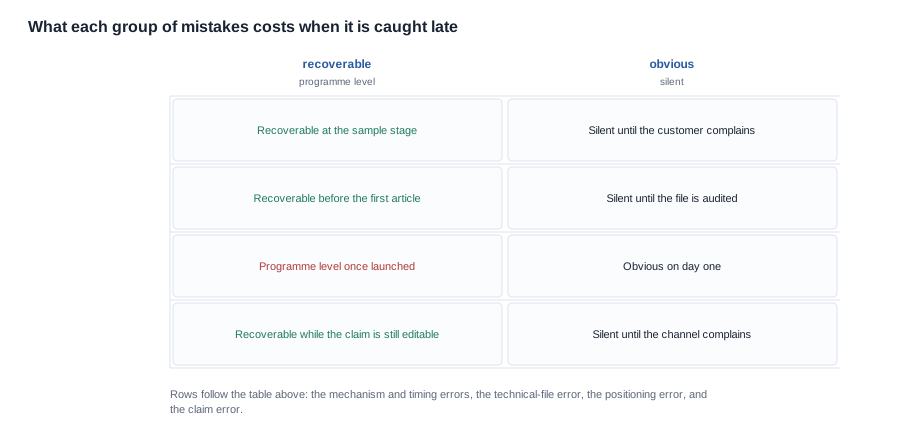
Recovery is possible for most of them, and the recovery window is the useful thing to know. Mistakes one, two and four are recoverable at the quotation stage, because nothing has been committed. Mistake three is recoverable as long as the file has not been assembled — and it usually has not, at that point. Mistake five is expensive once the artwork has been approved, because the model designation determines what goes on the box. Mistake seven is recoverable only before the first article, and a rejected first article is the cheapest version of that lesson. Mistake eight is the least recoverable of the eight, because a published claim cannot be withdrawn quietly and the correction is visible to the channel.
The recovery that is easiest to miss is the one that costs nothing at the time. If the buyer writes the criteria before the measurement, the recovery window is never opened, because there is nothing to recover from. A uniformity tolerance written in the request for quotation, a failure criterion written into the acceptance criteria, a mechanism written on the quotation — each of these is a paragraph of work in a document the buyer has to write anyway, and each of them removes one of the eight mistakes from the list of things that can go wrong later.
The one that costs the most, and why it is not the one buyers expect
Buyers usually expect mistake six, the unit price comparison, to be the expensive one, because it is the mistake with a number attached to it. It is not. The unit price comparison is recoverable — it is a negotiation, it happens before anything is committed, and it is visible to everyone involved the moment it is made.
The most expensive of the eight is mistake eight, the claim written from the intent, and it is expensive for three reasons that have nothing to do with each other. It cannot be corrected quietly, because the correction is visible to the channel and to the customers who read the original. It is expensive to correct late rather than early, because a listing change triggers a re-review on every marketplace where the product is listed. And it is the only one of the eight that damages the product rather than the programme — a claim that fails does not come back as a return, it comes back as a decision not to buy the category again.
That is why the claim question belongs at the request-for-quotation stage even though the claim itself is written much later. The evidence behind the claim is what has to be settled early, and the copy is a consequence of it.
How each mistake is prevented, in one line
If the eight mistakes are reduced to a single instruction each, they are much easier to carry into a live programme.
Mistake one: put the mechanism on the quotation and let the rest of the file inherit it. Mistake two: two figures, each with its condition, or the figure does not go on the sheet. Mistake three: a mechanism is a field of its own and never the value of a behavioural row. Mistake four: if the channel includes driving, the windscreen case is a written specification item. Mistake five: count the combinations, and make the model designation a condition of the order. Mistake six: compare the programme cost, and settle the lens specification before the quotation rather than after it. Mistake seven: write the uniformity criterion and the grid into the request, then carry it into the acceptance criteria unchanged. Mistake eight: demonstrate the effect in a photograph before the product page is written, and price the premium against what the channel can actually show.
None of these requires a laboratory, a legal opinion or a new relationship. They are all decisions, and every one of them is cheaper than the mistake it prevents.
We publish the rows we hold and mark the rest as open, and we would rather show you eight mistakes than six empty fields. We publish no photochromic performance figure for any model in our range: no switching time, no transmission range, no uniformity tolerance, no temperature range, no cycle durability figure, no lens model designation and no camera-interaction behaviour. A plausible-looking figure on a product page becomes a claim a customer will test, and a claim that fails is a return rather than a specification.
We will also be direct about the two routes. They are not variants of each other, and a buyer who treats them as one will find the difference in the technical file rather than in the catalogue.
What we can do is tell you which of the eight mistakes is most likely to cost you, given your channel and your product, and work the measurement protocol with you. The background is under photochromic lens technology, the rows are in photochromic spec sheet explained, the gaps are in what the spec sheet does not tell you, the upgrade side is in photochromic upgrade considerations, and the selection method is in how to choose photochromic smart glasses.
Where the mistake list comes from
Send us your channel and your product and we will say which of these eight mistakes you are most likely to make.


