

A photochromic programme is decided by the lens mechanism, not by the tint depth. A lens driven by ambient light and a lens driven by an electrical signal are different products with different bills of materials, different control paths, different service requirements and different failure modes, and the trade uses one word for both. The number a buyer is shown first is the darkest transmission figure, which is the least diagnostic of the five figures that actually describe a lens. Fix the mechanism, fix the environment it has to work in, and only then compare tint. Everything else in the document follows from that order.
The mechanism decides the lens before the tint depth does
Two mechanisms, one trade word
A light-driven lens changes because the ambient ultraviolet level changes, and the electrical path is absent: there is no control, no current and no actuator, and the lens responds to the environment whether the user wants it to or not. An electrically driven lens changes because the product commands it to, which means the product owns a control path, a power budget, a user interface decision and a failure mode that a light-driven lens does not have.
Both are sold as photochromic. A buyer who accepts the trade word as the specification has not chosen a lens at all, and will discover the difference in a windscreen, in a tunnel, or in a showroom where the lights are fixed.
Our catalogue draws the distinction explicitly. The dedicated entry in our range is an electrochromic product, labelled as such, published with Bluetooth V5.4, a 100 mAh cell, a charge time of two hours or less, a runtime of roughly seven hours and magnetic charging. The V03 Pro lists a light-responsive lens configuration on an existing 8 MP platform, alongside flexible temples and three colour options, and the catalogue does not publish the mechanism behind that lens configuration. That is an honest gap rather than a marketing one, and it is a row to request.
The environment decides which mechanism works
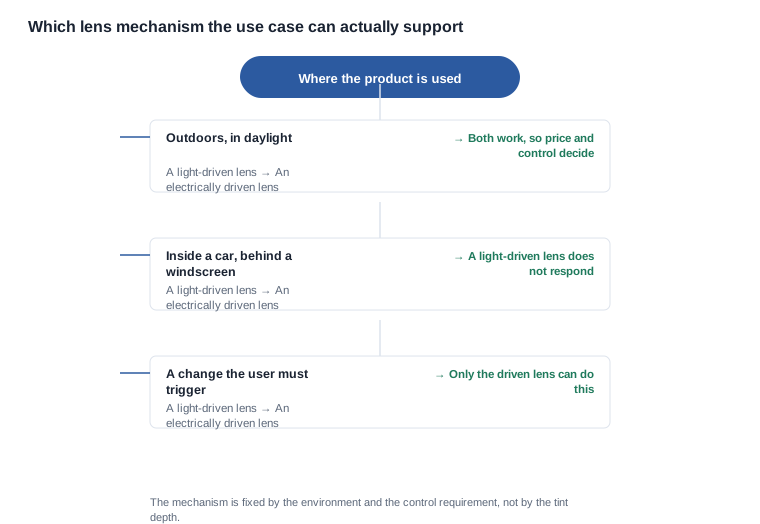
The environment, not the customer, decides the mechanism. Outdoors in daylight, both work, and the choice becomes a question of price, control and the service obligation. Inside a car behind a windscreen, a light-driven lens does not respond as it would outdoors, because the glazing removes a large part of the driving light, and this is the single most common mismatch in the category. When the change has to be triggered by the user rather than by the light, only an electrically driven lens can do it at all.
The three questions that settle it are therefore short. Does the product spend its time outdoors, in a car, or in both? Does the change have to be automatic or user-triggered? What happens to the product when the change does not happen — for a light-driven lens that is a non-event, and for an electrically driven lens it is a flat cell, a failed actuator, or a firmware condition that has to be described somewhere.
A supplier who answers those three with the mechanism named can be quoted against another supplier. A supplier who answers with the trade word has told you the lens is one of two things, and the price difference between the two is not the interesting part of the comparison.

The five figures that describe a lens, and the state each one belongs to
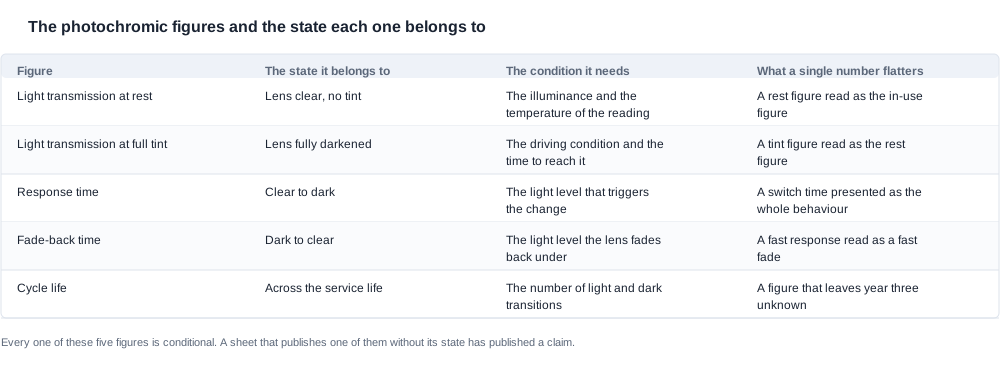
The table at the top of this article sets out the five figures that matter, and the third column is the one that is missing from most supplier material: the state the figure belongs to. Every one of these numbers is conditional, and a sheet that publishes one of them without its state has published a claim rather than a specification.
Light transmission at rest describes the lens when it is clear. The condition is the illuminance and the temperature of the reading, because transmission is temperature dependent. A rest figure read as the in-use figure is the most common way a photochromic product is oversold, and it is the reason two products with the same headline tint can behave completely differently in the hand.
Light transmission at full tint describes the lens at its darkest. The condition here is the driving condition and the time taken to reach that state. Quoted without the time, the figure is a target rather than a measurement, and the time to reach full tint is often the number a customer notices first, because they notice it when the lens is still clearing in a car park.
Response time is the clear-to-dark duration, and it needs the light level that triggers it. A response time without a triggering condition is a laboratory artefact at a threshold that will never occur in the field.
Fade-back time is the dark-to-clear duration, and it needs the light level it fades back under. A fast response read as a fast fade is a common error, and the fade is the more visible of the two: it is the one that happens indoors, in front of the customer.
Cycle life is the number of light and dark transitions the lens survives. Without it, year-three performance is unknown, and for a product in a sunglasses-adjacent channel that is a commercial question rather than an engineering one.
Set the thresholds before the first sample order, not after. A tolerance agreed afterwards is a tolerance that has already been missed, and a lens specification tightened after the lens supplier has quoted is a lens specification that moves the schedule.
What a photochromic listing may state, and what it may not
Because every figure in this category is conditional, the claims available to a listing are narrower than they look, and the narrowness is worth spelling out before the copy is written.
A listing may describe the mechanism, the environment the lens is rated for, the transition behaviour in words, the runtimes and the electrical rows of the underlying product, and the structural features. It may state a transmission figure, provided that the state is named next to it and the condition is available on request. It may state a transition duration, provided the light level is named.
A listing may not describe a photochromic product as automatically darkening, if the mechanism is electrically driven, because an automatic description is a promise the product does not keep on its own. It may not use a single transmission figure as the headline, because the two figures together are the specification and one of them alone is a half specification chosen in whichever direction flatters. It may not carry a claim about the lens in a vehicle, a tunnel or an indoor environment, because those are exactly the cases where a light-driven lens and an electrically driven lens behave differently.
The practical rule for a category where every number has a condition attached is to publish the condition with the number, always. A buyer who copies the figure into a product page without its state has created a support obligation and, in most channels, a compliance question as well.
The questions to put to a supplier before you order, in the order that saves time:
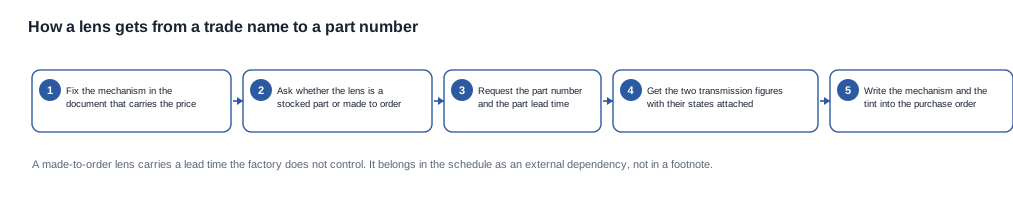
- Which mechanism drives the lens, named in the document that carries the price?
- Is the lens a stocked part or a made-to-order part, and what is its part number?
- What is the part lead time, and is it inside the factory's control?
- What are the two transmission figures, each with its state?
- What are the response and fade durations, each with its light level?
- What is the cycle figure for the configuration being quoted?
- How many lens configurations does the minimum order quantity apply to?
- What happens to the marking and the claims if the lens configuration changes?
The first three decide the schedule, the next three decide what you may write, and the last two decide what a range extension will cost.
Where a lens programme's schedule is really set
The item that most often determines the launch date in a photochromic programme is not the electronics and not the assembly. It is the lens, and specifically whether the lens is a stocked part or a made-to-order part.
A stocked lens carries the lens maker's minimum order quantity and a lead time the factory controls, because the factory holds the stock. A made-to-order lens carries a minimum and a lead time that the factory does not control and cannot compress, because the lens maker's own production window sits in front of it. That number belongs in the programme schedule as an external dependency, and asking whether the quotation includes the lens maker's minimum at all is a question that frequently changes the schedule.
The second scheduling item is the variant count. Every tint, every base lens colour and every logo position is a lens configuration question, and a configuration is a minimum. A programme that launches with one lens configuration and adds a second one later will find that the second one carries its own minimum and its own lead time, which is why a range decision taken at the quotation stage is worth more than a range decision taken at launch.
The third is the artwork. A photochromic product is usually sold in a configuration that includes a lens, so the packaging, the product photography and the instructions all change with the lens, and each of them carries a round of approval. The artwork is the last item in the schedule and the one with the least tolerance.
It is worth being clear about where the lens sits in the supply chain, because it determines who answers the questions. The lens usually comes from a specialist maker rather than from the factory, so the factory is often the party that quotes the lead time rather than the party that controls it. A buyer who asks the factory for the lens lead time is asking the wrong question once, and the right question twice: which party holds the stock, which party holds the part number, and which party signs the lens data that goes into your file. Where a factory manages the lens relationship well, it will have the answer in a document. Where it does not, the answer will be a phone call, and it will be a phone call every time the schedule is reviewed.
Checking a lens claim on a sample
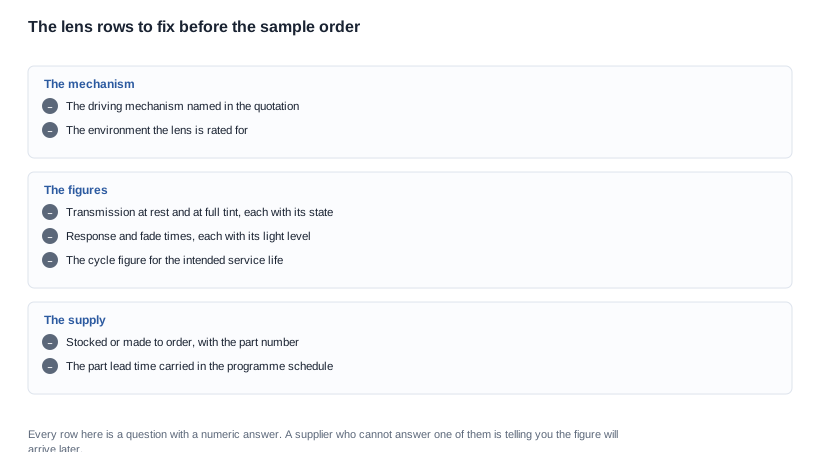
The sample protocol for a lens is short, and every step produces a number rather than an impression.
- Establish the mechanism on the unit in your hand. Ask for it in writing, and then check whether the lens responds to a change in the ambient light or to a command from the product. The second is a control test: drive the lens through its full tint and clear states and watch what it does.
- Measure the transition. With the unit in a defined environment, record how long the lens takes to reach its darkest state and how long it takes to clear again. Write the environment down next to both numbers.
- Check the transmission at both ends. The two figures are only useful as a pair, and a supplier who will give one and not the other is choosing which comparison to allow.
- Ask for the lens part number and the batch. The lens is the part most likely to be substituted, because it is the part hardest to identify in a warehouse, and a substitution is invisible until a customer complains about the tint.
- Ask for the cycle figure. If none exists for the configuration, treat that as an open row and price the risk, rather than assuming the lens is unlimited.
Two of those five steps are documentary and can be completed before the sample arrives, which is the point. The lens order and the documentation request belong in the same conversation, because a lens that takes six weeks to arrive and a lens specification you cannot obtain are two different problems, and only one of them is visible in the schedule.

What a lens programme costs, and what you can actually move
The commercial treatment of a lens is the item buyers underestimate most. A custom lens carries a minimum and a lead time the factory does not control, and it is frequently the longest wait in the whole programme. Tooling is not usually involved in a lens change, but artwork and packaging are, and a lens specification change after the packaging is approved is a reprint.
The numbers that move in a negotiation are the factory's own scope numbers: the minimum against a committed combination count rather than a unit count, the number of lens configurations committed at the outset, the artwork round count, and the retention held against the documentation package. Committing to a combination count rather than a per-lens-configuration count is the lever most buyers never pull, and it is the one that turns a lens minimum from a constraint into a volume tier.
The numbers that do not move are the lens maker's own cost and queue, and the cost of any new moulding required for a fresh base colour. The clause worth having in the agreement is the one that ties the lens specification in the order to the lens in the approved sample, because that is the clause that catches a substitution and the clause that gives you a remedy when one happens.
The total cost of a photochromic programme is the unit price plus the lens lead time carried in the schedule plus the artwork rounds plus the returns reserve for a product that behaves differently from a static lens. Which of those to press hardest depends on where your own programme is weak.
A worked example: a brand adding a light-responsive lens to an existing line
This is a worked case rather than a live order. Which order the decisions take.
Assume a brand with an established 8 MP camera line and a retail buyer asking for a light-responsive variant for an outdoor channel. The brand's constraint is that the variant has to ship in the same quarter as the base line, and the lens is not in stock.
The base platform is chosen first. The buyer accepts that the variant sits on the existing platform, with the existing battery, runtime and interface, and that the lens is the only variable. That decision is worth stating explicitly, because it removes the temptation to evaluate a second platform and it keeps the sample count down to the two candidate lens configurations.
The mechanism question is put in writing. The brand asks whether the lens on the V03 Pro configuration is light-driven or electrically driven, and what the part number and the lead time are. The answer establishes whether the variant can work inside a car at all, which the channel will ask about in the first call, and it establishes the length of the external wait.
The acceptance criteria are set before the sample. The brand writes down the transition durations, the two transmission figures and the environment in which they were taken, and puts them in the sample evaluation sheet. A supplier that cannot meet the stated transition timing in a defined environment says so at the sample stage rather than after the artwork is locked.
The artwork and the lens run in parallel. The packaging and the product photography are produced against the lens configuration that is actually on the purchase order, with the tint visible in the images, so that the customer receives what the page showed.
The substitution clause is added. The order ties the lens in the sample to the lens in the shipment, and a part number and batch are required on delivery.
The result is a variant that launches in the same quarter, with a lens behaviour the channel can describe accurately and a clause that catches the most likely failure. The decisive decision was the one about the platform, and it was taken before anything was ordered.
Our published position on photochromic, and what to send us
Here, we publish the rows we hold and mark the rows that are open, and we will not fill an open row with a plausible figure.
The rows our published data does settle are these. Our catalogue contains one photochromic entry, an electrochromic product published as Bluetooth V5.4, a 100 mAh cell, a charge time of two hours or less, a rated runtime of roughly seven hours and magnetic charging. The V03 Pro separately lists a light-responsive lens configuration on an existing 8 MP platform, published with flexible temples, a Type-C charging port and three colour options.
The rows we do not publish are these. Transmission at rest and at full tint, response and fade durations, cycle life, lens part numbers, lens batch identification and lens lead times are not published for either configuration. We will not estimate them, and we will not convert a feature name into a measured claim, because a photochromic listing that quotes a tint without a state and a condition is a listing that cannot be defended when a customer compares it with a competitor who does publish them.
If you are evaluating this category, send us the environment the product has to work in, the target market, the quantity and whether the transition has to be automatic or user-triggered, and we will tell you which configurations exist, what the published rows settle, and what will have to come from the lens maker. The technical background is under photochromic lens technology, and the comparison method is set out in how to choose photochromic smart glasses.
Related reading
-
The two technologies side by side — how photochromic works
-
The specifications behind the lens — photochromic key specifications
-
Where the marking and the lens sit — photochromic certification requirements
Send the environment, the configuration and the market, and we will say which parts of the lens specification are settled and which are yours.


