
A children's product is tested in a different order from an adult one, because the first question is not what it does but what it is allowed to be — and the second question, which the first one usually hides, is who controls the reminder cadence. The cadence sets the drain, the drain sets the endurance figure on the product page, and the cadence is normally set in firmware by whoever wrote it, not by the brand that sells the product. If a buyer does not establish where that control sits before the sample order, the family switches the feature off in the first fortnight and the twenty-hour figure in the catalogue describes a product that is sitting in a drawer. So the programme is: establish the regulatory position per market, fix the control points and who owns each one, test the sensing behaviour and log it, measure the sizing across the range, and run a household programme that produces adoption evidence rather than a demonstration. And we make no results claim about vision, health or eye protection for any product, in any market — the correct positioning is a compliant device with named functions, not a benefit claim about eyesight.
How to test kids eye protection glasses technology: the reminder cadence is not yours to set
The person signing the order and the person wearing the product
Three people are involved in a children's line and they are not the same person. The brand's product manager writes the listing and owns the claim. The parent decides whether the product stays switched on, and the parent does not read a datasheet. The child decides, on day one, whether the product stays on the head at all. The factory writes the firmware, and the firmware decides how often the reminder fires.
That chain is where the commercial risk sits, and it is invisible in a specification. A detection range is a number in a table. The cadence is a behaviour, and the behaviour decides whether the product is used. A reminder that fires every ninety seconds is a product the family disables, and the family is not going to send it back — they will simply stop using it, and the return rate will look like a fit problem rather than a cadence problem.
A buyer running this programme is usually building a children's line or adding one to an existing range, and they are holding samples, a target price, a size range and a market list. What they are not holding is the certification file for the exact model, and the reason is that in this category that file is genuinely expensive and slow to assemble, and because several of the children's platforms in circulation were derived from an adult platform without a fresh evaluation of their own.
The published rows for our own children's models are narrow and specific, and it is worth reading them as a list of what is settled rather than as a list of features. The A05 and the A06 publish a 40 mAh cell, magnetic charging and approximately twenty hours. The A07 publishes 70 mAh, the same charge time of two hours or less, and the same twenty hours. The published feature set across the tier is a lens-based electronic anti-fogging arrangement, posture and viewing-distance sensing with a reminder function, a low-power Bluetooth connection, and long endurance. The certification position is not published for any of them, and neither are the detection parameters, the frame weight or the dimensions.
Why a cadence set in firmware is a fixed drain
The twenty hours in that row is a duty-cycle figure, and a duty-cycle figure is the product's endurance multiplied by a factor that nobody can see. The same three models publish it on a 40 mAh cell and a 70 mAh cell, which tells you immediately that the cell is not what the figure is measuring. The reminder frequency is what it is measuring, and the reminder frequency is a setting.
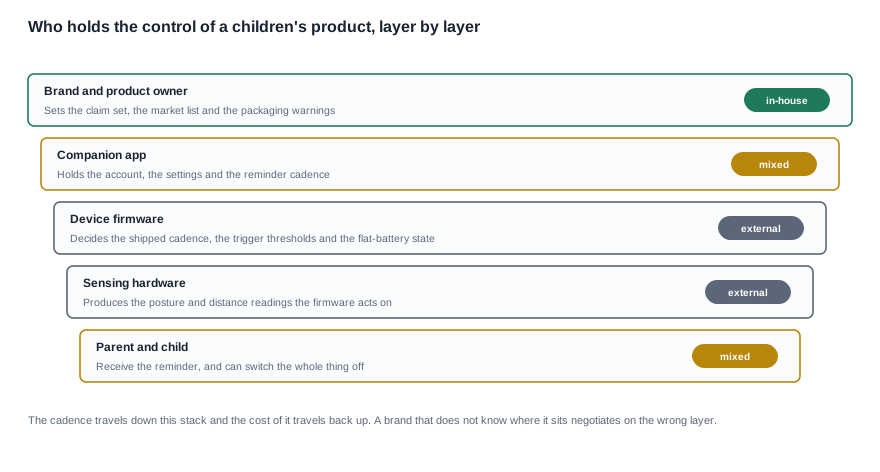
The layering above is the thing to hold in your head for the whole programme. The cadence travels down the stack from whoever configures it, and the cost of it travels back up. If the firmware ships a fixed cadence and the brand has no way to change it without a firmware release, then the drain is fixed, the endurance figure is fixed, and the only lever the brand has is the claim it makes about that fixed number. If the cadence is configurable through the companion app, then the brand has a lever, but also a responsibility: the product's endurance now depends on a setting a parent makes, and the product page has to say what the setting does.
The practical consequence is that "twenty hours" cannot be evaluated as a specification at all until the cadence question is settled. It is an output of a policy, and the policy is the thing you have to buy.

What a buyer of a children's line is actually approving
Three situations show up, and each of them is a different approval with a different document load.
The first is a brand adding a children's model to an existing platform, which is the cheapest route and the one where the control question is most often skipped. If the sensing and the reminder already exist in the platform, the brand inherits a cadence it never designed, along with a detection range it never evaluated. The work is not the hardware; it is establishing who can change the default and what the default is.
The second is a brand opening a dedicated children's line, where the product is its own bill of materials and the entire conformity file is new. Here the cadence is a decision the brand makes, and it should make it explicitly rather than accept it.
The third is a distributor adding the tier to a range they already stock, where the accessory and documentation questions outnumber the technical ones and the brand has very little control over the copy that ends up on the listing.
What the buyer is afraid of is specific in all three cases. The first is a product the family turns off in a fortnight, which is invisible in the return data until it is too late. The second is a listing that makes a claim about eyesight which the documentation does not support, which is a compliance exposure in several markets and has to be checked before the listing goes live rather than after it is published. The third is a product that does not survive being worn, where a twenty-hour runtime is irrelevant if the child removes it in an hour and the sizing is the variable that decides that.
The regulatory boundary is worth stating early because it changes the order of everything else. A children's product carries a documentation and safety obligation, and the applicable requirements in a given market are the children's product standards rather than the general consumer electronics set. The boundary we publish is covered in medical device boundary and the children's product requirements in child product compliance, and neither is a marketing question — both are conditions of being allowed to sell.

The four control points, and the thresholds that go with each
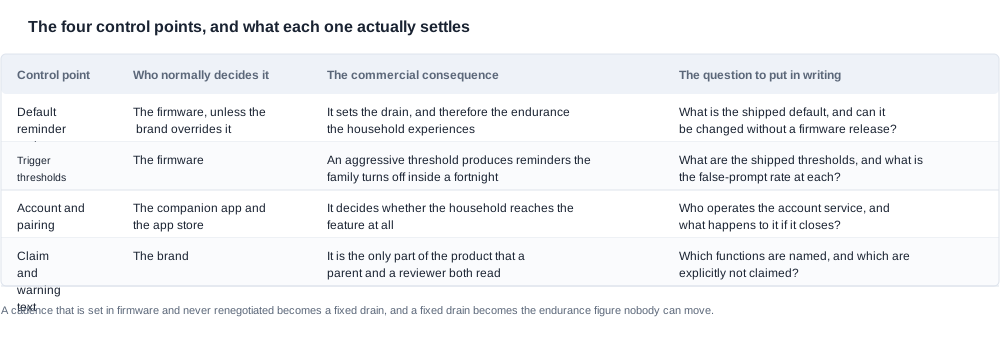
The four rows in that table are the control points, and each of them has to be asked about in writing, in the same form, of every supplier, before the samples are tested. The right-hand column of the supplier request list separates a supplier who has measured the product from one who is describing a feature.
The default reminder cadence is the first, because it is the one that decides the drain. The threshold to hold is a stated shipped default, expressed as a number of prompts per hour, and the answer to a second question that usually matters more: can that default be changed without a firmware release. A cadence that can only be moved by the factory is a fixed drain, and a fixed drain is a fixed endurance figure that has to survive whatever the brand wants to claim.
The trigger thresholds come next, because they decide how often a prompt fires for a child who is doing nothing wrong. The threshold to hold is a false-prompt rate at each shipped threshold, measured in a real room with a real child rather than in a lab. A reminder that fires when the posture is acceptable is a product the family disables, and the rate has to be low enough that the household keeps it on. This is the single most commercially consequential number in the whole category, and it is not published for any model we sell.
The account and pairing path decides whether the household reaches the feature at all. If the cadence is adjustable in an app, then the account, the pairing and the app itself are part of the product's working state, and the brand needs to know who operates that service and what happens to it if it closes.
The claim and warning text is the fourth, and it belongs to the brand rather than to the factory. The criteria here are not a threshold but a boundary: which functions are named, and which are explicitly not claimed. A listing in this category should describe functions and documentation, and it should have been reviewed against the certification file before it was published.
What each control point costs you in drain and in adoption
The sensing range decides whether the feature works in the real world. How far from the face does the product have to be, and how much does the reading change as it moves? A posture sensor that only functions at one distance stops working the moment a child looks down at a tablet, and the household will conclude the product is broken.
The reminder interval and the trigger logic are the product, not a setting. How often does it prompt, and what does it treat as bad posture versus bad distance? An adjustable interval is a product whose drain changes with the setting, and that question belongs to the endurance row before it belongs to any other.
The twenty hours is a duty-cycle figure and the same three models publish it on two different cell sizes. The reminder frequency is what it is actually measuring. A buyer who quotes twenty hours without the cadence attached is quoting a number that describes a policy rather than a product.
The anti-fogging arrangement has to be tested as a mechanism rather than as an outcome. Ask what it actually is, what it consumes, and how it behaves when it runs out. A feature that is a consumable in disguise is discovered in month two, and the discovery is a complaint rather than a specification.
A children's sizing range has to be established on children. A product whose sizing is established on one adult head is not a children's product that has been qualified, and no amount of documentation changes that.

Running a household programme that produces adoption evidence
A week in a household, written down properly
The test programme for this category is longer than it is technical. Its purpose is to answer one question that no specification answers: does the family keep the product switched on.
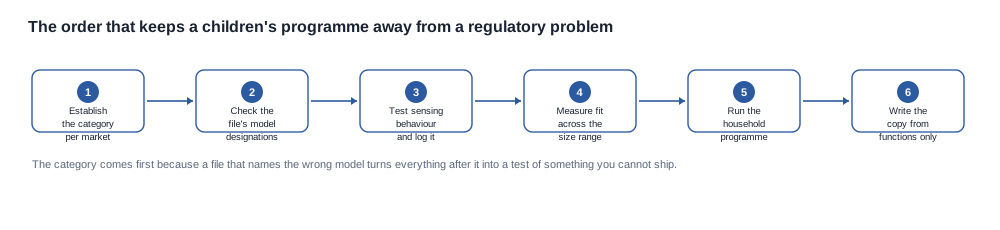
The five steps below are in that order, and the order is not a preference. The category comes first because a file that names the wrong model turns everything after it into a test of a product you cannot ship.
Establish the product's category per market, before anything else. Confirm the regulatory position for each target market, and check the certification file's model designations against the units in your hand. If the file does not name your model, everything after this point is a test of a product you cannot ship.
Test the sensing behaviour and log the numbers. The sensing range, the reminder interval, the trigger logic and the false-prompt rate, each with its conditions attached, each written into the acceptance criteria for the first article.
Test the anti-fogging arrangement as a mechanism. Find out what it is, how it is replenished, what it consumes, and what happens when it runs out. Record the observable behaviour before and after, because a photograph of a clear lens proves very little about month three.
Measure the sizing and the weight across the range. On the units you will actually ship, with children of the ages you are targeting rather than with one adult head.
Run the household programme. This is the step that produces the evidence nobody else has, and it is the one that gets skipped when the schedule is tight.
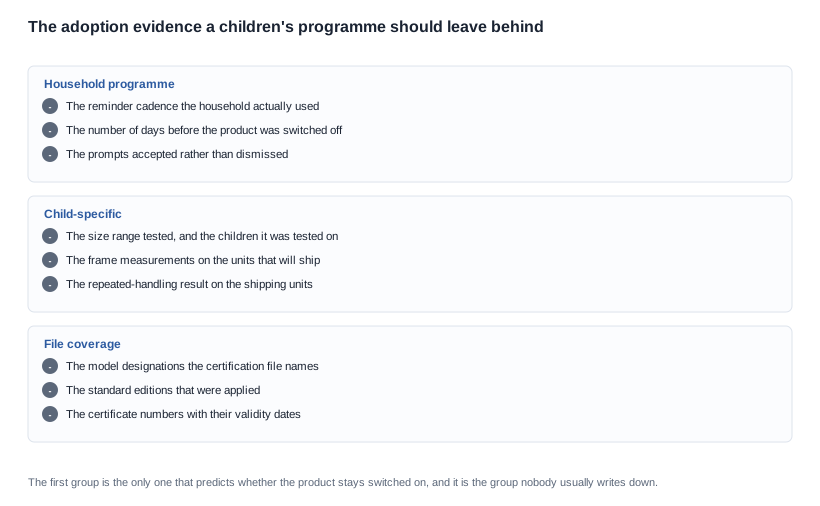
The three groups in that checklist are what the household programme is designed to produce, and the first group is the one that predicts whether the product stays switched on:
- The reminder cadence the household actually used, in prompts per hour, rather than the default.
- The number of days before the product was switched off, and by whom — the parent, the child, or both.
- The prompts that were accepted rather than dismissed, which is the closest thing to a satisfaction signal this product can produce.
The other two groups are ordinary qualification work — the sizing range and the frame measurements on shipping units, the repeated-handling result, and the file coverage with its model designations, standard editions and certificate numbers.
Two rules make the programme usable rather than merely interesting. Run it on more than one household, because one household's habit is one household's habit. And run the whole thing on two units of each model, because the variation between two units of the same model is the variation a customer's unit will actually be inside.
Where a children's line loses its second order
The feature is switched off within a fortnight and the return is attributed to the battery. The root cause is that the false-prompt rate was never measured, so the shipped cadence was too aggressive for a real household. The prevention is to measure the rate with children in a real room and to set the acceptance criteria from the result rather than from the datasheet.
The listing makes a claim about eyesight and the product is pulled. The root cause is that the copy was written from the category name rather than from the certification file. The prevention is to have the copy reviewed against the file before publication and to keep the claim set to functions.
The product runs flat by the afternoon for the heavy users. The root cause is that the runtime was published as a bare figure and the cadence that produced it was never varied. The prevention is to run the product at a realistic interval on both cell configurations and to publish the condition beside the number.
A child's glasses come back broken and the cause is never established. The root cause is that the durability case was never built, and that the sample used in the showroom was not the sample that shipped. The prevention is a repeated-handling test on the units you will actually ship, with the failures logged rather than replaced.
The file covers one model and three models are in the range. The root cause is that similarity was assumed to be coverage. The prevention is to ask which designations the file names and to make the answer a condition of the purchase order.
The second order is smaller than the first because the family cadence was never negotiated. This is the failure that is specific to a children's line and it is invisible in the shortlist. The first order is bought on the feature; the second order is bought on the evidence that the feature survives a fortnight. A brand that never produced that evidence is negotiating the re-order from a position it has not earned, and the questions to ask in that negotiation are about the household data the supplier holds from the first run rather than about the unit price.
A worked scenario: a brand opening a children's line
Assume a brand with an existing adult range that is adding a children's tier for the first time, with two size configurations, four colourways and a target market list of three countries. The binding constraint is not the price. It is that the brand's compliance reviewer will not approve any copy that implies a benefit to eyesight, and the brand has no idea yet who sets the reminder cadence.
The category is settled first. The brand confirms the product's regulatory position in each of the three markets, and checks the certification file against the model designations it intends to order. The file covers one of the two size configurations, which is a real gap, and it turns the second configuration into a precondition of the first order rather than something to sort out later.
The cadence is asked about before the sample arrives. The brand asks which of the four control points it can influence. The answer, for this platform, is that the shipped default cadence and the trigger thresholds are set in firmware, and that the brand can request a change through the supplier rather than through an app. That answer is disappointing and it is also the most useful thing the brand learned this month, because it tells the brand that the endurance figure is a policy rather than a variable, and that the policy has to be negotiated as part of the programme.
The false-prompt rate is measured on children. On the shipped default, in a real room, with the number of prompts recorded against the number of genuine posture events. The result is higher than the brand wanted, and the brand asks for a threshold change before the first article rather than after the launch, which is the only point at which the request is cheap.
The household programme runs on two households and two units of each model. One household switches the reminder off on day four and the reason is that the prompt fires while the child is reading at a desk, not while the child is slouching. That is a threshold problem rather than a cadence problem, and it is fixed by narrowing the trigger rather than by slowing the prompts.
The copy is written from functions. The listing names posture and viewing-distance detection, an anti-fogging arrangement, and the endurance figure with its condition attached. It makes no claim about eyesight, and the compliance reviewer approves it because the claim is narrower than the documentation.
The re-order is negotiated on the household data. The brand goes back to the supplier with the first-run household results and asks for a narrower trigger as a condition of the second order. The supplier agrees, because the alternative is a second order that arrives into the same evidence gap the first one did.
The result is a line with a defensible claim, one documented gap that is named rather than hidden, and a re-order conversation that has data in it. The decisive decision was the cadence, and it was taken before the sample order rather than after the first return cluster.
What we can evidence about the A05, A06 and A07
Here, we publish the children's models' electrical rows and mark the rest as open, because in this category an invented number becomes a safety statement on a product page that a parent will rely on.
What we publish for this tier is the 40 mAh cell on the A05 and the A06, the 70 mAh cell on the A07, the charge time of two hours or less, the roughly twenty-hour runtime, magnetic charging, Bluetooth 5.4 on the A07, and the presence of posture and viewing-distance detection with a reminder function. What we do not publish, and will not estimate, is the detection range, the trigger thresholds, the false-prompt rate, the default reminder cadence, the frame weight, the dimensions or the size range, and we publish no certification status for any of the three models.
We also make no vision, health or eye-protection efficacy claim for any of our products, in any market, and we would rather a buyer runs the copy past someone qualified than find out afterwards that the claim was the problem. We publish one unit weight in the whole catalogue, 158 g for the MT6, and no children's model publishes one.
What we will do is supply units, run the programme with you, and tell you which findings are consistent with the published rows and which point at something the product description should say. The background is under kids eye care technology, the endurance question is in battery life for kids, the durability case is in kids smart glasses durability, and the range is at kids smart glasses.
Four actions before the next supplier call
Ask who sets the cadence. Shipped default, trigger thresholds, and whether either can be moved without a firmware release. The answer decides how you evaluate every endurance figure in the range.
Send the control-point request as a list. The default cadence, the thresholds, the false-prompt rate at each threshold, the account path and its operator, and the model designations the file names. The questions to ask are the same for every supplier, so the comparison between them is fair.
Write the household programme into the schedule now. It is a week of wall-clock time and it cannot be compressed, and it is the only thing that produces the evidence the re-order will be negotiated on.
Send us the two size configurations and the destination markets. We will say which steps decide it, which rows our documentation answers today, and which ones have to be established on your own units. The background is under kids eye care technology and the range is at kids smart glasses.
Where the test programme comes from
- Kids eye care technology
- The child product compliance boundary
- The medical device boundary
- Kids smart glasses range
Send us the size configurations and the destination markets and we will say which steps decide it.


