
The megapixel number is the one figure everybody shortlists on and nobody can defend. It is easy to read, it is easy to compare, and it does not mean what a buyer assumes it means. A 13 MP sensor counts more pixels than an 8 MP sensor. It does not say that the resulting picture collects more useful information, because the number of pixels and the amount of light each pixel gathers are independent variables — and in low light, which is where first-person video is actually shot, the second one dominates.
So the conclusion first.
If your priority is first-person video that survives movement, choose on the architecture — the field of view, the sensor module, the video specification and the stabilisation method — and verify on a sample. The published megapixel figure is a quantity, not a quality measure, and a buyer who shortlists on it is choosing the cheapest available proxy for a question nobody in the supply chain has answered.
If the camera is an accessory on an audio product rather than the product itself, the decision is a positioning and packaging decision rather than a specification decision. In our range the 8 MP tier carries the same published battery and runtime rows as the 13 MP tier at a lower cell capacity, so the extra capability is paid for in mass and endurance rather than in a feature the customer will use.
Ask for the sensor module part number before you ask for any performance figure. It is the cheapest question to answer and the most diagnostic one, because the answer tells you whether the supplier controls the part that determines the picture.
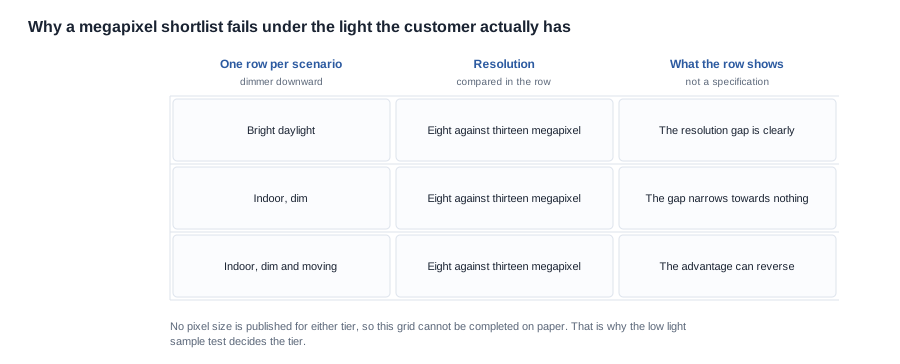
Do not publish a resolution figure as though it were a quality claim. An 8 MP or a 13 MP figure counts what the sensor collects. It is not a statement about what the picture looks like, and no sensor data is published to us from which such a statement could be derived.
Smart glasses camera technology: what our tiers publish, and what stays open
Our range publishes two resolution tiers, and that is the entirety of the imaging data available to a buyer. The thirteen megapixel tier appears on the L1 Pro and the L2 Utral, both with a 290 mAh cell, a charge time of two hours or less, a rated runtime of about seven hours, and a published case capacity of 1400 mAh for the L1 Pro with 900 and 1400 mAh options for the L2 Utral. The eight megapixel tier spans seven models, and the spread inside it is much wider than the spread inside the higher tier: cells from 220 mAh to 290 mAh, rated runtimes from five to eight hours, magnetic and Type-C charging, cases on some models and not on others, and published differences in temple design, colour options and lens configuration.
That asymmetry is worth pausing on, because it is a procurement finding before it is an imaging finding. The higher resolution tier in our catalogue is the narrower and more standardised choice — two models with the same cell, the same runtime and a case on both. The lower tier is where the variety lives, and it is where a range programme, a multi-market line or a tiered price structure is built. A buyer who wants one SKU deployed across several markets has less to configure in the thirteen megapixel tier. A buyer who wants a range has more to configure in the eight megapixel tier, and more to get wrong. The two facts are unrelated to image quality, and both of them bear on how the programme goes.
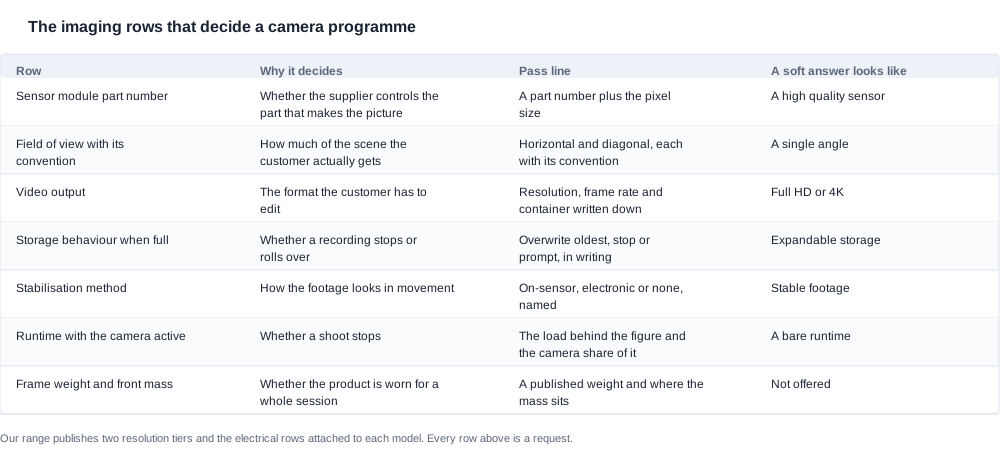
What is not published for any model in this range is the long list that actually decides the outcome: the sensor model, the field of view, the video resolution and frame rate, the stabilisation method, the low-light behaviour, the storage format, the sensor module part number, the pixel size, and the unit weight beyond the single published figure of 158 g for the MT6.
That gap is not a supplier failing to be forthcoming in the usual sense. It is structural, and understanding why changes the question you ask. Imaging data is generated by the module maker. The assembly factory frequently integrates and resells a module it did not design, and the data that would let a buyer compare two such products on picture quality does not exist at the assembly stage because it was never generated there. The consequence for a buyer is specific: a performance claim is not a request a factory can always answer, while a part number is. A factory that cannot name its module is telling you that it does not control the part that decides the picture, and that is information worth having before the deposit rather than after the first article.
The module boundary, and why it decides who controls the picture
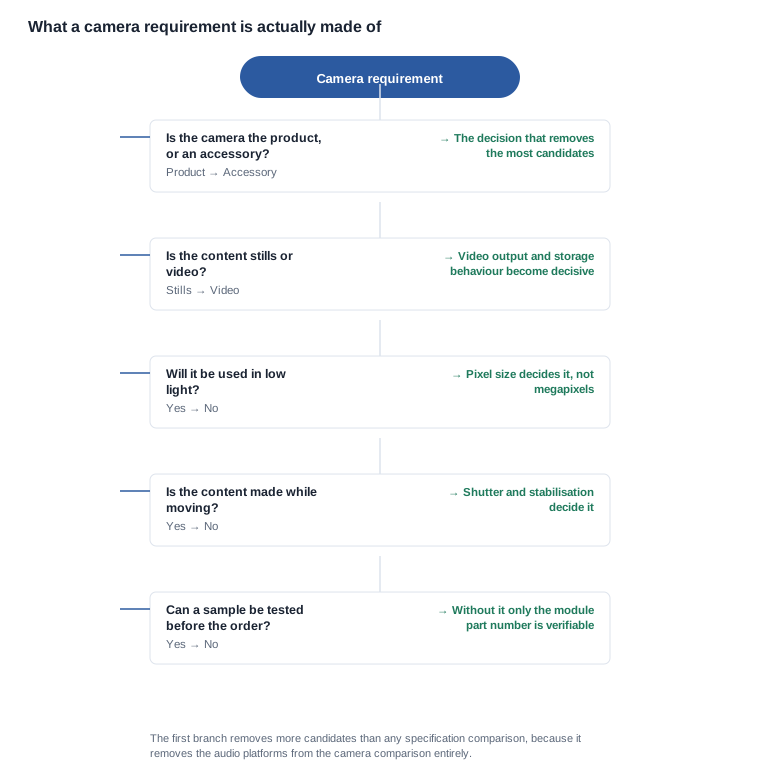
The most useful row in the whole of this category is the module part number, and it is worth being precise about why it does more work than any of the performance figures.
A part number is specific, checkable and stable. It can be looked up, compared against a second sample, written into a purchase order as a line item with a value attached, and used in a change-control clause with real force. A performance figure is none of those things: it is a summary of a test under conditions that are usually not stated, and it is a summary produced by whoever ran the test, which is frequently the module maker rather than the factory.
The four requests that matter, in the order we would make them:
- The sensor module part number. The cheapest question to answer and the most diagnostic one. It tells you whether the supplier controls the part.
- The field of view, horizontal and diagonal, each with its convention. This is the single most consequential missing row, and the convention is what makes comparisons wrong. A horizontal 90 degrees is a diagonal of roughly 110, so a comparison across conventions produces a confidently wrong answer. The frame's own geometry also occludes part of the scene, and that occlusion is a function of the front's width and height — which is why the usable field of view is always less than the sensor's.
- The video output specification. Resolution, frame rate and container format, written down. "Full HD" and "4K" are labels, not specifications, and neither tells you the frame rate, which is the row that decides whether movement looks smooth or broken.
- The pixel size. This is the row that decides low-light performance, and it is the reason the two published tiers tell you nothing about which is better in dim conditions. A sensor with fewer, larger pixels can gather more light per pixel and beat a higher-resolution sensor with smaller ones.
If a supplier will not answer the first, you have a legitimate route that is faster than three rounds of correspondence: ask the module maker directly. That is normal practice in a private-label programme, and a supplier who objects to the question is generally not the module maker, which is itself the answer you needed.
One more architectural point belongs here, because it connects the camera to the rest of the product and it is where the cost hides. The camera is the heaviest and the most power-hungry element on a head-worn product, and its load is not optional — it is a design constraint that has to be budgeted at the same time as the platform is chosen. A camera added to an audio product that was specified without one collapses the runtime, moves the mass forward on the temple, and adds a storage subsystem with its own behaviour. That is a decision about the product rather than about the camera, and it is cheaper to make before the platform is chosen than after.
Writing the four sample tests before the samples arrive
Because the published data cannot settle the question, the question is settled by a test. The four tests below are ordered so that each one finds more than the one after it, and the protocol has to be written down before the sample arrives — a protocol designed afterwards is a description of what happened.
Test one: the walk test. Record while moving at a normal walking pace, then watch the footage back. This is the test that exposes a slow shutter, and a slow shutter is the specification no product page mentions, because it is invisible in a still and obvious in motion. A ten-second recording is enough to see it.
Test two: the low-light test. In the actual environment rather than a dark room, comparing a 13 MP unit and an 8 MP unit side by side under identical conditions, with the same content and the same movement. This is the test that decides the tier, because the resolution advantage can narrow and even invert in poor light — and because the pixel size, which is what actually determines the outcome, is not published for either tier. The grid above is why a shortlist on resolution cannot be completed on paper.
Test three: the storage test. Fill the storage deliberately and observe what happens. Whether the recording overwrites the oldest file, stops, or prompts the user is a behaviour of the shipped firmware, it is invisible in a specification, and it is the behaviour that determines whether a customer can record a full day without losing the morning. A product whose storage fills and stops is a different product from one that rolls over, and a buyer who confirms the video format but not the storage behaviour discovers the behaviour in the field, in a customer's hands.
Test four: the control test. Use the button or the remote during actual movement, and record the far end as well as the unit's own output. A remote capture that works on a desk and not while walking is a feature that fails in the only situation the product exists for. Two of our published platforms carry a remote capture function, and the test is the same for both.
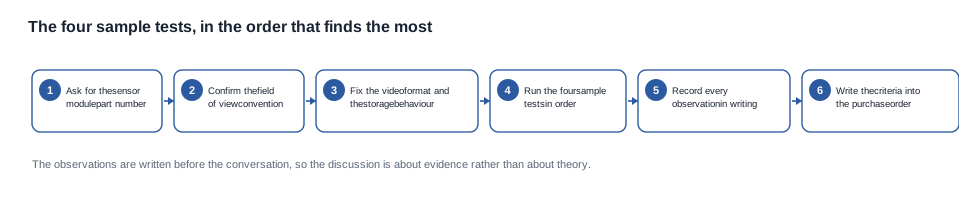
Two practical rules make the whole programme hold together. Write every observation down before you discuss it. A supplier disputing a written observation is arguing with evidence; a supplier who has never seen the test is arguing from theory, and the first conversation is far more productive than the second. Put the results into the purchase order. The test results become the acceptance criteria for the production lot, so that a lot which behaves differently from the approved sample is a lot you can refuse.
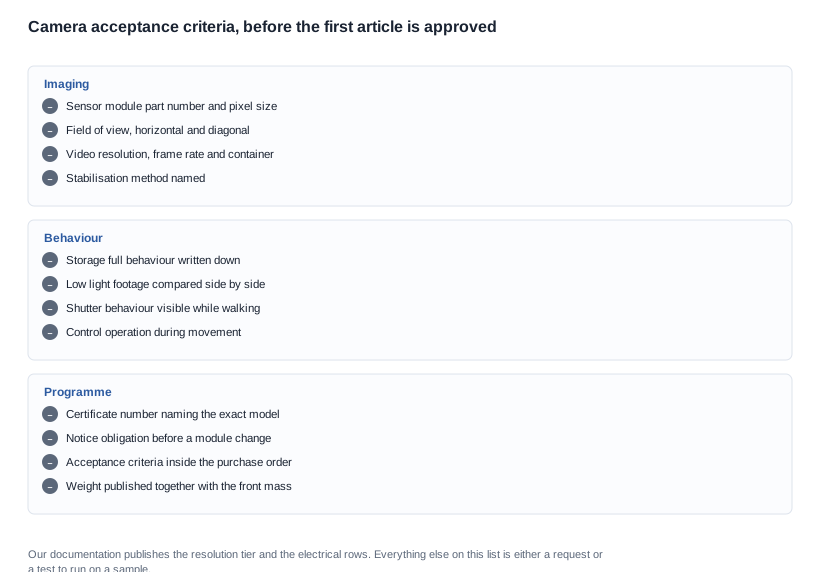
The documents to request before a deposit are: the sensor module part number; the certificate numbers with the issuing body and the validity dates; the declaration of conformity for the exact model designation; a written statement of the storage behaviour and the video format; and the measurement conditions behind the runtime figure.
A worked shortlist: a content brand choosing between the two tiers
The following is a hypothetical sourcing exercise, written to show the sequence rather than to report an outcome.
Assume a mid-size European brand selling first-person video to cycling and running communities, with one model, three markets, and a listing that leads on "capture everything". The binding constraint is not the price. It is that the brand's own community reviews the footage rather than the specification, and a reviewer who finds the field of view narrow will say so publicly.
Step one: the use case classification. The camera is the product, not an accessory, and the content is video made while moving. That makes the video specification and the field of view decisive, and it rules the audio platforms out of the comparison entirely.
Step two: the architecture rows. The brand asks for the module part number and receives one. The field of view comes back with both angles and their conventions, which is what allows a comparison with the competitor sample the brand buys on the open market. The video specification comes back as a resolution, a frame rate and a container, which is what allows the two candidates to be compared at all.
Step three: the tests. The walk test exposes a shutter difference between the two tiers that neither specification sheet shows. The low-light test, run in the actual evening light the brand's customers shoot in, produces a result close to the opposite of the resolution ranking. The storage test shows that one unit rolls over and the other stops. The control test shows a remote capture that works at walking pace.
Step four: the position. The brand drops the resolution tier from the listing, because the listing cannot defend it, and it rewrites the lead line around the field of view, which is the row the tests supported. The competitor sample is now the reference the brand is measured against, and the brand has a documented comparison rather than an opinion.
Step five: the commercial structure. The brand negotiates the delivery split against the sample approval, accepts the certification cost as fixed, and puts the module part number and the certificate number into the purchase order as line items with a change-control notice attached.
The decisive decisions were all made before the first article, and the resolution figure — the number the programme started with — was not one of them.
Where a camera programme goes wrong, and the cost of finding out late
Five failure patterns, written as symptom, root cause and prevention.
The camera is chosen on megapixels and the product returns as not good enough. The symptom is a review score that tracks the resolution tier rather than the picture. The root cause is that the only published camera figure was treated as the quality measure. The prevention is to shortlist on the architecture rows and decide the tier on the low-light test rather than on the specification sheet.
The field of view comparison is made across two conventions. The symptom is a comparison that is confidently wrong, and a product that feels like it is looking in the wrong direction in the customer's hands. The root cause is that one supplier quoted horizontal and another quoted diagonal and both were plausible. The prevention is to ask for both angles with the convention for each, and to refuse a comparison that only carries one number.
The product records video, the storage fills, and the recording stops. The symptom is a customer who loses a recording without knowing why. The root cause is that storage behaviour was not in the specification, so it was whatever the firmware did. The prevention is to put the behaviour in the acceptance criteria and to confirm it by filling the storage on the sample.
A camera is added to an audio product and the runtime collapses. The symptom is a product that no longer meets the session length the channel was designed around. The root cause is that the load was not budgeted into the power plan when the camera was specified. The prevention is to require the runtime condition and the camera's share of the load, and to treat the result as a constraint on the use case rather than as a number.
A certificate arrives for a camera model that is not the one ordered. The symptom is a customs query or a marketplace rejection in the launch window. The root cause is that the camera was changed late in the programme and the document was not re-issued. The prevention is to make the certificate number and the model list a condition of the purchase order, and to re-verify after any change to the imaging module — a camera change is a product change, because it changes what the product is and what the document has to describe.
On commercial terms, the camera tier carries more setup cost than the audio tier, which makes the first order the place to negotiate rather than the second. Negotiable: the minimum order quantity; packaging and insert design including the printed regulatory and market labels; the delivery split against a sample-approval milestone, which is often granted more easily than a price concession because it moves the risk onto the schedule where it belongs; and the payment staging, with a deposit ahead of the build, a balance at the pre-shipment inspection, and a holdback released with the documents. Not negotiable: certification cost and certification time, which follow the process and the testing body, and tooling, which is a one-off cost usually amortised across the first order — the useful question is over what volume it is amortised and what happens to the tooling if the programme is discontinued.
What we will not put on a product page for the camera range
On the camera data, a short one, and it is a limit rather than a marketing decision. We publish the two resolution tiers and the electrical rows attached to each model, and we stop there. We publish no field of view, no video specification, no stabilisation claim, no storage behaviour, no sensor module part number, no pixel size, and no frame weight for this range beyond the single published figure of 158 g for the MT6. We will not estimate any of them, and we will not quote a figure for a model that would have to come from a typical value rather than from the company's own documentation.
The reason is specific rather than cautious. A plausible-looking figure on a product page becomes a claim the customer tests in daylight, in a corridor, on a moving bus, and a claim that fails there is a return, a review and a support cost — all three arriving in the same month. The narrower claim costs less than the wider one, and in this category the narrower claim is also the one that survives the review.
The second half of the camera argument sits in the conformity file, and it deserves the same plain statement. Our published position is that the catalogue's export-certification page carries ten patent certificates, eight appearance-design patents and two utility-model patents, and names no CE, FCC or RoHS marking — an appearance-design patent records a shape and a utility-model patent records a technical solution, and neither of the ten is a conformity document for a model string in a given market — so the conformity documents for a specific model have to be obtained in writing, and a camera change is a product change, so the model list on the document has to be checked against the exact model rather than assumed to carry over. We publish no model-level certificate numbers, no test reports, no minimum order quantities, no production capacity and no lead times for this range, and those remain open internally.
Three things to do this week.
- Ask for the module part number, the field of view with its convention, the video specification and the storage behaviour. Four rows, in writing, and the first one is the diagnostic.
- Write the four sample tests down with their pass conditions before the samples are ordered. A page, a date, four tests, and it is the only measurement you will own on the imaging rows.
- Send us the model and the use case. We will tell you which of the architecture rows are decisive for you, so you know which questions to put to the engineering team and which you can let go.
The technical background is under camera and imaging, and the neighbouring documents are reading a camera datasheet, camera spec sheet explained and what to ask a supplier about the camera.
How the choice is made
Tell us the model and the use case and we will say which specifications actually decide it.


