

A travel listing makes a promise the buyer cannot check before they travel, and that is what gives a travel test programme a different centre of gravity from every other category in this range. The customer is going to unpack the device in a hotel room at the end of a long day, in a country whose sockets and network they have just joined, with a bag around them. Everything the test programme produces has to be true in that moment: the device charges, it pairs, it records what the customer is allowed to record, and it survives being carried in a bag for three days. A product that passes a laboratory test and fails that moment generates a one-star review that mentions a hotel, and that review is priced into every future unit rather than into the batch that produced it.
Two further conclusions set the shape of the programme. The first is that the published catalogue is unusually helpful on the interface rows and silent on the rows that decide a trip: Bluetooth 5.3 on the K01 and the K02 and 5.4 on the LC-105-2 and the D17, the YK12 and the LC-105-1, the G07 and the D12, the D11 and the YKC02, and the ZH12, with the camera models publishing no Bluetooth version row at all. The second is that a travel day is mostly gaps, so the standby figure matters as much as the working figure — and the standby figure is not published for any model in the range, which means the endurance claim has to be worded against the working figure alone unless the supplier will state the gap behaviour.
The third conclusion is about the kit rather than the device. A lens pressed against a shoe or a wallet is damaged with no agent involved, and the lens material and the coating are not published for any model, so there is no coating a customer can be told is safe against abrasion. The output of the carry test is therefore a rule rather than a feature — a pocket, a sleeve, or the case — and that rule has to appear in the user material or it will not be followed.
A travel listing is judged in a hotel room, so the test is built backwards from arrival
Who runs the travel test, and what it protects
The reader is a brand-side buyer, a channel buyer or an e-commerce seller listing a travel line, and the situation is usually one of three: a shortlist to narrow before a sample order, a factory to qualify for a multi-market launch, or a live listing whose support contacts have started to cluster around arrival problems. The third case is the one worth diagnosing properly, because the contact pattern itself identifies which of the four tests failed — arrival-charge contacts mean the interface or the adapter list, connect contacts mean the procedure, bag contacts mean the kit rule.
The commercial exposure differs from an indoor programme in one specific way, and it is worth putting to a supplier early. A travel customer buys the product before any of the risks materialise, and the decision is usually made from a listing rather than from a demonstration. That means the listing's wording carries more of the commercial risk than the hardware does, and the test programme is what produces the material to write that wording from. A listing written from the brochure rather than from the test sheet is a listing whose claims the supplier cannot stand behind when the first complaint arrives.
The second thing the programme protects is the buyer's ability to answer a customer support contact without a supplier. Four outputs do that work: an adapter list keyed to the markets, a connect procedure that a customer can follow without help, a bag-content rule, and an endurance figure with its condition attached. Anything not in that list becomes a conversation the buyer has to have with the factory on a customer's behalf, which is what makes a travel line expensive to operate.
What a multi-market travel line actually has to price
The interface question is settled by the published rows and it settles more than the charging. A Type-C device recharges from a cable that also charges the phone and the laptop, and the range publishes Type-C on the D11 and the D12, the L2 Utral and the D17, and the ZH12 and the V03 Pro. A magnetic device needs its own cable or its case, and in a hotel room at eleven at night that is one more object to find. Four camera models — the MT6 and the CY05, and the L1 Pro and the CY03 — publish no charging interface row at all, so a buyer shortlisting them is asking a question the catalogue leaves open.
The adapter is a market question rather than a product question, and the market list has to include the transit markets rather than only the destination. A customer who lands in a market they did not plan for is a support contact on day one, and the adapter list is the cheapest thing on the whole bill of materials that prevents it.
The case is the third commercial line, and it behaves differently here than in most categories. The question of which model carries the case is settled by the published rows rather than by preference: the L1 Pro and the CY05, and the CY03 publish a 1400 mAh case, the L2 Utral publishes 900 mAh or 1400 mAh, and the MT6 publishes a foldable 1200 mAh case. The KY06 and the MT5 ship with a case whose capacity is not published, and the catalogue lists no charging-case row at all for the V03 and the V06, and the S7 and the V03 Pro — and that silence is not a statement that any of them has no case, because no model in the range is published with a case row that says so. For a travel line a case is three things at once: a protection object, a charging accessory, and a second lithium cell that has to appear in the transit file.
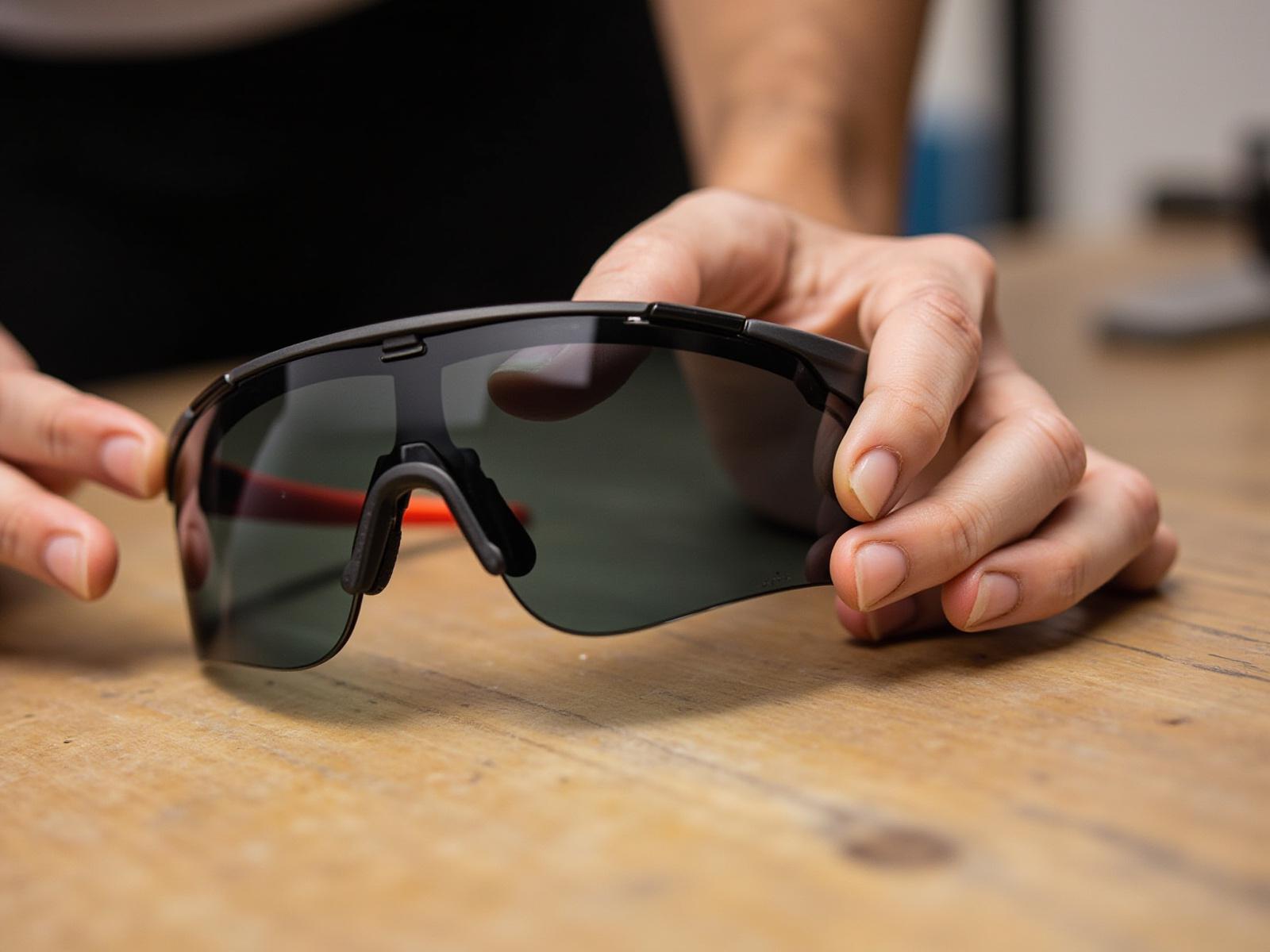
Smart glasses for travel: the tests that each need their moment
The arrival charge and the adapter decision
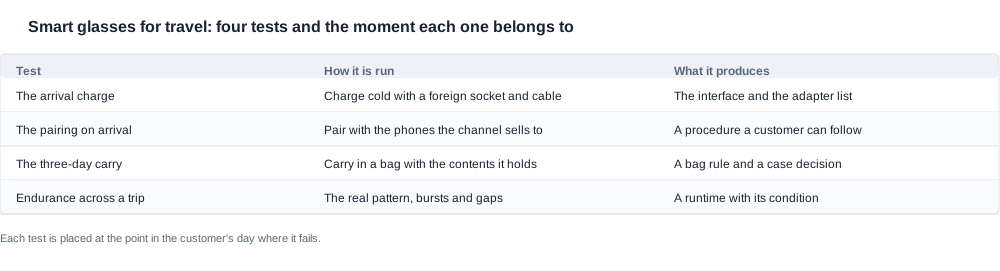
| Test | How it is run | What it produces |
|---|---|---|
| The arrival charge | Charge cold with a foreign socket and cable | The interface and the adapter list |
| The connect on arrival | Connect the phones the channel sells to | A procedure a customer can follow |
| The three-day carry | Carry in a bag with the contents it holds | A bag rule and a case decision |
| Endurance across a trip | The real pattern, bursts and gaps | A runtime with its condition |
The arrival charge is the test that decides the interface, and it is the one a laboratory never runs. It has to be a cold unit, because a device that has been sitting in a bag at room temperature for three days is not in the same state as one that has just been unpacked, and the difference shows up as a longer first charge. It has to use a foreign socket and a foreign cable, because that is what the customer has in the room. And it has to be timed, because the published charge time carries no start state — at or under two hours across the range, with roughly one hour on the D17 and the ZH12 — and the question the customer actually has is "how long until I can use it".
The output of this test is not a number, it is a market document. It is the adapter list keyed to the markets the listing serves, plus the statement of which interface the configuration uses and how long a cold charge takes. That list then becomes the packing card and the support macro, and it is the difference between one contact per hundred orders and four.
The connect step and the bag rule
The connect test is where a travel listing usually breaks, and the reason is structural rather than technical. The Bluetooth version rows are published per model, and the connect procedure lives in the product's own software. What is not published is a qualified list of phone models and operating system versions, so the test output is not a number — it is a procedure, and the procedure is what the customer reads in the first thirty seconds after opening the box. A listing that says it pairs with your phone without saying what to do when it does not is a listing that generates a support contact on day one. The phone question is at does it need a phone.
The three-day carry is the test that produces the bag rule, and it has to be run with a bag containing what a bag contains. A lens pressed against a shoe or a wallet is damaged with no agent involved, and because the lens material and the coating are unpublished, there is no specification a customer can be told is safe against abrasion. The test therefore produces a rule — a pocket, a sleeve, or the case — and the consumables that go with it, and the rule is worth more than any coating claim because it is the only instruction that can be obeyed without knowing the material.
Two things travel with the rule and are frequently forgotten. The first is the charging contact, which in a bag collects whatever the bag holds, and which is the same surface that the post-run problem in an endurance programme is about. The second is the storage condition over a trip: a device left in a parked car in a hot market is not in the same state as one left in a hotel room, and the operating temperature range is not published for any model, so a listing that promises a device will survive a car is making a claim the catalogue cannot support.
Thresholds a travel listing can defend
The runtime condition and the gap figure
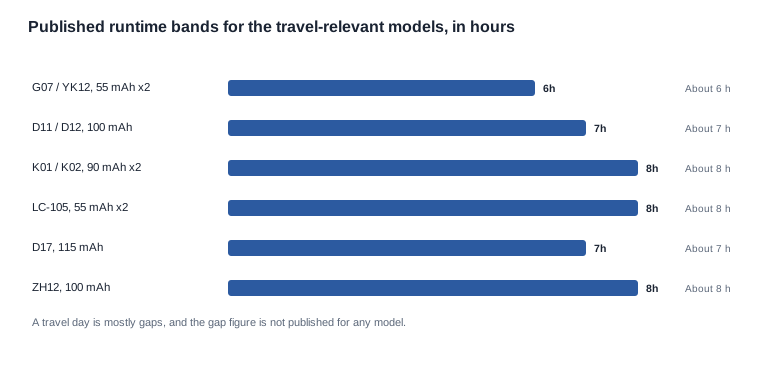
The published runtimes give a listing a usable envelope once the condition is attached. The chart shows the bands for the models that travel programmes shortlist, and the spread is the point: about six hours on the 55 mAh per side tier, about seven hours on the D11, the D12 and the D17, and about eight hours on the K01, the K02, the LC-105 pair and the ZH12. A listing that quotes eight hours without saying what the device was doing in those eight hours is quoting a number the customer will test in a way that produces a different answer.
The condition that decides the trip is the gap. A travel day is not a continuous session; it is a series of short sessions with the device idle for hours at a time, and the current draw in that idle state is the figure that decides whether a customer gets through the day on one charge. That figure is not published for any model, so the buyer has two honest options: obtain it from the supplier, or word the claim against the working figure only and say which figure is being quoted.
The third condition is the connection state. A device left connected to a phone for a whole day burns differently from one that is disconnected between uses, and a traveller's phone is rarely out of range. Any runtime figure that arrives without that detail is describing a different scenario from the one a travel listing is about.
The water wording and the bag-content rule
The IP54 marking covers splashing water and a dust protection level, not immersion and not a sustained downpour, and no test report behind it is published for either of the two models that publish it — the V06 and the S7. A travel listing can state the marking and describe what the digits refer to. It cannot say waterproof, cannot say rainproof, and cannot say tested, and the difference matters more in travel than elsewhere because the customer's most likely encounter with water is a hotel bathroom, a swimming pool or a rain shower rather than a puddle.
The mechanism is the same one that appears in every category where a marking is published without a report behind it. A customer in the rain tests the claim without knowing it was a claim, and the review says the product failed. The advanced considerations on the ingress rating are at IP rating advanced considerations, and the field behaviour in the adjacent endurance case is at cycling real-world experience.
Two rows must never appear in a comparison table between two travel candidates. Runtime without a condition is the first, because it is the row most likely to look comparable and least likely to be. The per-model weight is the second, because the range publishes one figure in total — 158 g for the MT6, which is a camera model with a foldable case and not a travel model — and every other cell in the table would be an assumption.
The evaluation checklist a travel shortlist runs on
Before you order a travel line, the useful question is not whether the device works in a laboratory, because every model in this range does. It is which of the four arrival moments the listing actually promises, and whether the test evidence covers each one. The practical way to evaluate two suppliers is to write the four pass lines first and hand the same four lines to both of them: the supplier who can tell you which step will take longer is telling you something useful, and the supplier who cannot tell you anything is telling you something more useful still.
The red flags in a travel quotation are recognisable and they are specific. A runtime with no condition attached to it. An adapter list that names only the destination market. A packing condition list described as standard rather than written down. A case configuration that appears in the artwork but not in the transit file. None of these is a reason to reject a supplier, and each of them is a line that can be added to the purchase order before the order rather than argued about afterwards.

The document trail behind a travel test programme
What to request before a travel listing goes live
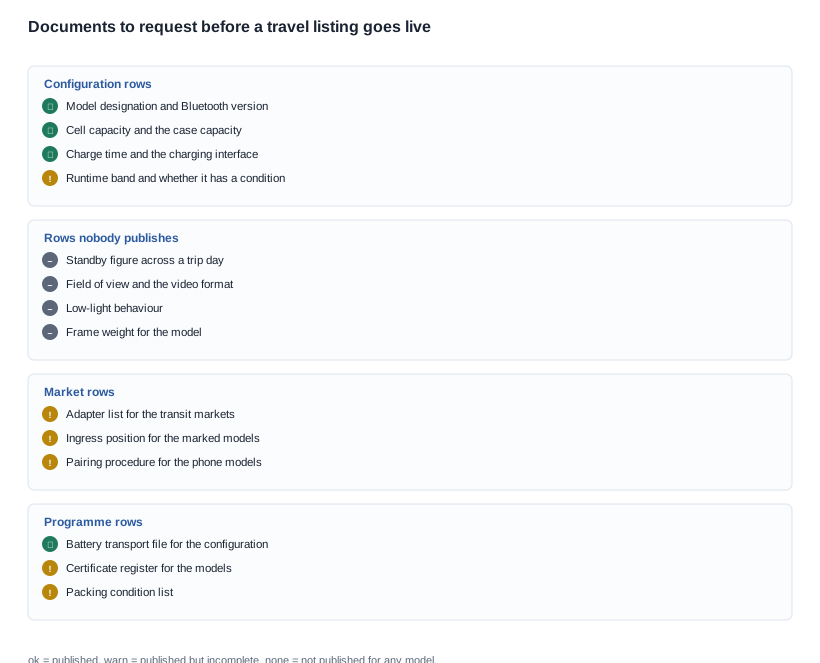
- The published rows per configuration, with the model designation recorded and the case configuration fixed, because a case configuration changes the artwork, the freight weight and the transit file.
- The four supplier answers, in writing: the runtime with its condition, the standby figure, the interface and its charge time, and the case's own charge time and input.
- The battery transport file for the exact configuration, including the case. This is a shipping gate rather than a quality item, and a marketplace seller that gets it wrong loses the account rather than a customer.
- The certificate register, checked against the issuing body's public register, with the model on the certificate matching the model being sold.
- The four tests above, on two units from the same batch, with the conditions recorded.
- The market adapter list, covering the transit markets as well as the destination.
- The packing condition list, so that the unit which arrives is the unit which was photographed.
Running the four tests on two units from one batch

Two units from the same batch is the minimum that separates a design characteristic from a manufacturing inconsistency, and it is the minimum because a travel failure is rarely intermittent in the laboratory sense — it is usually a configuration or a packing problem that affects every unit equally and is invisible on a single sample that was assembled by hand.
The order of the four tests is the order of the customer's day, and that is deliberate. A failure found in the arrival charge on day one is a cheap failure; the same failure found after a customer has flown is a review. So the cold charge runs first, the connect step runs second, the three-day carry runs third because it needs elapsed time, and the endurance figure is recorded last because it needs the whole pattern to have been lived through.
The result that has to survive is the packing condition list. It is the document that says what the box looks like when it arrives, what the unit is doing inside it, and which consumables are present. A travel channel that photographs a unit with a cloth and a wipe in the box and then ships without them has created a gap between the listing and the delivery that no amount of test evidence repairs.

Where travel test programmes go wrong before the listing goes live
A test written for the laboratory rather than the hotel room. The laboratory answer and the arrival answer differ, and only one of them produces a review.
A runtime quoted without its condition. A customer tests it on the second day of a trip, finds the difference, and writes that the product does not do what the page said.
An adapter list that covers only the home market. The first stopover produces the support contact, and it produces it in a language the support desk does not read.
A permissive lens instruction. A bag is the least clean object a lens spends time against, and the most available cloth in a bag is a shirt, which is abrasive on a coating whose specification is unpublished.
A waterproof claim in the copy. The marking covers splashing water and a dust protection level, not immersion and not a sustained downpour, and no test report is published behind it.
A measurement that never reaches the packing bench. A four-hour arrival charge and a bag rule are useful to the buyer for exactly one afternoon; unless they are written into the incoming inspection, the second production run repeats the whole programme from scratch and the first shipment's evidence never reaches a goods-in desk.
A case configuration that was priced but not documented. The case capacity is published for four camera models and one of those offers two capacities as a configuration choice, so a packing list without the capacity written on it is a packing list that cannot be checked against the transit file.
The commercial terms a completed travel test moves
Terms that move and terms that do not
The commercial value of a completed travel test is not a discount; it is the ability to price two configurations against each other and to move the lines the test exposed. The first is the case, and it is the largest single lever in a travel programme because it is the difference between one price point and two, and it changes the artwork, the freight weight and the transit file together. The second is the consumables, in particular the lens item and the contact item, which cost a fraction of a unit each and sit in the packaging rather than in a pocket — the cheapest available reduction in returns in this category.
The total cost of a travel programme is the unit price plus the returns reserve plus the adapter and packing material plus the support contacts that a listing's wording generates, and the trade-offs between those four are settled in the quotation rather than after it. The pitfalls in this category are rarely about the hardware: they are about the wording on the page and the material in the box, which is why the evaluation checklist above carries more lines about documents than about measurements.
The third is the market material: whether an adapter ships for a transit market, whether the packing card carries the market-specific instructions, and whether the arrival procedure is printed rather than sent by email. A listing that answers the arrival questions on the page converts better than one that answers them in a support thread, and the difference is measurable in the contact rate.
Order thresholds are negotiable, and so is the quantity a buyer keeps at pilot level rather than committing to the full run. Logo, lens tint and packaging are cheap to change between runs and expensive to change once the artwork is printed, and a travel line that will be re-ordered for a season has a different packaging conversation from one that will not. A first order released in two parts, with the balance tied to inspection, works for a channel that is being built market by market, and travel channels that work across several markets usually are.
What does not move is the acoustic architecture, the cell configuration, the charging interface and the case architecture. Certification cost and lead time, and the battery transport documentation, follow the process and the testing body and cannot be shortened by negotiation. Tooling is amortised across the first order and quoted as a separate line rather than folded into the unit price. The published pages are these: the terms as drafted is at contract terms, and the commercial footing of a first order at pricing.
A hypothetical travel programme, step by step
Take a travel accessories brand that sells into three markets through its own storefront, with a camera model at the top of the range and an audio model underneath it, and a first order sized for one season.
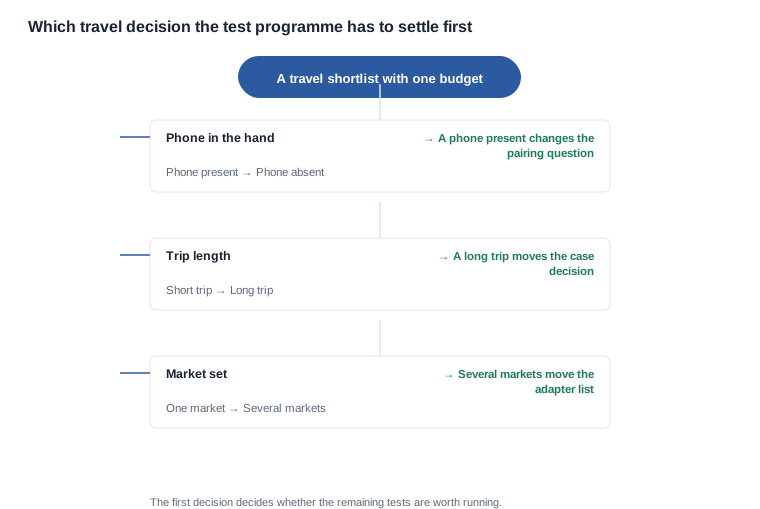
The first decision is the interface, and it is settled from the published rows rather than from a preference: a Type-C configuration recharges from a cable the traveller already owns, so the case can be an accessory rather than a mandatory part of the kit, and the transit file stays simpler for that reason. The second decision is the market list, which is written before the packing card and which has to include the transit points rather than only the destinations. The third decision is the endurance wording, and it is settled against the published bands with the gap figure either obtained from the supplier or the claim narrowed to the working figure.
The fourth decision is the kit, and it is the one with the best return in the programme: the lens item and the contact item in the insertion, plus a one-line bag rule. A travel channel that ships without them ships a product whose lens meets a wallet. The fifth decision is the test itself, on two units from the same batch, run in the order of the customer's day.
The sixth decision is the commercial one: the pilot share, the split delivery against a staged payment, the tier the consumables sit in, and the market material in the box rather than in an email. The outcome is a listing whose four arrival claims each have a test behind them, a packing card that matches the photograph, and a support desk that answers arrival questions with a document rather than an opinion. This is a worked sequence, not a record of a real engagement, and what is worth reusing is the order of the decisions rather than the numbers that appear in it.
What we publish for a travel configuration
The short answer: we publish the rows a buyer can order from and we will not fill the open ones with an industry average. For travel configurations that means the Bluetooth version per model, the cell capacities, the charge times at or under two hours and roughly one hour on the D17 and the ZH12, the rated runtimes, the charging interface per model, the published structural features, and the case capacities where they are published.
What we do not publish, and will not estimate: the lens material, the coating, the frame material, the hinge specification, the per-model weight beyond the single 158 g whole-unit figure for the MT6, the field of view, the video specification, the runtime test condition, the standby draw, the cycle life rating and the operating temperature range. We will not state that any model in our range is tested to IP54, because no test report is published behind that marking, and we will not extend it beyond the V06 and the S7. We will also not describe the range as certified to CE, FCC or RoHS, because the catalogue carries no per-model certification row and no such wording in its text.
What we will do is take the markets, the transit points, the trip lengths, the channel and the price band, and tell you which of the four tests decides the purchase, which published rows apply to the models you have shortlisted, and which results have to be in hand before the listing goes live. The scenario entry point is smart glasses for travel, and the model families are at Bluetooth audio glasses and AI camera glasses.
The action to take next
Send the markets, the transit points, the trip lengths, the channel and the price band, and we will say which of the four tests decides the purchase, which published rows apply, and which results have to be in hand before the listing goes live. If the listing copy already exists, send that first — it is the fastest way to find which of the four tests was never run.
Related reading
- Smart glasses for travel — the scenario entry point
- Travel long-term use — the longer-run behaviour
- Does it need a phone — the connection question
- Ingress considerations — reading the marking correctly


