

The question has a short answer and an important exception, and the honest version of both is that the published position in this range is thinner than the question deserves. Every model we list pairs over low-power Bluetooth. The camera tier publishes capture and an AI voice assistant. And whether any model records, stores and runs without a paired phone is not published for any model in the range.
That is worth stating plainly before anything else, because the practical answer follows from it. In the absence of a published standalone claim, the phone is the control surface and the storage destination. That is not a design limitation being hidden; it is a specification that has not been written down. The two situations are very different for a buyer, and the difference is the difference between a product that has a dependency and a product that has an undocumented one.
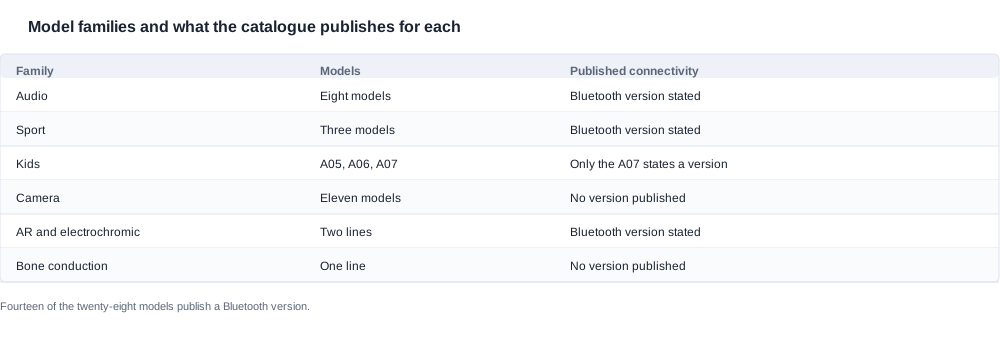
On the radio itself, the catalogue publishes a Bluetooth version for fourteen of the twenty-eight models. Those are the eight audio models, the three sport models, the A07, the AR glasses and the electrochromic line. It publishes no version for the eleven camera models, for the A05, for the A06 or for bone conduction, which means that for a camera programme the radio specification itself is not stated in the catalogue and has to be established with the supplier. Within the audio range the published versions are 5.3 on the K01 and the K02 and 5.4 on the rest of that range.
The background on the AI features is in does the AI feature need internet, and the two use cases where the phone question gets sharpest are covered in AI camera glasses for e-commerce and AI camera glasses for social media.
Does it need a phone: the three roles a phone plays
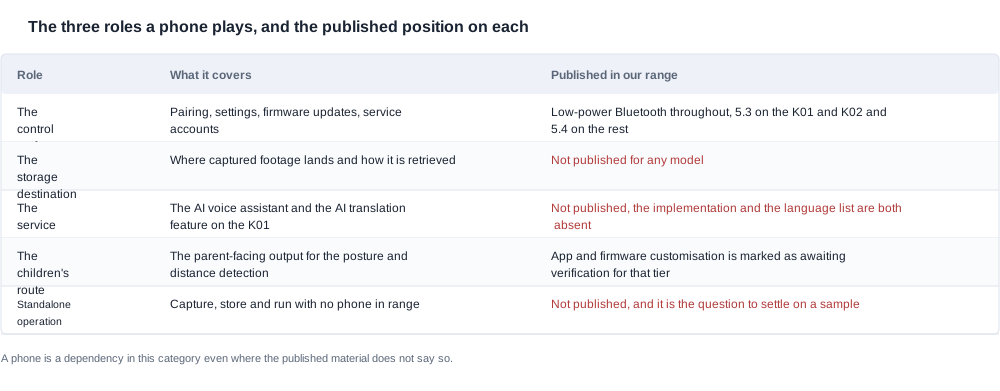
Almost every consumer question about a phone dependency comes down to three functions, and it is much faster to separate them than to argue about "does it need a phone" as a single question.
One: the control surface. Pairing, settings, firmware updates, and for the AI features, whatever account and configuration the service requires. This role is close to unavoidable in practice, and it is the role the published position supports. Low-power Bluetooth runs through the range, and where a version is published it is stated. For the fourteen models where it is not published — the whole camera tier, the A05, the A06 and bone conduction — even the radio detail is missing from the catalogue, so the pairing story cannot be stated from published material at all. That is a due diligence item, not a technicality, and it is the point at which a buyer's questionnaire gets a blank answer.
Two: the storage destination. Captured footage has to land somewhere, and the catalogue does not describe the storage path for any model. Whether a capture is held on the product and transferred later, or streamed to the phone as it happens, is a specification row that does not exist in our published material. This is the single most important unanswered question for a camera programme, because it decides what the customer owns after they press the button. A product that stores on the phone gives the customer a file they can use immediately; a product that stores internally and requires a transfer step gives them a file they have to retrieve. Both are defensible products, and the difference is invisible until a customer tries to find their video. The camera tier publishes a resolution — 8 MP across eight models and 13 MP across the L2 Utral and the L1 Pro, and the S7 — and a rated runtime for all eleven models, so the capture is documented and the destination is not.
Three: the service account. The AI voice assistant is a published capability on the camera tier, and an account-based feature implies a client, a data path and a service relationship. The account requirements, the language list, the offline behaviour, the data path and the retention position are not published for any model. Neither is a translation row: the catalogue carries no translation row anywhere, so any translation capability that appears in your marketing has to be established from the product and its service rather than from our specification. Our AI feature and internet dependency page works through what that gap means in practice.
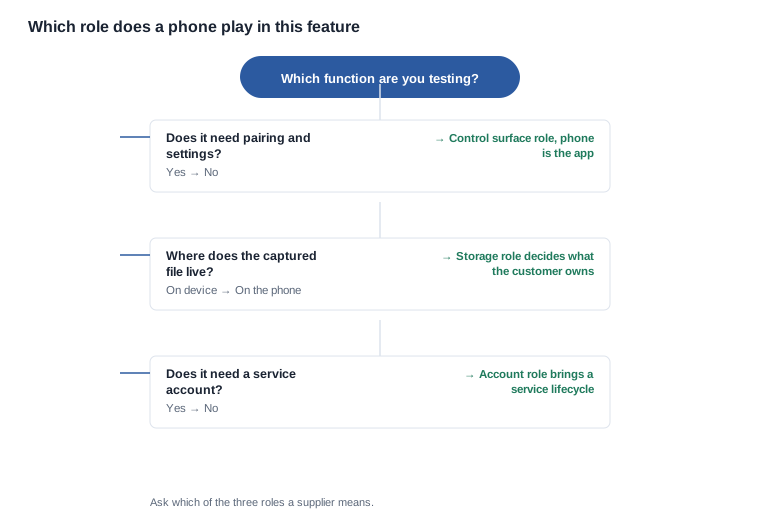
The value of separating the three roles is diagnostic. When a supplier tells you the product "does not need a phone", ask which of the three roles they mean. An answer that covers all three is a strong claim and deserves a test. An answer that covers only the control surface is a weaker and much more common claim, and it is usually the true one. A supplier who cannot say which role they mean has not established the product's behaviour, and that is worth knowing before the first order rather than after.
It also changes what a shortlist comparison looks like. Two suppliers who both say "works without a phone" may mean entirely different things, and the comparison only becomes meaningful once each answer is attached to a role. The practical form is a table with one row per role and two columns per supplier, where every cell is either a described behaviour or an explicit blank. The blanks are the interesting part, because they tell you where the sample has to do the work.
Where does it need a phone answer is clearly yes
The kids models. The A05 and the A06 publish posture detection and distance detection. A detection that is not visible to the person wearing it has to reach a parent somehow, and the sensible route for that is a parent-facing app on a phone. The published position is that app and firmware customisation capability for the children's tier is marked as awaiting verification, so the route exists in principle and its details are not confirmed.
This case is clear for a reason that is not about hardware: the feedback loop is the product. If the prompt does not reach the parent, then the detection has no output, and the customer is buying a sensor rather than a reminder. The A05 certification status page is the honest starting point for that tier, because it sets out which documents are settled and which are not, and the kids eye protection discussion covers the feature set these models publish.
A note on scope, since it matters for a shortlist: this is a statement about the three models in the kids range — A05, A06 and A07 — and about the parent-notification design those models use. It is not a general statement that every smart glasses product needs a phone, and it is not a statement that the A07 in particular does; the A07 publishes a 70 mAh cell, a Bluetooth version and a rated runtime of about twenty hours, and the published position on its own connectivity is thinner than the A05's.
The cases where does it need a phone is less clear than it should be
Four situations where the answer is genuinely ambiguous, and where the ambiguity is a commercial problem rather than a technical one.
In a shared office or a retail environment, where the phone is not in the user's hand but sitting on a counter, and the entire point of the product is that it is hands-free. Here the dependency is invisible to the person using it but visible to the person who bought it, which is exactly the configuration that produces a complaint. Our office use case discussion runs into the same tension from the workplace side.
In content creation, where a creator expects to press a button and walk away, and the phone is deliberately not in the shot. The phone may be in a pocket or on a rig, so the dependency is satisfied, but it is satisfied in a way the buyer has to plan for rather than a way the customer has to think about. The social media use case covers that pattern in detail.
In e-commerce photography, where the person shooting product images for a marketplace has both hands full and the phone may not be the phone that is photographing. Our e-commerce discussion covers what changes when the capture has to land somewhere specific and the operator cannot stop to move a file.
Where the phone belongs to the customer and not to the buyer. In a wholesale or distributor arrangement the product is sold separately from the phone, which leaves you selling a product whose main dependency is a device you do not control, do not support and cannot test on their behalf. This is a structural issue with the arrangement rather than with the hardware, and it is worth raising with the supplier before you design the packaging around it.
The common thread in all four is that the question is not really "does it need a phone". It is "does it need a phone at the moment the customer is using it, and who is holding it". In the kids case the answer is yes and the phone belongs to the parent. In the retail case the answer may be no and the phone belongs to nobody in particular, because it belongs to the shop. The published material does not resolve these cases, and a buyer who needs an answer has to test it.

How to establish does it need a phone on a sample before you order
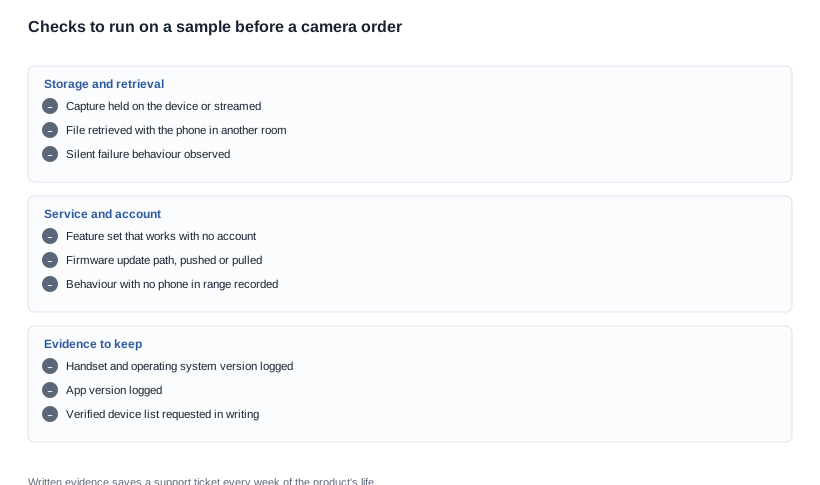
A sample answers this in an afternoon, and it is the cheapest part of the whole evaluation. Five things to establish, in this order.
- Whether a capture is stored on the product, and how it is retrieved. Try the simplest possible test: capture something, then put the phone in another room and try to retrieve it. If the file appears without the phone, the product holds it. If it does not, it was never there.
- What the product does with no phone in range. Switch the phone off, or put it in a drawer, and then use every function you intend to sell. Record what works, what fails, and what fails silently — a button that appears to work and produces nothing is worse than one that reports an error.
- Whether the account and the service are mandatory for the features being sold, and what happens to a customer who never signs up. This matters most for the AI voice assistant, because a service that requires an account is a service with a lifecycle, a data path and a support commitment.
- Which phone and operating system versions the product is verified against. This is a test rather than a document, because no verified device list is published for any model in this range. A sample that works on one handset is not a verification.
- What the customer sees on a firmware update, and whether the update is pushed to the product or pulled by the app. It sounds minor and it is not: a push update that a customer cannot install is a support ticket, and in a shipped product with a locked bootloader it is a brick.

The fifth question is worth expanding, because the phone is also the upgrade path. If the app is what delivers firmware, then a customer who changes phone, loses their account or receives a device that cannot reach the service is a customer with a product that cannot be updated. In a category where the specification changes faster than the warranty period, that is a live commercial exposure, and it is one a buyer can ask about in a quotation rather than discover in year two.
What to record from the test: the handset model and operating system version, the app version, what happened at each step, and what the customer would have seen on screen. Written evidence of this kind is what lets a distributor answer a customer question without escalating it to you, which is a small operational saving that recurs every week of the product's life.

What does it need a phone mean for the commercial terms of the order
The phone dependency is not only a technical fact. It changes what you can negotiate, what you can promise and what you should ask for in the quotation.
The dependency changes who your customer is. A product that runs from a phone in the buyer's hand and a product that runs from a phone in the parent's hand are sold to different people, in different channels, with different retail arguments. A kids range sold through a pharmacy or an optician is a different commercial proposition from a camera range sold through a marketplace, and the difference is not the hardware. Deciding which buyer you are writing the listing for is a prerequisite to writing the listing at all.
The dependency also changes what support looks like. If the phone is required, then most of the support contacts you will receive are pairing and account problems rather than hardware problems, and that changes the staffing, the scripts and the warranty response time you should be promising. A supplier who cannot tell you the expected contact rate for pairing issues is giving you a warranty position built on a guess.
A standalone product is a more expensive product, and the trade-off is measurable. On-device storage, on-device processing and a usable standby budget all cost power, and power comes out of the same budget as the published runtime. The camera tier publishes cell capacities in the range of 220 to 290 mAh and a rated runtime of about five to eight hours, and that figure is the whole of the energy available to the product. A supplier who offers a standalone configuration has to find that energy somewhere, and the sensible conversation is about what is given up — runtime, capture resolution, or the feature list — rather than about whether the feature can be added.
Ask for the storage and data position in writing. Where a capture is stored, how long it is kept, how it is deleted, and whether it can be retrieved without an account. For an e-commerce or social-media customer who is filming other people, this is not a footnote; it determines what your customer can safely sell.
The account question belongs in the service terms. If a feature depends on a third-party service, establish what happens when that service changes its pricing, its terms or its availability. A product whose main dependency is a service you do not control is a product with an availability risk that sits outside your supply agreement.
The normal commercial lines still apply and they interact with this one. Unit price and volume tiers. Minimum order quantity, which for a camera programme is often set by the packaging rather than by the unit. Sample policy, and whether a sample demonstrates the phone behaviour or only the hardware. Lead time, including whether a software or firmware change resets it. Warranty period with a stated response, and specifically what the warranty says about a product that is returned because a customer cannot complete the pairing. Return terms for a channel where the phone belongs to the end customer. And payment nodes tied to inspection.
The shortlist criterion. Between two camera suppliers quoting the same price and the same lead time, the question that decides it is which one can describe the storage path and the account requirement on paper. That is a due diligence question with a direct answer, and it is worth more than a small unit price difference or a slightly faster lead time.
What we publish about does it need a phone today
Published: the connectivity where it is published — a Bluetooth version for fourteen of the twenty-eight models, which is the eight audio models, the three sport models, the A07, the AR glasses and the electrochromic line, and no version for the eleven camera models, the A05, the A06 or bone conduction. The capture capability and the AI voice assistant on the camera tier. The camera resolution on the camera tier. The rated runtime on all eleven camera models. The kids range, its three models and the posture and distance detection published for the A05 and the A06.
Not published, for any model in this range: a standalone operation claim, a storage path, a data path, a verified device list, an account or service requirement, an offline behaviour, and a translation row.
We publish the connectivity per model because the radio is a durable fact and it is the thing that determines whether two products can pair with each other. We do not publish a standalone operation claim, a storage path or a data path, because we do not hold them for any model in this range, and a published number in that position would be an assumption rather than a specification.
We will also be direct about the part that is not a document question: a phone is a dependency in this category even where the published material does not say so, and a buyer who needs a product that works without one should establish that on a sample rather than assume it. What we will not do is describe the product as phone-independent, because the published position does not support it and the customer who finds that out is the one who paid for it.
Tell us the functions you intend to sell and the phone environment you expect them to run in, and we will tell you which of them can be established on a sample and which are simply not published.


