

Open-ear audio is not a smaller version of a headphone. It is a different engineering problem with a different set of compromises, and a buyer who understands the mechanism reads a specification sheet differently — including reading the rows that are not there. The whole chain runs in one direction: a sound enters the microphone, becomes an electrical signal, is compressed, crosses a radio link, is decoded and amplified, drives a transducer, and leaves the frame as sound in a room that also contains the person hearing it. Every one of those stages changes what the product can be sold as, and the stage that decides the commercial outcome is not the one a buyer expects. It is the last one, because the sound that leaves the frame is the sound the whole room receives. Open ear audio glasses smart glasses how it works is written as a chain rather than as a feature list, so that a procurement team can ask each supplier the question that belongs to the stage they are actually buying.
Our published technical description of the family is an open-ear acoustic structure, directional audio, intelligent noise reduction, a low-power Bluetooth connection, and magnetic or Type-C charging. That is the whole of it, and this article explains what each of those does, what it costs, and which published rows in the range are a consequence of which stage.
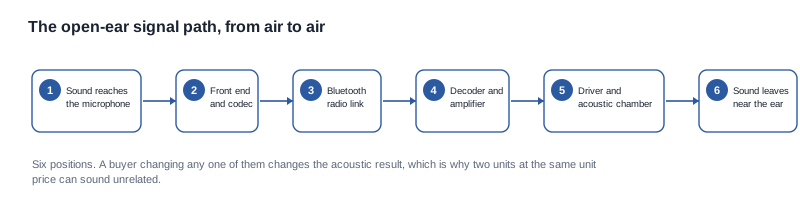
Open ear audio glasses: the signal path, stage by stage
Six stages, and each one has a buyer-visible consequence. A failure at any stage produces a different symptom, and the symptom is usually the fastest way to identify which stage is at fault when a sample fails an acceptance test.
The front end, the codec and the radio hop. Sound reaches a microphone mounted on the temple, where it is converted and usually amplified before being converted again into a digital stream. That stream is compressed by a codec, and the compressed data crosses a Bluetooth link to the paired phone or computer. The published radio rows in our range are V5.3 on the K01 and the K02 and V5.4 on the other nine open-ear models. That row tells a buyer the radio generation and, by implication, the regulatory class of the radio — which is what the compliance file is built on. It does not tell the buyer which codec is negotiated with a particular phone, whether the link holds a second connection, or how much latency the radio introduces. A version number is a generation statement, not a behaviour statement, and the behaviour is where the acceptance test lives.
The decoder, the amplifier and the driver. On the other side of the link the stream is decoded, converted back to an analogue signal, and amplified to drive the transducer. The amplifier's power draw is the single largest contributor to the average current in the chain, which is why the amplifier and not the radio tends to set the operating window. The driver itself is where the acoustic work is done, and in this category the driver is the part a buyer cannot evaluate from any published row we hold.
The chamber and the grille that shape the output. The driver does not emit sound directly into the air beside the ear. It drives a volume of air inside a chamber, and the chamber geometry, the shape of the sound outlet and the grille in front of it determine what leaves the frame. This is the stage that produces the sound a buyer hears, and it is the stage that is invisible in a quotation. Two units with the same driver and different chambers do not sound the same, and two units with different drivers and the same chamber do not sound the same either. The chamber is the reason the acoustic configuration has to be named in writing before a price is compared.
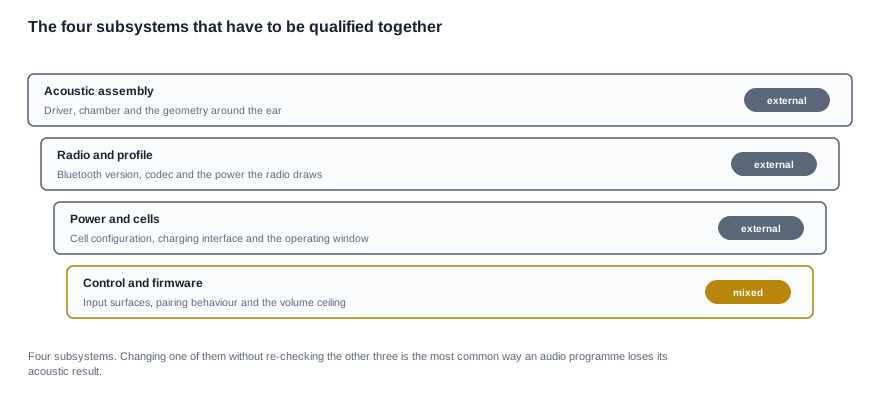
Why these four subsystems have to be qualified together. The acoustic assembly, the radio and profile, the power and cells, and the control and firmware are not independent. Changing the radio changes the power draw; changing the amplifier changes both the draw and the acoustic output; changing the cell configuration changes the board that carries the amplifier; changing the control surface changes the board layout, which changes the space available for the amplifier. This is why an audio programme that changes one of these late tends to change others accidentally, and why a change notice obligation in the purchase order is not a formality in this category.
Where the acoustic energy goes, and why the ear is the wrong measuring point
The defining property of the architecture is that the sound leaving the frame does not go only to the person beside it. It goes into the room. That single fact explains most of the commercially important behaviour in this category, including the confidentiality limit, the difference between two models at the same price, and why the acoustic measurement point is difficult to specify.
The second path the sound takes, into the room. An open-ear unit emits sound in a hemisphere roughly the size of the space in front of the frame. Some of it reaches the ear by a short path; some of it reaches the ear after one or more reflections from the surfaces of the room; and some of it is heard by everyone else in the room. The proportion that reaches the ear directly is a function of geometry and of the distance between the driver and the ear, and the proportion that is heard elsewhere is a function of the same geometry. This is the mechanism behind the privacy limit, and it is not a setting — no firmware update reduces it.
The coupling term that decides the usable low end. The quantity that decides how much low end a person actually receives is the coupling between the frame and the head: how tightly the chamber couples to the ear through the tissue and bone around it. A tighter coupling delivers more of the driver's output to the ear and also radiates more of it into the room. A looser coupling radiates less and delivers less. That is the trade the matrix below sets out, and it is the reason low end and privacy cannot both be maximised in the same product.
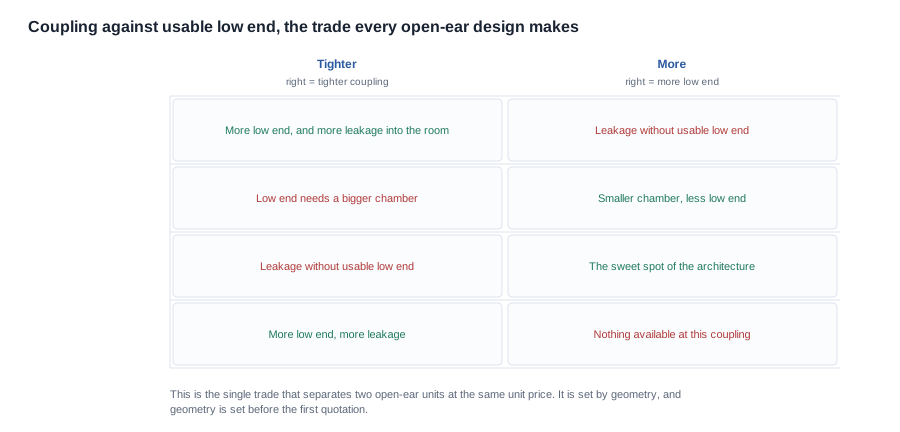
The consequence every open-ear design inherits. Three consequences follow directly and they are worth stating as facts rather than as caveats. The first is that a confidential conversation cannot be conducted on an open-ear unit, because the emission into the room is a property of the architecture. The second is that the perceived level varies from person to person and from room to room, because the direct path, the reflected path and the room's own absorption all contribute. The third is that a measurement taken at the ear says very little about the emission into the room, which is why the correct measurement point for a leakage question is a defined position in the room and not the ear of the person receiving the audio.
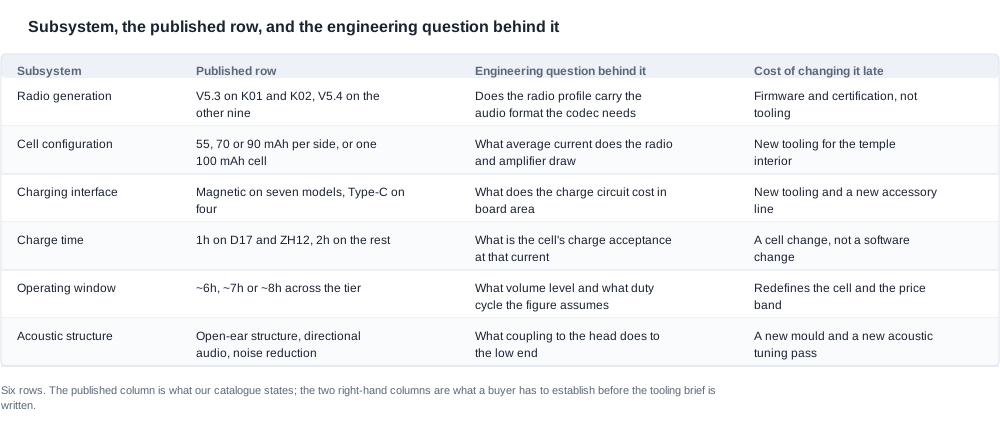
How a buyer reads a specification against this chain. Ask each published row which stage it belongs to, and then ask what that stage cannot tell you. The radio version belongs to the link stage and cannot describe behaviour. The cell configuration belongs to the power stage and cannot describe the window. The charging interface belongs to the power stage and cannot describe what the channel stocks. The operating window belongs to the power stage and cannot describe the acoustic result. Every row in a published sheet belongs to one of the six stages of the chain, and almost all of the useful information a buyer wants belongs to the chamber.
Power: what the published operating windows are actually measuring
The power story in this category is a story about averages, and it is the part of the chain where a buyer can make a mistake that is expensive and invisible.
Average current and the difference between capacity and runtime. A runtime figure is the ratio of stored energy to average current draw, and the denominator is set by behaviour rather than by components. A radio that is connected and idle, an amplifier that is running at a low output level and a control surface that is being touched all draw differently. The same cell, the same board and the same firmware will produce a different window at a different operating level, which is why a published window is a screen for a buyer and a poor acceptance value. Our published figures in the open-ear tier are approximately eight hours on the ZH12 and the K01, the LC-105-1 and the YKC02, and the LC-105-2 and the K02; approximately seven hours on the D11, the D12 and the D17; and approximately six hours on the G07 and the YK12.
Why two 55 mAh twin-cell models publish different windows. The LC-105-1 and the LC-105-2 both publish 55 mAh times two and approximately eight hours. The G07 and the YK12 both publish 55 mAh times two and approximately six hours. Identical published capacity, a two-hour difference in the published window, and no published row that explains it. The explanation is in the parts that are not published: a different amplifier, a different radio duty cycle, a different firmware behaviour, or a different chamber drawing more power. A buyer who wants to compare these four models has to ask for the current measurement behind the window, and a supplier that cannot produce it is telling the buyer that the figure is a category norm rather than a measurement of the unit.
The charge window tells you about the cell, not the product. The D17 and the ZH12 publish a full charge in one hour where every other open-ear model publishes two hours. That row is a property of the cell's charge acceptance and of the charge current the circuit delivers, and it does not describe the rest of the product. It is worth asking what the charge current is, because the same current that gives a one-hour window also generates more heat in a sealed temple cavity, and heat has consequences for the cell's service life that a buyer should raise before the design is frozen.
What the power stage does to the acoustic stage. A larger battery in a temple is a larger cavity to displace, which changes the chamber volume and therefore the acoustic result. This is why the power configuration and the acoustic configuration cannot be chosen independently, and why a buyer who asks for a different cell configuration is also changing the acoustic product and should expect the supplier to say so.

Control surfaces and the interaction model
The interaction model in this tier is small and it is cheap, which is why it rarely decides a programme on its own and occasionally ruins one.
Touch, buttons and the remote control configuration. No capacitive control surface is published for any model, and the D17 and the ZH12 publish a remote control for photography. Where a capacitive surface is fitted, it is a board-area item rather than a mechanical one: it needs a conductive area, a ground reference and firmware that has to distinguish a deliberate touch from a contact with the frame. That is a small cost and a meaningful failure mode, because a capacitive surface that misreads a contact produces a unit that changes state without being asked to, and because no model in the range publishes a touch row, the buyer has to ask whether the temple carries one and how it is configured. The remote control configuration is the opposite: it is a separate accessory with its own pairing, its own battery, its own certification scope and its own packaging line, and it appears on two sport models that publish no camera specification of their own, which is exactly why the buyer has to ask what the control actuates.
The firmware behaviours that belong to the interaction model. Three behaviours matter to a buyer because they appear in support conversations rather than in a specification. The first is what happens on a long press, and whether it resets the unit or a setting. The second is what happens when the unit reconnects to a previously paired device, and whether it reconnects silently or waits for an action. The third is what happens at the end of the published operating window, whether the unit announces it, drops out, or behaves in a way the channel has to explain to a customer. None of these appears on a published sheet, and all three are cheap to settle in a specification and expensive to discover in a returned unit.
What to write into the acceptance condition. The interaction model should be written as three written statements: the control actions that must work, the reconnect behaviour that must hold, and the end-of-window behaviour that must be specified. A procurement team that adds these three lines to the acceptance condition removes a class of support cost that is otherwise carried for the life of the programme.
Turning the chain into a supplier question list
A mechanism explanation is only worth writing if it changes what a buyer asks. Each stage of the chain above produces one question, and the six questions below are the ones that a quotation cannot answer on its own.
- Pickup. Which microphone arrangement is fitted, and what pickup distance was assumed when the noise reduction was tuned? A tuned method name with no stated assumption cannot be compared with another.
- Link. Which codec is negotiated with the target phone, and is the published radio version the version the unit actually ships with?
- Amplification. What is the amplifier's peak and average current draw at a stated output level, and how does the average change when the volume is raised?
- Output. Which driver and which chamber does this configuration carry, and can the acoustic arrangement be described in writing rather than as a method name?
- Power. What cell was fitted when the published operating window was measured, at what output level, and over what duty cycle?
- Control. What are the defined control actions, the reconnect behaviour and the end-of-window behaviour, written as three statements?
How to use the list. Compare the answers across suppliers rather than across a single document, because each question is a place where two quotations can diverge without either of them being wrong. A supplier who answers all six in writing has a process that a procurement file can rely on. A supplier who answers the radio version and the cell figure has answered the two rows that were on the sheet anyway, and the remaining four questions are the ones that will decide the acceptance condition.
Three trade-offs worth naming before you order. The first is between acoustic configuration and unit price, because the chamber decides the sound and the chamber is set before the quotation exists, so a cheaper quotation in this category is frequently a different acoustic product rather than a better deal. The second is between the operating window and the acoustic result, because a larger cell occupies temple cavity that the chamber needs, and the two compete for the same space. The third is between the number of configurations and the certification workload, because every added configuration multiplies the documentary scope without changing the product.
The criteria a buyer should apply to a supplier's answers. How to choose between two suppliers who both answer the list is a matter of specificity rather than of coverage. An answer that names a measurement, a condition and a method beats an answer that names a technique. An answer that states a limit beats an answer that states a capability. And an answer that says a figure is not published is more useful than an answer that supplies a typical value, because it tells the buyer which rows still have to be closed on samples.
What the mechanism decides for the sourcing team
The mechanism argument is only worth writing if it changes a decision. These are the decisions it changes.
The engineering brief the mechanism implies. A buyer specifying this architecture is specifying a frame that carries an acoustic assembly in both temples, a battery in at least one of them, a radio, and a control surface, and the consequence is that the frame is the product. The tooling brief, the tooling cost and the amortisation of that tooling are all consequences of the architecture rather than of the electronics. A buyer who treats the electronics as the product and the frame as packaging has the cost structure backwards, and this is the single most common pricing error in this category.
The questions the mechanism puts to a supplier. Which acoustic configuration does this price cover, and can it be described in writing. What measurement method was used to produce the published operating window, and at what output level. What is the current draw behind the published window, and how does it change with volume. What are the acoustic consequences of the cell configuration. And what changes in the acoustic result if the control surface is replaced. These five questions are the mechanism translated into procurement language, and they are the questions that separate two quotations that present the same configuration rows.
Where the detail sits. The published rows are collected at the open-ear audio technology overview, the vocabulary for the terms used above is at the open-ear audio glossary, the scenario selection that depends on this mechanism is at choosing a model by use case, the selection procedure is at how to choose open-ear audio glasses, and the range itself is at bluetooth audio glasses.
What we will say plainly about our own documentation. Our published technical description names the techniques — open-ear acoustic structure, directional audio, intelligent noise reduction, a low-power Bluetooth connection and the charging method. It does not include a driver size, a chamber dimension, a leakage figure, a frequency response, a pickup distance or any third-party acoustic measurement, and we publish no unit weight for any audio-tier model. We publish the cell configurations, the charge windows and the operating windows exactly as our catalogue states them, including the two 55 mAh twin-cell groups that sit two hours apart, and we would rather show that inconsistency than tidy it away, because a buyer who finds it in advance is a buyer who knows to ask the question. If a stage in the chain above matters to a decision you are making, tell us which one and we will tell you what our documentation can and cannot settle.


