
The G07 is published as a Bluetooth V5.4 audio frame: two magnetic charging, 55 mAh cells, a charge time of two hours or less, about six hours of rated use, and ultra-thin detachable temples. What is not published is everything a customer actually touches — the pairing flow, the control layout, the charge indication, the application question. Writing an operating procedure from the specification alone would mean inventing the steps that matter most, so this page does something more useful to a procurement team. It sets out the sequence the published rows support, the two features that genuinely change the handling routine, and the questions to put to a supplier in writing before a first order is placed.
The reader here is a buyer or a channel manager with two deliverables: a quick-start card for the end customer, and an acceptance test for the first shipment. Neither can be produced from a datasheet that stops at the battery line. What follows is the framework for producing both, with the gaps marked rather than filled.
G07 first-week sequence: what the catalogue supports
Who is writing this and what it is for
A brand owner commissioning this model is usually buying two things at once: a spec sheet they can defend in a listing, and a product that does not generate support tickets in month one. Those two objectives pull in different directions whenever the documentation trail is thin, and the G07 is a case where it is thin. Six published rows describe the hardware. None of them describes what happens after the customer presses something.
The practical consequence is that the first-week sequence below is a supplier-question-driven document, not a finished operating manual. Each step states what the catalogue already settles and what still has to be obtained. Where a step cannot be written yet, it is listed as a question rather than filled with a plausible answer, because a plausible answer that turns out to be wrong costs a returns cycle, a rating, and a re-listing later — while an honest gap costs one email before the order.
The published rows in one place
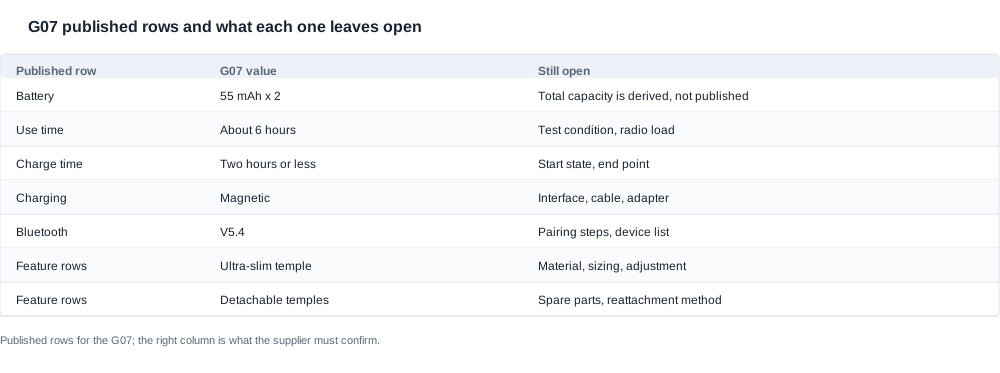
Six rows are published for this model, and the table below puts each one next to the decision it settles. Two rows are worth reading twice because they are commonly misread in the other direction: the charge time is a ceiling of two hours or less, not a fixed figure, and the battery is published as two 55 mAh cells rather than as a total. The catalogue publishes the cell value and the count; any combined figure quoted elsewhere is arithmetic, not a catalogue number, and it should never appear in a product listing as though it were published.

The steps the data supports
- Charge the dock before the frame. The charging method is magnetic, so the frame seats on a dock rather than taking a cable. Charge time is published as two hours or less, which means the dock and the frame both need to be on charge before the frame is put into service. The catalogue publishes no dock row — not a dock capacity, not a dock charge time, not a row that says a dock ships in the box — so whether the customer receives a pad, a case or a cable is a question for the supplier, and the packing list depends on the answer.
- Pair over Bluetooth V5.4 and record the device name exactly as it appears. The radio version is published, so the radio is a known quantity; the pairing procedure is not. For a branded programme the device name is the single brand element most customers read consciously, and it appears in the phone list, the instruction card, the packaging and every support ticket afterwards. Capture it from the first unit and freeze it in the packaging artwork.
- Run an audio check, then a call test in background noise. No driver size, no frequency response, no leakage figure and no microphone pickup distance are published for this model — and none of them are published for any audio model in the catalogue. A short audio check confirms the radio path; the call test in noise is what decides whether the product can be sold for calls at all, and that is a category-wide risk that no specification row will retire.
- Record the temple part numbers before the first shipment leaves the warehouse. The temple row is the differentiator on this model and it is also the part most likely to be needed later. Whether a replacement temple can be supplied separately, at what lead time, and under what warranty terms, is not published and has to be settled in the contract rather than discovered in a returns queue.
Reading each row: the judgement it settles, and the one it does not
A buyer who treats a published row as a conclusion will mis-buy this model in one of two directions: either assuming a feature that was never published, or refusing to buy because the row looks thin. Reading the six rows as settlements rather than as specifications avoids both errors. The pattern below is the same one we would apply to any frame in the audio group, and it is the working format for a shortlisting sheet.
- Radio row — Bluetooth V5.4. It settles which radio generation the frame belongs to, and that it sits one tier below the two frames in the same catalogue that publish V5.3. It does not settle the pairing procedure, the list of hosts the frame is tested against, the codec set, or how the radio behaves on a phone that is also running a call. Those are acceptance-test items, not row items.
- Battery row — 55 mAh × 2. It settles the cell value and the cell count, and therefore that the frame carries two cells rather than one. It does not settle the chemistry, whether the cells are user-replaceable, how they are arranged inside the temple, or the combined figure. A total of 110 mAh is a derived number and has to be labelled as such wherever it appears, or a reader will take it for a published figure.
- Charge-time row — two hours or less. It settles a ceiling and nothing below it. There is no published starting state of charge, no published termination criterion, no published dock charge time, and no published behaviour when the frame is docked while already on. A buyer who wants an interruption budget has to ask for the definition, because two hours of charging from a flat frame is not the same operational event as two hours of charging from a partially charged frame.
- Runtime row — about six hours. It settles a rated figure under conditions the catalogue does not describe. It is the shortest published runtime among the dual-cell audio frames, and it is the number most likely to be inflated in a listing.
- Charging-method row — magnetic. It settles the interface type and tells you the frame seats rather than plugs. It does not settle what the seat is (pad, dock, case or a lead with magnetic terminations), what arrives in the box, or whether the accessory is sold separately.
- Feature row — ultra-thin detachable temples. It is the only feature row on this model's page, so it carries the entire product story. It settles that the temples detach and that the profile is slim. It settles nothing about reattachment tooling, spare-part availability, marking, or whether the temple pair is interchangeable left to right.
Read in that order, the six rows tell you where the risk actually sits: not in the battery or the radio, both of which are published and therefore testable, but in the accessory chain that the feature row implies and that the catalogue never documents.
The step that stays open
The control surface is the step that cannot be written. The catalogue publishes no touch row for any model, no gesture row, and no translation row — the only control-surface rows anywhere in the catalogue are an indicator light and button control, and they belong to the unbranded AR glasses page, not to this model. Any description of tapping, swiping or voice translation on this frame would be invention. Until the supplier supplies a control description in writing, the quick-start card has to say what the hardware does, not what the customer does with it.
G07 detachable temples: the spare-parts and returns argument
What the feature actually changes
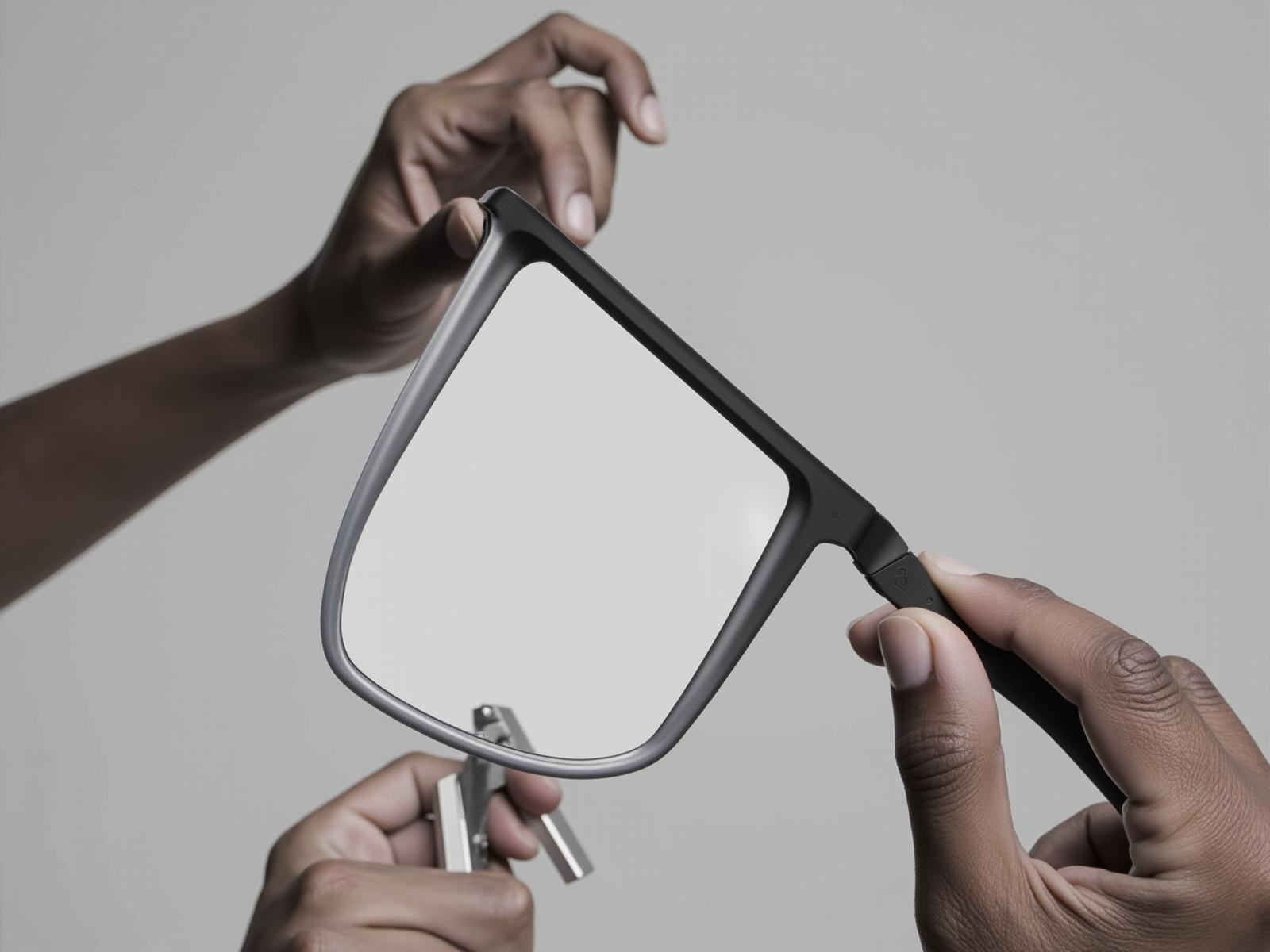
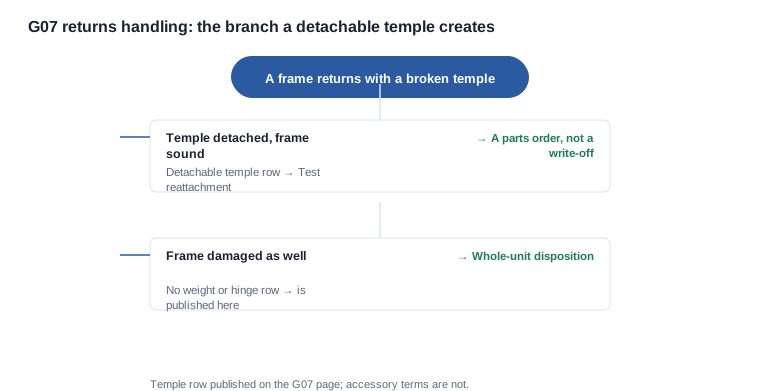
超细+可拆卸镜腿 is the only feature row published on this model's page, and it is worth more commercially than a marketing adjective usually is. A detachable temple means a broken temple is not a write-off, which converts a returns event from a total loss into a parts order. For a channel with a meaningful return volume, that is a margin line. For a buyer writing the returns policy, it is the difference between a disposition decision and a refund.
Ultra-thin temples point the other way, towards a different question: thin temples are the component most exposed to twisting during transport and to repeated handling, so the failure mode that the detachable design absorbs is also the failure mode most likely to occur. The two halves of the feature row are in tension, and the evaluation protocol should reflect that rather than treating the row as a single benefit.
Where the procurement value sits
Three questions convert the temple row from a product-description item into a sourcing term, and all three belong in the contract rather than in the listing:
- Replacement supply. Are temples supplied as spare parts, at what lead time, and in what minimum quantity? A detachable design with no spare-part channel is a warranty claim waiting to happen, and the buyer absorbs it in returns handling.
- Sample coverage. Does a sample order include spare temples? If the first units arrive without spares, the first transit incident is the first evidence you have, and that is a slow way to test a supply route.
- Customisation. If the programme needs a branded temple, the tooling question — tooling cost, tooling lead time, and whether the factory will hold the tool for a repeat order — is a quote item. We do not publish tooling charges or lead times for any programme, and a buyer should expect the same from any supplier that has them.
What the row does not tell you
The temple row says nothing about the frame itself. No weight is published for this model, and no dimensions — the catalogue publishes a weight for exactly one product in the whole range, and it is not this one. Nothing is published about ingress protection, drop rating, hinge cycle life, or the material of the frame or the temples. A buyer who needs a shipping-weight figure for a parcel calculation, a drop specification for a courier contract, or a hinge-life figure for a durability claim has to request each of them in writing, because none of them can be read off the catalogue row.
G07 six hours of rated use, planned properly
Why the figure needs a plan rather than a boast
Six hours is the shortest published runtime among the dual-cell audio frames in the catalogue, and it is published as about six hours — a rated figure, not a floor and not a guarantee. The comparable frames in the same cell bracket split clearly: two models sit at about eight hours, two at about six. Same cell value, same cell count, materially different published runtime, which tells you immediately that cell capacity alone does not predict the outcome and that the measurement conditions carry the real information.
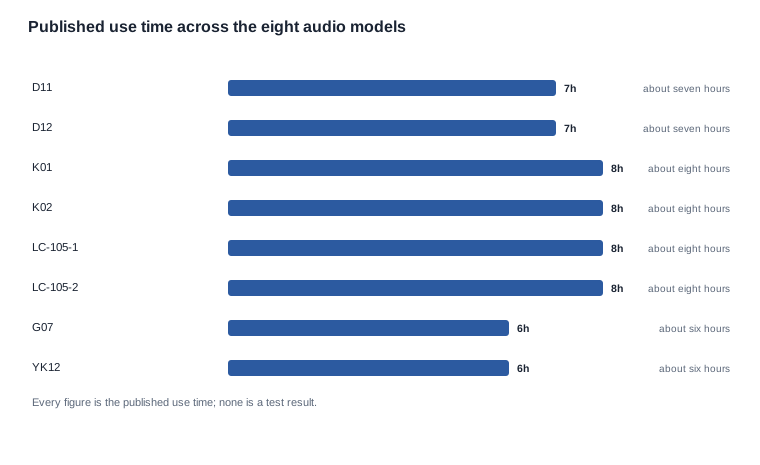
The chart spreads the whole audio group so the position of this model is visible rather than asserted. Across the eight audio models the published use times are: about seven hours on the D11 and the D12, about eight hours on the K01 and the K02, about eight hours on the LC-105-1 and the LC-105-2, and about six hours on this model and the YK12. The two frames that sit at six hours are the two with a slimmer temple profile, which is a strong hint that the temple is where the budget went — and a reminder that a buyer choosing on the runtime number is choosing on the least complete row in the set.
For a buyer the practical reading is this: six hours is a shift-length figure, not an all-day figure. If the customer removes the frame for a lunch break and returns it to the dock, the published runtime is adequate. If the customer keeps it on through a full working day, the published number does not support the claim and the specification sheet has to say something else. Listing it as a twenty-hour or all-day product because it charges quickly would be the single most common error made with this model, and it is a claim that a customer will test within a week.
What to ask about the conditions
Three questions turn a rated figure into a usable specification, and none of them has a published answer:
- What was the test condition? Volume level, codec, whether a phone was in active use, whether the frame was on a call or playing a stored file. Two models with identical cells and different published runtimes are evidence that this matters.
- What is the standby and pairing drain? The number a customer experiences between uses is not the number a laboratory measures under continuous playback, and the gap is where the "the battery drains overnight" support tickets come from.
- What does the dock do to the schedule? The charge time is two hours or less for the frame, but the dock's own charge time is not published. If the customer owns one dock, the dock becomes the constraint, and that constraint belongs in the acceptance criteria.
None of these questions has a catalogue answer, and none of them is a reason to walk away from the model. They are the difference between a spec sheet that survives contact with customers and one that generates refunds.

G07: four questions before you order
The four that decide the programme
- What is the pairing and control procedure, in writing? Device name, pairing sequence, what each control does, whether an application is required, and whether the application is required for the audio functions or only for configuration. Without this, the quick-start card cannot be written and the first-week acceptance test cannot be run.
- What ships in the box and what does the magnetic dock do? Dock or pad or case, dock charge time, dock capacity, and whether a case variant exists. This determines the accessory chain, the packing volume, and the return cost per unit.
- What are the acoustic and microphone details? Driver size, frequency response, leakage, microphone pickup distance and behaviour in wind. None is published, and all of them are what a buyer who is selling calls will be asked about.
- What are the supply and warranty terms for the temple and for defects? Spare-temple lead time, defect replacement policy, warranty period and what the warranty excludes. These belong in the agreement, and asking for them in writing before the order is the cheapest quality control in the whole programme.
The order to ask them in, and what an unanswered row costs
The four questions are not of equal weight, and the order matters more than most buyers expect. Asking for everything in one message is what produces a partial answer: the supplier answers the easy rows and leaves the two that need a production decision to a second round, and the second round arrives after the artwork is locked. The sequence below is the one we would use.
- Ask the identity and control chain first. Device name, pairing procedure, control method, and whether a companion application exists and what it is called. This row gates the documentation, the packaging artwork and the support scripts, and it is the row most likely to require a second exchange. Nothing downstream can be finalised while it is open, because every instruction, every printed step and every support article depends on it. If the answer never arrives, the practical result is a product listing with no operating instructions and a support desk working from a script that the factory wrote.
- Ask the temple and accessory chain second. Whether the temples detach by hand or need a tool, the part references for the left and right pairs, whether the pair ships as a spare kit, what the accessory SKU is, and whether the frame is traceable once the temples are separated. This row gates the packaging structure and the returns disposition rule. If it stays open, the channel has a frame with a thin, fragile, detachable temple and no way to refurbish it, which converts every cosmetic transit incident into a full-unit refund.
- Ask the acoustic and microphone detail third, and only if the channel sells calls. Driver size, frequency response, leakage, microphone pickup distance and the wind condition used for the measurement. If the programme is music-only, this row can wait and the order can proceed on the hardware evidence. If the programme sells calls, the microphone figures decide whether the listing can make a call-quality claim at all, and a claim written before the measurement comes back is a claim that will be tested by a customer with a noisy room.
- Ask the commercial and warranty terms last, and in writing. Spare-temple lead time, minimum quantity for a spare reorder, defect replacement policy, warranty period and exclusions, and the sample order contents. These are quotation items, and a supplier who will not put them on paper is telling you how the programme will be handled after the first shipment.
The cost of an unanswered row is worth stating plainly, because it is rarely a single failure. An open identity row stops the documentation, which means the listing has to ship without instructions and the returns volume rises. An open temple row stops the refurbishment route, which means the cost per incident is a full unit instead of a two-part repair. An open acoustic row stops the claim, which means either the listing says less than the competitor's or it says something that will be contradicted. An open commercial row stops the plan, which means the buyer learns the warranty position at the moment it is needed. Each of these is cheap to prevent and expensive to discover later, which is the whole argument for asking in writing before the first order rather than during the first complaint.
A shortlist of what to put in writing
- The control procedure, the device name and the application question, as one document
- The box contents, the dock specification and the dock charge time
- The acoustic details and the microphone test conditions
- Spare-temple supply, defect replacement and warranty terms
- The sample order contents, including whether spares are included
Each of these is a line in the supplier questionnaire rather than a paragraph in a listing. A supplier who answers all five in writing is a supplier who can be planned around; a supplier who answers none of them is a supplier whose first shipment is also the first quality investigation.

G07 published limits, and what we will not claim
Rows that are not differentiators
Buyers build comparison sheets, and this model attracts three comparison lines that cannot survive a sample check. It is worth naming them, because a supplier who quotes them to you is either reading a different document or paraphrasing a competitor's listing.
- Touch or gesture control. No model in the catalogue publishes a touch row, a capacitive surface row or a gesture row; the only control-surface rows anywhere in the document are an indicator light and button control, and they sit on the unbranded AR glasses page. A touch interface therefore cannot be used as a comparison point between audio frames, and it cannot be written into a specification for this model without a written answer from the supplier.
- Translation. There is no translation row anywhere in the catalogue. If a translation capability matters to the programme, it is a feature request and a software question, not a published line and not a comparison axis.
- Certification. The catalogue carries a company-level export-certification page, and every item on it is an image rather than typed text — ten patent certificates, eight for appearance designs, two for utility models — and the catalogue text names none of the conformity frameworks, and no per-model certification row exists anywhere. Certification is therefore a document request against the shipping route, handled the same way as the acoustic detail and the temple references, and it is never a published advantage on this page.
The same caution applies to the physical rows: no weight, no dimensions, no ingress rating, no hinge cycle life and no material are published for this model, so none of them can be a comparison line either. A comparison sheet that is built only on the published rows for this model — cell value and count, rated runtime, charge ceiling, charging method, and the detachable-temple feature — will be short, but every line on it will survive contact with the sample.
The six rows this model is published on
The catalogue supports a narrow set of statements about this model: a Bluetooth V5.4 radio, two 55 mAh cells, magnetic charging, a charge time of two hours or less, about six hours of rated use, and ultra-thin detachable temples. We will publish those rows as they stand, and we will not decorate them.
Specifically, we will not publish a price, a minimum order quantity, a lead time, a capacity figure or a warranty period, because none of them is published; we will not claim any certification, because our company-level export-certification page holds images rather than typed text, names none of the conformity frameworks, and provides no per-model certification row anywhere; and we will not describe a touch surface, a gesture scheme or a translation capability on this or any other model. Where a row is missing, the honest answer is what a buyer should put in the questionnaire, and the G07 limitations review sets out the full gap list for this model.
The wider comparison is in the G07 against the K01 specification comparison, the handling context is in the comfort notes for this category, and the commercial side of the model is in the value-for-money discussion for this model. The family this model belongs to is on the Bluetooth audio glasses range page.
G07 selection framework: the trade-offs to name
A shortlist for this model has to be built from published rows only, because the unpublished rows come back in the same answer set whichever frame is quoted. The criteria that actually separate the audio frames are structural and visible in the catalogue: cell value and count, rated runtime, the charge ceiling, the charging method, the radio version, and whether the model carries a feature row at all. On those criteria this model is the one with the slimmer temple, the detachable temple and the shortest published runtime in the group, so the trade-offs a buyer should name are the mirror image of the usual ones. How to choose between it and the eight-hour frames is a question about accessory economics, not about battery claims.
The red flags in this category repeat across the audio frames, and naming them before quotations arrive saves an expensive second round. A runtime quoted without a test condition. A charge time presented as an exact figure where the catalogue publishes a ceiling. A combined cell capacity presented as though the catalogue published it. A certification claim with no per-model document behind it. A touch or translation capability quoted from a listing rather than from a written specification. None of these is a reason to disqualify a supplier on the spot, and each of them is a question to ask before you order.
The checklist a channel should run is short. Confirm which rows you will publish, because the listing copy locks at that point. Confirm the document behind every claim you intend to make, so that a customer who reads the listing and then reads the manual finds the same product. Confirm the acceptance points in writing before the first shipment is booked, so that a defect found at intake is measured against a criterion you agreed in advance rather than against an expectation you are reconstructing afterwards.
The due diligence question that decides the model for most channels is narrow: does the supplier answer the accessory and control questions in writing, with part references and a procedure, or does the answer stay in the form of a general capability statement. The second kind of answer tells you nothing you can put in a manual, and it leaves the total cost of a returns event unresolved until the first incident arrives.
Send us the questions this page leaves open and we will answer them from the documents we actually hold, marking each one as confirmed, held in draft, or not held. That distinction is the point: a figure we can show you is worth more to a G07 programme than a confident answer we cannot document, and a listing built on the second kind always breaks the first time a customer checks it against the hardware.


