
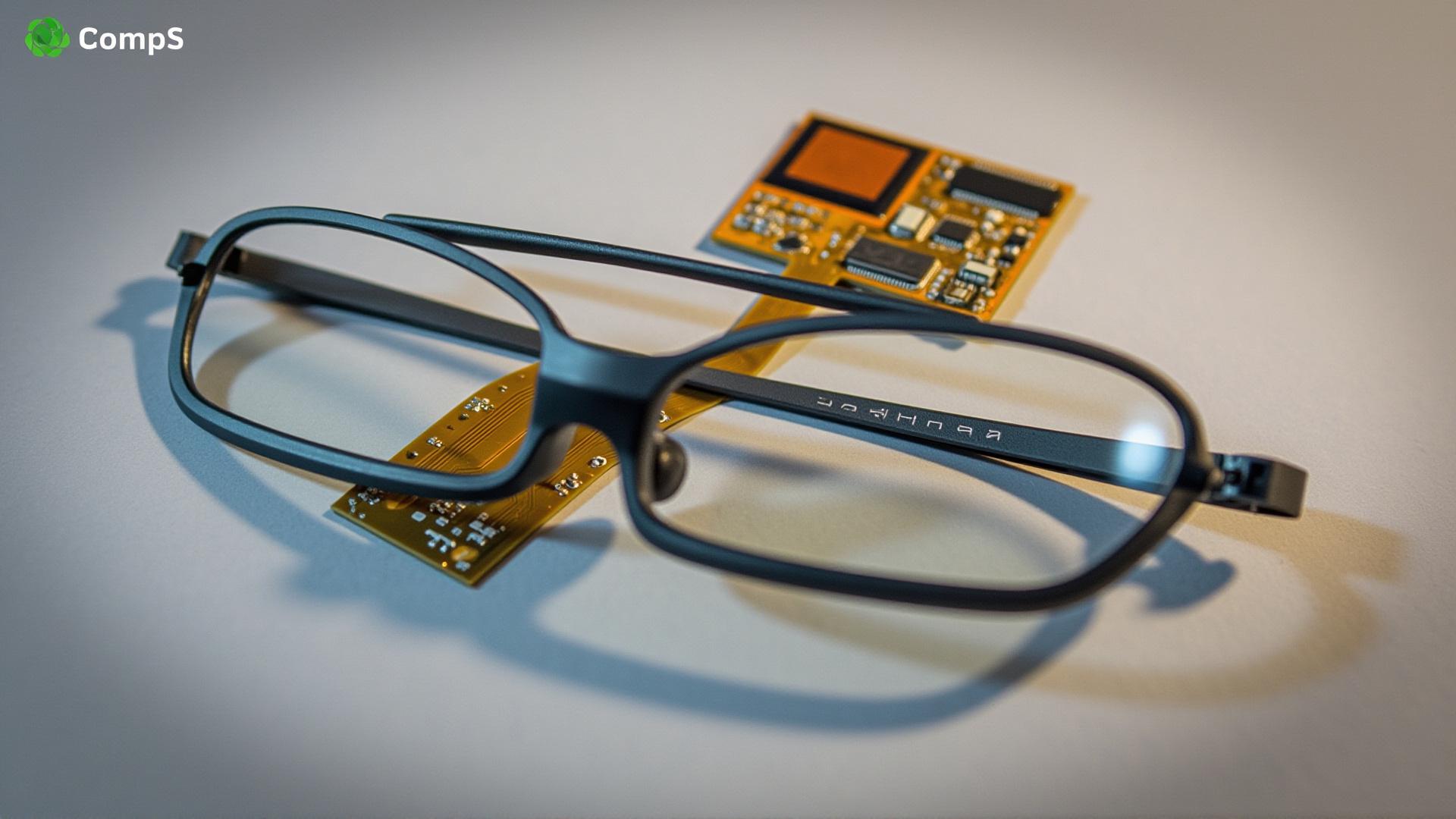
Most KY06 smart glasses how to use guides start with a feature list and leave the buyer to work out the order of operations. That order is the real problem. A procurement team taking delivery of a new camera-glasses model is not asking whether the device records video; it is asking which specification rows are published, which are assumptions, and what has to be signed off before a first purchase order goes out. This article runs the model as a seven-day operating sequence: what to check on arrival, what to log through a normal working week, and what to file before a repeat order is approved. A first week is short, which is exactly why the sequence has to be planned rather than improvised.
KY06 first-week sequence: what to do on day one
Day one is a triage day, not a demo day. The output of day one is not a feature list; it is a small set of recorded facts that later units can be compared against and that a supplier can be held to.
Start before the box is open. Record the batch or serial identifier, the delivery date, and the name of the person who accepted the shipment. These three fields cost nothing and they are the ones you cannot recover later. Inspect the lenses, the temple tips, and the charging contacts under a direct light, and photograph any mark while the packaging is still present. A photograph taken on arrival is worth more than any later description of a scratch, and it is the cheapest evidence you will collect in this whole process. Packaging conditions are also worth photographing if your channel sells opened units — our after-sales support and packaging for returns note covers the handover convention we use when a sample is rejected.
Then charge the unit to a known state and time the cycle with a wall clock. The catalogue gives a two-hour ceiling for charging on this model, so a first cycle that runs right up to the ceiling tells you almost nothing, while a first cycle that finishes earlier is a fact worth recording. Note the start time, the finish time, and the state of the case when you began. You are establishing a baseline that the next unit can be measured against, and a baseline only works if every baseline is measured the same way.
Pair the glasses once and record what the device actually does rather than what the packaging promises. Capture the application version and any firmware string shown on screen. Both change over the life of a product, and both are the first things a support conversation needs. Resist the urge to exercise every control on day one. The decision that protects you is to establish the baseline functions — power, pairing, capture, and the case — before you test anything the published rows do not promise.

The flow above is the order we work in internally when a new camera-glasses model lands on a desk. Seven steps, and each one produces a record rather than an impression. The order matters because the later steps are expensive to redo: a unit that has been paired with an unknown application version cannot be unpaired from that version, and a unit that has been cycled on a charger you cannot identify cannot be re-baselined later.
- Accept and label — serial, batch, date, receiver, one photograph per outer carton.
- Inspect before power — lenses, temple tips, contacts, packaging condition.
- Charge and time — one measured cycle, start and finish written down.
- Pair once — application version and firmware recorded.
- Capture test — one indoor frame and one outdoor frame, saved as evidence.
- Log a working day — runtime, heat at the temple, comfort over wear time, errors.
- File the pack — evidence in one place before a repeat order is discussed.
The red flags that make us stop and escalate rather than continue are narrow: a serial that does not match the delivery note, a charging case that does not seat the glasses reliably on the third attempt, a firmware string the supplier cannot identify, or a capture file that will not open on a second machine. None of these is fatal on its own, but each one makes a later comparison meaningless, and a comparison is the entire reason the unit exists.
If your own team works to a different sequence, keep the seven records. The sequence itself is a convenience; the records are what protect the order.
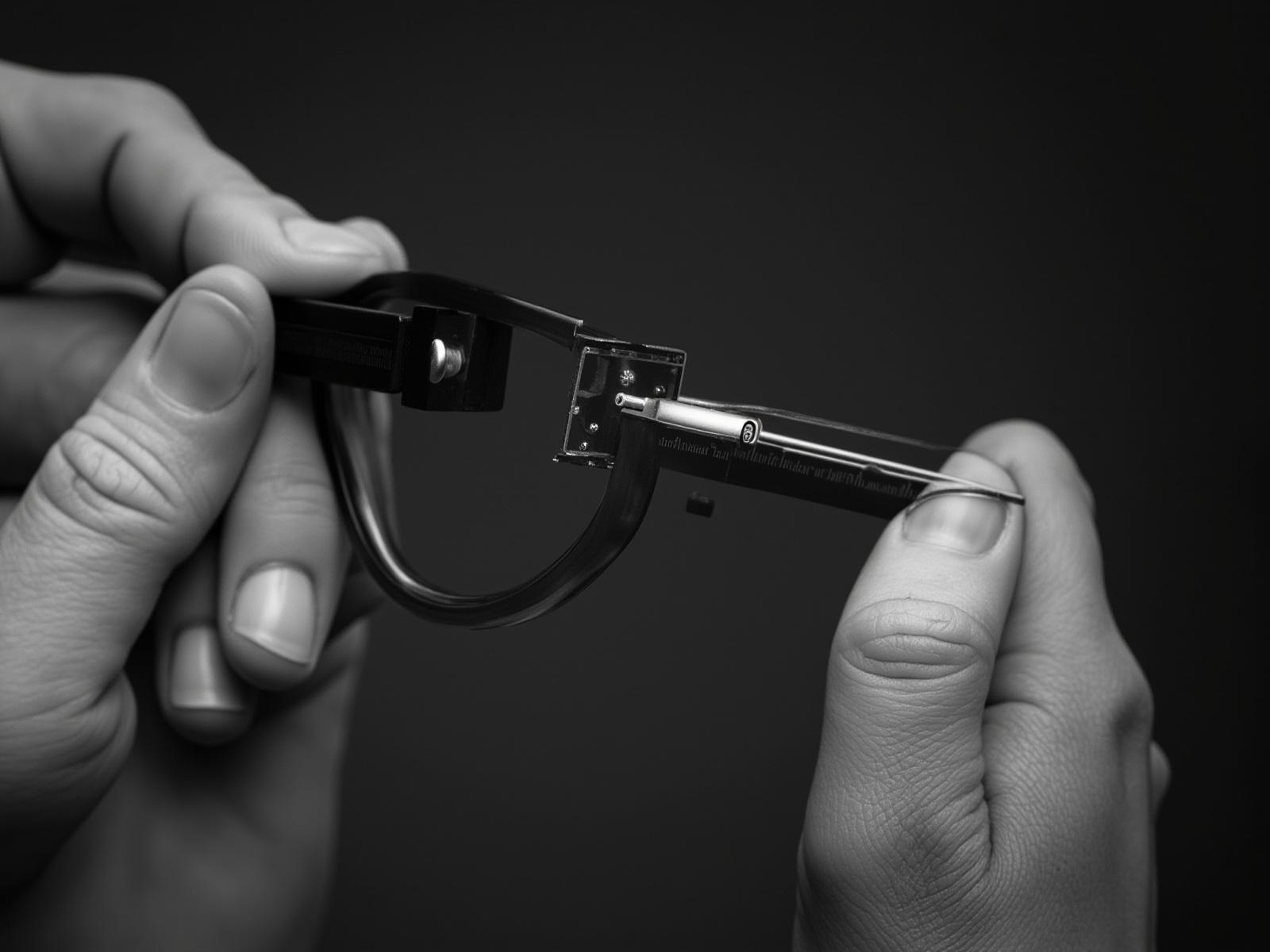
Reading the KY06 published rows before the first charge
Two hours before the first shipment arrives, most of the information you need is already written down. The catalogue rows for this model are short, and the value of reading them carefully is that they tell you which questions you no longer need to ask.
Four rows are published for this model and three of them are firm. The cell is 260 mAh. The camera is 8 MP. The charging case is listed as present, although its own capacity is not published — the catalogue shows the case without a figure for it. The same page also prints a runtime band of 6 to 8 hours, on a row labelled as charging duration that sits next to a separate two-hour charge time, so it reads as how long the unit runs rather than how long it takes to charge. The Bluetooth version, the IP rating and the weight sit outside the published rows, and a buyer who treats an unstated row as a promise is the buyer who gets surprised at the review meeting.
The catalogue-wide charging table is worth reading once. Across the range, charging methods split into magnetic and Type-C, with a small group of models where the method is not published at all. This model is not in that unpublished group, so a method is on record; ask the supplier to name it against your purchase order so that both sides of the contract agree. On charge duration, the range carries a general two-hour ceiling and only two models are published at close to one hour, so plan a two-hour window for a full charge and treat anything longer as an issue to raise rather than an inconvenience to absorb.
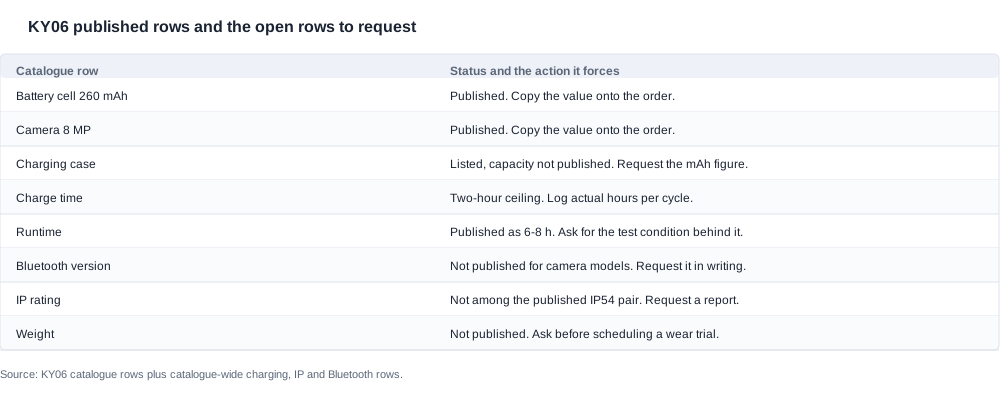
The table above separates the three published rows from the five rows that still need a written answer. Work it in that order. The published rows cost nothing to close: you copy them onto the purchase order and the specification sheet, and the supplier's later paperwork has to match them. The open rows are where the cost of a wrong assumption is highest, because each one becomes a number on your own datasheet and then has to be defended to a customer who read the same number somewhere else.
Three habits separate a buyer who has this under control from a buyer who does not.
- Copy published rows exactly. "260 mAh" and "8 MP" belong on the specification sheet in that form, with the catalogue reference beside them.
- Mark every other row as unverified rather than as pending. Pending implies movement; unverified is a fact about what is known today.
- Ask one question per row, in writing, and attach the answer to the order file rather than to an inbox.
There is one more category worth naming because it is easy to import by accident. The range publishes no capacitive touch row for any model, and it publishes no translation row either. If a sample unit appears to respond to a tap, or if a colleague's note mentions translation, treat both as unverified behaviour and confirm it in writing before it reaches a datasheet. Product pages inherit features from a previous generation more often than anyone expects, and the cost of removing a claim after it ships is far higher than the cost of asking one question.
The weight row is not a specification question so much as a logistics question: it decides whether the sample goes to a wear trial or straight to a packing bench. Ask for it early, because a sample that arrives and cannot be worn is a sample that never gets tested. The same logic applies to the IP rating, where the only models in the range with a published IP54 marking are a specific pair and this model is not one of them; the general note on IP ratings explains how we frame an unprotected row.
The KY06 case, the cell and the charge cycle
The 260 mAh cell is the one number you can build around, and the case is the part that most often breaks a delivery plan.
A published cell capacity tells you what to expect from the device; it does not tell you how long the device will run, because any runtime figure depends on a test condition that is not printed on the row. Treat the cell as an input to a comparison, not as an answer about endurance. If a colleague quotes a runtime number for this model, the useful question is not whether it is right but under which condition it was measured.
The case needs its own paragraph, because a case without a published capacity is a very different object from a case with one. Across the range, some models publish a case capacity in mAh, some list a case without a figure, some carry no case row at all, and one model is stated as having no case. This model sits in the group that has a case and no published figure for it. The practical consequence is direct: you cannot calculate how many charge cycles the case holds, so you cannot promise a customer a number of days away from a charger, and you should not put such a promise in a sales sheet. The general options and limits for case-based charging are summarised in our note on charging case options.
The charge cycle itself is the cheapest part of the whole qualification to measure, and the one most often skipped. Use a meter that reports the negotiated current and the elapsed time rather than the lamp on the charger; a charger that has a light is not evidence that a cell is full.
- Record the cell's state when the unit arrives, in whatever condition the packaging implies.
- Measure one full cycle from that state, with start and finish times written down.
- Repeat the cycle three times on the same unit and the same charger.
- Log the case dwell separately: how long the case holds the glasses before the cell is topped up.
- Keep the raw notes. Summaries are what come back to you quoted incorrectly.
The order of these five steps is not arbitrary. A single measured cycle tells you the shape of the curve but not whether it is stable; three cycles tell you whether the second unit in the shipment behaves like the first. The dwell measurement belongs at the end because it is the only one that requires the case to have been used normally for a while, and running it first biases it. Our battery life note covers the measurement conventions we expect a buyer to follow when comparing models.
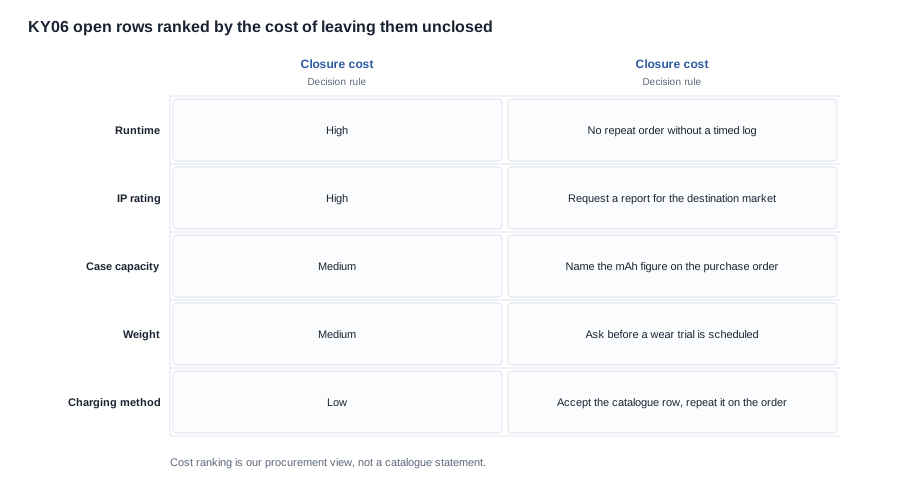
The cost ranking in the matrix above is our procurement view, not a catalogue statement. Runtime and the IP rating are rated high, because a wrong assumption there reaches the customer as a working-hour claim or a market-access claim. Case capacity and weight are rated medium, because they affect planning and packaging rather than compliance. The charging method is rated low, because it is published and only has to be written down correctly. The ranking tells you where the written questions go first and how much engineering time to spend on the answer.
One practical rule follows from all of this: keep the numbers you have verified in one column and the numbers you are still waiting for in another, and never let a sales sheet draw from the second column. We have watched a single unrounded figure in the wrong column travel further than the rest of the document combined.

KY06 daily use: what a procurement team should log
A first-week sequence is only worth something if the week produces records that survive the week. The daily log is the least glamorous artefact in this whole process and the one that decides, six months later, whether a supplier conversation is a request or an accusation.
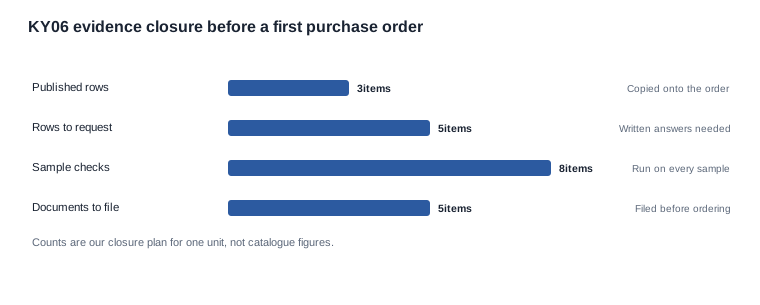
The plan above is the closure we aim for before a first purchase order: three published rows carried onto the order, five rows requested in writing, eight sample checks run, and five documents filed. Those four numbers are a plan, not a catalogue claim, and they are the reason the sequence in this article has a fixed length. Publish fewer records than that and you will be negotiating from memory; publish more without closing the five open rows and you have simply produced a longer document.
The daily log itself needs only a handful of fields, and every field has to be answerable by someone who was not in the room.
- Date, unit serial, and the number of hours the glasses were worn that day.
- Start and end state of the cell, plus the number of charge events and the case dwell in between.
- Ambient conditions for any capture test, including light level, because a frame that looks weak indoors and fine outdoors is a test result, not a defect.
- Any error, refusal or disconnect, described in the words the device actually displayed.
- Application version and firmware, re-checked at the end of the week rather than only on day one.
- Fit notes from whoever wore the unit: pressure points, temple slip, heat after the first hour.
The order of those fields mirrors the order of the questions. Wear time comes first because it is the only field nobody disputes later, and the rest of the log is an explanation of what happened during that time. The field that teams most often skip is the error description in the device's own words, and it is the field that decides whether a later fix is verified or merely believed to be fixed. Our troubleshooting note uses the same phrasing convention when a buyer asks us to read a log.
Two decisions matter more than the rest here. First, decide who owns the log — a rotating owner produces a complete file only if the file is in a shared place that everyone writes to. Second, decide what triggers escalation: our own threshold is two unlogged errors in one day, or a single error that makes the unit unusable, and we escalate on the same day rather than at the end of the week.
Keep the daily log linked to the sample programme rather than stored beside it. A wear trial is only meaningful if the person wearing the unit is logging to the same file the procurement team is reading, and our sample process is built on that assumption.
Checks to run on a KY06 sample before it ships
A sample is evidence, and evidence has a cost that only appears later. The cheapest samples are the ones that answer the most questions in the shortest time, which is why the eight checks below run in a fixed order on every unit that leaves our sample desk.
- Identity — serial, batch, and the date code reconcile with the delivery note and with the packing list.
- Charge cycle — one timed cycle from the documented starting state, written down rather than estimated.
- Case behaviour — the glasses seat correctly, the case reports its state, and the dwell behaviour matches the note on file.
- Pairing — pairing succeeds from a clean device, and the application version and firmware are recorded.
- Capture — one indoor frame and one outdoor frame, each checked on a second machine, with the camera settings on our camera imaging page used as the reference for what should be visible.
- Controls — every control the published rows describe is exercised exactly once, and any behaviour beyond those rows is recorded as unverified.
- Wear — a minimum wear session with fit, heat, and slip noted, at the point where the unit would normally be worn rather than held.
- Packaging — the unit is returned to packaging that survives shipping, and the return path is documented before the sample leaves.
The cost of this sequence is one working day. The cost of skipping it is a repeat order placed on assumptions, and that is the number worth keeping in view. Our position on samples is simple: one unit is evidence, ten units are a trend, and neither is a substitute for a written answer to the five open rows. If you cannot get the five answers in writing, take ten samples and measure the spread instead — that is a legitimate strategy, but it is a different cost decision and it should be recorded as one.
Check four is where qualification usually stops early, and check six is where over-claiming usually starts. At check six, ask the supplier to demonstrate only the controls their published rows describe, then write down everything else the device appears to do as unverified behaviour. We do not publish a capacitive touch row for any model in the range, and we do not publish a translation row, because neither is on the catalogue sheet. If a sample seems to do either, that is a question for the supplier and not a specification.
Export paperwork is the other place where samples are usually under-used. The export certification page in our catalogue is an image page rather than a list of transcribed marks, so a buyer who needs specific documents for a destination market should ask for them against the certification checklist and file the answers with the sample report. If the answer is "not available for this configuration", that is still a usable answer, because it tells you the model does not carry the document into that market and the routing has to change. What is not usable is an unmarked page forwarded as if it were a certificate list.
If your channel needs private labelling, run the eight checks on a labelled unit as well, because the label changes the packaging, the unboxing sequence, and the serial legibility. Our OEM-ready programme and the sport configuration options both change the physical handling, and a sample of the final configuration is worth more than a sample of the stock unit.
What the KY06 documentation does not answer
There is a limit to what a catalogue can answer, and it is worth naming it explicitly rather than letting a gap be filled by whoever speaks last.
Where CYNRIN stands on unpublished rows. We will not fill an unpublished cell with a plausible number, and we will not repeat a runtime figure that has no test condition attached to it. Our position is that an unnamed specification is an open question, not a small detail — it is the point at which a buyer's own datasheet drifts away from the supplier's, and the drift is invisible until a customer returns a unit. So we publish the rows we have, we name the rows we do not, and we tell you exactly what to ask.
Five rows are open for this model, and they are worth repeating in the order that saves time.
- Case capacity — the case is listed, its capacity in mAh is not. Ask for the figure, and ask which units it applies to.
- Runtime — the catalogue prints a 6 to 8 hour band, so ask for the condition behind it: screen state, brightness, capture frequency, and ambient light.
- Bluetooth version — the range publishes a version for only part of its models and camera models are largely outside that group, so request it directly rather than inferring it from a sibling product.
- IP rating — only a specific pair in the range carries a published IP54 marking, so request the applicable rating or the report behind it for your destination.
- Weight — ask for the shipped weight, because it decides packaging, freight, and whether a wear trial is worth running.
Beyond those five, two further items sit outside the catalogue for this model and belong at the order stage rather than the specification stage: the colourways available for your configuration, and the packaging configuration for a given destination. Both are questions to put to the supplier in the same written request, so you get one answer set instead of six.
The way to phrase these questions matters as much as the questions themselves. Ask for the value and the condition it was measured under. Ask whether the value applies to every unit in the batch or to a sample configuration. Ask the supplier to restate the three published rows — 260 mAh, 8 MP, and the charging case — so that a mismatch between their order confirmation and their catalogue is caught at the first document, not at the first dispute. If you are comparing this model against another in the range, our common questions note sets out the same discipline for the questions buyers most often skip.
Finally, a closing note on where the evidence ends. We have described the sequence, the published rows, the measurements and the five open questions. We have deliberately not given you a weight, a case capacity, a runtime condition or a market recommendation, because the catalogue does not publish them and our own test data is not a substitute for yours. The camera-glasses range overview on our product page is the right starting point for the specification side, and the sequence above is the right starting point for the evidence side. Run both, keep the records, and the first repeat order will be the easiest decision you make this year.


