

AI camera glasses troubleshooting is usually written as a user manual, and a user manual is the wrong document for the person who owns the problem. The reader of a troubleshooting sequence in this category is usually a support lead or a distributor's returns clerk, and their question is not "how do I fix this" but "is this a hardware fault, a configuration fault or an expectation the channel created" — because those three answers lead to three entirely different costs. A hardware fault becomes a warranty claim, a configuration fault becomes a picking or accessory problem, and an expectation fault becomes a copy problem, and a support team that resets and replaces before it has established which one it is looking at ends up with a higher returns rate than the product actually has. This article sets out the triage order, the published rows that make part of the triage possible, and the documents a distributor needs in writing before the first unit is sold.

AI camera glasses troubleshooting: the triage order
The order below is arranged cheapest-check-first, and that ordering is the whole argument. A unit that has not been charged correctly produces the same symptom as a unit with a dead cell, and a support team that opens with a replacement policy rather than with a charge check will replace good units indefinitely.
Step one, establish the charge state and the interface. Ask what the customer did before the unit failed, and specifically which interface the unit was charged on. This is the cheapest question in the sequence and it resolves the largest share of cases, because the range contains two published interfaces and one published case of a third position that is simply not stated.
Five camera models publish magnetic charging: the S7 and the KY06, and the V06 and the MT5, and the V03. Two publish a Type-C port: the V03 Pro and the L2 Utral. Four publish no charge interface at all: the CY05 and the CY03, and the L1 Pro and the MT6 — and those four are exactly the models that publish a charging-case capacity. A unit in that last group cannot be triaged on the interface until the supplier has confirmed what it uses, and a support script that assumes a dock will mis-handle it every time.
Step two, check the charge path, not the electronics. For a magnetic unit, the contact between the unit and its dock is the first thing to examine, because a magnet that has picked up metal or that is seated on a dirty surface presents exactly like a charging fault. For a Type-C unit, the cable and the port are the equivalent. Ask whether the unit charges on a known-good dock or cable. If it does, the fault is in the customer's accessory and the unit does not need to come back at all.
Step three, check whether storage filled, if the camera stopped recording. This is the branch that most often gets misclassified as a hardware fault. No camera model in the range publishes a storage rule — not a capacity, not a limit, and not the behaviour when a limit is reached — which means a camera that stops recording because it reached a limit is indistinguishable from a camera that has failed. The only way to separate them is to obtain the behaviour from the supplier in writing and then reproduce it on a sample.
Step four, separate the hardware fault from the expectation the channel set. A unit that behaves exactly as designed but does not match what the listing promised is not a defective unit; it is a claim that was wider than the evidence. That distinction is the one that protects a distributor's warranty position, and it is the one that is lost when the support line and the marketing line are run by different people who never speak.
Step five, record the outcome against the batch code. A returns log keyed by month produces a number that cannot be argued with. A returns log keyed by batch code produces a number that can be traced to a production window, and that is the number that distinguishes a batch problem from a seasonal one.
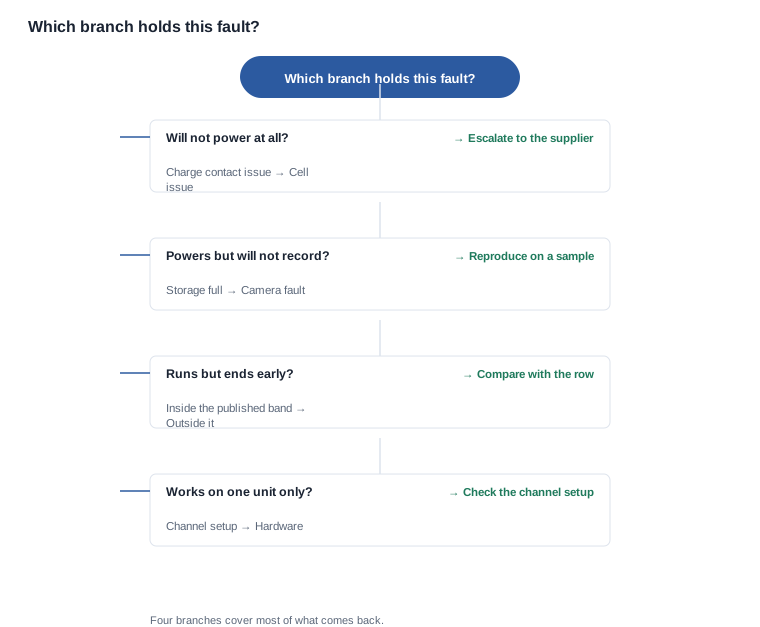
The order is not arbitrary and the steps are not interchangeable. The criteria for stopping at a step are simple: if the step has produced an explanation, stop there; if it has not, move to the next one. Which model the unit is, and what the published rows say about it, decide how much of the sequence is even available to the agent. Charging before storage, and storage before expectation, because each step is cheaper than the next and each removes a category before the next is examined.
The published rows that make part of the triage possible
Triage needs reference values, and this category publishes fewer of them than a support team would like. Here is the complete set that exists for the eleven camera models, and what each one lets a support team do.
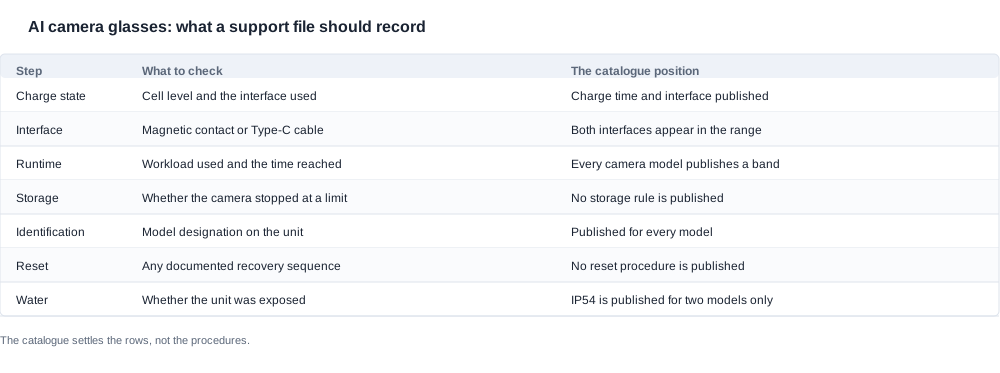
Charge time. Published as two hours or less for every camera model. Two things follow for support. A unit that does not charge within the published ceiling has a problem worth escalating, and a unit that charges slowly but within the ceiling does not. And because the published figure is a ceiling rather than a measured cycle, a support script cannot say "it should charge in X minutes" — it can only say whether the unit reached the published ceiling.
Rated runtime. Published for every camera model in three bands: five to eight hours for the V03 and the V06, and the V03 Pro and the S7; six to eight hours for the KY06 and the MT5; about seven hours for the L1 Pro and the MT6, and the CY05 and the L2 Utral, and the CY03. A customer reporting that the unit "runs out early" has produced a symptom, not a diagnosis, and the band is what turns it into one. If the unit finishes inside its published band, the runtime is not the fault; if it finishes well outside, it is.
Charge interface. Published for seven camera models and unpublished for four, as set out above. This row is the basis of the first triage step and the most common source of a wrong first diagnosis.
Identification. The model designation is published for every model, and it is the row that makes the whole sequence possible. Before any triage step, the support agent should have the designation of the unit in front of them, read from the unit or the carton. Without it, every published row is inaccessible.
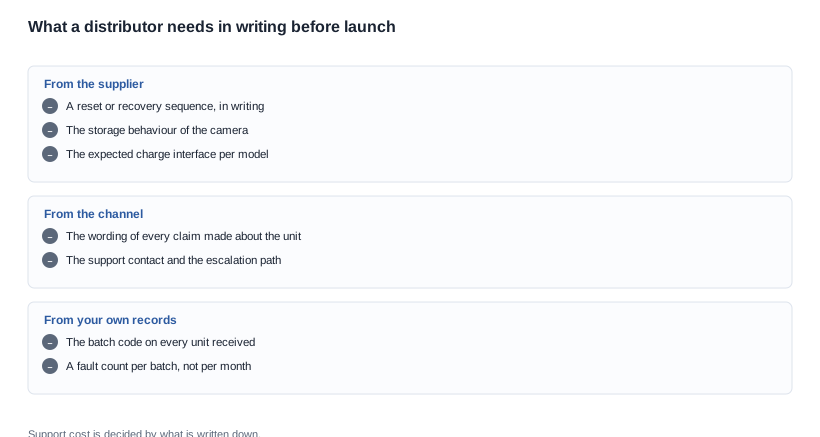
Storage behaviour. Not published for any model. It is therefore a supplier question, and until it is answered, "the camera stopped recording" cannot be classified. The correct handling of an unanswered question in a support system is to record it as a known-unknown with a named owner and a date, and to route affected returns to a reference sample rather than to a replacement.
Reset and recovery sequences. Not published for any model. A documented recovery sequence is a support-cost item: it decides how many units come back and how many are closed on a call, and it belongs in the manual rather than in one agent's memory. The Bluetooth audio glasses troubleshooting order piece covers the equivalent sequence for the audio models, where the storage question does not arise, and the AI camera glasses quality checks piece covers the incoming checks that catch faults worth catching before a carton is sealed.
Water exposure. IP54 is published for the V06 and the S7 only, and for no other model in the range. So "it got wet" is a triage question, not a verdict: on the two rated models there is a published reference to reason from, and on the other nine there is not. The rain and speaker analysis piece and the low temperature battery notes piece cover the environmental questions that sit alongside this one.
What a support file should record, and what it should decide
A troubleshooting article for a consumer is a set of instructions. A troubleshooting file for a channel is a decision procedure, and the difference shows up in what it contains.
The first requirement is that the file can be handed to a support agent without a supervisor beside them. That means every step has a defined input and a defined output, and every branch terminates in one of three outcomes: the unit is returned for replacement, the unit is returned for credit, or the case is closed without a return. Those three outcomes have different costs, and a file that does not name them will have the agent choosing by mood.
The second requirement is that the file separates the three fault classes, because each one has a different owner.
Hardware faults are the supplier's. The file should name the evidence needed to escalate one, and the evidence is a charge-path result, a runtime comparison against the published band, and a batch code. The returns and warranty notes piece covers how that agreement is structured, and the returns packaging guide piece covers what a customer should be asked to send back, because a unit returned without its accessories is a unit whose diagnosis cannot be completed.
Configuration faults are the channel's. A unit shipped with the wrong accessory, or with an accessory the channel never stocked, or with an insert in the wrong language, arrives as a fault report and is resolved by a picking or a stocking correction. The published rows make this class identifiable: the case capacity, the interface position and the accessory set are all catalogue-level facts for seven of the eleven camera models, so a returned unit can be checked against what should have been in the box.
Expectation faults are the marketing line's. A unit that works as published but does not match the listing is a copy problem, and the evidence is the published rows themselves. This is the class that most often gets misclassified, and it is the one where the cheapest correction is a change to the listing rather than a change to the product.
The third requirement is that the file records what is known and what is not, in writing, with owners. A support operation that does not know its own reference gaps will discover them one at a time, from customers, at the most expensive moment.
What the returns data has to settle, and what it cannot
A returns log is the cheapest support asset a channel can build, and it is the one most often built in the wrong shape. A log that records a count per month is useful for a trend line and useless for everything else. What makes returns data actionable is that it is keyed by the same identifiers the supplier uses, which means it can be read as evidence in a negotiation rather than as an internal metric.
Five fields do most of the work. The model designation says which product the unit was. The batch code says which production window it came from. The fault class says which of the three categories it fell into. The outcome says what was done with it. And the accessory set says whether the unit came back complete, because a unit returned without its dock cannot be diagnosed on the charge path and will be counted as unexplained.
With those five fields, a returns log settles a series of questions that otherwise stay open.
Is there a batch problem? A cluster of returns from one batch code is a production question, and it is the one question a supplier cannot deflect with a general assurance. The OEM ready platforms warranty setup piece covers why that question has to be asked in the agreement rather than in the first quarterly review.
Is the fault rate real? A rate needs a denominator, and the denominator is units received, not units sold and not units in the channel. This is the same discipline the quality inspection requires, and the two share a log format.
Is the expectation class growing? A rising share of returns in the expectation class is a copy problem, and it is invisible in a warranty conversation because those units are usually closed without a return. The cheapest fix is a change to the listing, and it is worth more than any negotiation with a supplier.
Is the supplier's response acceptable? A warranty agreement should carry a response time and a credit or replacement procedure, and the returns log is the evidence that either is being met. A supplier with a good response time and no written commitment is worth less than one with a written commitment, because the commitment is the thing that survives a change of personnel.
What is the total cost of a return? Not the replacement unit. The total cost is the replacement unit, the freight in both directions, the handling time, the stock movement, the channel relationship and the customer. The total cost of a returns problem is what decides whether a channel continues with a line, and it is the figure to put in front of a partner.
What the returns data cannot settle is equally worth naming. It cannot establish a fault rate before the first shipment, it cannot tell you what normal behaviour is where the catalogue publishes no reference, and it cannot distinguish a genuine deterioration from a change in the reporting habit. A log started late produces a rate that mixes two regimes, so the start date belongs on the sheet with the first entry.
The questions to ask a supplier about the warranty position, therefore, are about the mechanism rather than the rate: which reference values will the supplier accept as the basis for a claim, what evidence the supplier requires with a returned unit, how quickly a claim is answered, and what credit or replacement terms apply. Those four answers are what a buyer should negotiate before you order, and they are worth more than a promised fault rate, because a promised rate is a number the buyer cannot check and the four answers are commitments that can.

A triage walkthrough for a distributor taking on a new line
The following is a hypothetical walkthrough, written to show the decision sequence rather than to report a result from a client project.
Assume a distributor taking on a camera-glasses line with a small support team of two people, neither of whom has handled this category before. Their constraint is that the distributor cannot afford to ship every returned unit back for a replacement it does not need, and it has no product engineer on the payroll.
The distributor's first step is to obtain the two references that the catalogue does not publish and that the support team cannot work without: the storage behaviour of the camera and a documented reset or recovery sequence. It asks for both in writing, per model, before the first shipment lands, and it treats the two as blocking items on the launch. That decision converts an unknown into a reference, and it is the single highest-value thing in the whole support file.
The distributor's second step is to build the triage decision tree from the published rows rather than from a generic template. It writes the interface positions beside the branch names, so that the first question an agent asks is which interface the unit was charged on, and it writes the runtime bands beside the runtime branch so that "ends early" becomes a comparison against a number rather than an opinion. For the four camera models whose interface is not published, it puts a card in the agent's view saying the interface must be confirmed by the supplier before that branch can be used.
The distributor's third step is to decide the three outcomes and their evidence requirements, and the criteria for each one are written on the agent's card rather than held in a supervisor's judgement. A hardware escalation requires a charge-path result, a runtime comparison and a batch code. A configuration mismatch requires a photograph of the box contents and the model designation. An expectation mismatch requires the published row and a copy of the listing wording that was live at the time. Each outcome then has a defined next action, and the agent is never choosing between "replace" and "credit" without evidence.
The distributor's fourth step is to set up the returns log by batch code from the first shipment, with the fault class as a second field, so that the rate is available when the warranty conversation comes round rather than reconstructed afterwards.
The result is a support operation whose cost per return is known, whose largest category is identified, and whose reference gaps are on a list with owners rather than in an agent's memory.
What our published position is, and what we cannot supply
On AI camera glasses troubleshooting, our position is that most returns in this category are not hardware failures, and that a distributor who resets and replaces before establishing the charge state and the interface will end up with a higher failure rate than the product actually has. We publish the rows that make the first three steps of the triage possible: the charge interface for seven of the eleven camera models, the rated runtime band for all eleven, the charge-time ceiling for all eleven, the model designation for all eleven, the charging-case capacity for five, the ingress rating for two and the mass for one.
We cannot supply a reset procedure, a storage rule, a camera specification beyond the resolution tier, a support script or a fault rate, because the documentation does not contain them for these models. A support team working without those references is guessing at the physical side of a return, and we would rather name the gap than fill it with a plausible sentence. What we can do is tell you which published row applies to which model and which questions have to go to the supplier, so that the file you end up with is built on references that exist rather than on ones that were invented for the sake of completeness.
The AI camera glasses quality checks cover the incoming inspection that catches the faults worth catching before a carton is sealed, and the AI camera glasses which model to pick piece covers the model decision that determines which rows your support file needs in the first place.
Send us the models you are stocking and the markets you are selling into, and we will tell you which published rows each of them supports, which references your support file has to obtain from a supplier, and how to structure the returns log so that the warranty conversation later is one you can win.
Related reading
- The incoming checks — AI camera glasses quality checks
- The audio-side equivalent of this sequence — Bluetooth audio glasses troubleshooting
- Building the support agreement — after-sales support warranty policy
- What a customer should send back — after-sales support packaging for returns
- The environmental questions — does rain affect the speakers
- The temperature questions — does cold weather affect battery


