
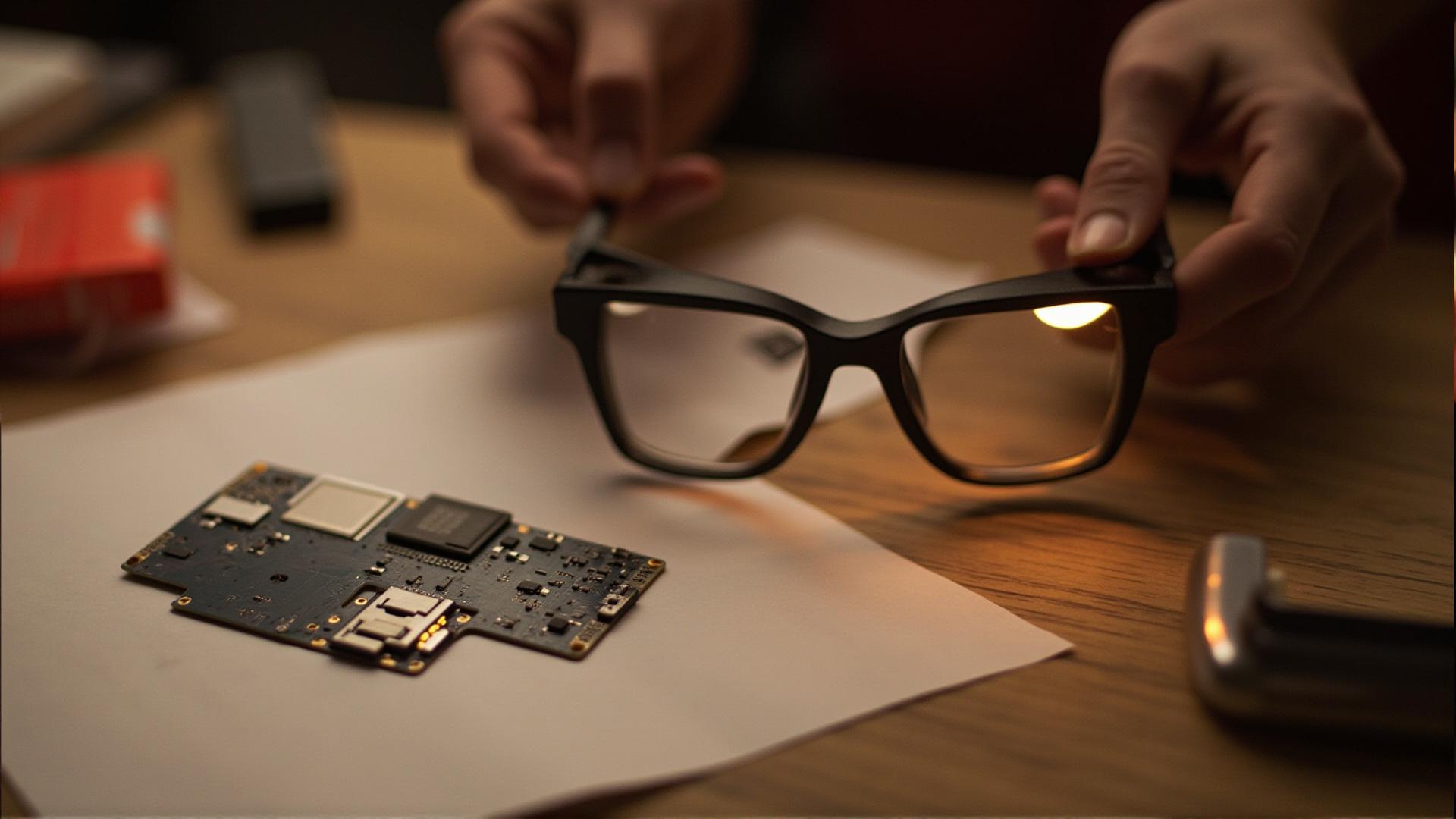
The published specification for this model is Bluetooth V5.4, 55 mAh × 2 cells, magnetic charging in two hours or less, a rated runtime of approximately six hours, and a configuration recording surround sound on a slim temple. There is no published control method, no published application requirement, and no acoustic figure of any kind. That last gap is the one that decides how the YK12 is used, because an open-ear audio frame is judged on three things a buyer can measure — whether the person next to them can hear it, whether they can be heard over it, and whether the other end of a call is intelligible — and the catalogue publishes no figure for any of the three. What it does publish is a geometry: a slim temple carrying a surround-sound configuration. That geometry is the reason the model behaves the way it does in use, and it is the reason the first session has to be about positioning rather than about pairing.
YK12 smart glasses how to use: the open-ear rhythm and the call switch
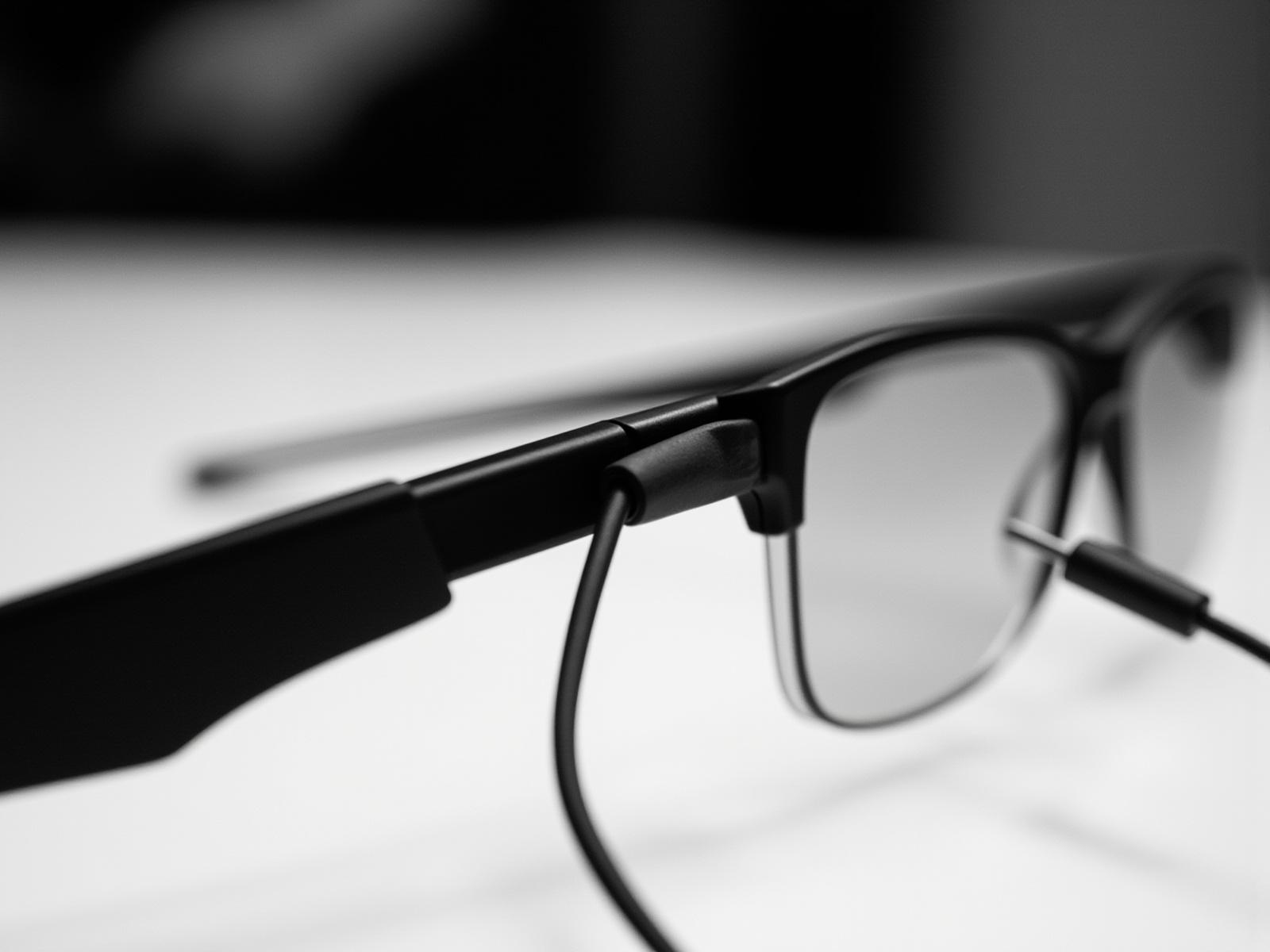
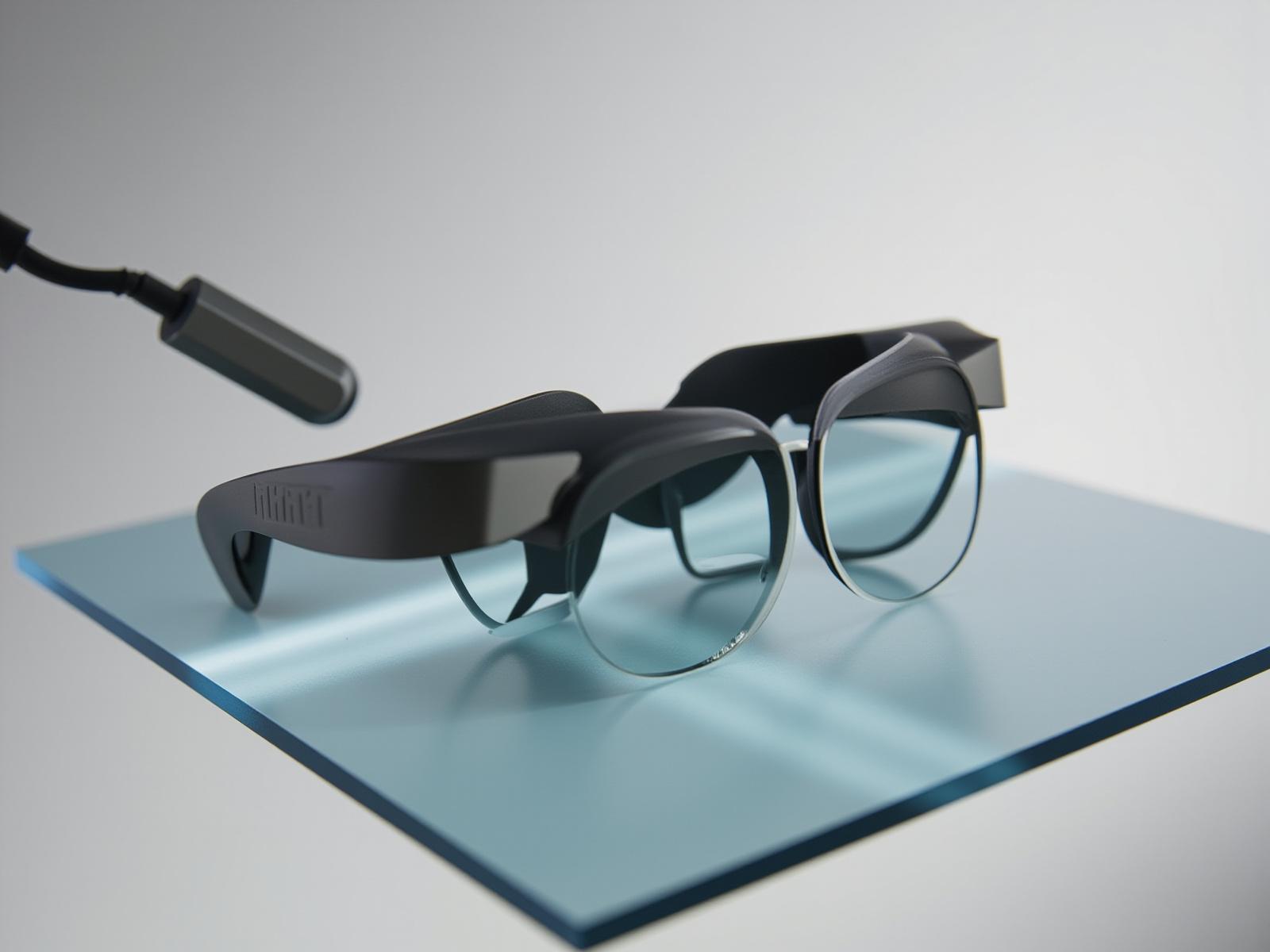
Two published rows do almost all of the work in this model, and they are usually read separately when they have to be read together. The first records surround sound. The second records a slim temple. A frame that places a speaker at the end of a slim temple and then asks that speaker to deliver a surround-sound field is making a specific geometric claim, and that claim is what a buyer is actually buying when they select this model over a plain open-ear frame. It is also a claim with a cost attached, because the same geometry that positions the driver close to the ear also positions it close to the jaw, and the published specification says nothing about how much of that field escapes.
So the routine for this model is not a sequence of button presses, because there are no published buttons to press. It is a sequence of positions. The frame goes on, the temple runs back along the side of the head, the speaker ends up at a particular point relative to the ear, and the acoustic result of that point is the whole of the product. A buyer who writes the quick-start card for this model is writing a positioning card, and the acceptance test that goes with it is a measurement of what can be heard at a given distance from the wearer and what the wearer's own voice sounds like to the other end of a call.
The second half of the routine is the switch between listening and talking, and this is where the catalogue is completely silent. An open-ear frame is a telephone handset that nobody holds, and the moment a call arrives the product has to decide something: does playback stop, does it duck, does the wearer need to act, and is there any indication of what is happening? A published specification that says nothing about this leaves the customer to discover the behaviour, which is the most expensive way to ship a product. A buyer therefore treats the call handling as a specification to be obtained, and the routine around it as something to be written only once that specification exists.
What the catalogue does publish, and what a buyer can rely on, is the electrical envelope. Two 55 mAh cells, a charge time of two hours or less, and a rated use of approximately six hours on magnetic charging. The catalogue publishes the cell values and the cell count rather than a single total, and it publishes no charging-case row for this model. Those three facts together set the rhythm of a working day: roughly six hours of rated use, after which the frame needs a magnetic charge, and no published case to do it in.
The figure that most often gets misquoted in a conversation about this model is the six hours, so it is worth being exact. The catalogue publishes a rated use of approximately six hours. It does not publish the workload behind that rating, the start state, the end criterion, the volume level, or any indication of whether the figure was measured with a call in progress. A rating is a manufacturer's number under unstated conditions, and a listing that prints six hours as a bare figure has made a promise the data does not support. Six hours is also the lower of the two endurance figures published inside the four-model group that shares this cell configuration, and the higher of the two belongs to models that are otherwise electrically identical — which means something differentiates them that the catalogue does not print, and the buyer should ask what it is before treating the number as a settled product property.

What the YK12 publishes: surround sound, a slim temple, and nothing acoustic
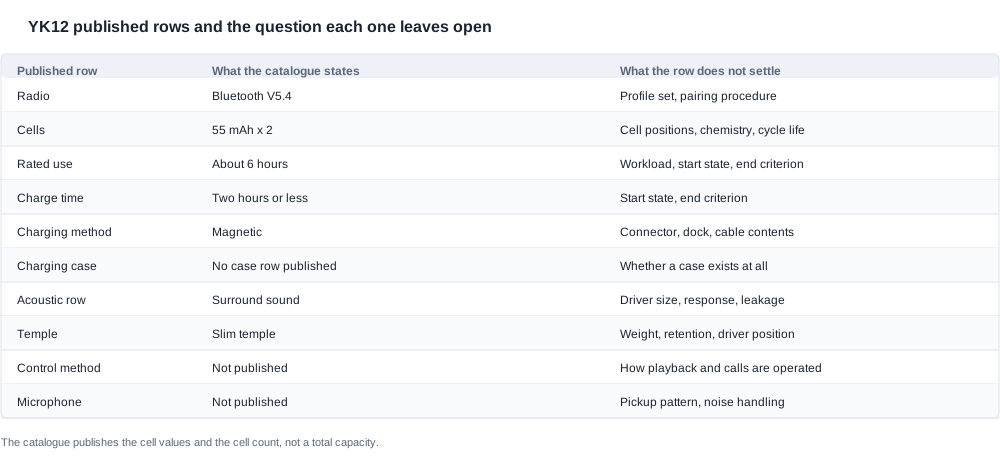
The table pairs each published figure with the question it leaves unanswered. The specification rows are five in number and they are short: the radio version, the cell configuration, the charge-time ceiling, the rated use, and the charging method. The feature rows are two: surround sound and a slim temple. Everything a buyer would use to write an audio specification is absent, and the absence is systematic rather than accidental, so it is worth listing in order rather than as a general complaint.
There is no published driver size, no frequency response, no impedance, no sensitivity and no rated output. There is no published sound-pressure figure and no published leakage figure, so nothing in the catalogue says how much of the programme reaches the ear and how much reaches the room. There is no microphone specification at all: no microphone type, no pickup pattern, no pickup distance, no noise-suppression behaviour and no published description of what the microphone hears in a noisy environment. There is no published description of the call-handling behaviour, no published control method, no published application requirement, no published pairing procedure, no published storage capacity, no published frame weight, no published ingress marking and no published charging-case row.
The two rows that do exist are more useful than they first appear, provided the buyer reads them as structural. Surround sound is an acoustic configuration, and a configuration row is a statement that the product does something specific rather than a statement of how well it does it. A slim temple is a geometry row, and a geometry row tells a buyer where the acoustic elements sit relative to the head. Together they tell a buyer that this is a deliberately positioned open-ear product, and they tell the buyer nothing about the measurements that would let them compare it with a competitor that publishes nothing either. The honest commercial position is that the configuration can be described and the performance cannot, and a listing that writes "premium surround sound" has taken the first and dropped the second.
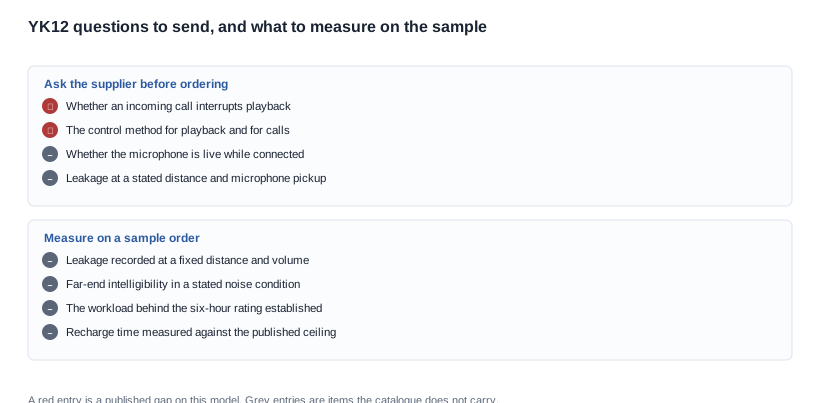
This matters because of how the category is sold. Buyers compare open-ear frames on published rows, and the rows in this category are thin for everyone, which means the differentiator in a listing tends to become a qualitative claim about the sound rather than a specification. The professional response is to convert the qualitative claim into a measurement protocol. Ask the supplier for the leakage figure at a stated distance, for the microphone pickup in a stated noise condition, and for the call-handling behaviour, and then put those figures into the acceptance file with the conditions attached. A buyer who does that ends up with three numbers; a buyer who does not ends up with a word.
The published set for this model is collected on the Bluetooth audio glasses range page, the items this model does not publish are in YK12 limitations, and the range-level selection argument is in YK12 smart glasses best for.
Switching between a call and playback: the behaviour nobody publishes
Almost every open-ear frame in this category has to make the same decision when a call arrives, and the decision is invisible until it goes wrong. Playback has to stop or reduce, the microphone has to open, and the wearer has to be told something. The catalogue publishes none of that for this model, and it is the single most valuable thing a buyer can ask for, because the answer determines three separate things: whether the customer can be trusted to take a call in a meeting, whether the customer can be trusted to take a call in a public place, and whether the product needs an application at all.
There are two plausible arrangements and they produce completely different customer experiences. In one, an incoming call interrupts playback automatically and the frame behaves like a headset without a boom. In the other, the wearer has to act — a button, a double tap, a voice command — and until that action is taken the call is not answered. The second arrangement is entirely normal in this category and it is the reason the published control method matters so much, because an action that requires looking at the frame or finding it by touch is not an action a wearer will take while talking to a customer.
That is why the absence of a control row in this catalogue is worth flagging to a buyer rather than treating as a detail. Not one model in our catalogue carries a published touch row; the single row anywhere that speaks of a physical control belongs to a different product in the range. So the question of how the YK12 is operated is not answered anywhere in our published material, and it has to be answered by the supplier. The three questions to ask are narrow and answerable: what action starts and stops playback, what action accepts or ends a call, and what the wearer receives as confirmation of each.
There is a fourth question that a buyer should add, and it is the one most often missed because it is a privacy question rather than a usability one. An open-ear frame has a microphone that is on while it is connected. A buyer in a corporate or retail deployment will be asked whether the device is listening when it is not in a call, and the answer is a product and firmware question rather than a design question. The catalogue publishes nothing that bears on it. A supplier that has a documented answer — a physical switch, a firmware behaviour, a published policy — is supplying something the buyer's customer will ask about, and a supplier that has no answer is supplying something the buyer's customer will decide for themselves.
A fourth question belongs in the same category, and it is the one a retail buyer is asked most often: what happens to the audio when a second device connects. With version 5.4 published and no connection-behaviour description printed, a buyer cannot state whether the frame holds one call and one stream or something else, and a channel that sells these frames to office workers will have the question asked in the first week. It belongs in the same supplier request as the call-handling behaviour, because both are answered by the same firmware document.
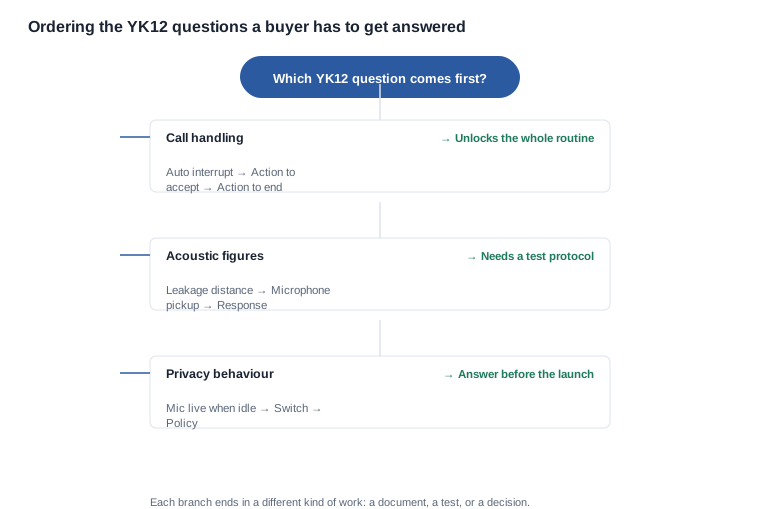
The decision structure above is a way of ordering the questions, and the ordering matters because some of them are cheap to answer and some of them are not. The call-handling behaviour is a single paragraph in a supplier document and it unlocks the entire operating routine. The acoustic figures need a test and they need a protocol, so they come after the routine has been written. The privacy behaviour is a firmware question and it may need to be answered before the product is announced rather than before it is shipped.
A six-hour rating in a working day: the charging rhythm for the YK12
A pair of 55 mAh cells, a magnetic charging method, a two-hour ceiling and a rated use of roughly six hours together describe a product with a half-day battery in a category where a full working day is the expectation a customer brings to the table. The gap between the published six hours and the expectation of a working day is the single most useful commercial fact on this page, and it is a fact about the published rows rather than a criticism of them.
The charging method is magnetic, and magnetic charging has a specific consequence for a daily rhythm: the frame has to reach a magnetic interface, so somewhere in the deployment there has to be a defined charging point. With no published charging-case row for this model, a buyer cannot assume that the case is the answer, so the charging point has to be designed in deliberately — a desk, a drawer, a charging station at a counter, a locker. A business that deploys these frames across a shift needs more than one, and a business that deploys them to people who move needs the charging accessory to be portable, which is a question about the magnetic interface and the cable rather than about the frame.
The six hours should be scheduled against as a floor rather than as a target. A buyer running a seven-hour shift should plan the recharge at the five-hour mark, and a buyer running an eight-hour shift should plan two. That planning is only sound if the rating is a rating under a stated workload, and the catalogue does not state the workload, so the first thing a buyer should obtain is the condition under which the six hours was measured: playback at a stated volume, or a mix of playback and calls, or a standby condition. Those three produce three different numbers, and our catalogue does not say which of the three it published.
The interaction with the call-switching question is direct and is worth making explicit, because it is where the six hours really gets decided. If the workload is a continuous playback session, the six hours is the relevant figure. If the workload is a working day of intermittent calls with occasional playback, the figure will be different and the catalogue does not say which way. A buyer who plans a deployment around the lower of the two possible numbers, and who asks the supplier to confirm it with the workload stated, is not going to be the buyer who discovers a shortfall in month two.

The routine that follows is short and it is the routine a buyer can print once the supplier answers. Charge the frame fully at the start of the day. Use it. At the point where the deployment needs the frame to keep working, bring it to the defined charging point and let the magnetic interface attach. Confirm the charge state. Return it to service. The catalogue supports the first, the third, the fourth and the fifth of those steps; the second exists only because the charging method is published and a method without a location is not a plan.
The range-level view of the endurance question, including the models that share this cell configuration and publish a different figure, is in the general method for reading a published rating, and the accessory and interface question in the accessory and interface question across the range.
The YK12 open-ear file: positioning, the call switch and the six-hour rhythm
The trade-offs behind the audio questions
- The call-handling behaviour: whether an incoming call interrupts playback automatically, and what action accepts and ends a call.
- The control method: what starts and stops playback, and what confirmation the wearer receives.
- Whether the microphone is active while the frame is connected but not in a call, and what the documented behaviour is.
- The acoustic figures: the leakage at a stated distance, and the microphone pickup in a stated noise condition.
- The workload behind the approximately six-hour rated use, with the start state and end criterion.
- The charge-time start state and end criterion, since the published row is a ceiling of two hours or less.
- The cell configuration in the built product: where the two cells sit and whether their positions are fixed.
- The weight of the frame as shipped, and the packed weight including any charging accessory.
- The radio version confirmation, and the conformity documentation covering this model.
- The box contents, including whether a charging cable or dock is supplied.
An audio configuration and a full smart-glasses unit are not the same regulatory object, and the distinction is worth settling before any file is assembled. The published configuration for this model is radio and audio only — Bluetooth V5.4, two cells, magnetic charging, no camera and no display — and a declaration of conformity has to describe the configuration that is actually shipped. A supplier that holds a technical file for a broader platform will often be able to produce a document for this model, and that document has to be checked against what is in the box rather than accepted on the strength of the model name. What this model ships is narrower than what a camera platform ships, and that has consequences for what the file has to cover.
Nothing in our catalogue settles any of that. Nowhere in the catalogue text is there a mention of CE, FCC or RoHS, no product carries a certification line of its own, and the export-certification page is pictures rather than words, so the marks a buyer will be asked about have to come from the supplier's own documentation rather than from ours. The instrument that applies to a radio product on the European market is the Radio Equipment Directive (EU) 2014/53/EU, and Bluetooth membership is confirmed separately by the buyer against the member database. The radio version is published for this model, which is the one part of the file our material does help with.
Building a measurable acceptance file
The YK12 acceptance file is unusual in that the most important items on it are measurements rather than documents. A positioning test is straightforward: the frame is worn, a programme is played at a stated volume, and a microphone at a stated distance records the leakage. A call test is equally straightforward: a call is placed from a stated noise condition and the far end reports intelligibility and background noise. A charge test is a third: the frame is run under a stated workload to depletion and the recharge time is measured against the published ceiling. Each of the three produces a number with a condition attached, which is the only form in which an endurance or an acoustic figure can be printed in a listing without creating a dispute.
What our catalogue settles for the YK12
Five specification rows and two feature notes are printed for this model, and they are not stretched here into an acoustic figure, a call-handling description, a control method, a cell position, a frame weight, a charging-case capacity or a certification claim. We also do not put the YK12 against the other audio models in the range on sound quality, and the reason is that the rows that would settle it are not printed for any of them. What we will say is that the two feature rows describe a deliberate acoustic geometry, and that a buyer who wants a comparison should ask every supplier in the shortlist for the same three measurements, because in this category the differences live in the numbers nobody publishes.
If the YK12 is on your shortlist, send us the deployment, the daily hours the frame has to cover, the noise conditions it will be used in, and the listing copy you intend to publish. We will say which of your lines follow from a published row, which need a measurement taken first, and which are better dropped than softened. Put the questions first, and what follows is a shortlist you can actually defend.


