
Smart glasses sourcing risk: what a supplier claim has to produce
The answer a buyer can act on
Verification before a commitment is cheap; verification after one is not. The reason is that each check produces an artefact, and an artefact produced before the deposit is something a buyer can act on, while the same check performed afterwards produces an opinion about a supplier who is already holding the money. So the useful way to frame supplier verification is not a due diligence checklist but a sequence of six questions, each of which should produce a document, a named contact or a dated commitment, and each of which has an obvious pass condition and an obvious reason to stop.
The first two questions cost nothing and eliminate the worst outcomes. Does the contracting entity match the bank account beneficiary, character by character? And can the supplier produce evidence for a named model rather than for a capability? A third question — does the evidence describe a run that happened rather than a process that exists — separates a factory from a trading company that has read the same brochure. The last three questions are commercial: what does the price contain, what happens when the schedule slips, and what governs the terms that only surface after the first shipment has arrived and been paid for.
None of the six ends with the supplier being declared safe. What they produce is a supplier who is known, and known is the realistic objective. Every one of the six is answerable in writing by a legitimate factory, so the refusal or the evasion of any single one is itself the finding.
The cost of checking late
Each check skipped has a cost profile that is asymmetric, and understanding the asymmetry is what justifies doing them before the money moves rather than after. A beneficiary check that is performed after the first transfer cannot recover the transfer. A capability check performed after the first shipment arrives can only be satisfied by a credit note or a return, and the cost of that is the units, the freight, the delay and the channel relationship. A process check performed after three shipments have arrived can still be done, but the supplier now knows what the buyer cares about and has an incentive to present the evidence that answers the question rather than the question that should have been asked.
The pattern is worth stating plainly: every check that is deferred is a check whose answer gets worse, and the deterioration is fastest on the checks that are cheapest to perform.
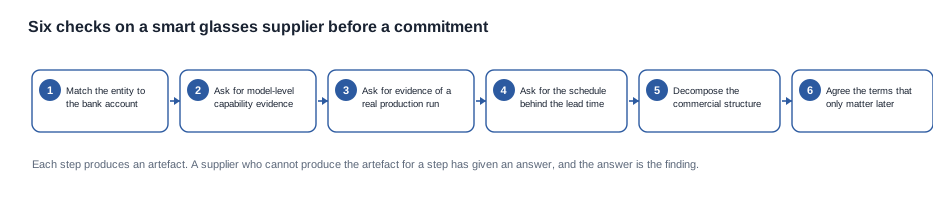
The sequence runs from identity to remedy, and each step produces an artefact. A supplier who cannot produce the artefact for a step has still given an answer, and the answer is the finding.
The identity check that costs one email
The beneficiary test
The clearest available indicator of a sourcing problem is on the payment instruction, and it costs one email to confirm and one email to refuse. Check the business licence of the contracting entity against the name on the bank account that will receive the deposit. Not the trading name, not the brand, and not the name of the contact — the registered entity, and then the beneficiary, character by character.
Three outcomes are possible and all three are informative. The beneficiary matches the contracting entity, and the check passes. The beneficiary is a different company, and the reason is given and is checkable — an arrangement where a group company collects for a manufacturing entity is legitimate if it is disclosed and if the contract says which entity performs and which entity pays. The beneficiary is a different company and the reason is not given, which is not an unusual pattern in a sourcing problem.
The third outcome is the one that ends the conversation, and it does not need to be dramatic. A payment to an account that cannot be traced to the contracting entity, on the explanation that the factory prefers it that way, is a supplier that has declined to identify the legal entity behind the goods.
What a mismatch means
It is worth being precise about what the mismatch does and does not prove, because over-reading it leads to walking away from legitimate suppliers and under-reading it leads to paying the wrong company.
A mismatch is not evidence of fraud. It is evidence that the buyer does not know who is obligated to perform. That is a material fact on its own, because the obligations a buyer wants — the delivery date, the conformity of the goods, the defect remedy, the availability of spare parts — are enforceable against a legal entity, and the entity is the one whose licence matches the bank account. Where those are different, the question to resolve is which of them is the manufacturer, which is the seller, and which is the party that signs the technical documentation.
Two practical consequences follow. The contract should name the entity that performs, separately from the entity that invoices, if they differ, and each should be checked against the licence rather than against the email signature. And the technical documentation should be issued against the performing entity, because a file issued by an entity with no relationship to the production site is a file that will not survive a question about scope.
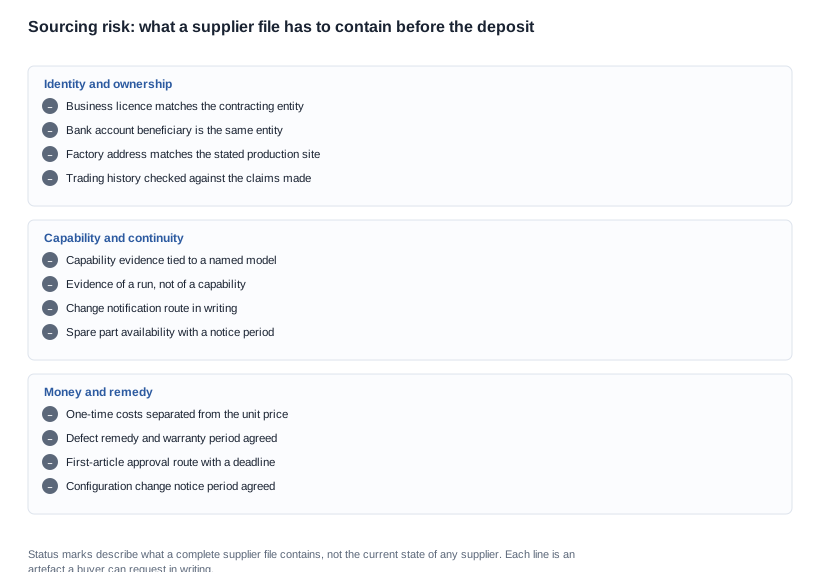
The checklist is organised by the three areas where sourcing problems actually appear: identity, capability and continuity, and money and remedy. Each line is an artefact a buyer can request in writing today.
Capability evidence that names a model
Three levels of capability evidence
Supplier capability claims in this category come in three distinguishable levels, and confusing them is the most common error in a supplier evaluation.
The first level is a product claim: the supplier can build camera-equipped smart glasses with a charging case, or AI audio glasses, or both. This is the weakest level and it is the one most often quoted in a first reply, because it describes a product family rather than a build. It cannot be checked against anything without more information.
The second level is a configuration claim: the supplier has produced the model, in the configuration, with the options that matter. This is checkable and it is where the evaluation should sit. The catalogue makes the distinction concrete because the configurations are genuinely distinct: the L2 Utral exists in two case capacities, the V03 Pro has no case in the box and a photochromic lens option, the MT6 has a folding 1200 mAh case, and the camera models split across an 8 MP group of eight and a 13 MP group of three.
The third level is a documented claim: the supplier can produce the file, the test evidence or the specification behind the configuration. This is the level that actually determines whether the buyer can ship, and it is the one most often missing.
The questions that separate them
- Which model codes have you produced, and in which option sets?
- What was the most recent run of each of them, and for which customer if we need to know the volume?
- Which of the published rows for that model can you show evidence for, and which are open on your side?
- Which parts of the build are sourced outside your factory, and who supplies them?
- Can you produce the technical file for the configuration we are ordering, and does it name our model code?
Question three is the one that reveals how much of the supplier's own knowledge is real. A supplier who can list which published rows are open has read the specification rather than the brochure, and that difference in familiarity is a good predictor of how the first disagreement will be handled.
Question four is the one that decides whether a supplier is a manufacturer or an assembler. The answer in this category is that a range with this much branching involves parts sourced from outside: cells, camera modules, cases, hinges, packaging inserts. A supplier that says everything is in-house when the range includes a folding case with a hinge is telling you something about the care they take with accuracy.
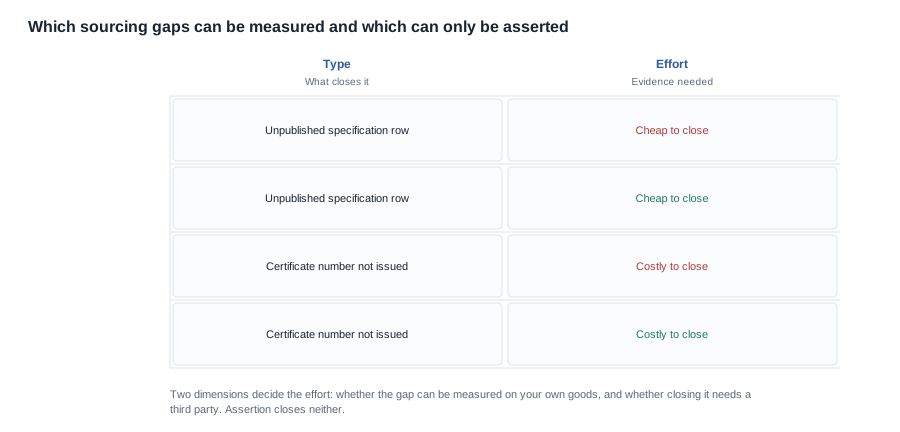
The matrix states the principle behind the whole sequence. A gap that can be measured on the buyer's own goods is a cheap gap to close. A gap that can only be asserted is closed by a document, and a document has to come from someone with accountability.

Evidence of a run, not of a brochure
What a run leaves behind
A factory leaves traces and a trading company does not. The traces are unglamorous: a first-article approval record, a production plan with a date against it, a packing list, an incoming inspection result, a retained sample from a named lot, a serial or lot numbering scheme, a photo of the line with the work in progress. None of these is proprietary and none of them requires a site visit to ask for. Asking for them is how a buyer distinguishes the two kinds of company without the cost or the disruption of an audit.
The point of collecting them is not to catch anyone. It is to establish what the supplier's own record-keeping is like, because the record-keeping is what the buyer will depend on later when something goes wrong. A supplier with a coherent production record will also produce a coherent documentation file, a coherent change notification and a coherent answer about the first shipment. A supplier without one will produce all four of those on demand, and none of them will be consistent with the others.
The audit that is worth reading
Where a buyer is going to read a supplier's own audit or test report, the same test applies to it: read it for what it covers and what it does not. A report covering a single production run describes a period and cannot support a claim about an ongoing capability. A report that names the model codes and the configuration is worth a great deal more than a general statement about the plant, because a general statement cannot be matched against a purchase order.
The three questions to ask of any such document are the same three: which models are named, what period does it cover, and who is the named owner of the file it came from. The third question is the one most often overlooked and the most revealing, because a document with no owner is a document that cannot be produced again, and a document that cannot be produced again is worth very little when the question reappears at the border.
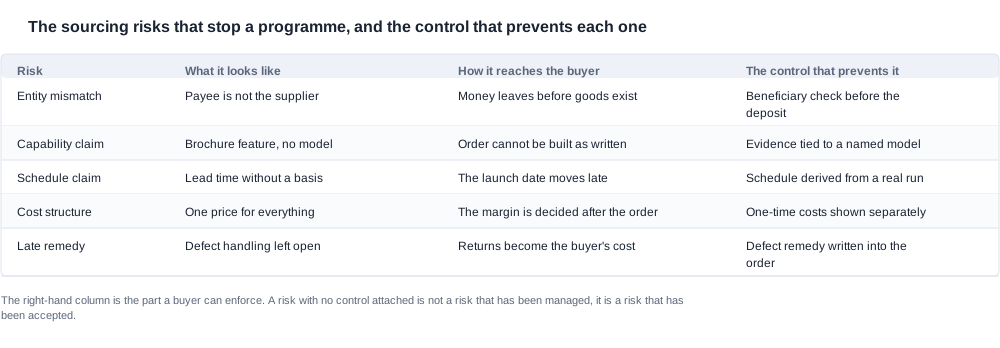
The risk register below sets out the sourcing failures that actually stop programmes, in the order they occur. Each of them is a reason to request a specific artefact, not a reason to distrust a supplier.

The commercial structure and the terms that arrive late
Decomposing the commercial structure
A quoted price is a structure, not a number, and the structure is what the buyer is really negotiating. The parts respond to different forces. The unit price responds to volume and to the component market. The tooling and the artwork respond to the programme length, because they are amortised over the run. The compliance work responds to the number of markets and to the number of configurations, because the testing and the assessment are per product family and per market while the handover work is largely fixed. The packaging responds to the print run length, and a moulded insert is a tooling cost rather than a printing cost.
The useful negotiation is usually not about the unit price but about the scope of the compliance work, because that is the part where a buyer has a genuine choice: an unnecessary market in the quotation is a cost the buyer chose, and removing it is worth more than arguing about the rate on a line that is already competitive.
The terms that only matter after the first shipment
Five terms arrive after the goods and are worth settling before they do, because each of them is a term that is usually omitted from a quotation and conceded late.
The defect remedy decides whether a defect becomes a return, a credit or a dispute. The warranty period and the claim route decide whether the channel's problem becomes the buyer's problem. The first-article approval route and its deadline decide whether a shipment can leave before the buyer has seen it, which is a commercial choice with a quality consequence. The configuration change notice period decides whether a factory-side substitution can move the build under the buyer without notice. And the spare part availability term decides whether a warranty on a product with a hinge, a case and a camera module is a commitment or a hope.
None of these is unusual to ask for. All five are routinely absent, and the reason is the same in every case: they are the terms a buyer asks for after the first problem rather than before it.
The trade-off behind the six checks
The six checks are not free, and a buyer who asks for all of them without acknowledging the cost will get a slower and less open answer than one who asks for the two that matter most. An identity check costs the supplier an email. A capability check that names a model costs them a file, and if the file does not exist that is expensive for them to produce and is therefore the check with the most signal. A schedule commitment costs them flexibility. A defect remedy costs them money. The checks that get resisted are the ones that transfer risk, and that is exactly why those are the ones a buyer should write into the agreement rather than merely request.
Building the shortlist from the evidence, not from the reply
Two suppliers can both pass all six checks and still be very different to work with, and the difference shows up in how the answers were assembled. A supplier whose answers arrive as complete documents, with the model codes named and the period stated, is a supplier whose internal records are organised. A supplier whose answers arrive as sentences will require a conversion step on the buyer's side before anything can be filed, and that conversion step is unpaid buyer time that recurs on every subsequent order.
The second difference is whether the answers are stable when the question changes shape. Test it by asking a second question about the same subject in a different form: a supplier that described the model in one reply and the configuration in the next is describing a product family, not a build. This test costs a single email and it separates a catalogue from a production system more reliably than any question about capacity.
The third difference is what happens when the answer is unwelcome. Ask a question whose answer you expect to be difficult — a row that is not published, a file that takes time, a cost that cannot be amortised — and watch what happens next. A supplier who treats an unwelcome answer as a normal exchange will treat an unwelcome claim from the buyer the same way. A supplier who treats it as a threat will do the same when the first shipment is short.
Before you commit, the shortlist criteria are therefore three things: the entity and the beneficiary are known, the evidence names the model and the configuration, and the answers are documented and stable under a rephrased question. Where to evaluate a supplier is on the artefacts rather than on the confidence of the reply, and how to compare two of them is to put their six answers into the same order before any of the assessments are made.
When the evidence stops and we step away
The stop signals
There are a small number of findings that end a supplier evaluation on their own, and they are worth listing separately from the ordinary gaps because a gap can be closed and a finding cannot.
- The contracting entity cannot be identified, or the beneficiary cannot be explained.
- The supplier cannot produce evidence for the specific configuration, only for a product family.
- The supplier declines to name which parts are sourced outside its factory.
- The capacity figure has no unit, no period and no configuration attached to it.
- Any commitment offered is verbal only, or is documented but will not be put into the purchase order.
- A change of entity, address or payment account appears between the quotation and the invoice.
Any one of these is a legitimate reason to decline. What is not legitimate is to proceed with the reasoning that the others are careful enough to compensate, because the six checks are not independent — a supplier that will not produce a file for a configuration will not produce a retained sample for a lot either, and the failure will surface at the point where the buyer has no leverage left.
What we publish and what we keep in the file
The short answer: the published catalogue is the part of our own record-keeping that a buyer can check us against, and we would rather be measured on it. We publish 28 models with their electrical rows, the case capacities, the charging methods, the charge times and the pixel tiers, and we publish the one weight we have, which is the MT6 at 158 grams for the glasses themselves excluding the folding charging case. We do not publish a capacity figure, a yield percentage, a defect rate, an on-time delivery record, a client list or a certification file, because we cannot evidence them publicly and because a public figure in any of those categories would be a claim rather than a fact.
That boundary is also the reason we answer configuration questions without a commercial conversation. If you send us the models, the options, the quantity and the market, we will tell you which configurations exist, which published rows are open on our side and what to put in your enquiry to the other suppliers. That is a faster and more useful answer than a capability claim, and it is one a buyer can verify by opening the catalogue.
Names, entities and beneficiaries
Send the supplier's name, the entity on the contract and the beneficiary on the payment instruction, the models in the configuration, the quantity and the market. We will tell you which of the six checks the published data can already settle for you and which have to be asked in writing.
- The papers required — sourcing risk documentation requirements
- The procedure — sourcing risk SOP template
- The factory audit list — what documents to request for a factory audit
- The risk pillar — procurement sourcing risk
Send the entity, the beneficiary, the configuration and the market, and we will tell you which checks the catalogue can already settle and which need a written answer.


