

Smart glasses sourcing risk run as a six-gate procedure
The short answer on a gate-based SOP
A gate is a decision point with an exit criterion, a file behind it and a named owner. That is the whole mechanism, and it is worth running in this category because the failures here are not technical failures — they are gaps that were still open when the commercial conversation started, and a gap that reaches gate 6 has already been printed onto packaging artwork. Six gates will carry a camera glasses or an audio glasses programme from a written requirement to a released first production run: need definition, market and compliance mapping, supplier screening, specification, commercial terms, and production release. Each gate has one question to answer — may we proceed — and one artefact to leave behind. The two gates that teams compress are the fourth and the sixth, because neither produces a visible output at the moment it is run. They are also the two that decide whether your second order is a reorder or an argument. If you adopt nothing else from this procedure, adopt the rule that a gate cannot be passed without a file, because a gate without a file is a conversation somebody remembers differently later.
Who runs the gates, and what a gate actually settles
The reader is a procurement manager working for the brand, a channel buyer or an importer, and the situation behind this procedure is usually one of two. Either a programme is opening and nobody has written down what "done" means at each stage, or a programme is already running and the team has discovered that every stage decision is being made in a corridor conversation. In both cases the problem is the same: a sourcing risk with no gate in front of it is a risk that gets closed by whoever happens to be in the room when the shipment is late.
A gate settles exactly one thing — whether the programme may proceed to the next stage — and it settles it against a criterion that was written before the meeting, not after. That discipline is what separates a procedure from a review. A review asks how things are going; a gate asks a yes-or-no question and produces a dated answer, and if the answer is no, the consequences of no are named before the meeting rather than negotiated during it. This matters commercially because the most expensive stages in this category are the ones a team is tempted to pass informally.
The roles are worth separating, because conflating them is the most common structural mistake. The gate owner is the person accountable for the purchase decision, not the person running the search; the runner is whoever is collecting the file; the supplier contributes the documents but does not own the gate. A gate where the supplier's own assessment is the exit criterion is not a gate at all, because it can only be passed by agreement. The full assessment behind each gate sits in the sourcing risk section.


The six gates and the file each one has to leave behind
Gates one to three, before any supplier is compared
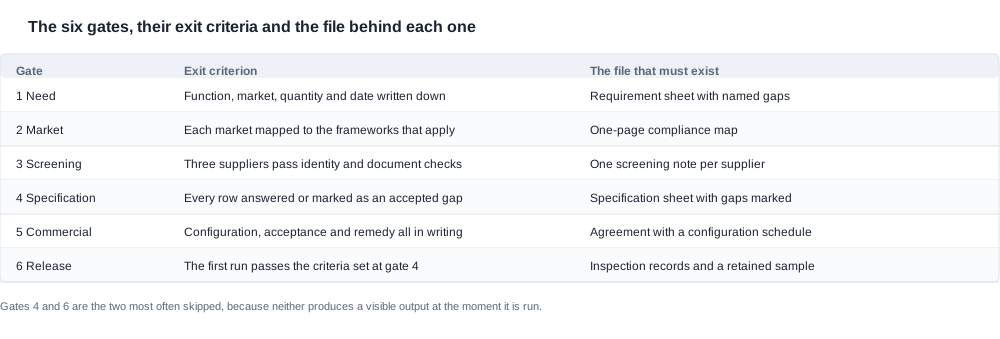
Gate one, need definition. The exit criterion is a written requirement document naming the function, the destination market, the quantity range and the target date. The file is a requirement sheet, and the important part of it is the rows you already know cannot be answered yet. For a camera product that means the sensor model, the field of view, the video resolution, the frame weight, the storage behaviour and the ingress rating. Naming a gap is different from discovering it, because a named gap can be given an owner and a date and a named gap can be priced. The catalogue publishes cell capacity, charge time, rated use, Bluetooth version, charging method, case capacity and, on some models, the colourway — so those rows can be written down from published data and treated as settled rather than as questions.
Gate two, market and compliance mapping. The exit criterion is a one-page map from each destination market to the frameworks that apply. For the European Union that map includes the Radio Equipment Directive (Directive 2014/53/EU) for radio equipment and GPSR (Regulation (EU) 2023/988, applicable since 13 December 2024) for traceability and the responsible economic operator. Battery transport documentation belongs on the same list: it is a shipping requirement that is frequently forgotten at sourcing stage and stops the first consignment rather than the tenth.
Gate three, supplier screening. The exit criterion is that three suppliers have passed identity checks and hold the documents they claim to hold. The file is one screening note per candidate, covering the legal entity, a bank account beneficiary matching that entity, and the model-level test evidence rather than a category-level claim. The full document set for this gate is set out in the factory audit document list, and the questions that buyers most often ask at this point are collected in the most-asked questions article.
Gates four to six, after a supplier has been selected
Gate four, specification. The exit criterion is that every row on the requirement sheet is either answered in writing or explicitly marked as a gap you have accepted. The file is the specification sheet with the published figures filled in and the gaps marked rather than filled. This is where the published data has the most leverage: eight camera models in the catalogue sit in the 8 MP tier and three sit in the 13 MP tier, the charge method is magnetic on seventeen models, Type C on seven and unpublished on four, and the charge time is published for every entry with a stated ceiling. Those are rows a specification can be built on rather than argued about.
Gate five, commercial. The exit criterion is that the agreement carries the configuration schedule, the acceptance criteria, the milestones, the remedies and the compliance ownership. The configuration becomes a numbered schedule, acceptance criteria carry methods rather than adjectives, there is an acceptance window measured from arrival rather than from an opinion, a component substitution rule with written approval attached, and an exit clause that covers tooling and firmware ownership.
Gate six, production release. The exit criterion is that the first run passes the criteria defined at gate four. The file is the inspection records retained per carton plus a production sample kept at the factory. This is the gate most suppliers forget to build, and skipping it is precisely what makes the second order an argument rather than a reorder, because the evidence needed to settle a defect dispute eighteen months later simply does not exist any more.
Running a gate without turning it into a committee
What a gate meeting has to produce
The practical risk with a six-gate procedure is that it turns into six meetings of four people, which is slower than no procedure at all. The discipline that prevents this is to make each gate a short event with a written entry condition, a written exit criterion and a written record.
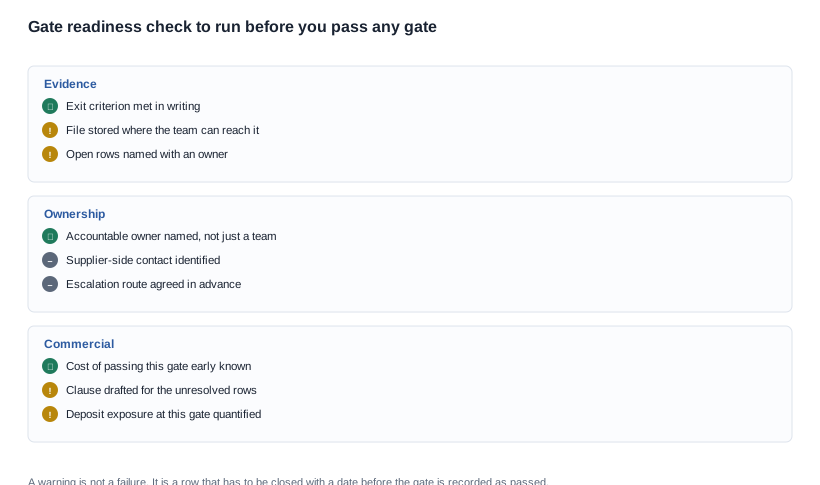
A gate entry condition is a checklist, and it is checked before the meeting rather than during it. If the required file does not exist, the gate does not convene — it returns to the runner with the missing items named. That single rule is worth more than the rest of the procedure combined, because it is what stops a gate from being held to ratify a decision that has already been made.
The exit record has three fields and no more: the decision, the date, and the owner of each open row. Nothing about why. A gate is not a forum for relitigating the specification, and a gate that invites an argument about scope will be passed with a verbal agreement and a written gap — which is the outcome the procedure exists to prevent.
Two further rules keep the gates honest. First, an open row at a gate is not a failure of the gate; it is a failure only if it has no owner and no date. A row marked "pending the supplier" with no date is not an open row, it is an absent one. Second, the gate owner has to be able to say no. A procedure in which nobody has ever stopped a programme has no exit criteria in practice, only exit criteria in writing.
What a gate produces when the answer is no
A gate that stops is not the same as a gate that fails, and the distinction matters more than it sounds. A failed gate means the exit criterion was never met and the procedure does not continue. A stopped gate means the criterion was not met yet and the programme waits on a named row with a named owner and a date in front of it. Most programmes in this category treat every blocked gate as a failure, and the result is that the team either abandons the procedure under pressure or learns to pass gates it should have stopped.
There are three possible outputs when a gate cannot be passed, and a procedure that recognises all three is far more usable than one that recognises only "stop". The first is stopped: the row is blocking, an owner is named, a date is set, and the gate reconvenes when that row is answered. The second is conditional: the programme proceeds on a written condition with its own verification date, which is the right answer when the gap is bounded and someone else can close it. The third is passed with the gap accepted: the row is closed as an accepted risk, and the record names the person who accepted it and the reason.
The third output is the one that is most often used and least often recorded, because it feels like paperwork rather than governance. But accepted gaps are where a programme quietly becomes fragile, and the reason is that an accepted gap has no natural expiry date — nobody wakes up on the day the gap was supposed to be closed and asks whether it still matters. What makes the accepted gap safe is not the acceptance itself but the two fields attached to it: the name of the person who accepted it, and the review date on which it is re-examined. A gap accepted by a named buyer on a dated review cycle is a decision. A gap accepted by a supplier over a phone call is a deferral that will be discovered in a dispute.
This is also the point at which a procedure starts to earn its keep commercially. The rows that reach gate three as "the supplier will confirm" and reach gate six as "the supplier confirmed" are the same row, and the difference between the two is worth more than any price negotiation later in the programme. The hidden costs article covers what the second version of that row costs when it turns out to be wrong.
The two gates that teams compress deserve the attention. Gate four is compressed because by then the commercial conversation has started, and closing a specification feels like walking back from something already agreed. That is backwards — a gap closed at gate four costs a conversation, and the same gap closed at gate six costs a consignment, a customs query or a return cycle, at which point the packaging artwork is already printed and the configuration is physically committed. Gate six is compressed because it produces no visible output: nobody notices an inspection record that shows a passing batch, and nobody notices the missing retained sample until they need to argue about a defect. Those records are the cheapest insurance available in this category precisely because nothing happens on the day you need them.

Where the file changes hands, and what gets dropped in the handover
The layer boundaries where rows disappear
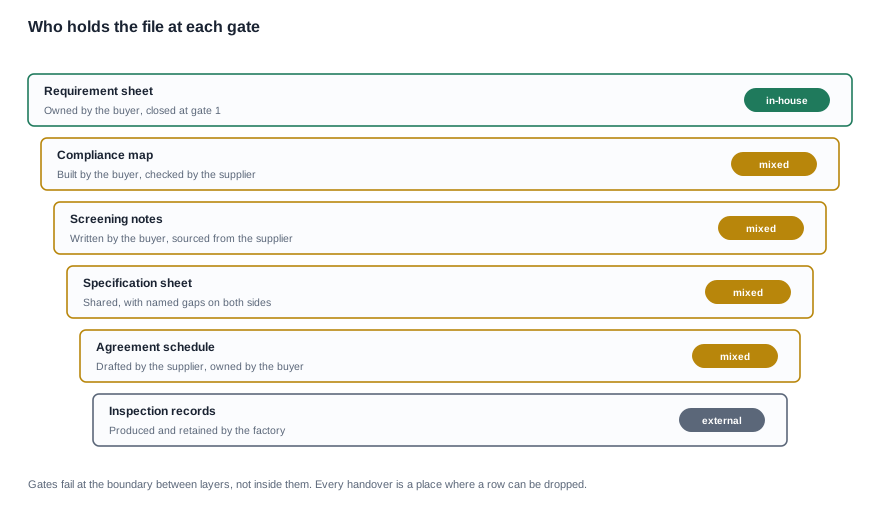
The diagram above shows who holds the file at each stage, and the pattern it reveals is that gates fail at the boundaries between layers rather than inside them. A row is not usually lost because a supplier refused it; it is lost in a handover, when responsibility passes from one party to another and nobody was told that the row was still open.
There are three handovers in this procedure that carry the most risk. The first is from the requirement sheet to the compliance map, where a market-specific requirement is quietly dropped because it looked like a compliance problem rather than a specification problem. The second is from the screening notes to the specification sheet, where a supplier's claim was recorded at gate three and then not carried forward as an open row at gate four — the single most common way a documented gap disappears, because it was converted into a belief. The third is from the agreement to the production release, where an acceptance criterion written into the contract never became an inspection item.
The control for all three is the same and it is unglamorous: every row that crosses a boundary carries a status, and the status is visible to the party receiving it. Open, answered, or accepted-as-a-gap — three values, no fourth. A row that arrives without a status is treated as open, because that is the only reading of an ambiguous handover that does not lose information. The hidden costs article covers what arrives when a row crosses a boundary without a status attached.

A programme moving through the six gates
One hypothetical programme, week by week
This is a reasoning exercise written as a hypothetical case rather than a client project. No client, order, supplier or figure is claimed; the shape of the programme is assumed so that the sequencing can be followed.
The scenario: a channel buyer is opening a camera glasses programme for two European markets, with a first order in the low thousands of units and a launch date fixed by a marketplace listing. Two suppliers have expressed interest and a third is being approached. The decision to work through is how the programme is sequenced, and where the schedule is actually at risk.
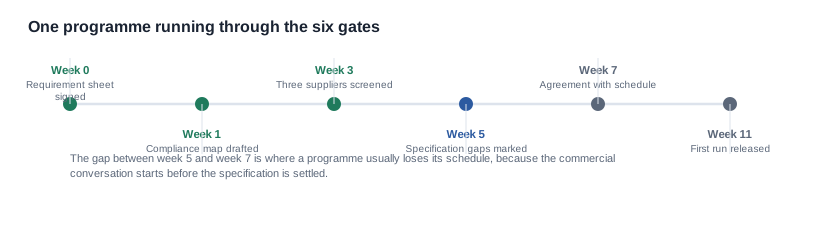
At gate one, the requirement sheet names the function, the markets, the quantity range and the date, and it names the open rows rather than leaving them blank. That decision is what makes the rest of the programme cheap, because the open rows can be requested in parallel with the supplier search instead of surfacing one at a time.
At gate two, the compliance map is a single page: radio equipment and the responsible economic operator for the European markets, battery transport for the movement of the goods, and the destination-specific labelling and traceability requirements. Each line gets an owner, and the battery transport line is given a date that precedes production rather than following it.
At gate three, the three suppliers are screened against the same document list. One supplier's notes are complete, one has a banking mismatch worth a question, and one has no model-level evidence at all. The third drops out here rather than at gate four, which is the entire argument for running screening as a gate rather than as a background task.
Gates four and five are where the schedule is lost, because the commercial conversation opens while the specification is still being marked up. The recovery is to keep the two conversations separate for as long as possible: the specification gate closes on the requirement sheet, and only then does the agreement start. A programme that does this arrives at gate six with a configuration schedule that the factory can actually build against, because both sides are working from the same numbered list.
At gate six, the first run is released against the criteria written at gate four, with inspection records retained per carton and a production sample kept. Nothing about week eleven looks different from week nine, which is exactly the point: the value of the records appears only later, when a defect dispute has to be settled from evidence rather than from memory.
The two rows that actually decide whether the schedule holds
Watch the schedule for two rows rather than for the gate dates, because the gate dates are the parts of the procedure that everybody manages. The first is the compliance-map row that carries the battery transport documentation, since movement of the goods is the requirement most often left until the shipment is booked and the one that stops a consignment rather than a document pack. The second is the specification row that accepts a gap in writing, because a gap accepted verbally has to be re-opened with the supplier, and that conversation lands in the middle of the production window where it is least affordable.
Everything else in this programme compresses without harm. The screening notes at gate three can be reviewed in a single sitting; the requirement sheet at gate one is a document the buyer controls; the commercial terms at gate five are negotiable in the ordinary way. The two rows above are not compressible for the same reason — one of them is a regulatory dependency with a date attached that no one on the buying side controls, and the other is the only mechanism that lets a programme move forward with an unresolved specification instead of stopping.
If a programme is slipping, look at those two rows before looking anywhere else. In the hypothetical above, the battery transport row carried a date that preceded production, and the accepted gap at gate four was closed against a named row rather than a general assurance — which is why week eleven in the timeline was a production release rather than a negotiation.
What we can put into a gate file, and what we cannot
The published rows and the rows we mark as gaps
The boundary we hold: we will supply the published configuration for any model in our catalogue, and we will mark the gaps rather than fill them. Unit prices, minimum order quantities, capacity figures, defect rates and certificate identifiers are not published in our documentation, and a supplier that produces those numbers at gate three is producing something we cannot check. We would rather hand you a sheet with three rows marked as open than a sheet where a marked row has been quietly replaced with a typical figure, because a typical figure is how a product ends up failing its own specification sheet three months after launch.
There are two boundaries worth stating plainly, because they are the ones most often misread. The first is the certification position: the catalogue carries a company-level export certification page and does not publish a per-model certification row for any entry in the range, and it contains no CE, FCC or RoHS document references. Where a file needs certification evidence, that evidence has to be requested in writing, and the request is itself a legitimate step at gate three. The second is the weight position: the catalogue publishes a unit weight for one model only, the MT6 eyewear body at 158 g including the 265 mAh battery and the camera and excluding the folding charging case, whose capacity is 1200 mAh and whose own weight is not published. A gate file that quotes 158 g without that context has misstated a published figure, and the brief says what to do about it — request the basis.
Our preference is that this procedure runs fast on the first two gates. The buyers who lose money in this category are rarely the ones who chose badly; they are the ones who started a supplier conversation before writing down what they needed.
Opening the sourcing file
Send the models, the quantities and the target markets, and we will tell you which configurations exist in the published range, which of your requirement sheet rows are settled by published data, and which have to come from a supplier as a written request with a date against it. That is enough to open gates one and two properly, and gates one and two are where the schedule is won.
Related reading
- Hidden costs — what arrives after the order
- Questions buyers ask most — the six standard questions
- Factory audit documents — gate 3 in detail


