

Ip rating smart glasses how it compares to alternatives is usually framed as a ladder, from IP54 up to IPX7, and that framing is misleading — because the numbers are not a scale of general robustness. They are a set of independent tests, and the useful comparison is not which rating is higher. It is which failure mode each one leaves you with, and whether that failure mode is one your customer can live with. This page is written for the buyer comparing two products on their ingress positions, and it sets out the four common positions, the one option that is not a rating at all, and the question that decides between them.
Our catalogue marks two sport models IP54 — the V06 and the S7 — and publishes no third-party test report number behind either of them. We also publish no rating at all for any charging case, and that is the comparison most often missed.
IP rating: who compares, and what they defend
Three roles in a supplier comparison
A brand owner is choosing between two candidates for a channel and needs to know which exposure each one leaves open.
Two quotes on the same platform make a different comparison. The ingress position is then fixed by the hardware, and what is being compared is the documentation: which supplier will name the tested configuration, which one will confirm the seal material, which one will accept a per-lot configuration confirmation in the purchase order.
The person writing the packaging needs to know how far the wording can go for each product, and that limit is set by the evidence rather than by the copywriter's confidence.
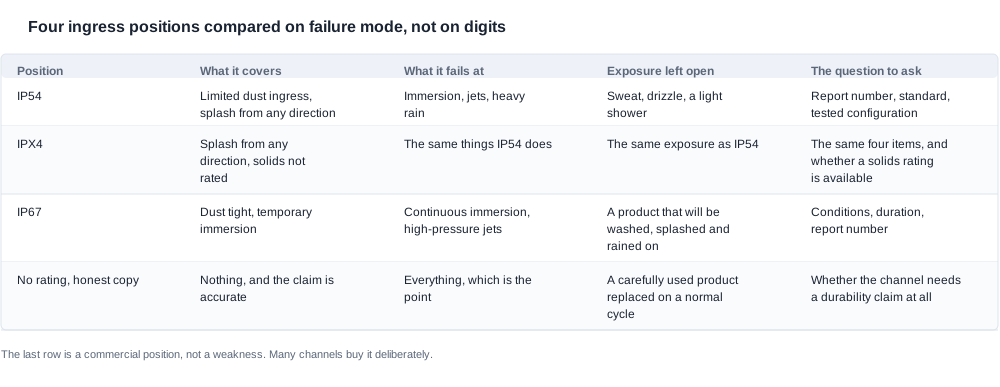
Four positions, and the one that is not a rating
| Position | What it covers | What it fails at | Exposure your customer still has | The question to ask |
|---|---|---|---|---|
| IP54 | Limited dust ingress, and splashing water from any direction | Immersion, jets, and heavy rain | The answer it supports is sweat, drizzle and a light shower | The report number, the standard and the tested configuration |
| IPX4 | Splashing water, with the solid protection not rated at all | The same things IP54 does | The same exposure as IP54 | The same four report items. It is useful to a buyer because it makes clear that the "4" and the "5" are independent claims: a device marked IPX4 is not less dust-proof than one marked IP54; it is simply not rated for dust, which is a different statement |
| IP67 | Dust tight, and temporary immersion to a stated depth and duration | Continuous immersion and high-pressure jets | The right answer for a product that will be washed, splashed and rained on | The conditions, the duration and the report number |
| No rating, with honest copy | Nothing, and the claim is accurate | Everything — and that is the point | A product that makes no durability claim and carries no marking is making a claim it can support, and for a channel where the product is used carefully and replaced on a normal cycle, it is often the correct commercial answer | Whether the channel needs a durability claim at all |
Where our own catalogue sits in a comparison
Two sport models in our range carry the IP54 catalogue marking with no third-party test report number behind them, and every other model in the range publishes no ingress marking at all. No charging case in the range carries a marking either — and the case is a separate enclosure with its own seals, so it is frequently the part that fails and frequently the part that carries a borrowed claim. The ip ratings and durability page covers the standard, the ip rating industry standards page covers the frameworks, the ip rating problems and fixes page covers the recurring faults, the ip rating limitations and drawbacks page covers the rest, and the ip rating red flags page covers the misreadings.

Comparing two candidates on failure mode instead of on digits
The most common comparison error in this category is arithmetic on the digits, and it produces the wrong answer reliably because the digits are not an arithmetic scale. IP67 does not "beat" IP54 by two points. It is a different experiment with a different fixture and a different engineering demand, and the comparison that matters is what each candidate does when the customer puts it in the water.
A comparison that works. For each candidate, write three things: the exposure the position covers, the exposure it leaves open, and what the customer sees when the product meets that open exposure. Then read the two rows side by side and ask a single question — which of the two open exposures does your channel actually produce?
Three outcomes, and each one leads somewhere different. If both candidates leave an exposure open that your channel produces, the comparison is a wash and the decision should be made on price, lead time or another axis entirely. If one candidate leaves an exposure open that the channel produces and the other does not, the comparison is decided and the higher position wins even if it costs more. If neither candidate covers the exposure the channel produces, the comparison is irrelevant and the real problem is upstream — the channel specification needs revisiting before the supplier shortlist.
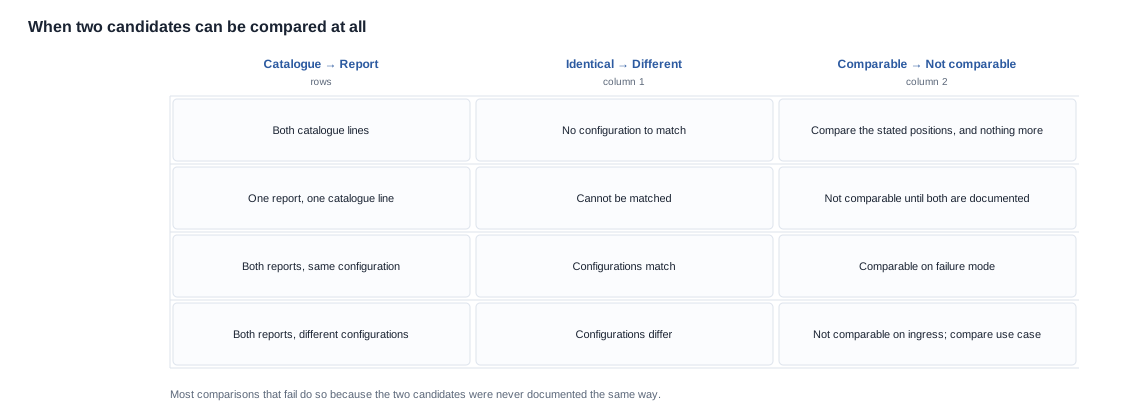
The matrix above is the part buyers skip. Most comparisons that fail do so because the two candidates were never documented the same way, so there is nothing to compare. Two catalogue lines can be compared as statements. A report and a catalogue line cannot be compared as results, because one of them is a result and the other is not.
The comparison that a procurement manager is actually doing. Often it is not product against product at all — it is supplier against supplier on the same product. In that case the ingress position is fixed by the platform and the comparison is about the documentation: which supplier will name the tested configuration, which one will confirm the seal material, which one will accept a per-lot configuration confirmation in the purchase order. That comparison is worth more than the digit comparison, because it is the one you can actually influence.
A sign that the comparison has been made on the wrong axis. The two candidates are described with words like "better" or "more advanced" rather than with exposures. If a supplier's summary of their own advantage is a higher number, ask them which exposure their position covers that the other does not — the answer is either specific or it is not an answer.
The rating-free option, and when it is the strongest commercial answer
The fourth row of the table is the one that most buyers read past, and it is frequently the correct commercial choice. It deserves to be argued for properly rather than treated as the absence of an answer.
What the rating-free option actually is. A product with no ingress marking and no durability claim on the packaging or the listing, sold into a channel where it is used carefully and replaced on a normal cycle. It is not a defective product or a lazy specification. It is a product that makes no promise it cannot keep.
When it is the strongest answer. Three conditions, and all three have to hold. The channel's environment does not produce the exposure. The channel's buyers are not reading durability as a purchase criterion — which is usually true of a consumer channel and usually false of an industrial or institutional one. And the commercial competition is not won on durability, so nothing is lost by not claiming it.
The trade-off you are making. A buyer choosing the rating-free option is trading a marketing asset for a cost and a schedule saving. The asset is real: a durability claim lifts a listing, answers a retailer's technical questionnaire, and reduces the number of pre-sale questions. If the competitive set is all claiming durability, the honest no-claim product is competing with one hand tied — and the honest question is whether the sales uplift of the claim exceeds the qualification cost, not whether the claim is defensible.
When it is the wrong answer. As soon as the channel has a technical reviewer, a returns pattern that includes weather, a customer base that includes organisations rather than individuals, or a channel where the product is used near water as a matter of routine rather than exception. In those cases the absence of a claim is not a neutral position — it is a gap the buyer's customers will fill with their own assumptions, and the assumptions will not be conservative.
The middle path, which most buyers end up taking. Publish the marking as an attribute without claiming a tested result, and write the digit's own reading on the listing. This gives the buyer something concrete to say without making a promise the documentation does not support, and it is the position we can describe for our own V06 and S7 rows — a catalogue annotation with no report number published behind it.
The question to ask before choosing it. Does anyone in the channel — a retailer's technical team, a marketplace review queue, a procurement questionnaire — ask for evidence of protection? If the answer is yes, the rating-free option will be raised as an information request within a quarter, and it is cheaper to have the answer than to explain the absence.
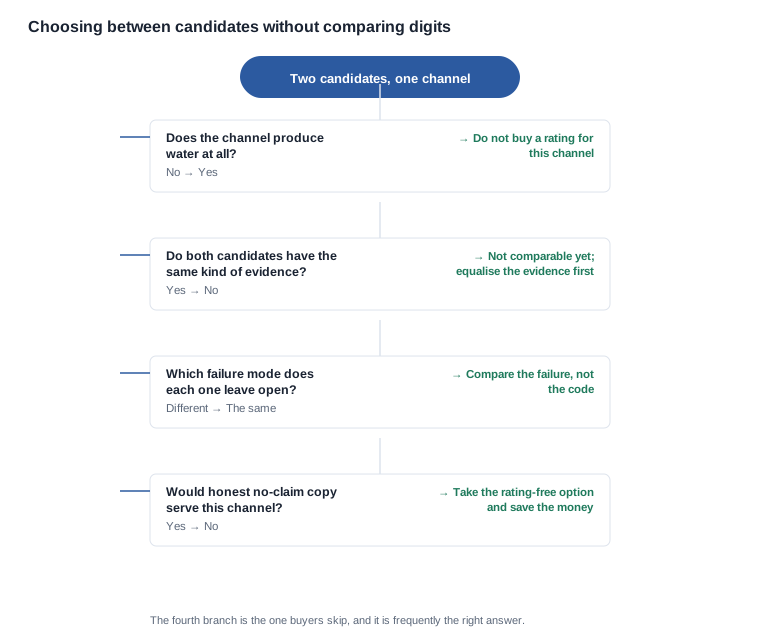
A fair comparison needs the same four questions asked of every candidate
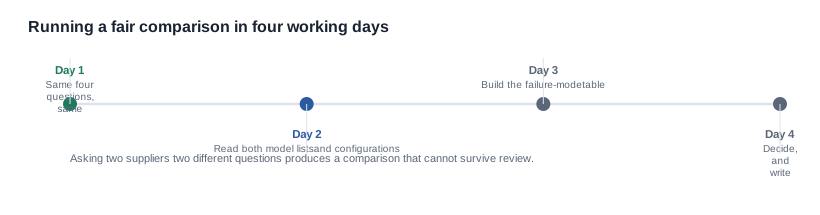
The protocol below takes four working days and it is designed to be fair rather than fast. Fairness is the point: a comparison built on two different requests produces a result that cannot survive a review, and the buyer who has to defend the decision internally will not be able to.
The same four questions, sent to every candidate, in the same format, on the same day.
- Which ingress position does this candidate carry, and is it a code or a description?
- What document supports it — a report number, or a catalogue line?
- Which configuration does it attach to: which ports, contacts and interfaces, which parts tested?
- What happens to the position if the configuration changes?
Why these four. The first separates a code from a description. The second separates a result from an assertion. The third is the row that is almost always missing. The fourth is the one that decides whether the comparison survives the production run.
The scoring rule. An answer that names a document, a configuration or a date passes. An answer that describes a quality does not. The pass rate across candidates is usually more informative than the individual answers, because it tells you whether you are comparing two documented products or one documented product and one brochure.
The questions to ask your own team before you start. What decision does this comparison feed, and who signs it? Which axis is the decision actually made on — durability, price, lead time, or a mixture with stated weights? What would make us reject both candidates? Answering the third question first is what stops the comparison becoming a search for confirmation, and it is the question most often left unanswered.
Red flags during the comparison. A candidate who declines to name a configuration, on the grounds that it is proprietary, is telling you the position cannot be checked against the unit you receive. A candidate who offers a different answer to the same question on a second call is telling you the documentation is assembled per conversation rather than per product. And a candidate whose advantage is stated as a level rather than as an exposure is telling you the comparison will have to be redone by someone else later.
What to record. The four answers, the pass or fail against the scoring rule, the exposure each candidate covers and leaves open, and the channel's own exposure. That table is the deliverable, and it is worth more than any of the candidate materials it was built from.
When the comparison exposes a gap, and what to do about it
A comparison that ends with "the candidate with the better position is undocumented" is not a dead end. It is a specification with one hole in it, and the hole is either filled or consciously accepted.
Three ways to fill it. The first is to require the document as a condition of the order rather than as a condition of the purchase — the qualification happens, and the marking on the listing waits for it. The second is to narrow the claim to what can be published without a report: the position as a catalogue attribute, the digit's reading on the listing, and no tested claim. The third is to change the channel, so that the exposure the candidate actually covers is the exposure the channel produces.
How to choose between the three. The first option costs schedule and buys the strongest commercial position. The second costs nothing and buys the weakest. The third costs a business decision and can be the cheapest of all, because a channel whose exposure matches the product you can actually evidence is a channel whose returns will behave.
The question to ask when you choose the second option. Will anyone in this channel ask for the report within the next year? If the answer is yes, the narrow claim is a stage rather than a destination, and the qualification should still be scoped. If the answer is no, the narrow claim is the final position and should be written as one.
The one thing not to do. Do not treat an undocumented candidate's description of its sealing as a substitute for a tested configuration, and do not let the comparison be closed on the basis that the other candidate's report "must be the same". A supplier's engineering description and its test report are different documents with different evidential weight, and the gap between them is where a substitution ends up.

Comparing a sport line against a security line
The comparison below is a method demonstration rather than a project report. The two candidates are left unnamed so that the argument is about how the comparison is run — the order of the questions, the treatment of the failure mode — and not about anybody's product.
Picture a brand choosing between two suppliers for a hardware platform it intends to sell into two very different channels — a consumer cycling line and a security line for site staff — holding one quotation at a splash level and one at an immersion level.
Day one, the same four questions. The questions go to both suppliers in the same format. One supplier answers with a report number for the tested configuration; the other answers with a catalogue line and a description of the sealing. Both answers are on the table, and the comparison has already revealed something that a price comparison would have hidden.
Day two, read the configurations. The documented candidate's configuration lists an exposed charging contact on the tested sample. The undocumented candidate's description implies a recessed contact. Neither is disqualifying on its own, but they are different products for this purpose, and the brand notes that the second candidate's claim cannot be checked against a unit.
Day three, build the failure table. The cycling channel produces rain, sweat and road spray; the security channel produces rain, dust, a pressure wash and a high drop rate. The splash position covers the cycling channel's exposure and leaves the security channel's pressure wash open. The immersion position covers both but changes the engineering, the seal and the cost of every variant in the range.
Day four, the decision. The brand concludes that the comparison is not between the two positions but between two different programmes, and that the real decision is whether the security channel justifies a second qualification on the same platform. It does, because the security channel's unit price is high, the customer is an organisation buying a service rather than a consumer buying a gadget, and the cost of a corrosion return is a replacement cycle rather than a support ticket. The cycling channel takes the splash position with the digit written out on the listing.
What the comparison established. The decisive facts were not the digits and not the prices. They were that one candidate had a document and the other did not, that their configurations differed in a way that mattered, and that the two channels produced different exposures. The digit comparison would have selected the immersion position for both channels and would have overpaid for the cycling line.
The generalisation. Two candidates, one channel, one question: which exposure does your channel actually produce. Everything else in the comparison protocol exists to make sure that question gets answered with evidence rather than with brochures.
What our catalogue can and cannot enter into a comparison
Our catalogue publishes an IP54 marking on the V06 and the S7, and publishes no ingress marking for any other model because none is stated. It publishes no third-party test report number, no standard, no test condition, no sample size and no laboratory behind the marking, because the company has not confirmed them. We will not publish a test report number, a standard, a tested configuration or a seal material that the documentation does not contain, and we will not extend the two models' catalogue marking to any other model or to any charging case.
That means our own catalogue can be entered into a comparison on one axis — the stated position and the exposure it covers — and not on another. Where a buyer needs the exposure each candidate leaves open, we can supply it from the standard. Where a buyer needs a tested configuration or a document, our own row is an open item, and we would rather present it as one than present a plausible-looking value.
How we enter a comparison. We will take a candidate's documentation and a channel's exposure and tell you which terms in the candidate's material are anchored to a document and which are not. We will tell you which of our models carry a marking and which do not, and we will tell you what a comparison between our platform and a documented candidate can and cannot settle. The background is under ip ratings and durability, the frameworks behind the codes are in ip rating industry standards, and the misreadings worth avoiding are in ip rating red flags.
Where the comparison comes from
Give us the channel, the environment and the candidates, and we will tell you which ingress positions are published and which failure modes you would be carrying.


