

An ingress rating is the narrowest document in the entire durability conversation, and it is the most widely quoted. IP rating smart glasses limitations and drawbacks is therefore a list of what the rating does not do, because that list is what a buyer needs before the claim is written rather than after the complaint arrives.
The reason the list matters commercially, rather than academically, is that a customer who has made an informed decision does not return a product, and a customer who has been misled does. The width of the claim and the width of the evidence have to match. A listing that says "IP54 — dust protected, protected against splashing water from any direction, not for immersion" produces the first kind of customer. A listing that says "IP54" alone produces the second, because the reader fills the gap with the strongest available reading rather than the accurate one.
Our own catalogue marks the V06 and the S7 IP54 — dust protected, and protected against splashing water from any direction. It is not immersion, it is not a jet, and it is not dust-tight. We publish no third-party test report number behind the marking, no ageing data, and we will not estimate a service life for a seal we have not tested.
IP rating: the narrowest document in the file
The short answer, and the shape of the limitation
An ingress rating describes one laboratory test, on one configuration, at one moment in time. It does not describe a product's life, and it does not describe most of the ways a wearable actually fails.
It does not cover immersion, water jets, salt spray, ultraviolet and thermal ageing, drop or flex, chemical exposure, the charging case, the lens surface, or the third year of service. Every one of those is a real failure mode in this category, and every one of them sits outside the code. That is not a criticism of the standard. It is the reason the standard is usable: a narrow test produces a reproducible number, and a number is what a technical file can carry.
The commercial consequence follows directly. When a buyer reads an ingress rating as a durability specification, the programme inherits an unbounded promise that the evidence does not support, and the first consequence is usually a warranty dispute rather than a returns problem. When a buyer reads it as one line among several, it does its job properly, and the other lines get written.
The buyer assembling a durability claim
The person who needs this is usually writing or approving the durability copy for a product page, a spec sheet or a retail listing, and is holding a catalogue entry, a competitor's listing and a feature list. What they will not be holding is the exclusion list, because the exclusion list is written into the report, and the report is the document nobody has asked for yet.
What they are trying to avoid is three specific outcomes. The first is a claim wider than the evidence, which the customer can falsify in a single afternoon in the outdoor channel. The second is a rating presented as a lifetime guarantee, when every seal ages and the rating describes the product as it left the factory rather than the product in year three. The third is a rating quietly extended to the charging case, which is a separate object with its own electronics, its own contacts and its own opening — and no case in our range carries a published rating.
Why the width of a claim is a commercial variable
A claim that is narrower than the evidence costs almost nothing. It is a sentence on a product page, and in most channels it reads as precise rather than cautious. A claim that is wider than the evidence is expensive in a way that scales with volume, because the exposure is not one bad review but a cluster of returns that arrives with a pattern, and a pattern eventually gets noticed by the platform, by the retailer or by the reviewer.
There is also a category effect worth understanding. When one model in a range carries a rating and the others do not, the buyer who has not written the exclusions down will find that the rated model gets the marketing attention and the unrated models get the questions. The rating does not raise the whole range; it raises the scrutiny of the whole range. That is a strong commercial argument for writing the exclusion list before the rating is used to differentiate anything.

The exclusion list is the commercially expensive part of the rating
What sits outside a code, and what each gap costs
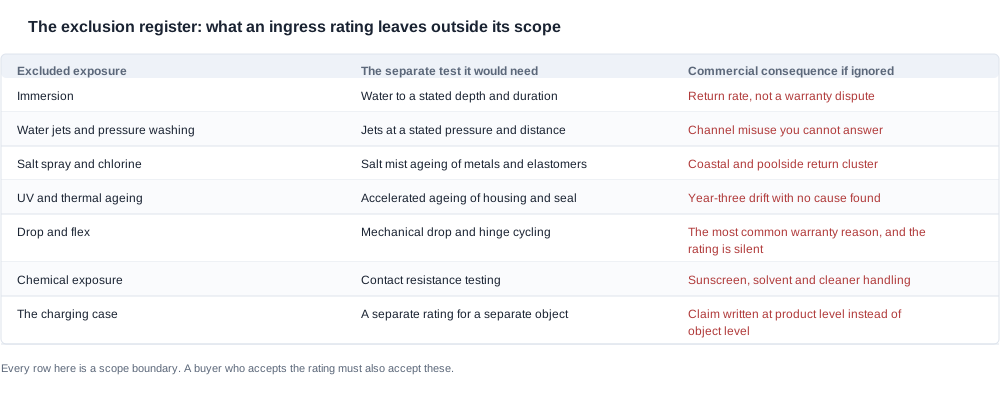
The table below is the exclusion register. It is the document a buyer should build before writing any durability copy, and it is also the document that decides what the warranty can honestly cover.
| Excluded exposure | The separate test it would require | Commercial consequence if it is ignored |
|---|---|---|
| Immersion | Water to a stated depth and duration | A return rate, not a warranty dispute |
| Water jets and pressure washing | Jets at a stated pressure and distance | A channel misuse you cannot answer |
| Salt spray and chlorine | Salt mist ageing of metals and elastomers | A coastal and poolside return cluster |
| Ultraviolet and thermal ageing | Accelerated ageing of housing and seal | Year-three drift with no cause found |
| Drop and flex | Mechanical drop and hinge cycling | The most common warranty reason, and the code is silent on it |
| Chemical exposure | Contact resistance testing | Sunscreen, solvent and cleaner handling disputes |
| The charging case | A separate rating for a separate object | A claim written at product level instead of object level |
| The lens surface | A separate coating statement | A review complaint that no documentation answers |
| Seal service life | Ageing data on the specific elastomer | A warranty set on a calendar assumption |
Two of these rows deserve particular attention from a procurement point of view, because they are the ones buyers most often assume are covered. The first is drop and flex. In this category the durability failures reported through channels are more often wear and drop than water, and an ingress rating says nothing about either. A retailer whose product fails at a hinge will not be reassured by a code, and the wear-out failure will sit in the warranty file looking like a defect.
The second is seal service life. It is the row nobody publishes, and it is the one that determines the warranty, because the rating describes the factory state and the warranty describes the third year. We publish no ageing data for our range, and we will not estimate a service life for a seal we have not tested. Ask the supplier what they have measured, and treat "not published" as a finding rather than as a refusal.
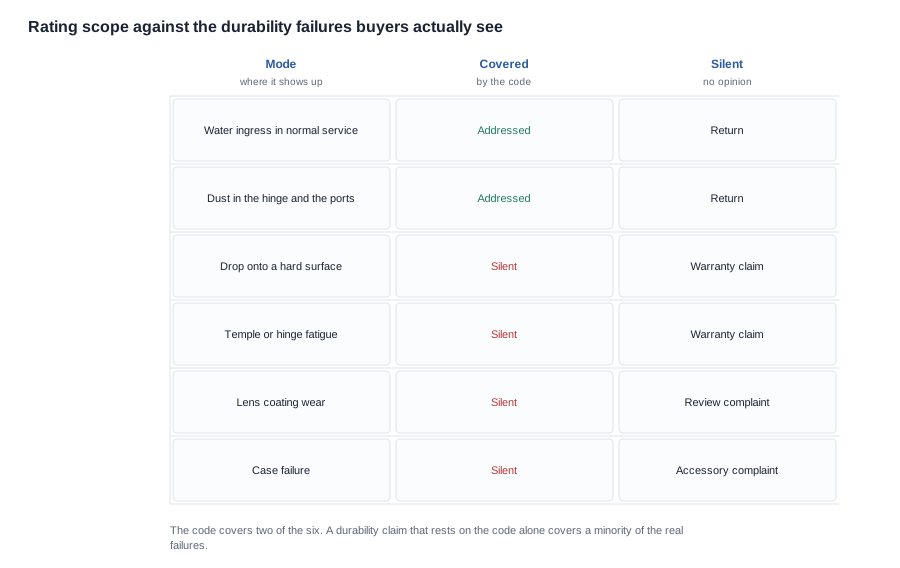
The rating covers two of the six real failure modes
A useful discipline is to list the failure modes your channel actually generates and mark each one as covered or silent. The matrix below does that for a general wearable channel, and the pattern is consistent across categories: the code addresses the two ingress-related modes and is silent on the mechanical ones.
| Failure mode in service | Covered by an ingress code | Where it surfaces |
|---|---|---|
| Water ingress in normal service | Yes | Returns |
| Dust around the hinge and the ports | Yes | Returns |
| Drop onto a hard surface | No | Warranty claim |
| Temple or hinge fatigue | No | Warranty claim |
| Lens coating wear | No | Review complaint |
| Charging case failure | No | Accessory complaint |
This is the single most useful thing a buyer can carry out of this article. A durability claim that rests on the ingress code alone covers roughly a third of the real failure modes in the channel, and the remaining two thirds arrive as warranty disputes rather than as returns — which is worse, because a warranty dispute is a negotiation and a return is a cost.
Turning each exclusion into a warranty and claim decision
The rows that have to be written before the first order
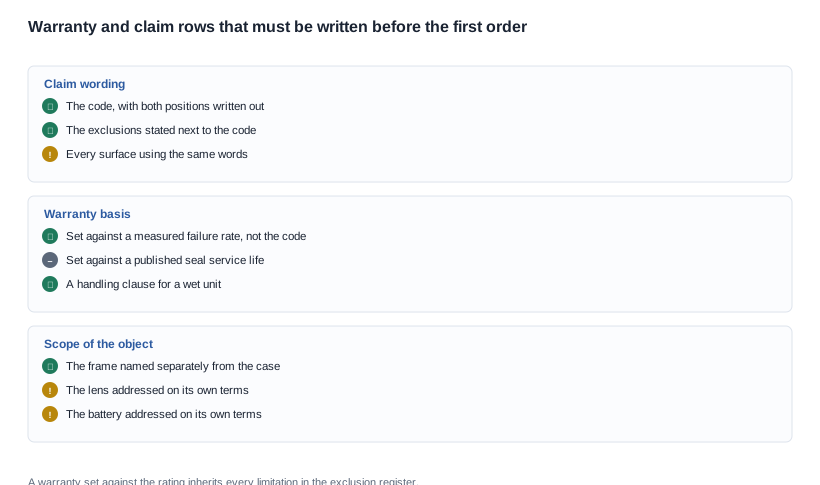
Each exclusion in the register has to end up somewhere, and the three destinations are the claim wording, the warranty basis and the object scope. The table below is the checklist for that, and it is the document to agree with the supplier before a deposit rather than after a launch.
| Area | Requirement | Status |
|---|---|---|
| Claim wording | The code, with both positions written out | Required |
| Claim wording | The exclusions stated next to the code, not in a footnote | Required |
| Claim wording | The same words on device, packaging, documentation and listing | Required |
| Warranty basis | Set against a measured failure rate, not against the code | Required |
| Warranty basis | Set against a published seal service life, where one exists | Optional |
| Warranty basis | A handling clause covering a unit that has been wet | Required |
| Object scope | The frame named separately from the charging case | Required |
| Object scope | The lens addressed on its own terms | Recommended |
| Object scope | The battery addressed on its own terms | Recommended |
The criteria in the left column are where a warranty becomes defensible or indefensible, and the distinction to hold is simple. A warranty set against the rating inherits every limitation in the exclusion register, because the rating is the only evidence available and the rating does not cover the mechanical failures. A warranty set against a measured failure rate covers the mechanical failures by accident of the data, and it can be reviewed annually as the data accumulates.
The three thresholds that decide how much the code is worth
There are three thresholds worth fixing before the quotation, and each one changes the price and the paperwork in a way that is not obvious until it is too late.
The first is the immersion threshold. Immersion is a different programme, not a bigger splash. It goes beyond a splash code entirely, with a different seal, a different fixture and a different cost. If your channel needs it, you are specifying a different requirement, and saying so in your own specification is what stops the programme buying a level it will never use.
The second is the solids threshold, and it has three distinct positions that are routinely collapsed into the phrase dust proof. Limited ingress permits some ingress. Dust protected permits no ingress of dust in quantities sufficient to interfere with operation. Dust-tight permits none at all. A buyer who needs a dust-tight product must be able to see that word in the requirement, and a buyer who accepts limited ingress must be able to see that word too.
The third is the seal service life threshold, and it is the one that decides the warranty length. A published service life is worth more than a longer warranty period, because it is evidence rather than an assumption. Where no service life is published, the criteria to use instead are a measured return rate by cause and a periodic re-test of a retained unit against a fresh one, which is the only way a drift in year three becomes visible before it becomes a trend.
The object-scope decision, which is usually made by accident
The frame, the case, the lens and the battery are four objects and each one needs its own answer. A charging case is a separate object with its own electronics, its own contacts and its own opening; a case that holds the glasses is not a waterproof enclosure for them. A lens is a surface with its own coating. A battery is a cell with its own transport documentation.
The decision usually gets made by accident because the claim is written at product level rather than at object level, and product level is where marketing copy naturally sits. The procurement consequence is that the claim on the listing becomes wider than any document supports, and the fix arrives as a copy correction across every surface rather than as a single line change.

Proving the exclusions: which document each one lives in
Five checks, and where each exclusion is actually evidenced
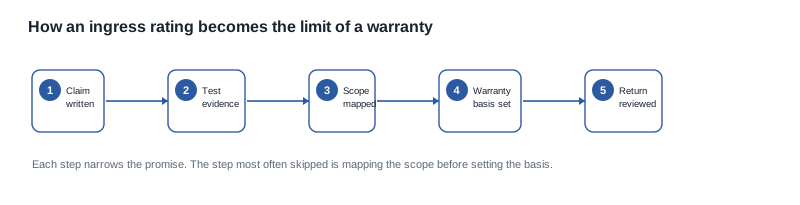
Verifying an exclusion is a question about which document carries it, and the mapping is not the same for every row.
The first check is to get the exclusion list in writing before the copy is written, because it is the most useful line in the whole document: it is the list of things a customer might reasonably believe the product can do. The second is to resolve the report number in the issuing body's register and confirm the model designation, the covered functions and the validity date. The third is to check the tested configuration against the unit you received, looking at the charging contacts, the ports, the button and the microphone openings, because a mismatch means a component was substituted after the test.
The fourth check is to establish what the factory actually holds in production. A reference unit, a defined test frequency, a seal material and a service life are what distinguish a production control from a type test, and that distinction is what keeps a claim true on the tenth thousand unit. The fifth is to run your own protocol on a sample against the failure mode your channel actually produces — the sweat-and-dust case for a sport product, the saltwater-and-sand case for a beach product, the repeated-handling case for an industrial product. A generic spray test is none of these.
What to ask the supplier, in the order that saves time
The questions themselves matter less than their order. Asking about the tested configuration first, before asking about the service life, saves a conversation, because a configuration answer tells you whether the rest of the conversation applies to your unit at all.
The sequence that works is this. Ask which document carries the exclusion list and get it. Ask which model designations that document names, and check them against the model you are ordering. Ask which object was tested. Ask what the production control is and whether a reference unit exists. Ask what seal ageing data exists, and accept "not published" as a complete and useful answer.
A supplier who answers all five in this order has a documentation habit and a process behind the claim. A supplier who answers two and deflects the rest has given you a marketing position, and the criteria to apply at that point are commercial rather than technical: either narrow the claim to match what they will evidence, or price the gap.
The three questions to put before you order
Before you order, put three questions in writing. Which document carries the exclusion list, and can we have it. Which object was tested — the frame, the case, the lens or the battery. What does the factory hold in production that keeps the result true after the first shipment.
These three are worth sending before the deposit rather than after the first delivery, because the answer changes the claim you write, and the claim you write changes the artwork you approve, and the artwork is the last thing in the chain that you can still change cheaply.

Five failures that begin where the rating stops
A product page says waterproof and the customer returns the unit after rain. The symptom is a cluster of returns with a description that says the product is broken. The root cause is that the code was carried forward as shorthand instead of being written out, and the exclusions were never attached to it. The prevention is to write the marking in words, state what it excludes on the same surface, and publish a care instruction next to it.
The product is bought for a rain channel and the rating turns out to be a splash rating. The symptom is a warranty argument where the buyer assumed the product was specified for sustained rain. The root cause is that the exposure was never written down, so the requirement was chosen by comparison rather than by analysis. The prevention is to write the exposure first and ask which of the four water steps covers it.
The frame breaks in year two and the ingress claim is cited in the dispute. The symptom is a warranty claim where the buyer's own marketing material is quoted back at them as evidence of durability. The root cause is that an ingress rating was treated as a durability claim. The prevention is to keep the two separate, test the drop and flex case separately, and set the warranty against a measured failure rate.
The warranty is set from the rating. The symptom is a returns pattern that exceeds the warranty reserve before the warranty period ends. The root cause is that a code describing the factory state was treated as a service life. The prevention is to set the warranty against the seal service life where one is published and against a measured failure rate where one is not, and to review it annually as data arrives.
The case is claimed as protected because the glasses are. The symptom is a submerged or washed case returned under a claim that the frame's rating was supposed to cover. The root cause is that the claim was written at the product level rather than at the object level. The prevention is to ask which object was tested, and to write the frame claim and the case claim separately even when both are absent.
Scoping the warranty, negotiating the exclusions, and our published gaps
The commercial terms that matter when the claim is narrow
Because the claim is narrow, the documentation work is what the buyer is really buying, and that changes where the negotiating room sits. The per-variant cost of a documentation-only change is usually negotiable, since no hardware is touched. The number of units per variant is negotiable, and more so on a repeat order than on a first. Delivery splitting against a documentation-review milestone is often granted more easily than a price concession, and in a category where the binding constraint is evidence rather than capacity, it is the concession that actually moves the risk onto the schedule where it belongs.
Payment node structure is the other lever. A deposit, a balance on inspection before shipment, and a retention held against the documentation package protect the buyer on the failure that costs most here, which is a product that arrives with a marking nobody can evidence. What is not negotiable is the certification cost and the certification time: an ingress test is a per-configuration cost and the elapsed time is set by the laboratory, and pressing on either does not make the product arrive faster. The tooling cost is one-off and is usually spread across the first order, so the useful questions are over what volume it is spread over and what happens to the tooling and the sealing tooling if the programme is discontinued. And the seal is not negotiable either, because a supplier who will not change the seal material, the seal geometry or the port design is telling you that the ingress performance is fixed, and with it the exclusion list.
A worked scenario: an industrial line with a coastal installation base
This is a hypothetical case rather than a client project, and it is here to demonstrate how the exclusion list changes a commercial decision.
Assume an industrial-safety brand selling a smart-glasses line into two markets, one with a humid coastal installation base and one with an indoor warehouse base. The brand has an IP54-marked configuration on the supplier's list and is considering making the ingress claim a headline feature of the coastal SKU.
The first decision is the failure-mode inventory, and it changes the shape of the problem: the coastal channel generates salt spray, standing humidity and mechanical wear from headgear and harnesses, of which only the first is even partially in the code's scope. The second decision follows from the matrix: a claim built on the ingress code alone would cover a minority of what the channel actually generates, so the warranty is set against a measured return rate by cause rather than against the marking. The third decision is the object scope, and the supplier confirms that the charging case carries no rating of its own, which means the case is described in the copy without any ingress language at all.
The fourth decision is the documentation trade. The supplier offers to include an ageing statement on the seal as part of the first order at no extra unit cost, in exchange for the brand accepting a shorter warranty period and a higher documentation retention. The brand takes it, because a published service life is worth more than a longer warranty period, and the retention is held against a document the brand will actually be able to file. The fifth decision is the copy. The listing states the code, states that the case carries no rating, and states the two exclusions that the coastal channel will actually ask about — immersion and salt spray. The result is a narrower product claim that survives its own channel.
What our catalogue publishes, and what we cannot supply
It is worth being precise: we publish the IP54 marking on the models that carry it, that we publish alongside it that no third-party test report number supports it, and we will not describe a splash-protected product as waterproof or present a rating as a lifetime guarantee. The marking appears on the V06 and the S7. We publish no rating for any other model in the range, and no ingress rating for any charging case. We publish no ageing data, and we will not estimate a service life for a seal we have not tested.
We will also say plainly that our own documentation has the same shape of limitation this article describes: the marking is there, the report is not, and the gap is the gap. A buyer who needs the document should ask for it during the qualification rather than assume it exists.
What we can do is tell you which exclusions apply to a given marking, and help you write the copy at the width of the evidence. The background is under IP ratings and durability, the standards context is in IP rating industry standards, the field failure modes are in IP rating problems and fixes, the screening list is in IP rating red flags, and the ageing question is in does IP degrade over time.
Three actions that close the gap before launch
Build the exclusion register for your own channel before you write any durability copy, and mark every row as covered, silent or not applicable. Then set the warranty against a measured failure rate rather than against the code, and write the object scope into the copy so that the frame and the case are described separately.
Finally, put the three documentation questions to the supplier in writing while they still want the order: which document carries the exclusion list, which object was tested, and what the factory holds in production. The answers change the copy, and the copy is the last thing in the chain you can still change cheaply.
Where the exclusion list comes from
Send us a draft listing and we will tell you where the claim is wider than the evidence.


