

Ingress claims are worth learning because the claim is short, it is repeated everywhere, and it is almost never wrong in a way that reads as wrong. The failure mode is not a fabricated rating; it is a real rating that has been stretched, paraphrased, or detached from the object it was established on. IP rating smart glasses red flags is a list of six signals, and the question that exposes each one.
Our own position is the sharpest example of the fifth signal: we publish an IP54 marking on the V06 and the S7, and we publish no third-party test report number behind either of them. We think a buyer should be able to find that gap in our own material as easily as in a supplier's, because a screening method that only works on other people is not a screening method.
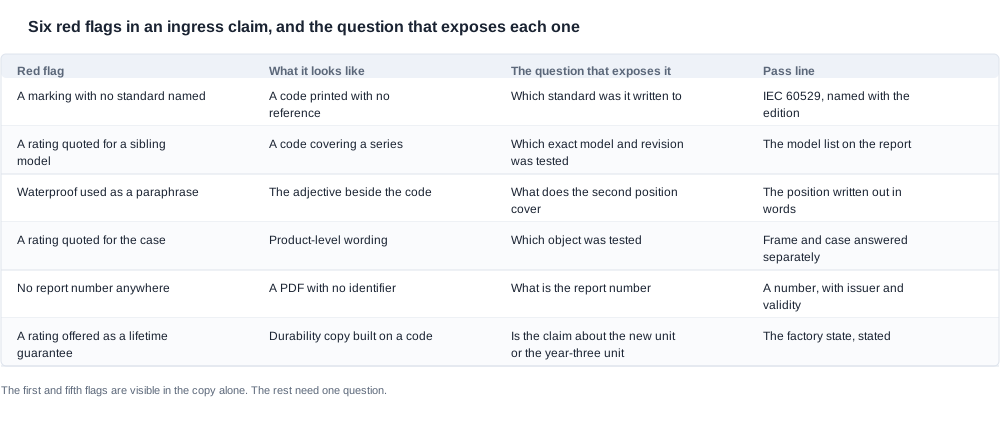
IP rating: six red flags in any claim
The short answer, and why the screen is worth running early
A red flag in this category is not an accusation. It is a signal that a claim has drifted away from the document that would support it, and each one has a specific question attached to it that resolves it in a few minutes. The screen is worth running before the sample arrives rather than after, because a red flag found at the quotation stage costs an email, and a red flag found at the first-article stage costs a tooling change.
The three that cost the most are worth naming in advance, because they are the ones buyers tend to accept. "Waterproof" used as a paraphrase is the most common and the most expensive, because it is a real code with a stronger word attached to it. A rating quoted for a sibling model is the most common document failure, because the model names look similar in a catalogue and nobody checks them character by character. A rating quoted for the charging case is a category error, because a case is a separate object with its own electronics, its own contacts and its own opening.
The alternative to all of them costs nothing: use the marking's own words, state what it excludes, and write a care instruction.
The buyer running the screen, and what they already hold
The buyer running this screen is usually comparing two or three suppliers' ingress claims for a listing or a technical file, and is holding the marketing material, a datasheet, a target market list and a channel plan. What they will not be holding is the report, and the screen is designed so that the absence of a report is itself one of the signals rather than a separate investigation.
That design decision matters. A screening process that requires a document before it can start will only ever run on suppliers who have volunteered a document, which means it runs last and runs least. A screen that starts on the copy catches the cheapest signals first, and it produces a shortlist before any supplier is asked for anything.
The four outcomes the screening protocol is meant to prevent
A claim the customer can falsify. In the outdoor channel the customer is the person who tests the product in the rain, and a claim wider than the evidence produces a return with a photograph attached to it.
A rating that does not cover the unit being bought. A rating attaches to a configuration, not to a product family, and a sibling model with the same electronics is not automatically covered.
A rating quoted for the case. No charging case in our range carries a published rating, and a case that holds the glasses is not a waterproof enclosure for them.
A rating quoted as a lifetime guarantee. Every seal ages, and the rating describes the product as it left the factory rather than the product in year three.

The screen, and the question behind each signal
The six signals and their pass lines
The table below is the screen. The middle column is the question that exposes the signal, and the right-hand column is the answer that clears it.
| Signal | The question that exposes it | The pass line |
|---|---|---|
| A marking with no standard named | Which standard was it written to | IEC 60529, named, with the edition |
| A rating quoted for a related model | Which exact model and revision was tested | The model list on the report |
| "Waterproof" used as a paraphrase | What does the second position cover | The position, written out in words |
| A rating quoted for the case | Which object was tested | The frame and the case, answered separately |
| No test report number anywhere | What is the report number | A number, with the issuer and the validity date |
| A rating offered as a lifetime guarantee | Is the claim about the new unit or the year-three unit | The factory state, stated plainly |
The thresholds inside each signal, and what a soft answer sounds like
The six signals are simple, but each of them hides a threshold that decides whether it is a red flag or merely an untidy sentence. The thresholds are what to ask, and the answer that clears the signal has a recognisable form.
A standard named but no edition is a threshold question. The edition determines the test apparatus and the acceptance criteria, so a code quoted without it has an unknown provenance and cannot be compared with another code quoted with it.
A model list that contains a similar name but not your designation is the second threshold, and it is the one that catches substitutions. The comparison is character by character, and a near-match is a mismatch.
A paraphrase that is technically true but drops the exclusions is the third threshold. "Splash resistant" is not false; it is incomplete, and the incompleteness is what the customer fills in with the strongest reading.
An object question that the supplier answers with a product-family name is the fourth threshold. The frame and the case are different objects, and a rating attaches to one of them.
A document with no identifier is the fifth threshold, and it is the one that is cheapest to check. A number is the only part of a rating document that a customer, a broker or a marketplace can resolve later without the supplier in the room.
A durability sentence that starts with the code and ends with a lifetime is the sixth threshold. The question is whether the claim is about the unit as it left the factory or about the unit in year three, and the answer is almost always the first one.
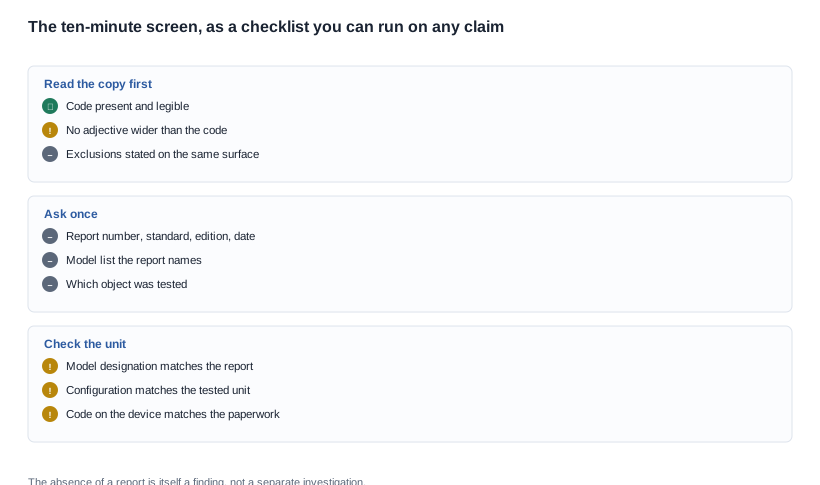
Running the screen in ten minutes
The order, and why the copy comes first
The screen runs on the copy first and the report second, and the order is chosen so that the cheapest disqualifying check happens before anyone is asked for anything.
The first step is to read the claim as written and list the signals it raises. This costs nothing and requires no document. A claim that fails here is either rewritten or dropped, and that decision does not depend on any supplier's cooperation, which is why it can be taken on the spot.
The second step is to send one email containing the four document questions in a fixed order: the report number, the standard, the edition and the date. Asking them together rather than one at a time is what keeps the screen at ten minutes.
The third step is to resolve the number in the issuing body's register and confirm the model designation, the covered functions and the validity date. This is the highest-yield check in the category and it takes minutes.
The fourth step is to ask which object was tested, and to check the model list against the units that will actually arrive. The fifth step is to ask the scope question in writing — new unit or year-three unit — and what the seal's expected service life is.
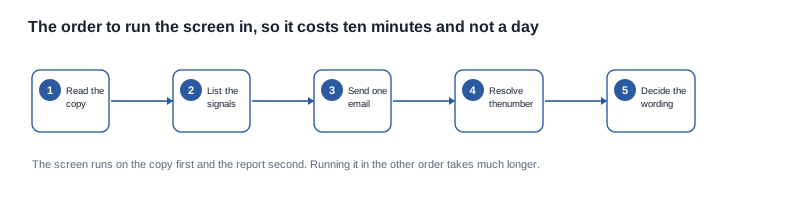
The screen as a shortlist tool
The screen is more useful as a way of ranking suppliers than as a way of eliminating them, and the ranking it produces is usually the reverse of the ranking the unit price produces.
A claim that raises only the fifth signal — a marking with no report number — is a materially different proposition from a claim that raises three. The first is a supplier whose documentation has a gap. The second is a supplier whose marketing has run ahead of their engineering, and the two behave very differently when a broker asks.
The practical output is a three-column list: the signals raised, the evidence requested, and the decision taken. That list is short enough to circulate inside a buying team and specific enough to defend in a review, which is the standard a screening tool has to meet if it is going to be used rather than admired.
When to run it, and when to stop
The screen is designed to run at the quotation stage, but it is not wasted later. The two checks that change at each stage are the model comparison and the configuration check, and both become more valuable as the programme advances: a mismatch found against a quotation is a negotiation, and the same mismatch found against a production unit is a recall.
What to watch for is the screen being used as a substitute for judgement rather than as an aid to it. A supplier who answers every question correctly but who will not discuss the seal material is telling you something the screen cannot capture. The signal list narrows the field; the judgement is yours.

What to do with a claim that raises a signal
Four outcomes, and the decision each one leads to
A screen that only identifies problems is a screen that has not finished its job. Each signal has to produce a decision, and there are four.
The first outcome is narrowing. Where the claim is a real code with a real document and the problem is the wording, the code is kept and the phrasing is replaced with the position written out in words, together with the exclusions. The second outcome is escalating to a document request, which applies where two or more signals have been raised and the document might still resolve them. The third outcome is publishing with the gap declared, where no report exists and none can be produced but the catalogue states a marking. The fourth outcome is removing the claim, where the claim belongs to a different object or where the wording cannot be narrowed into accuracy.
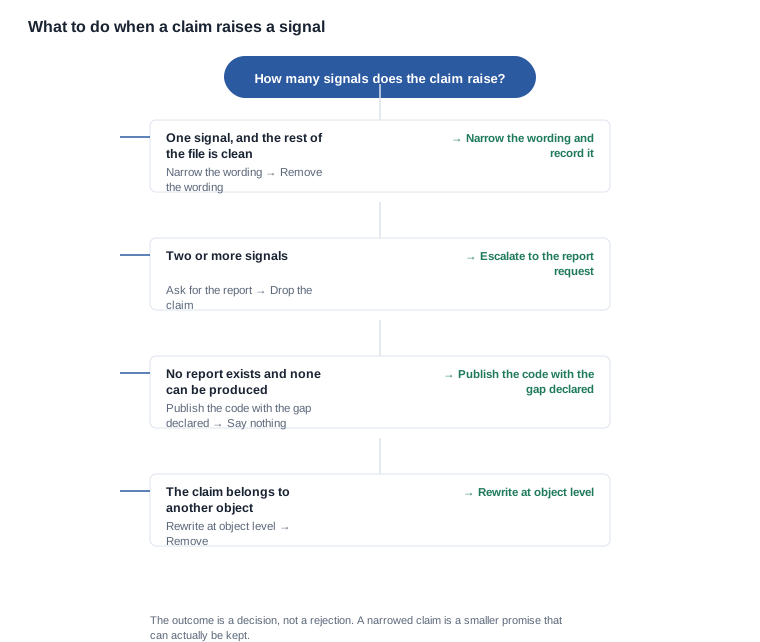
The third outcome deserves a note, because it is the one buyers are least comfortable with and it is entirely legitimate. Publishing a code together with a declared absence of the supporting document is a defensible position, provided the absence is declared as prominently as the code. It is a weaker claim than a documented one, and it is honest about being weaker. What is not defensible is publishing a code and concealing that the document behind it does not exist, because the concealment is what turns an ordinary documentation gap into a dispute.
The criteria that decide which outcome applies
The criteria are the same for every signal. Is the claim anchored to a document. Does that document name your exact model. Does it describe the configuration being bought. Is the object the one the claim is about. Is the scope the factory state rather than a lifetime. And can the wording be written so that each adjective resolves to a position.
Where the answer to the last question is no, the adjective goes rather than being softened. "Water resistant" is exactly as unanchored as "waterproof" while sounding more careful, and it survives more review stages because it does not look like an over-claim.
The commercial consequence of the decision
Each outcome has a different commercial shape, and the negotiation should reflect it. A narrowed claim needs no new money; it needs a copy revision and an artwork round. An escalation to a document request needs time rather than money, and the cost falls on the supplier if the document exists. A published gap needs a retention held against the documentation package, because the buyer is carrying a residual risk. A removed claim usually needs a positioning change instead, which is a marketing cost rather than a compliance one, and sometimes the cheapest outcome of the four.
What is not available in any of the four cases is a price concession that makes the problem disappear. A lower unit price does not narrow a claim, does not produce a document and does not change the object that was tested.

Where a flagged claim turns into a commercial loss
A brand publishes IP54 waterproof and the customer returns the product after rain. The symptom is a return cluster with a photograph attached. The root cause is that a real rating was paraphrased into a stronger word. The prevention is to use the marking's own words, state what it excludes, and write a care instruction.
A certificate arrives naming a model that is not the one ordered. From the buyer's side the symptom is a customs query, a warranty claim, or a listing rejection that cannot be closed. The root cause is that the rating was quoted for a sibling. The prevention is to check the model list and make the exact designation a condition of the purchase order.
The case is claimed as protected because the glasses are. The symptom is a submerged or washed accessory returned under a claim that the frame's rating was supposed to cover. The root cause is that the claim was written at the product level. The prevention is to ask which object was tested and to answer for each object separately.
The product is published as immersible and the customer tries to swim with it. The symptom is a return from a customer who read the listing in good faith. The root cause is that a 7 in the second position was read as a general water rating. The prevention is to read both positions independently and publish the exclusion.
A supplier cannot produce a report number and the claim goes ahead anyway. The symptom is a claim that cannot be defended when a retailer's technical team asks for the file. The root cause is that the claim was accepted because it was plausible. The prevention is to treat the absence of a number as a red flag in its own right and to decide deliberately whether to publish the marking at all.
A red flag appears in year two, after the programme has scaled. The symptom is a return drift with no cause identified, and a suspicion that something has changed in the factory. The root cause is that a change of gasket, screw, housing supplier or torque driver was made without notice, which invalidated the configuration the rating applied to. The prevention is a change notification obligation in the purchase order and a retained unit that the buyer can inspect.
Why we publish our own gap, and what we can answer about a claim
The commercial terms that apply once the claim is settled
The negotiation after the screen is an ordinary one, and the term with the most weight is the retention. A deposit, a balance on inspection before shipment, and a retention held against the documentation package protect the buyer on the failure that costs most in this category, which is a product that arrives with a marking nobody can evidence — which is exactly the failure the fifth signal predicts.
The per-variant cost of a documentation-only change is usually negotiable, because no hardware is touched. The number of units per variant is negotiable, and more so on a repeat order than on a first. Delivery splitting against a documentation-review milestone is often granted more easily than a price concession, because it moves the risk onto the review rather than onto the shipment.
What cannot be negotiated is the certification cost and the certification time, which are a per-configuration cost and a laboratory queue respectively. Tooling, like the certification cost, is one-off and usually spread across the opening order; what a red-flag review should surface is the volume that absorbs the charge and whether the tooling and the sealing tooling would still be needed if the programme stopped. And the seal is not negotiable either: a supplier who will not change the seal material, the seal geometry or the port design is telling you that the ingress performance is fixed, and with it the exclusion list.
A worked scenario: three supplier listings screened the night before a decision meeting
This is a hypothetical case rather than a client project, and it is included to show the order of the screen changing a shortlist.
Assume a channel buyer reviewing three suppliers' sport eyewear listings, each carrying an ingress claim of some kind, and with a decision meeting the following morning. The first listing says "IP54 rated, tested to international standards". The second says "IP54 — dust protected, splash protected, not for immersion". The third says "fully sealed, military grade, waterproof".
Running the screen on the copy alone takes about ten minutes and produces a clear result. The first raises the first signal, because no standard and no edition is named, and it would also raise the sixth if the page says "built for all weather". The second raises no signals on its face, and the remaining question is documentary. The third raises the third signal outright, because "waterproof" is a paraphrase attached to no code, and it also raises the first, since no standard is named.
The follow-up email then resolves the rest. The first supplier sends a report number whose model list does not include the channel buyer's private-label configuration — which is the second signal, and it converts a marketing question into a procurement question. The second supplier sends a report number that does cover the buyer's designation. The third supplier cannot produce a number at all.
The outcome is a shortlist of one, and a decision made on the screen rather than on price. The value of the screen is visible in the second supplier: because the screen ran on the copy first, the buyer knew what to ask for, and the buyer's only follow-up was one email. The cost of the screen was ten minutes of reading and one email, and it removed a supplier whose copy would have generated the returns.
What we publish, and what we can answer
The short answer: we publish the IP54 marking on the models that carry it, we publish that no third-party test report number supports it, and we will not describe a splash-protected product as waterproof or present a rating as a lifetime guarantee. The marking appears on the V06 and the S7. We publish no rating for any other model in the range, and no ingress rating for any charging case. When the company confirms the test documentation for a model, we will publish the report number here rather than a restatement of the marking.
The other half of our position is that we apply the screen to our own claims. We publish a marking without a report number, which is the same shape of gap as a supplier who quotes a marking without a standard, and we would rather a buyer could see that gap than not.
What we can do is tell you which of the six signals a given supplier's claim raises, and which rows our documentation answers today and which do not. The background is under IP ratings and durability, the standards context is in IP rating industry standards, the failure modes are in IP rating problems and fixes, the ageing question is in does IP degrade over time, and the code itself is in IP rating smart glasses.
Three requests for a buyer running the screen this week
Run the screen on the copy before you send anything to anyone, and mark the signals against each supplier. Ask for the four document items in one message — report number, standard, edition, date — in that order.
Then decide the wording per supplier, and put the change notification obligation into the purchase order before the first variant is ordered, because the sixth signal is the one that arrives after the programme has scaled.
Where the screen comes from
Send us a supplier's ingress claim and we will tell you which of the six signals it raises.


