

What to ask supplier to know about IP rating: the ingress rows that decide a sealing programme
An ingress rating is a claim about a sealed assembly, and a sealed assembly is a manufacturing question before it is a marketing question. That ordering is the source of most of the confusion in this category: the marking appears on a product page and on a box, and it is read as a description of the product in a customer's hand, when in fact it is a description of one tested sample under one set of conditions.
The practical conclusion for a buyer is short. Before comparing quotations, establish two things: what exposure the product actually has to meet, and what the rating's scope will be. Those two answers determine whether you need a rating at all, which severity is worth paying for, and what you are allowed to write in the listing. A rating requested without an exposure definition tends to arrive at the lowest severity a factory already has, which is frequently not the one the channel needs and always the one the paperwork is cheapest to obtain.
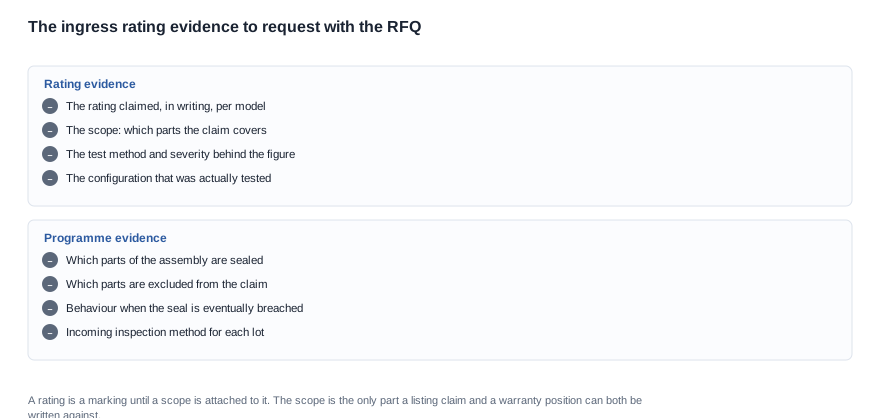
There is a second conclusion that matters more than the first, and it is about wording. A rating is a marking. The document behind it is what gives it meaning: the test method, the severity, the configuration that was tested, and the parts of the assembly that were excluded from the claim. A buyer who has those four things has a warranty position, a listing claim and an inspection method. A buyer who has only the marking has a badge, and a badge is what a marketplace returns desk asks about when a customer reports a device that stopped working after rain.
Reading the two digits before you write the requirement
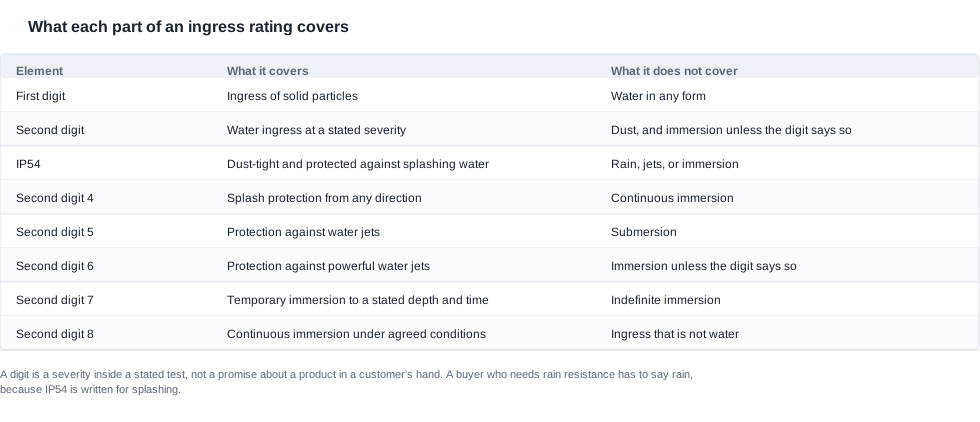
Most of the avoidable cost in this category comes from specifying a digit rather than an exposure. The first digit of an ingress rating describes the protection against solid particles, and the second describes the protection against water. They are not a single scale and they are not sequential in the way buyers often assume.
The second digit is where the money is, because it is the digit buyers misread. A second digit of 4 covers protection against splashing water from any direction. It does not cover rain, it does not cover a jet of water under pressure, and it does not cover immersion. A second digit of 5 covers water jets. A second digit of 6 covers powerful water jets. A second digit of 7 covers temporary immersion to a stated depth and time. A second digit of 8 covers continuous immersion under agreed conditions. Each step up is a different test with a different cost and a different lead time, and each is a different claim.
So the requirement should be written in the exposure language of the channel rather than in the language of the standard. "Must survive a full working shift of rain outdoors" is a specification a supplier can price and a factory can test. "Must be IP67" is a specification that settles the number and leaves the exposure open, which is how programmes end up with a rating that is either excessive or mismatched.
One more piece of vocabulary to fix before it causes an argument: the word waterproof. It is not a category term, it describes no test, and it is the source of most of the disputes that arrive at a returns desk. The usable phrase is a stated severity under a stated method on a stated configuration, and the listing should use that phrase rather than a superlative.

Who carries the ingress rating risk into the channel
The reader is a brand-side product owner working with a procurement manager, a channel buyer building a private-label range, or a distributor whose customers are buying on a specification. The situation is one of three: comparing quotations that quote different ratings, opening a new material number for a channel with a defined exposure, or fixing a claim that a listing reviewer has already questioned.
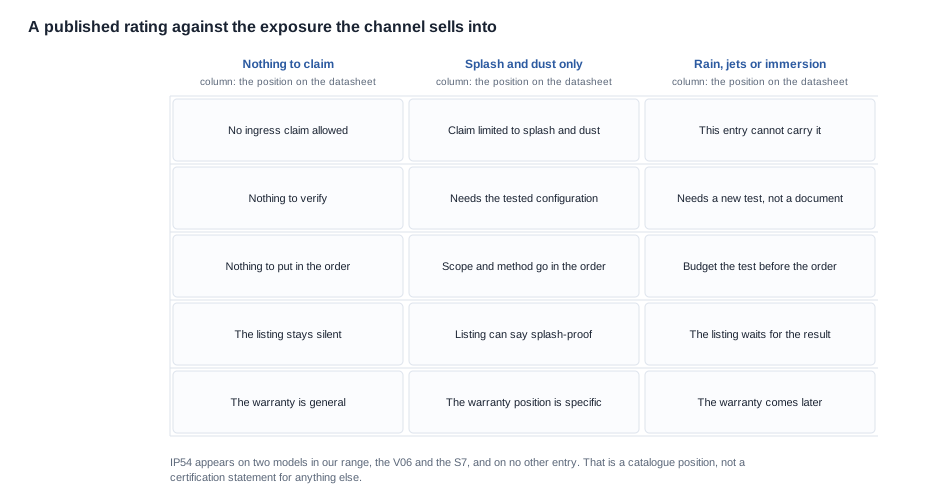
The risk in this category does not sit with the factory, and that is the part buyers often misplace. It sits with whoever places the product on the market and writes the listing, because that is where the claim is made and where the customer decides whether the claim was true. A factory that delivers a product matching its documentation has done its job. A brand that then writes "waterproof" on a listing has taken on a warranty exposure that the documentation does not support, and no amount of supplier documentation fixes that afterwards.
That is why the exposure definition belongs in the buyer's requirement and not in the supplier's brochure. The buyer's channel knows what the product is exposed to. The supplier knows what the factory can seal. Neither of them can substitute for the other, and a quotation asked without an exposure definition defaults to whatever the factory already has on the shelf rather than to what the channel needs.
There is a second risk holder that is easier to overlook, and that is the channel partner or the marketplace whose customer bought the product from them. In that structure the brand is invisible to the end customer, which means the channel partner absorbs the conversation and the brand absorbs the cost of the resolution, usually as a credit against the next order. Where that is the structure, the incoming inspection method becomes commercially important rather than merely prudent: a small check on a sample of each lot is cheap and it catches the failure before it reaches a customer who cannot name the brand.
Both risk holders need the same artefact, and it is not the rating. It is the scope: the parts of the assembly the claim covers, the parts it excludes, the configuration that was tested, and the behaviour when the seal is eventually breached. The last of those is the one buyers forget, and it is the one that determines whether a water-related failure is a defect, a limitation or a design choice.
Where the cost of an ingress rating sits in the quotation
The cost of an ingress rating is rarely the visible line in a quotation, and the reason is that most of the cost sits before the order, in engineering time and test time, and is amortised into the unit price rather than quoted separately. That makes it invisible to a buyer comparing prices, and it means a buyer who treats the rating as a free feature is comparing two products that have had different amounts of engineering invested in them.
The first cost is the seal design itself. Sealing a charging interface, an acoustic port and a set of microphone openings is an engineering exercise, and the choices are visible in the product: a magnetic charging interface, a Type-C port with a cover, a sealed acoustic mesh, or a design that accepts that some of these are open and states so. Each of those choices has a unit price, a tooling consequence and a conformity consequence. A buyer who specifies the exposure and asks for the sealing approach to be named in the quotation can see all three.
The second cost is the testing and its lead time. A severity that has not been tested before on this platform is a queue at the test laboratory, and the queue is not compressible by the factory. That number belongs in the schedule as an external dependency with a date attached, exactly like a custom lens, a custom cell or a radio approval. Buyers who treat it as part of the production lead time discover it late.
The third cost is the re-test that follows a configuration change. Changing the housing, changing the charging interface, changing the lens option or changing the internal frame can all invalidate a rating, and the re-test is charged per configuration. This is the line that compounds across a range, and it is the reason a programme with four colourways and a sealed configuration is not one configuration but four.
The fourth cost, and the one that never appears on a quotation at all, is the channel cost of a claim that does not match reality. A listing that says waterproof and a product that is only splash-protected will generate returns that nobody can classify as defects, so they cannot be charged back, so they come out of the buyer's margin. The only defence is to agree the claim wording and the inspection method before the listing is written, which costs one document review and saves an unknown number of customer conversations.
So the negotiating space sits in the configuration definition, the number of sealed configurations, the tooling amortisation and the incoming inspection method. It is not in the price of the seal.

Verifying an ingress rating before the purchase order
Verification here is mostly documentary and fast, and the failure mode is not a missing document. It is a document that is present, belongs to a different configuration, and is read as coverage.
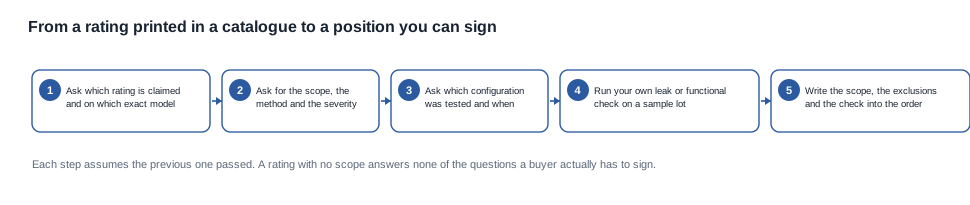
Step one: ask which rating is claimed and on which exact model. Not which model family, and not which platform. A rating established on one configuration does not transfer to another, because a different housing, a different port or a different internal frame is a different assembly.
Step two: ask for the scope, the method and the severity. The scope decides what the claim covers; the method and severity decide what the number means. Ask for them in one question, because a supplier who answers the severity but not the scope has given you the number without the meaning.
Step three: ask which configuration was tested, and when. A rating established on an engineering sample describes that sample. A rating established before the current production tooling was cut describes a product that no longer exists in the same form. The date is worth asking because it tells you whether the rating has been re-confirmed since the last change.
Step four: check the exclusions against the design. Sealed charging contacts, open acoustic ports and microphone openings are the usual exclusions, and they are usually the reality in the field. The question is not whether there are exclusions; every assembly has some. The question is whether the exclusions are the ones you expected and whether the listing and the support script mention them.
Step five: run a check on the sample lot yourself. It does not need to be a laboratory test. A functional or leak check applied to a defined sample of each lot, recorded and retained, gives you two things: a detection mechanism for the failure that matters, and an evidence trail if a customer disputes it. Write the sample fraction and the method into the purchase order, because an incoming inspection nobody has specified is an incoming inspection nobody performs.
Step six: write the scope, the exclusions, the check and the remedy into the order. The remedy for a water-related failure is the clause worth the most attention, because it is the one most often left to a general warranty statement and the one a channel asks about when a customer reports a device that stopped working after rain. A specific position on that scenario is worth more than a broad warranty statement.
How ingress rating programmes fail in the channel
The rating quoted for a different assembly. A datasheet rating was applied to a configuration with different seals, and the units in the channel behaved differently from the units on the evaluation desk. The root cause is that the tested configuration was never identified. The control is to require the tested configuration to be named and to match it against the ordered configuration before the first lot.
The scope nobody checked. The rating excluded the charging contacts or the ports, and the field data did not. The root cause is that the exclusions were never requested in writing. The control is to ask for them and to put them in the listing and the support script, not only in the file.
The factory test with no incoming check. A unit with a defective seal passed the initial check and failed in the channel. The root cause is that the inspection method was the factory's and not the buyer's. The control is to add a functional or leak check to the incoming inspection for a defined sample of each lot, and to state the sample fraction in the order.
The lifetime that was implied. A channel sold the product as waterproof on the strength of a factory rating. The root cause is that the claim was written by the channel rather than agreed with the brand. The control is to agree the claim wording against the evidence and to document the limitation in the listing.
The programme that changed after the rating. A configuration change invalidated the rating and the programme continued to quote it. The root cause is that the rating was not on the change-control list. The control is to put the rating, the tested configuration and any sealing-related change on the change-control list with a notice obligation attached.
Every item here is ordinary, and not one of them is a reason to look elsewhere for supply. They are reasons to put a line in the order.

The clauses an ingress rating needs and the ones it cannot buy
The commercial treatment of an ingress rating follows one rule: the cost of the test is fixed and the cost of the paperwork is fixed, while the cost of the configuration and the claim is negotiable. Knowing which is which saves an argument that cannot be won.
The configuration and the sealed variant set are the live commercial numbers. Where a sealed configuration sits alongside an unsealed one in the same programme, ask whether they are separate orderable configurations with their own part numbers and their own minimum order quantities. The multiplicity cost of that decision, across artwork, packaging, documentation and inspection, is usually the largest hidden item in the quotation, and it is the one a buyer can actually influence by committing to a configuration count.
Sample cost, evaluation unit quantities and first-article inspection allowances are negotiable and are usually given away. Under pressure on a first order, a supplier will often concede these. They are real numbers, they cost the supplier very little, and they are worth taking before the buyer spends capital on anything structural.
The incoming inspection method and the sample fraction are negotiable in detail and fixed in principle. The supplier will argue about how many units per lot and how the check is performed. What it will not move is whether there is a check. A supplier who insists there is no buyer-side check is telling you where the risk sits, and the answer at that point is a larger allowance in the cost model.
Certification cost and certification time are fixed. They are a per-family cost and a queue at the test laboratory. Pressing on either produces a longer schedule rather than a shorter one. A one-off tooling cost is usually amortised across the first order, so the questions worth asking are over what volume it is amortised and what happens to it if the programme is discontinued. A re-test caused by a configuration change is charged per configuration, which makes it the line that compounds across a range.
The seal design itself is not a commercial variable. If your requirement needs the charging interface to be sealed, no negotiation turns a magnetic interface into a sealed one. What negotiation can do is change the number of configurations, the size of the first order, the amortisation of the tooling, the documentation obligations and the acceptance criteria that bind them.
The clauses worth having in the agreement are these. The rating and its scope, attached to the order. The test method and the tested configuration. The exclusions, listed. The incoming inspection requirement, with the sample fraction and the method. A change-notification clause covering the housing, the charging interface, the acoustic path and the internal frame, since each of those invalidates the configuration. And the warranty position for a water-related failure, written specifically rather than left inside a general warranty clause.
A worked example: a sports brand moving into a rain-exposed channel
The scenario below is invented for the sake of the reasoning: it is not a client project, and it shows the order of steps rather than an outcome.
Assume a sports brand with an existing open-ear audio line, currently sold for training and leisure, now targeting an outdoor workwear channel where the product is used on a site in all weather. The constraint that matters is not the factory. It is that the workwear channel buys on a specification and will return goods against a stated requirement rather than against a feeling, so an imprecise rating is commercially expensive there in a way it is not in the consumer channel.
The brand's first move is to write the exposure down in the channel's language. Not "IP67" and not "waterproof", but the requirement that the product must continue to function through a full shift of heavy rain, must be storable in a wet vehicle overnight, and must survive a routine hose-down after a shift. That paragraph is what the supplier can price and what the factory can test, and it also gives the brand's own listing team a claim they can actually write.
The second move is to ask for the scope with the rating. The answer comes back with an exclusion list: the acoustic openings and the charging contacts. The brand now has a decision, and the decision is not to reject the rating. It is to write the exclusions into the workwear channel's technical data sheet and into the product instructions, so that the channel is not promising more than the product delivers. The channel will accept that, because the channel would rather have a precise document than a marketing phrase.
The third move is the inspection. The brand asks for a functional check on a defined sample of each lot, and the supplier proposes its own factory check, which is a reasonable starting position. The brand asks instead for the method and the sample fraction to be written into the order, and for a retained record. This costs nothing and it creates the evidence trail the channel will ask for the first time a customer disputes a return.
The fourth move is commercial and it is the one that was not obvious at the start. The brand learns that sealing is per configuration, so the two colourways it had planned become two sealed configurations with two artwork lines and two documentation scopes. It reduces the launch to one sealed colourway and one unsealed colourway, keeps the second for the following season, and negotiates the per-configuration minimum on the basis of that committed count. The second colourway would have looked like a minor range decision and would have doubled the sealing and documentation scope.
The result is a claim the brand can defend in a channel that buys on specification, an exclusions statement the channel can pass on, and a first season whose configuration count was set by the cost of sealing rather than by the cost of the seal.
What our catalogue publishes about ingress, and what it does not
The published material on ingress protection is the part of the specification we can stand behind, and the rest is a question for the supplier's own file. We publish what our documentation states, we mark the open rows as open, and we will not fill an open row with a typical figure from a general data sheet. A buyer who builds a claim on an estimated number finds the error in the channel rather than in the quotation.
These are the rows we do not publish, and they are the same for every entry in the range:
- The test method, the severity and the tested configuration behind any ingress marking are not published.
- The scope of any claim, and the parts of the assembly excluded from it, are not published.
- The behaviour of a unit after the seal is breached is not published.
These are the rows our published data does settle:
- An IP54 marking appears on two models in our range: the V06 AI sport photo glasses and the S7 AI sport photo glasses. Both publish a 260 mAh cell, a rated runtime of 5 to 8 h, a charge time of two hours or less, magnetic charging, and a detachable inner frame. It appears on no other entry.
- Our catalogue's export certification is a company-level capability. The catalogue carries no per-model certification row, so a company-level capability cannot be used to infer that any particular model carries any particular approval.
- The published rows across the range do include Bluetooth generations, cell configurations from 40 mAh to 290 mAh, charge times of two hours or less on every entry except the D17 and the ZH12 at about one hour, and rated runtimes from roughly six hours to roughly twenty hours.
What we will not do is quote an ingress rating from a photograph, a packaging mock-up or a supplier's general data. What we will do is take a use case, a configuration and a target market, and tell you which parts are settled, which are open, and which have to come from a sub-supplier.
For the standard itself, what each part of the ingress standard means is the longer treatment, whether a rating is worth buying at all is the commercial question, and the sport family questions covers the proof points a catalogue marking does not carry. The sport smart glasses range is where the two IP54 entries sit.
The action to take this week
Write the exposure in the channel's language before you write anything else: what the product has to survive, for how long, and in what state it has to be in afterwards. That paragraph decides the severity worth paying for and stops the quotation from defaulting to whatever the factory already has.
Then put four rows in the RFQ: the rating claimed per model, the scope with its exclusions, the test method and severity, and the configuration that was actually tested. Ask for the model designation in the answer, because a rating without one cannot be written onto a purchase order.
Finally, specify the incoming inspection — a functional or leak check on a defined sample of each lot, with the method and the fraction written into the order. That is the clause that converts a badge into a position you can defend, and it is the cheapest thing on this list.
Send us the model, the quantity, the target market and the exposure, and we will tell you which of the published rows apply to that configuration and which questions are the ones we would put to the factory ourselves.
Related reading
- What each part of the standard means — IP ratings
- Whether a rating is worth buying at all — do you need one
- The proof points that a rating is a catalogue marking — sport family questions
- sport smart glasses
Send the configuration, the quantity and the exposure, and we will say which parts of the ingress rating are settled and which are yours.


