

"Is it comfortable for small faces" is a question about geometry, and the catalogue answers it in one specific way: by not answering it. Across the twenty-eight models in the range there is no dimension row anywhere. No temple length, no bridge span, no lens height, no total frame width, no head-size band, and no age bracket appear on any product page. The one physical measurement printed anywhere in the whole catalogue is a weight, and it sits on the MT6 — an adult camera model with a folding charging case, where the 158 g figure describes the glasses body alone, with the cell and the camera inside and the case outside. So the answer a procurement team needs is not a catalogue lookup. It is a short list of measurements to demand in writing before a purchase order is released, and the useful work here is separating the rows that already exist from the rows that have to be created.
That matters more for this question than for most, because a sizing gap is not a soft preference. A frame that is too wide at the bridge will not stay in position through a shift; a temple that is too long will sit behind the ear and the camera will carry the load, which is exactly the failure mode the camera models are sold into. The buyer who assumes the geometry can be read off a product page is discovering this at the sample stage, when the changes that can still be made are the cheap ones.
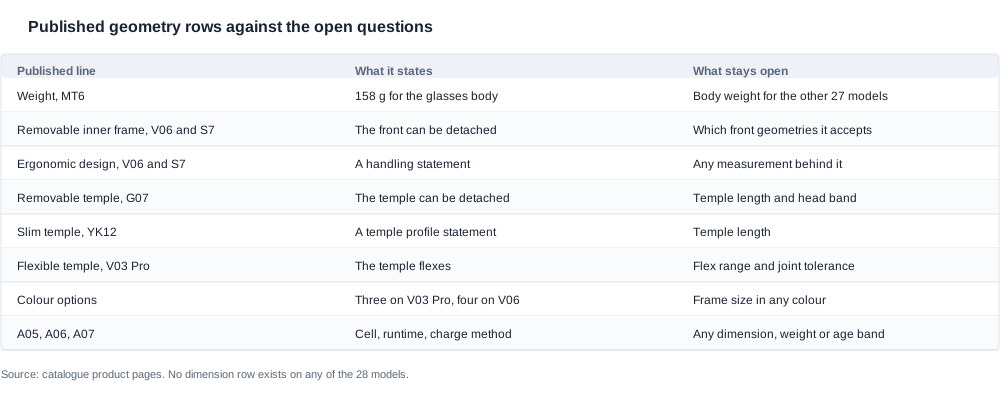
is it comfortable for small faces: what the catalogue publishes and what it does not
Five rows in the entire catalogue touch on physical geometry, and every one of them is qualitative. The V03 Pro publishes a flexible temple. The V06 and the S7 both publish an ergonomic design statement together with a removable inner frame. The G07 publishes an ultra-slim temple that can be detached, and the YK12 publishes a slim temple profile. Those are the five, and none of them carries a number. There is no line anywhere that says how long the temple is, how far the bridge spans, how tall the lens sits, or how wide the whole front measures.
Weight is the other published measurement, and it appears exactly once. The MT6 is published at 158 g for the glasses body, which is stated to include the 265 mAh cell and the camera and to exclude the folding charging case whose capacity is published separately as 1200 mAh. It is worth being precise about why that number cannot travel. It belongs to one adult camera model in a range that also contains three children's models, eight audio models and three sport models. A buyer cannot use it to represent any other model, and a buyer cannot use it to describe the models where a narrow head would be the binding constraint. Nor can it be converted into a size: weight scales with volume, and a frame's length, bridge and lens height do not follow from its mass in any way a purchaser can calculate.
Two further rows bear on how the range can be read, and both are about appearance rather than measurement. Colour is published for exactly two models in the whole range — three options on the V03 Pro, four on the V06 — and colour tells a buyer nothing about frame width. And the children's models, the A05, the A06 and the A07, publish a cell, a rated runtime, a charge time and a charging method, with a Bluetooth version on the A07, but no dimension, no weight and no age band. Their feature rows are identical on the A05 and the A06 and describe, in the catalogue's own terms, an electronic unit mounted in the lens, a fogging unit, prompts that separate correct from incorrect posture and distance, and states covering both lens clarity and lens fogging. Those are catalogue lines and they are worth reading carefully, because they describe a monitoring device rather than a frame geometry, and nothing in them should be restated as a claim about eyesight or about protecting vision.
The published rows and what each one leaves open
| Published line | What it states | What stays open |
|---|---|---|
| Weight, MT6 | 158 g for the glasses body, cell and camera inside, case outside | Body weight for the other 27 models, and for all three children's models |
| Removable inner frame, V06 and S7 | The front section can be detached from the body | Which alternative front geometries the detached part accepts |
| Ergonomic design, V06 and S7 | A qualitative handling statement | Any measurement or test behind the statement |
| Removable temple, G07 | A temple section that can be detached | Temple length, and the head band the model is built for |
| Slim temple, YK12 | A temple profile statement | Temple length, and the temple tip material |
| Flexible temple, V03 Pro | A temple that flexes | The flex range and the tolerance the joint survives |
| Colour options | Three on the V03 Pro, four on the V06 | Frame size in any colour |
| A05, A06, A07 | Cell, runtime, charge method, and a Bluetooth version on the A07 | Any dimension, any weight, any age or head-size band |
The table is the honest state of the evidence: seven published lines, and in every case the geometry the buyer actually needs is the one that is absent. The absence is not a statement about the product. A model with a published dimension would still need to be checked against a head; a model without one is simply asking the buyer to create the datum themselves.
The four sizing rows a buyer has to obtain
Because the catalogue supplies none of them, the specification has to be built from four measurements, and each one should be requested with the measuring convention attached so that the two sides of the order are talking about the same thing. The criteria that decide a shortlist here are simple to state and hard to obtain, and the whole of the due diligence sits in obtaining them.
- Temple length, measured along the temple from the hinge to the tip, in millimetres. This is the row that decides whether the frame stays in position, and it has to be given as a single figure with a tolerance rather than a range of sizes. Where a model publishes a flexible temple — the V03 Pro is the only row in the catalogue that speaks to this — the flex range should be requested alongside the length, because a temple that flexes and a temple that fits are different properties, and a buyer needs to know which of the two is doing the work.
- Bridge span, measured between the lens inner faces at their narrowest point, in millimetres. This is the row that most often decides whether a frame can be held at all on a narrow head, and it interacts with the nose pads: a fixed bridge of a given width is a hard constraint, while a bridge with a pad set that can be exchanged is a soft one. Ask whether pads are supplied in more than one size and whether they are a consumable, because that changes the aftersales position considerably.
- Lens height and the vertical position of the camera, in millimetres. For the eleven camera models this row carries more weight than for the rest, because the lens height and the front height determine where the camera sits relative to the line of sight, and the catalogue publishes a still-image resolution class for each of the eleven camera models, on one of two bands, but says nothing at all about the optical geometry that determines the shot. A resolution class is not a field of view, and no field of view is published for any of the eleven.
- Total front width and temple tip section, with the head band the frame is validated against. These two travel together. A front that is wider than the head can be held in place by the temples pulling inward, and that is a force the temple tips have to take; the tip material and the front width therefore have to be read together, and a supplier who quotes a front width without a head band has not answered the question that matters.
Each of the four should arrive as a number on a drawing, not as a phrase in a catalogue. A drawing states the measurement convention — where the length starts and stops, and whether the measurement is taken flat or on the curve. Without that, two suppliers will produce two different numbers for the same model and the buyer will be the one reconciling them.
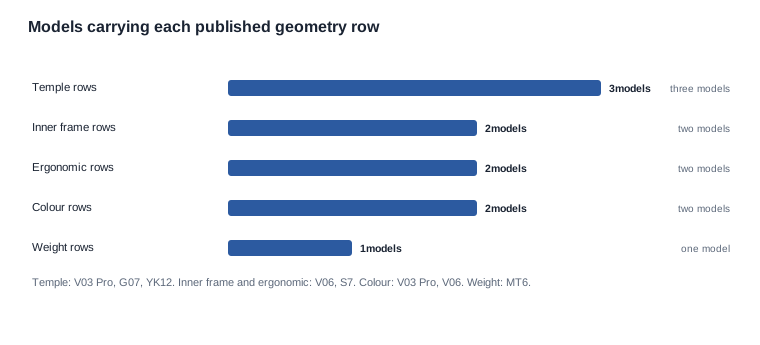
Where the structural hints sit, and what they do not settle
The five qualitative geometry rows are scattered across three families, and their distribution is instructive. The camera family carries three of them — the flexible temple on the V03 Pro, and the removable inner frame with its ergonomic statement on both the V06 and the S7. The audio family carries two, the removable ultra-slim temple on the G07 and the slim temple profile on the YK12. The sport family carries none at all, and neither does the children's family.
That distribution is the reason a buyer cannot shortcut the question by working within one family. The models whose pages mention temples at all are not the models that would be chosen for a small head on any other grounds — the G07 and the YK12 are audio models whose published pages carry a Bluetooth version, a cell figure and a runtime, and nothing else; the V03 Pro is a camera model that also publishes a photochromic lens and three colours. The catalogue's families are electrical families. They sort by what the device does with a cell and a radio, not by the shape of the frame, and the geometric hints that do exist are scattered across them without any relationship to the other rows on the same page.
The removable inner frame on the V06 and the S7 deserves a separate note, because it is the only published row in the whole catalogue that offers a way to change the geometry of a frame after manufacture. If the front can be detached, then in principle a second front of a different width can be fitted. What the catalogue does not publish is the range of front geometries the removable part accepts, whether the alternative fronts are available as orderable items or only as workshop replacements, whether the camera alignment changes with the front, and whether a swapped front needs its own verification. A buyer treating the removable frame as a sizing solution should ask all four before assuming it solves anything.
The G07's removable temple and the YK12's slim temple point the same way from the other end. A detachable or slim temple is usually the answer to a geometry problem — it lets a head of a different proportion use the same body — but the published rows describe the mechanism, not the range. The G07 page publishes a 55 mAh × 2 cell, a magnetic charge method, a two-hour-or-less charge ceiling, a rated runtime of about six hours, a Bluetooth version and nothing else; the YK12 publishes the same five standard rows, a surround sound statement and a slim temple statement.
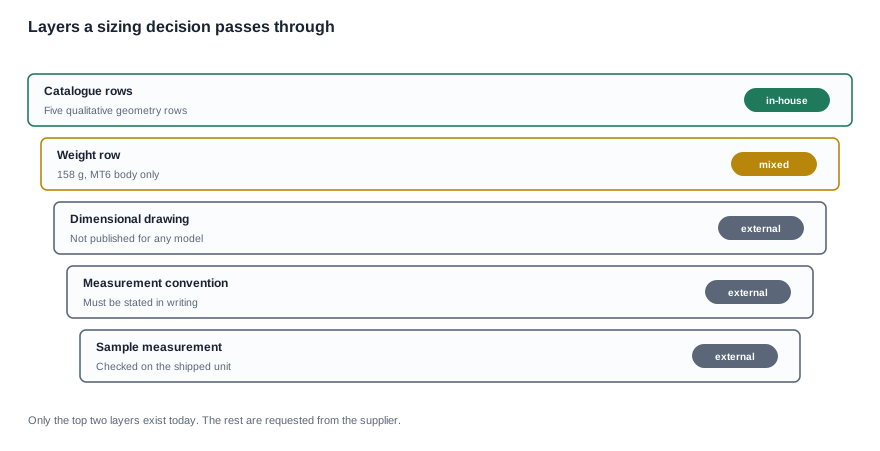

Questions that turn a sizing gap into a written specification
The following are the questions to put to a supplier. They are ordered so that a refusal or a vague answer to an early one tells the buyer something about the later ones before the sample is ordered. A shortlist built from answers in this order is a shortlist of specifications rather than of marketing lines, and only the second kind survives a purchase order review.
- Will you provide a dimensional drawing for this model, with units and the measurement convention stated? A drawing with no stated convention is close to no drawing at all, because the buyer cannot compare it against the sample and cannot quote it to a channel partner.
- What is the weight of the glasses body without the case and without packaging, measured on what sample? This is deliberately worded to match the convention the MT6 row already uses, so that the answer is directly comparable with the one published figure. A number quoted including the case, or including the retail box, cannot be compared with it.
- Is the temple adjustable, and if so over what range in millimetres? For the models that publish a flexible temple or a detachable temple, the specific range matters more than the existence of the feature, because the range is what determines the head band covered.
- What nose pad material is used, are pads supplied in more than one size, and are they a consumable? This converts a fixed bridge constraint into a manageable one when the answer is favourable, and it defines the aftersales cost when it is not.
- What head size band has the frame been validated against, and against what test? If the supplier cannot name a band, the question becomes whether a dimensional drawing exists at all, which usually resolves the whole sequence quickly.
- For the V06 and the S7, what front geometries the removable inner frame accepts, are they orderable, and does the camera alignment change? And for the G07 and the YK12, what temple lengths are available against the detachable or slim temple, and what is the tolerance between them.
- For the A05, the A06 and the A07, what is the frame dimension, the body weight and the head band? These three models are the natural candidates for a small-face use case, and they are the three with the fewest published physical rows. The feature rows published for the A05 and the A06 describe a monitoring device and should be read as such.
- Does the printed instruction card or the packaging carry a size mark, and if so what does it correspond to? A size mark on the packaging is a convenient shorthand for a channel partner, but it only works if it maps to a published measurement somewhere in the documentation set.
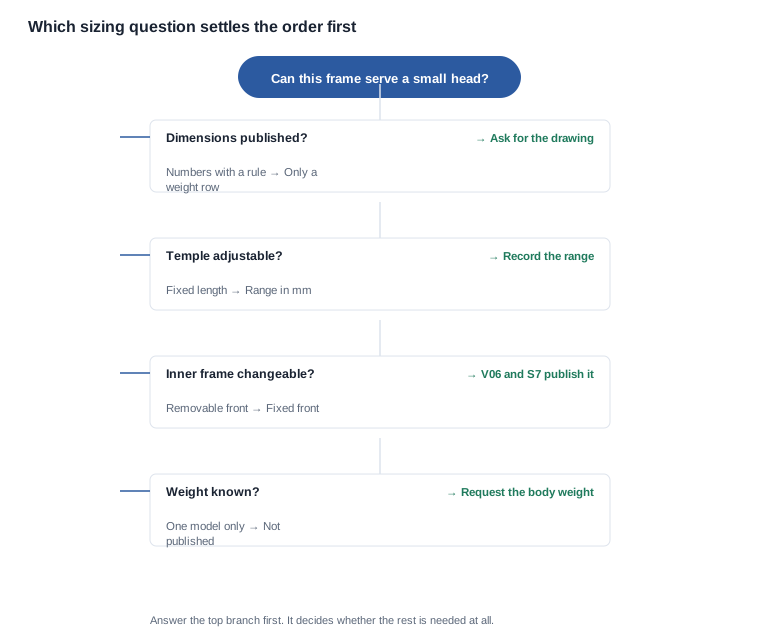
The pattern across the eight is worth stating, because it is where most of the practical value sits. A supplier who answers the first five with numbers, states the measurement convention alongside them, and is explicit about which of the published rows already exist is a supplier whose samples can be signed off against a written specification. A supplier who answers with adjectives — ergonomic, lightweight, adjustable — is describing the same five published rows that are already in the catalogue, and the sample will not settle the question. There are three red flags worth naming: a drawing with no stated convention, a weight quoted with the case included, and a head band given without the test that produced it. Any one of them means the answer is not yet verifiable, and the due diligence has to go back a step rather than forward.
What belongs in the purchase order, and what belongs in the sample report
Once the measurements arrive, they need somewhere to live, and the usual mistake is putting them in an email and losing them between two revisions of the order. The four rows belong in the order document as an annex, referenced by drawing revision and date, with the measurement convention written out once and applied to all four. The tolerance on temple length is the row most often left out and the one most often disputed, because a frame that is a fraction outside the band still looks acceptable to the person who unpacks the box.
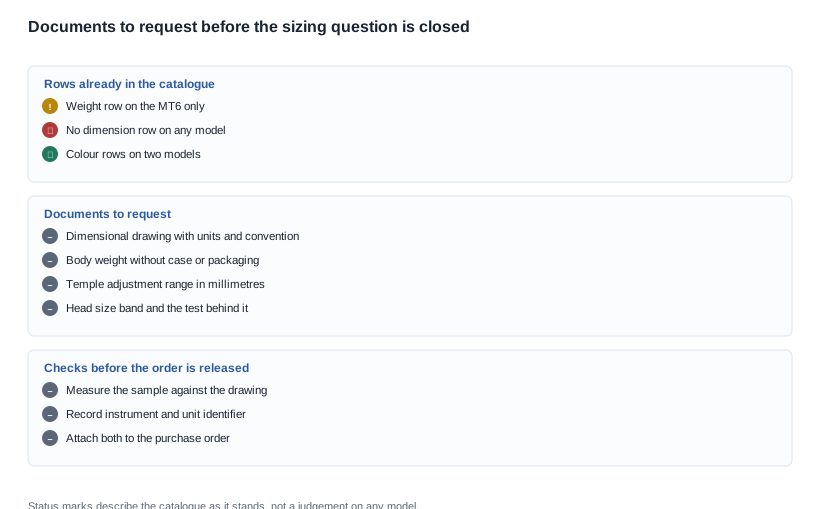
The sample stage should carry the same four rows as a measurement report rather than a photograph. Photographs cannot show a millimetre. A sample report records the measured value for each row on the specific unit that was shipped, states the instrument used, and identifies the unit by serial or batch. If the order is a repeat of an earlier one, the report from the first shipment is the reference, and a unit that measures outside the band is a non-conformance against an agreed specification rather than a discussion about the product.
is it comfortable for small faces: how to put the answer in writing
Three layers have to be settled before this question can be closed, and they are better read in sequence than in parallel.
The published position comes first, and a buyer should read it as the starting point for a shortlist rather than as the end of one. It publishes twenty-eight models across seven families. It publishes five qualitative geometry rows — a flexible temple on the V03 Pro, an ergonomic design statement and a removable inner frame on the V06 and the S7, a detachable ultra-slim temple on the G07, and a slim temple profile on the YK12. It publishes one weight, 158 g for the MT6 glasses body, with the folding case excluded. It publishes colour options on two models, and it publishes no dimension on any model.
The second layer is what the catalogue leaves unstated: no temple length, no bridge span, no lens height, no total front width, no head-size band, no age bracket, no body weight for twenty-seven of the twenty-eight models, and no test method behind any of the five geometry statements. We do not publish a dimensional row for any model in the range, and it would be better for a buyer to know that plainly than to find a number published against a different product and infer a size from it.
The third layer is the request list, which is the eight questions above. The answer to the first of them — whether a dimensional drawing with a stated convention exists — determines how much of the rest is even necessary. A buyer who works through them in this order will be able to assess which model is worth a sample, and which one can be removed from the shortlist without a request being sent.
There is one further point about how the question is framed commercially, and it belongs in this article because it is where the cost sits. A sizing gap on a model with a published removable inner frame, such as the V06 or the S7, costs a unit of sample effort and possibly a second front section. The same gap on a model with no geometry rows at all costs a full drawing request, a sample measurement round, and a documentation set that has to be carried forward across every subsequent order. A buyer comparing two quotations is therefore not comparing products; one of the quotations has absorbed a specification cost that the other has not.
Two questions are worth separating from the rest, because they are about how the answer reaches the end customer rather than about how it reaches the procurement team. The first is whether a size mark appears on the packaging and what it maps to, since a channel partner will use exactly that mark to set expectations before the product is opened. The second is what a customer does when the frame does not work, and whether the answer is an exchange, an adjustment, or nothing — a question whose commercial weight falls on the aftersales budget rather than on the purchase order, and which is easier to settle in advance than to settle after a batch has shipped.
The closing position is that this question cannot be answered from a catalogue page, and that this is not a failure of the page. It is a reason to ask better questions earlier. A buyer who requests the four measurements with a stated convention, checks them on the sample, and attaches them to the order has converted an unanswerable question into a specification. A buyer who expects the answer to be printed somewhere will keep asking the same question of every supplier in the range, and will keep receiving the same five qualitative rows. Two trade-offs are worth holding in view while that work is being done. The first is between a model with a published removable inner frame and one without, where the first carries a specification cost that the second hides inside the sample round. The second is between the total cost of a documented model and the total cost of an undocumented one, where the second appears cheaper until the first complaint arrives. Neither trade-off is visible in a unit price, which is one reason the total cost of the answer is worth writing into the order before the order is placed.
Related reading
- Weight figures across the audio range, where body mass is published: weight comparison for the audio models.
- How to choose an open-ear model when temple geometry is the deciding row: how to choose open-ear audio glasses.
- Where the A05 and the A07 sit against each other in use case: use case comparison for the A05 and the A07.
- Prescription lens questions a procurement team asks alongside sizing: lens questions for buyers sourcing frames.
- Building a requirement brief that other suppliers can answer: smart glasses OEM requirements checklist.
Send the four measurements with a stated convention and the sample report will carry the answer that no product page in this range publishes.


