

"Is the audio clear when I speak" is the question a content-creation buyer asks most often and the question this catalogue is least able to answer, because the single row that would answer it does not exist. There is no microphone row on any of the twenty-eight models in the range. No microphone model, no microphone count, no array geometry, no beamforming statement, no preamplifier gain, no noise floor and no wind-handling specification appears on any product page. What the range publishes instead is a set of adjacent rows — a Bluetooth version on the eight audio models, a surround sound descriptor on five entries, a cell figure, a charge ceiling and a runtime band — and none of those rows sits on the capture side of the chain.
That is why the honest answer is not a quality verdict but a decomposition. Clear speech at the far end of a recording or a call is produced by a sequence of links, and a buyer can evaluate most of the sequence from published rows today, which means the question can be narrowed before a sample is ordered. The links themselves are below, stage by stage, with the published row attached to each one and the document request attached to each one that is missing.
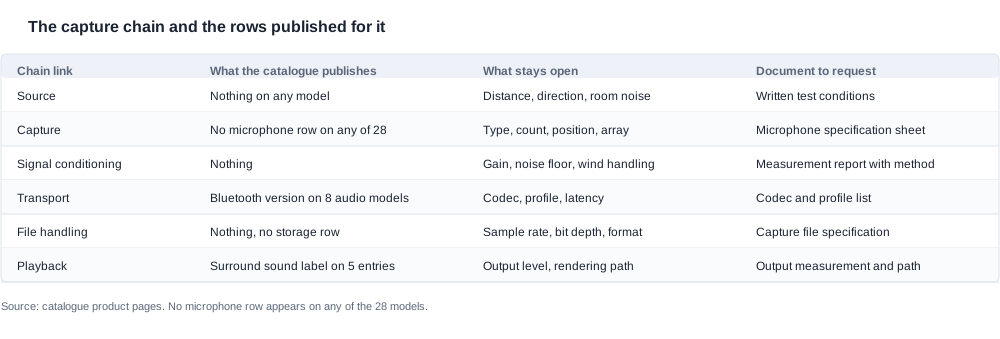
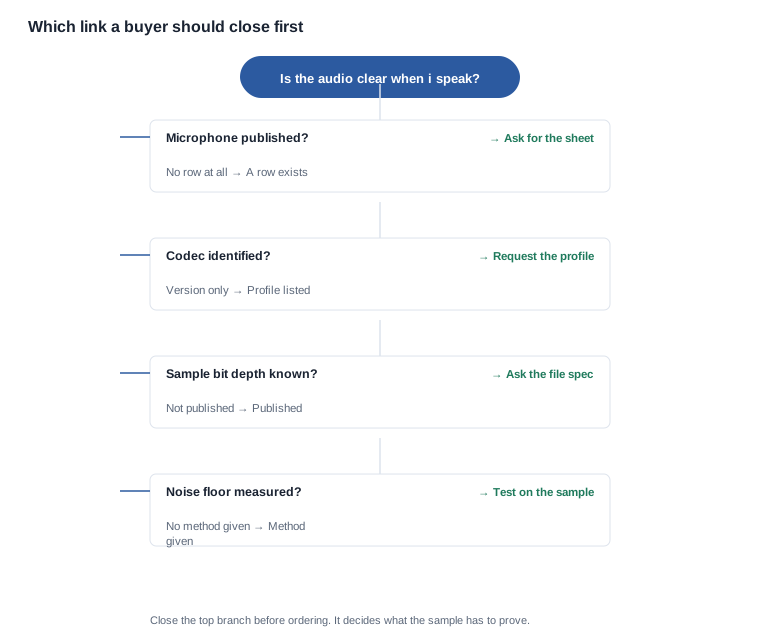
is the audio clear when i speak: the six links in the chain
The first link is the source, and it is the only link a buyer can control entirely. How far the mouth is from the microphone, whether the speaker is facing forward or turned, and what else is in the room are properties of the shot rather than of the device. They are worth writing into a test protocol because they are the variables most often left uncontrolled, and an uncontrolled variable is what makes a comparison between two models worthless.
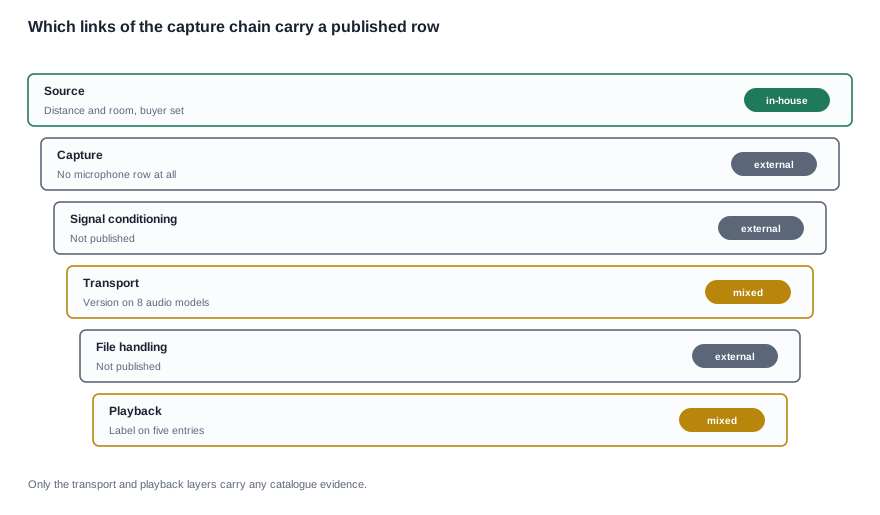
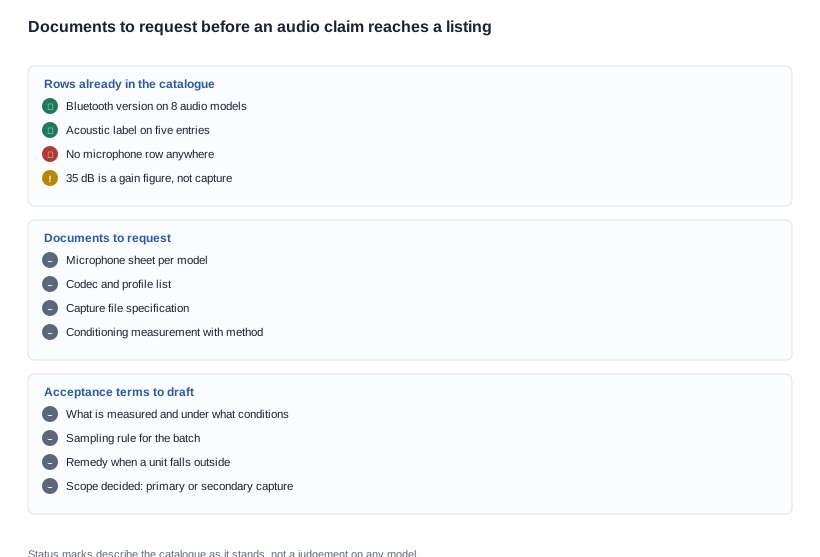
The second link is capture, and this is where the catalogue is silent. No model publishes a microphone. The absence covers every family in the range: the audio models carry a Bluetooth version, the camera models carry a resolution class, the sport models carry an acoustic descriptor, and none of the three carries a capture row. The absence is total rather than partial, which means a buyer cannot even narrow the question to a category of device — there is no page on which a microphone type is named. The document request that closes this link is straightforward: a microphone specification sheet per model, stating type, count, position relative to the front of the frame, and any array or beamforming arrangement.
The third link is signal conditioning, and it is the link that decides whether a quiet speaker produces a usable file. Automatic gain control, the noise floor, the preamplifier gain and the wind-handling behaviour are the properties that turn a weak signal into a legible one, and none of them is published. The bone-conduction entry carries a figure that is sometimes mistaken for a capture specification — an amplification gain of 35 dB — but it measures a signal path rather than a microphone, and the entry carries no stock keeping unit, so it cannot be ordered, tested or quoted against. It belongs in a hearing-amplification context and it says nothing about what a microphone captures.
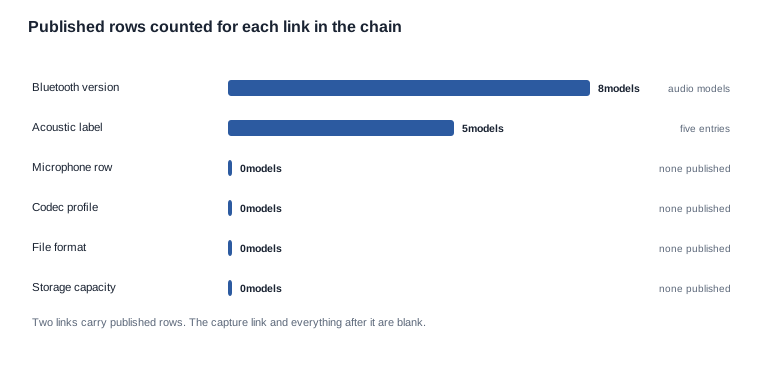
The fourth link is transport, and it is the one link with a published row — for some models. All eight audio models publish a Bluetooth version: version 5.3 on the K01 and the K02, version 5.4 on the G07 and the LC-105-1, the D11 and the LC-105-2, and the YK12 and the D12. None of the eleven camera models publishes a Bluetooth version, so for a camera model the transport leg of the chain is unpublished as well. The codec profile is not published for any model, and neither is any latency figure, so the version row settles the radio generation and nothing else.
The fifth link is file handling, and it is empty. No model publishes a storage capacity, no file format, no sample rate and no bit depth. A creator programme therefore cannot specify the deliverable format at the procurement stage, and cannot compare what a channel will accept against what the device produces. This is the link where the cheapest fix exists, because a file format specification is a single sheet and does not require a measurement.
The sixth link is playback, where the captured audio is rendered. Whether it renders through the device speakers, through a separately paired headset, or both is a product decision that the catalogue does not record, and the output level of the device speakers is likewise unpublished. What the range does publish here is a surround sound descriptor on five entries — the YKC02 and the YK12, the D11 and the ZH12, and the D17 — which tells a buyer that an acoustic configuration exists and nothing about how loud or how clear it is.
There is a specific reason why comparisons between two suppliers in this category so often end inconclusively, and it is worth naming because it is visible in the catalogue rather than hidden in the products. Every supplier in this category can produce a clear recording at a desk with a quiet room, and every supplier can produce a poor one on a windy street, because the variables that decide the outcome are almost entirely outside the device. The comparison therefore needs to control the source, and the control has to be written down, because without a written protocol the demonstration that happens to be scheduled will set the answer. In practice this means specifying the mouth-to-microphone distance, the speaking level, the ambient noise level and the noise character, the position of the device relative to the speaker, and the distance and position of the listener. Each of those is a line in a protocol, and each of them is the line that a comparison between two suppliers will have been argued about afterwards.
A second and more uncomfortable point is that the absence of a capture specification cuts both ways. It removes the evidence a buyer would use to disqualify a weak implementation before a sample arrives, and it also removes the evidence a supplier would use to demonstrate that its implementation is better than a competitor's. A supplier with a well-documented capture chain has to invest in that documentation, and in a category where nobody publishes capture rows, that investment is not rewarded by the comparison tables that circulate. The practical consequence for a buyer who has to choose between two quotations is that the evidence has to be requested explicitly rather than inferred from how professionally the documentation happens to look.
The chain, link by link
| Chain link | What the catalogue publishes | What stays open | Document to request |
|---|---|---|---|
| Source | Nothing on any model | Distance, direction, room noise | Written test conditions |
| Capture | No microphone row on any of 28 | Type, count, position, array | Microphone specification sheet |
| Signal conditioning | Nothing | Gain, noise floor, wind handling | Measurement report with method |
| Transport | Bluetooth version on 8 audio models | Codec, profile, latency | Codec and profile list |
| File handling | Nothing, no storage row | Sample rate, bit depth, format | Capture file specification |
| Playback | Surround sound label on 5 entries | Output level, rendering path | Output measurement and path |
The pattern in that table is worth making explicit for a buyer comparing suppliers, because it is unusual. Most categories publish a headline specification and leave the details open. This one publishes a transport row and a set of power rows, and leaves the capture specification entirely blank. A supplier who answers the capture link quickly with a microphone model number has done real work, and the number itself should then be checked against the rest of the chain rather than accepted as the answer to the question. A supplier who answers with a chipset name has answered a different question.
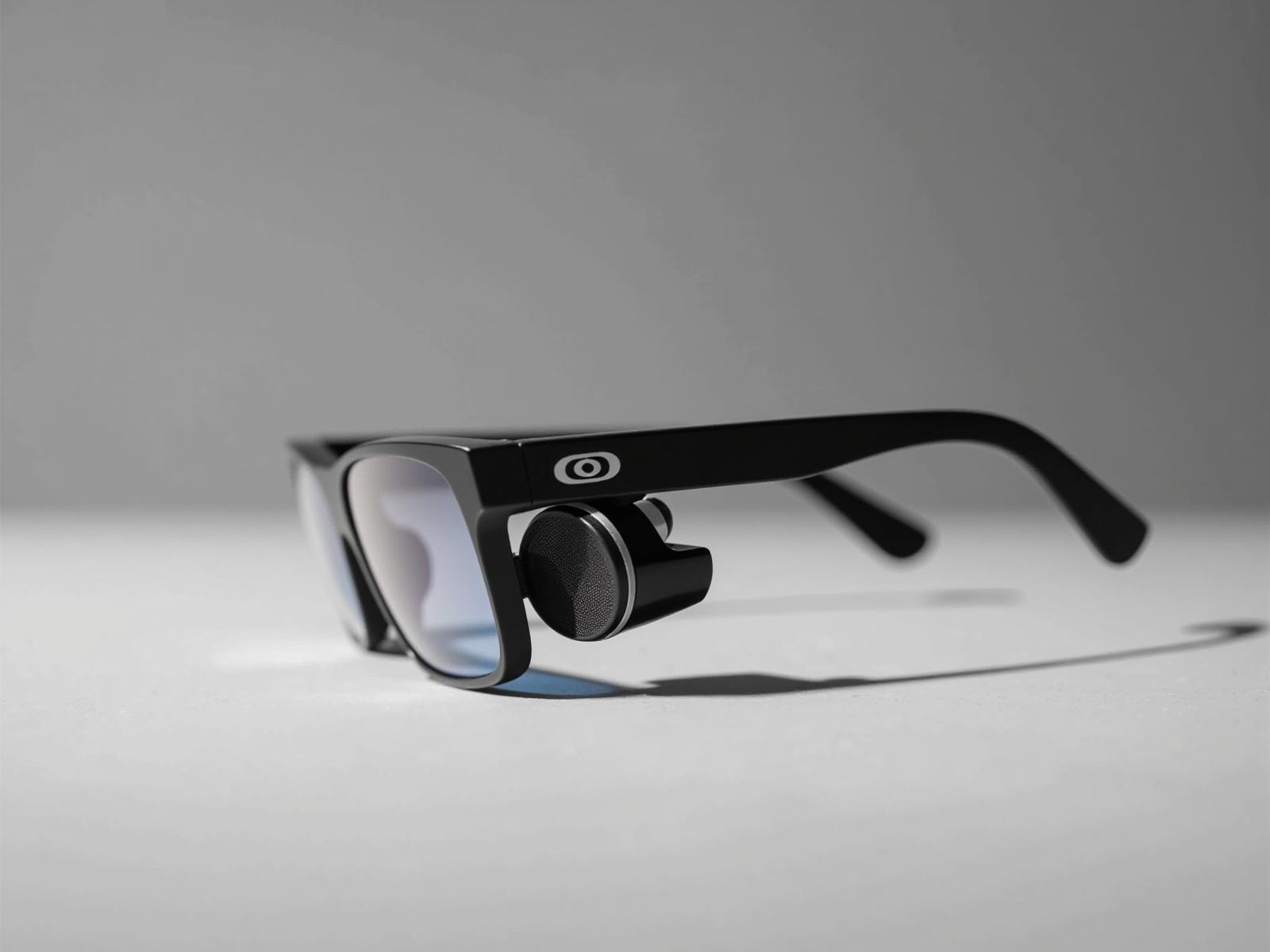
How to evaluate the answer without a sample
Because the capture link is blank, a buyer who wants to compare models on speech clarity has to design the comparison rather than look it up. Four steps do it, and none of them requires the unit to arrive.
Write the test protocol before the units arrive. The protocol fixes the source distance, the speaking volume, the room, the competing noise level and the position of the listener, and it states what is being compared. Without it, a demonstration produces an impression; with it, the same demonstration produces a comparison that two engineers can reproduce.
Ask for the microphone sheet and the file specification first. These two documents close three links between them — capture, conditioning and file handling — and they can be requested and read before any hardware is shipped. A supplier that produces both quickly has a mature product in this area.
Ask for the codec list. The transport link needs the profile names rather than the radio version, because a version number and a profile name answer different questions. This request is easy to make and often reveals whether the capture path is a standard profile or something proprietary.
Then decide what the sample has to prove. With the documents in hand, the sample test narrows to the links the documents did not settle — the actual level of the signal under the conditions the protocol specifies, and the behaviour in noise. A buyer who skips to the sample without the documents pays for a measurement that the paperwork would have replaced.
There is one group of models for which the whole chain is dark, and it is the group most likely to be bought for this purpose. All eleven camera models publish a still-image resolution class on one of two bands, and not one of them publishes a Bluetooth version, a microphone row, a storage row or a capture file specification. For a camera model, the transport link is blank as well as the capture link. That is a much larger evidence gap than the audio models present, where at least the radio generation is on the page, and it changes what a buyer can ask for: a camera-model requirement cannot be settled by asking which Bluetooth version is fitted, because that row does not exist for those models either. It has to be settled by asking for the complete capture chain as one document, and by accepting that the answer will be a description of an implementation rather than a comparison against a published figure.
That has a knock-on effect on how a camera model is shortlisted. The published rows for the camera family allow a structural filter — the resolution class separates eight models from three, the charging method separates five magnetic from two Type-C from four unpublished, and the ingress marking on the V06 and the S7 separates two from the rest — but none of those filters touches the audio leg. A buyer who needs a capture chain they can defend should therefore treat the audio requirement as a separate work item with its own request list and its own acceptance criterion, rather than as a line inside a broader camera requirement that will be satisfied by the resolution class.
There is a version of this that applies to a procurement team rather than to a technical reviewer, and it is about how the question gets budgeted. A speech-clarity requirement that arrives as a single line in a requirement brief will be answered with a demo, and the demo will settle nothing. The same requirement split into the four requests above will be answered with four documents and one test, and it will land in the file as evidence. The total cost of the first route is a product decision made without evidence; the total cost of the second is an afternoon of correspondence.
A related caution applies to the language used in a listing. Because no microphone row exists, a page cannot claim a microphone specification, and it cannot claim a beamforming or noise-cancelling arrangement either, because those are capture properties. What it can do is describe the published rows it has: the Bluetooth version where it is published, the cell, the charge ceiling, the runtime band, the resolution class on the camera models, and the acoustic descriptor on the five entries that carry one. A listing built that way is narrower than one built on a capture claim and considerably easier to defend when a channel partner asks for substantiation.

Turning the answer into an acceptance criterion for speech clarity
The commercial value of the four requests above disappears unless the answers are turned into something a supplier is accountable to. As with any measurement in this category, the criterion has to carry three sentences: what was measured, under what conditions, and what happens when a unit falls outside.
For the capture link the sentence reads something like: the microphone specification on file for the named model matches the sheet supplied at quotation. For the conditioning link it reads: the level of a reference signal at the stated distance falls within the agreed band, with the method and the noise floor stated. For the file link it reads: captures are written in the named format at the named sample rate and bit depth. For the playback link it reads: a call or a monitoring session rendered through the device is intelligible at the stated level, with the measurement convention attached.
The sampling rule matters as much as the threshold, and it is the part that buyers most often leave out. A criterion that applies to every unit is a different commercial instrument from one that applies to a sample drawn from a batch, and the difference has to be written down before the order rather than negotiated after it. So does the remedy. What happens when a batch produces units outside the band — rework, a downgrade of the published claim, a credit, or a rejection — is the sentence that converts a test into a term.
One of the most useful answers a supplier can give is a refusal, and it deserves a specific handling. A supplier who states that the capture configuration is not something they disclose, and who offers a measured sample against an agreed protocol instead, has given a buyer something workable: the criterion moves from a document to a test, and the test can be run against every supplier in the shortlist on the same terms. A supplier who states that the capture configuration is not something they disclose and offers nothing in return has closed the link, and the link cannot be reopened by asking the same question a second time. Buyers should note which of the two they are dealing with, because it determines whether the specification can be closed before the order or only after the sample round.
There is a commercial term that belongs in the same place as the acceptance criterion, and it is the one most often left out: what the sample round costs, and who bears it. A capture test needs a controlled environment, a reference signal, a fixed protocol and enough units to be meaningful, and all four cost money. If the cost of that round is agreed in advance and attached to the order, it stops being a friction point at the point where a buyer is already committed. If it is not, it becomes a negotiation at the moment the buyer has least incentive to walk away. Writing the total cost of the evaluation into the quotation is the difference between a due diligence step and an argument.
There is one commercial distinction worth carrying into the requirement brief, and it is the distinction between a product sold with capture as a primary function and a product sold with capture as a secondary one. In the first case the entire chain is in scope, the requests above are the specification, and the cost of getting it wrong is a returned product. In the second case only part of the chain is in scope, and the missing links are handled by whatever the creator pairs with the device. Both are legitimate products; they need different requirement briefs, and a brief that does not distinguish them will either over-specify a secondary function or under-specify a primary one.
is the audio clear when i speak: what to settle before the order
Three things settle this question, and they are best taken in this order.
The first is what the catalogue can be relied on for. It carries a Bluetooth version on the eight audio models, an acoustic descriptor on five entries, cell capacities, charge ceilings and runtime bands across the whole range, a still-image resolution class on the eleven camera models, and a single amplification gain figure on the bone-conduction entry. Those are real published facts and they are the ones a requirement brief should be built from.
The second is the shape of the silence. There is no microphone row, no microphone model, no array geometry, no beamforming statement, no preamplifier gain, no noise floor, no wind-handling behaviour, no codec profile, no latency figure, no sample rate, no bit depth, no file format and no storage capacity anywhere in the range. We do not publish a capture specification for any model in the range, and a buyer should treat every figure that sounds like one as requiring its method before it is used.
The third is the request set: the four documents above, the four acceptance sentences that attach to them, and the sampling rule that goes with those.
The closing point for a content-creation programme is that the comparison a buyer wants is not available from the catalogue and is not obtainable from a demonstration. Is the audio clear when i speak is answered by a protocol, a document set and one test, and a buyer who assembles those three things has an answer that can be filed, reused on the next order, and defended in front of a channel partner. It is also the shortest path to a shortlist, because the documents arrive before the hardware does and the sample round then has a much smaller job to do. It is obtainable from a protocol, a document set and one test. Buyers who write the protocol before the order arrives tend to end up with an evidence file that supports the listing; buyers who write it afterwards tend to end up with a marketing claim instead. The content-creation range note covers the application as a whole, how to choose smart glasses on microphone quality covers the selection criteria, can it record with sound covers the capture question from the other end, and does wind noise ruin the audio covers the one environmental factor that most reliably destroys a speech recording.
Related reading
- Selecting on capture criteria: how to choose smart glasses on microphone quality.
- Whether the device records sound at all: can it record with sound.
- The environmental factor that breaks speech capture: does wind noise ruin the audio.
- Checking a supplier rather than a product: factory versus trading company on a video call.
- The application in full: smart glasses for content creation.
Write the protocol before the units arrive, and the clarity question becomes a specification instead of a demonstration.


