
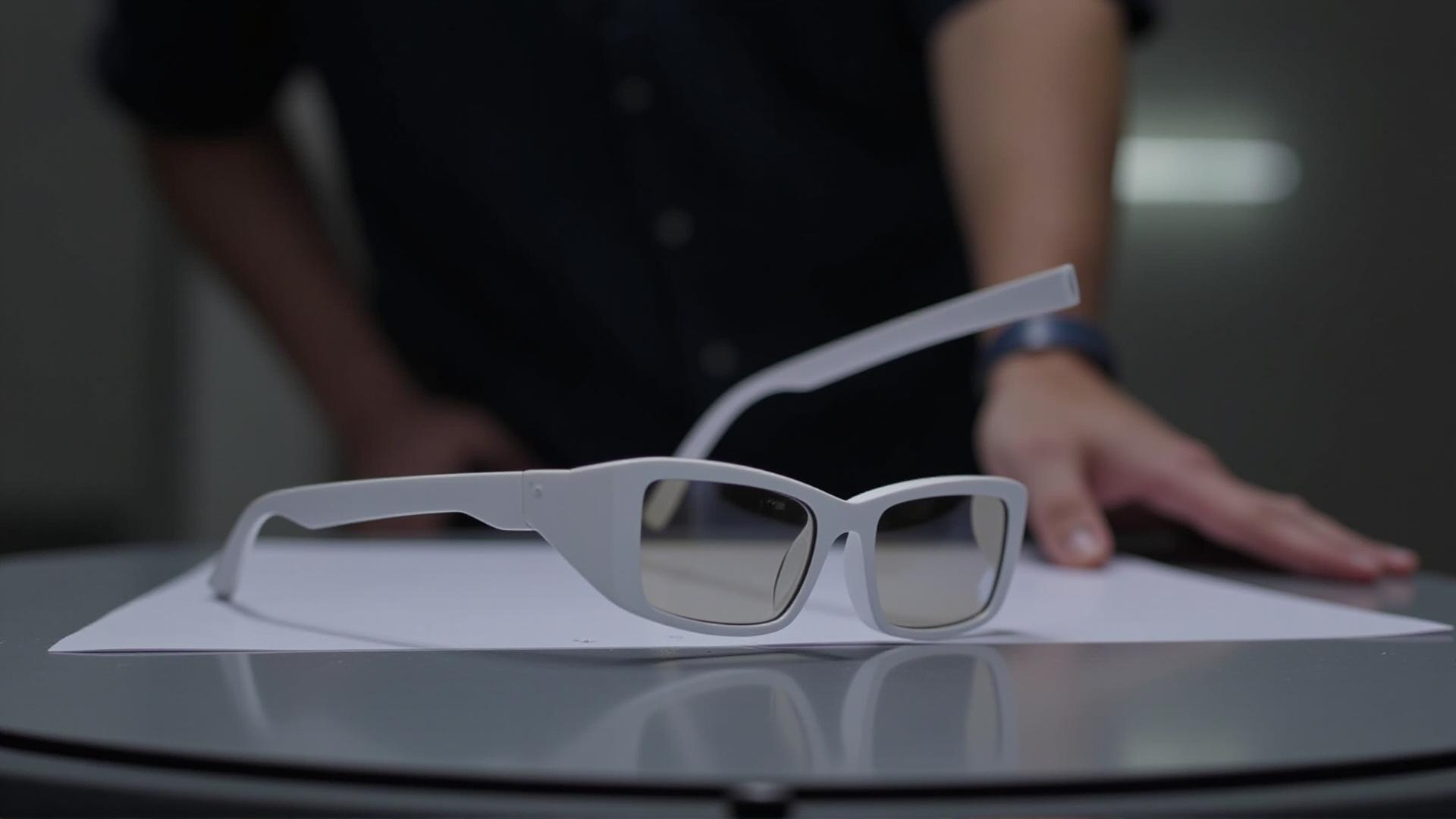
Direct answer: we do not know, and our catalogue does not say. That is an accurate description of what we have been given to publish, not a dodge, and the difference between those two things matters to a buyer who is about to write a claim into a listing.
Here is what the catalogue does publish about the camera family. Eight models publish 8 MP — the V06 and the V03 Pro, the CY05 and the MT6, and the MT5 and the KY06, and the CY03 and the V03 — and three publish 13 MP: the L2 Utral and the L1 Pro, and the S7. All eleven publish a stated runtime of roughly five to eight hours on cells in the region of 220 to 290 mAh, with no test condition published. The V03 Pro is the only camera model with photochromic lenses and three colour options, and the V06 publishes four colours. Charging is magnetic on most models and Type-C on others, and the method is not published for the L1 Pro and the CY03, and the MT6 and the CY05.
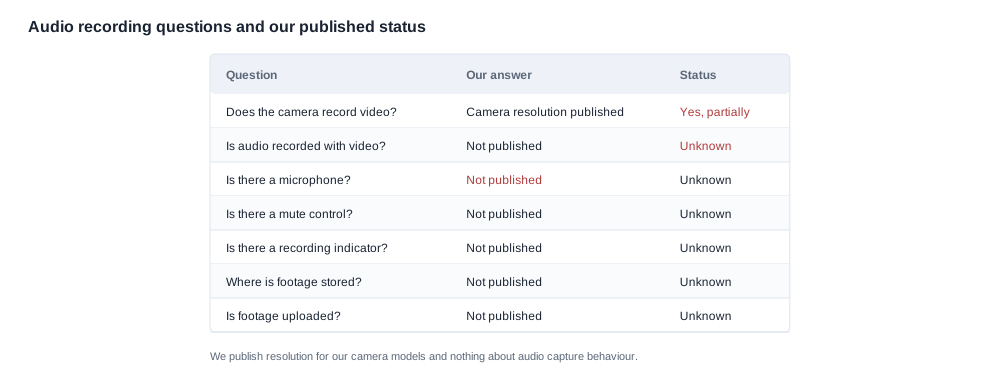
Here is what it does not publish. Whether audio is captured with the video. Whether a mute control exists, and whether that control is physical or software. Whether there is a recording indicator. Where the audio goes, how long it is kept, and whether anything is transmitted off the device. There is no capacitive-touch row anywhere in the catalogue, so no touch control can be described for any model, and there is no row anywhere describing a microphone count, a pickup distance or a response.
So anyone telling you that a smart glasses product records with sound — or does not — is telling you what they believe, unless they can produce the firmware specification. That is the short version. The rest of this article is about what to do with the gap, because in this particular product category the gap has legal consequences rather than only commercial ones.
Can it record with sound: the direct answer and what it rests on
It is worth being precise about what "not published" means, because buyers read it in two different ways and one of them is a mistake.
The wrong reading is that the row has been checked and found to be false — that the product was evaluated and does not capture sound, or does capture it and the manufacturer decided not to say. The right reading is that the row does not exist in the source material we publish from. Nothing has been tested, nothing has been confirmed, and nothing has been denied. That distinction is not pedantry: a supplier who has tested it and a supplier who has never considered the question will give you the same non-answer, and only one of them is a supplier you can work with.
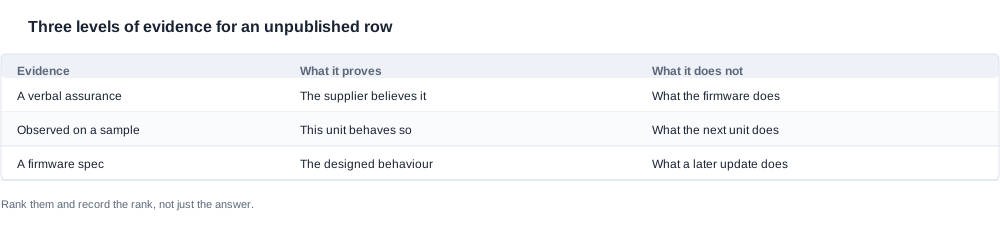
That leads to the part that actually matters, which is the evidence ladder. When a supplier tells you something about audio capture, there are three qualitatively different kinds of answer, and they should be ranked and recorded differently.
A verbal assurance is the supplier's belief, repeated. It is worth having, and it costs nothing, and it should be recorded as an unverified belief with a date and a name attached. If it turns out to be wrong, you will not be able to show anyone that it was ever in doubt, which is precisely the problem.
An observation on a sample is stronger: you have a unit, you make a recording, and you play the file back on a computer and listen. That is a definitive answer for that unit, at that firmware version, on that day. It does not tell you what the next unit does, and it does not tell you what a firmware update does. It is nevertheless a real answer and it is available to any buyer who has a sample and ten minutes.
A firmware specification is the strongest, because it describes the designed behaviour rather than an observed instance. It also tells you what is configurable, what is hard-coded, and what a later update could change — which is the difference between a product with a physical mute and a product with a software mute that a firmware update could turn on.
The honest position, stated without hedging: we publish the rows we hold and we mark the rest as not published rather than assuming either way. We will not tell you that a model records with sound, and we will not tell you that it does not, because neither statement is in the documentation. What we will do is take your model and your recording test and tell you what we can confirm from our side and what has to come from the manufacturer.
There is one more published fact that bears on this question indirectly, and it is worth putting in the record. The catalogue has no capacitive-touch row anywhere in the range — across the eight audio models, the three sport models, the eleven camera models, the three kids models and the AR, electrochromic and bone conduction entries. That means no control type can be described from the catalogue, which is a stronger statement than saying the audio row is missing. If the answer turns out to be that there is a physical mute button, that is new information and it is publishable; if the answer is that there is no control of any kind, that is also publishable, and arguably more useful to a buyer than a vague statement about settings.
The compliance stakes, and can it record with sound in a public space
Audio capture is not a minor specification row. It is the difference between a consumer wearable and a device that may fall inside recording law in several jurisdictions, and it changes the compliance position rather than merely the feature list.
The legal position on recording a conversation differs materially between countries, and it differs in ways that have nothing to do with the technology: some places require one party's consent and others do not, some protect the speaker regardless of consent, and most impose separate obligations on processing recorded voice as personal data, on storing it, and on transferring it across borders. None of that is something a product specification can settle, and any buyer deploying into more than one market should establish the position per market with its own adviser rather than generalising from one.
The deployment environments where this bites are specific and they are exactly the environments where smart glasses are being proposed most often. On a retail floor, ambient capture means capturing conversations between staff and customers that were never intended for anyone. In a classroom, it means capturing children. In a workplace, it means capturing colleagues, and it means the recordings have to be stored, retained and deleted according to a policy that somebody has to write and somebody has to enforce. A camera resolution figure addresses none of this, and a product whose audio behaviour is unknown cannot be assessed against any of it.
The privacy design questions follow from that. The three that matter most are whether the recording state is visible to the people being recorded, whether the capture can be disabled by the wearer in a way that persists through an update, and what the default state is when the device starts. A device that can capture ambient audio without an obvious user action creates a problem that the resolution tier, the battery figures and the colour options do not touch.
The commercial consequence is the part a buyer has to plan around. A product whose audio behaviour is unknown cannot be assessed, and a product that cannot be assessed should not be deployed where the consequence of being wrong is regulatory rather than commercial. That does not mean it cannot be sold — it means the deployment decision has to wait for the answer, and the buyer should be explicit about that in the rollout plan rather than discovering it when a customer or a regulator asks.
The retail and education solution page covers the deployment shapes these products are proposed for, and it is where the privacy-by-design questions become concrete, because in a shop or a classroom the people being recorded are not the people who bought the device. The camera imaging page is the reference for the imaging rows that the catalogue does publish, and it is useful context for the ones it does not.
The six questions, and can it record with sound by firmware design
Six questions, in the order that produces the most useful answers. Each of them has an answer that can be written down, and a supplier who cannot answer them does not have the information, which is itself the finding.
- Is audio recorded together with the video? Yes, no, or configurable. This is the question the whole list is built around, and it needs three possible answers rather than two, because a configurable answer means the behaviour depends on a setting that somebody controls and that a firmware update could change.
- If yes, is there a physical mute? A physical control is a materially different product from a software setting. A physical control cannot be changed by a firmware update, which means the buyer can rely on it today and in two years. A software setting can be changed by a firmware update, possibly without notice, and possibly in a direction that increases exposure.
- Is there a visible or audible recording indicator? And is it defeatable? The indicator question is about the people being recorded, who cannot see a screen on the wearer's face. An indicator that only appears in the companion app is an indicator the wearer cannot see.
- Where is the audio stored, and for how long? Not where it is stored in the moment, but what the retention policy is, whether the file is written to a fixed location or to a rolling buffer, and what the device does when storage fills.
- Is anything uploaded, and can that be disabled? This is the question that turns a local device into a networked one, and it is the one that matters most for a deployment where the recordings are of people who did not consent to being recorded by anyone.
- What happens after a factory reset? Whether the recordings, the settings and the associated state are wiped. This sounds pedantic and it is not: it is the question that decides whether a resold or returned device is a privacy exposure.

The question underneath the list is whether any of it is fixed by hardware or is a matter of firmware. Can it record with sound by firmware design means: is the audio capture path a physical characteristic of the unit, or is it a behaviour the software chooses? The difference matters for a buyer who is planning a multi-year programme, because a physical characteristic is stable and a software behaviour can be changed, in either direction, by an update your company does not control.
Two of these questions also feed back into the published rows. Question four intersects with storage, which is not published for the camera family — no capacity, no file format and no overwrite behaviour. Question five intersects with the connected features, where the catalogue is also silent on where processing runs. A buyer who gets a confident answer to the audio questions should ask for the same answer on storage and on transmission, because a supplier who has the documentation for one usually has it for the others.
And the documentation request itself is worth making explicitly. Ask for the firmware specification, or the relevant extract of it, in writing, with a version reference. A verbal answer to question two can be tested in ten minutes on a sample; a documented answer costs the manufacturer nothing and gives the buyer something to re-check after an update.

What a buyer should do, and can it record with sound without an indicator
If you are deploying into retail, education or a workplace — the environments where ambient audio capture creates exposure — this question belongs in the acceptance criteria, not in a later conversation. And the good news is that several of the six questions can be answered on a sample in a single afternoon, without the manufacturer's cooperation, if you know what to do.
The definitive sample test is simple and it settles the main question outright. Make a recording in a known environment with a known sound — speak to the wearer, and have a second person talk in the background at a known distance. Pull the file onto a computer and open it with a tool that shows the tracks. If there is an audio track, the file has sound; if the track is silent, the microphone is not reaching the recording. This is a fact about the unit you have, at the firmware it is running, and it costs ten minutes.
The second test is the mute. Look at the hardware. Count the physical controls on the frame and on the temple. If one of them is a mute, photograph it and note its position. If there is no physical mute, then any mute is a software setting, and the question about firmware updates becomes live. A product with no physical mute and no published touch control is a product where the answer to the question is uncomfortable, and the buyer should hear it early.
The third test is the indicator. Record with the companion app open and closed, in a pocket and in the hand, and watch for a light. If the recording state is only visible in an app, write that down, because it is the difference between a device that signals to the people around it and one that does not.
The fourth test is the update. If the product has a firmware update mechanism, find out when updates are pushed and whether they are pushed silently. A setting that a buyer can observe today can be changed by the manufacturer later, and the only defence is a documented commitment that the audio behaviour will not change, or a physical control that cannot be changed.
What to do with the results is straightforward. Put the answers into the acceptance criteria, so that the product cannot be bought past the unanswered question. Record what was established and what was not, in your own file, with the date, the source and the firmware version. Then decide, per market and per deployment, whether the remaining unknowns are acceptable.
The shortlist is where this question does its damage, so it is worth deciding it early rather than at the end. A buyer comparing four camera models on resolution, battery and colour options is comparing them on the wrong axis for a deployment where ambient audio matters, because none of the published rows says anything about audio. The criterion that separates the models here is the evidence each supplier can produce, and that is a criterion you can apply before the sample arrives. Which model you end up buying may be decided by who can answer the six questions in writing rather than by any published specification, and that is a legitimate basis for a shortlist — it is just not the basis most buyers start with.
The trade-off to be explicit about is between speed and exposure. A buyer who ships into a retail environment before the audio behaviour is established gets to market first and carries the exposure later; a buyer who waits for the answer loses those weeks and carries no such exposure. The negotiation helps here rather than hurting, because a supplier who treats the audio question as a gating item for a specific deployment is usually willing to commit to an answer for a specific model in a specific context, which is a much smaller thing to agree than a universal guarantee.
There is a commercial dimension to this as well, and it belongs in the same negotiation as the rest of the order. Whether the supplier will put the audio behaviour in writing, whether the answer is a commitment or a description, whether the behaviour is fixed for the life of the model or revisable, and what happens if it changes after the programme has launched are all legitimate commercial questions. A supplier who answers them precisely is telling you they control the answer. A supplier who declines to answer is telling you they do not.
What to record in the file, and can it record with sound in your market
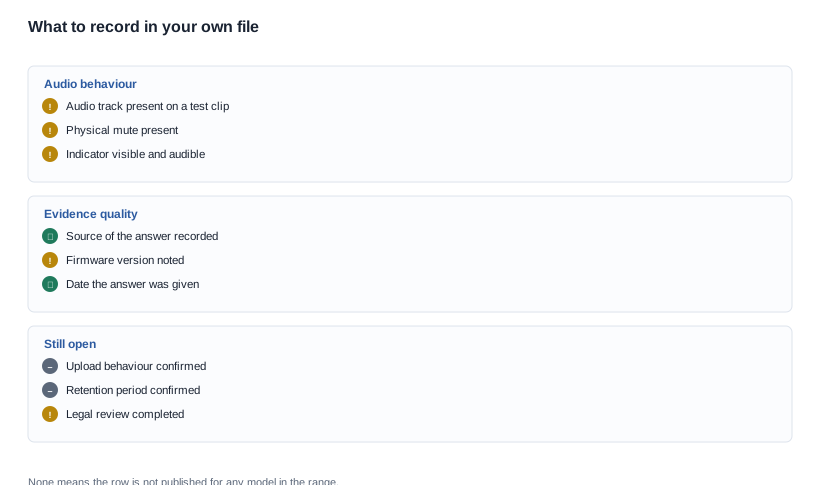
There is one further thing worth recording, and it is the reason this article is longer than a specification question usually warrants. If the product will be sold in a market where recording is regulated, then unknown audio behaviour is not only a specification gap — it is a question your own legal position has to answer. Whether a wearable that may capture ambient audio changes your obligations in that market is a legal question, and it is worth raising with your adviser before the listing rather than after the first enquiry from a customer or a regulator.
There is also a multi-market consequence that is easy to miss and expensive to discover. One product, sold into several markets with different rules, has to satisfy the strictest market it reaches, or it has to be configured or positioned differently per market. The practical options are a single global configuration that satisfies everyone, a separate stock per market, or copy that makes no audio claim in the stricter markets. All three are legitimate and they have very different commercial consequences, and the decision belongs to the buyer rather than to the supplier, which means it has to be taken deliberately.
We tell you precisely what we hold and precisely what we do not, and we would rather leave this question open than fill it with a plausible answer. A buyer who knows the audio behaviour is unknown at sourcing stage can ask the right person and put the right question in the agreement. A buyer told a comfortable answer will not ask at all, and will discover the gap in whichever market has the strictest rule and the most attentive customer.
What we will do is straightforward. Tell us the channel, the models you are considering and whether the product will be used where ambient audio matters, and we will say what we can confirm from the published rows, which parts have to come from the manufacturer, and what a sample test can settle on its own. We will also say which of the six questions we can put to the manufacturer on your behalf and which ones you should put to them directly, and we will put the answers into the same due diligence file that carries the rest of your specification rather than into a separate thread that gets lost.
If you want a starting point rather than a questionnaire, the practical order is this. Start from the deployment: where the product will be worn and who will be near the wearer. That determines whether ambient capture is a genuine question or a hypothetical one. If it is a genuine question, take it to the supplier as a gating item before the sample is ordered rather than as an additional check afterwards. If it is hypothetical, record it as unresolved and revisit it at the point where the channel moves from a demo into a deployment. Either way, the criteria are the same, and the due diligence is short enough to finish in a week.
That is the whole of our position on this question. We hold the imaging rows and we publish them; we do not hold the audio rows and we will not invent them. A buyer who plans around that fact gets a defensible listing and a defensible deployment. A buyer who plans around an assumption gets neither.
Related reading
- The imaging rows we do publish — AI camera glasses imaging
- The camera family and its per-model rows — AI camera glasses
- Privacy when deploying smart glasses — retail and education deployment
Tell me your channel and whether ambient audio matters and I will say what is unknown.


