

Does wind noise ruin the audio? On this range the honest answer is that nobody can say from the published material, and the reason is sharper than a simple gap in the data. Every audio row the catalogue publishes describes the output side of the product — a surround-sound feature line on five models, a Bluetooth version on the audio and sport tiers, the capacity of the cell, the duration it is rated for, the ceiling on recharge time and the way the unit is charged. Wind noise is an input-side phenomenon: it enters through the microphone before it reaches the speaker. The catalogue publishes no microphone row for any model in the range, no signal-to-noise figure, and no indication of whether any noise handling exists at all.
So the question splits the way it should. Published: the surround-sound feature line on the YKC02 and the D11, the ZH12 and the YK12, and the D17; V5.3 on the K01 and the K02, with V5.4 carried by the remaining six audio entries; the specification rows that separate the tiers — 90 mAh × 2 cells and about eight hours on the K01 and the K02, 55 mAh × 2 and about eight hours on the LC-105-1 and the LC-105-2, 55 mAh × 2 and about six hours on the G07 and the YK12, 100 mAh and about seven hours on the D11 and the D12, 70 mAh × 2 and about eight hours on the YKC02, 115 mAh and about seven hours on the D17, and 100 mAh and about eight hours on the ZH12. Not published: microphone count or type, any signal-to-noise figure, any noise-processing description, any audio codec, and any measured performance under a defined wind condition. Ask the supplier: the input-side specification for a named model, and a measurement taken under a stated wind condition that a buyer can repeat.
For a cycling channel the third part is not a nicety. Wind performance is the difference between a product that a customer uses for calls on a bridge and one that goes back in the box after the first ride, and no amount of careful reading of a datasheet substitutes for a measured ratio.
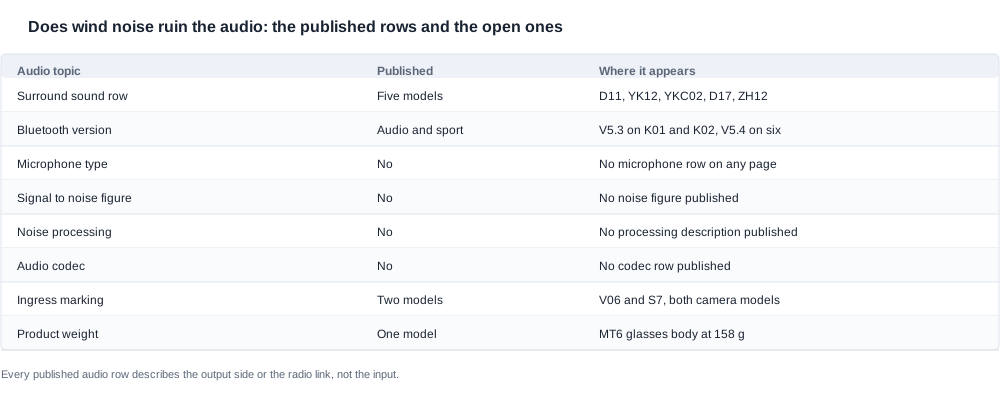
Does wind noise ruin the audio: the published rows describe the speaker, not the microphone
The feature rows the catalogue does publish
Five models in the range publish a surround-sound line. The D11 carries 环绕声 together with a long-runtime line, the YK12 publishes Surround Sound and Slim Temple, the YKC02 publishes Surround Sound and Long Battery Life, the D17 publishes Surround Sound alongside a Remote Control Photo line, and the ZH12 publishes 立体环绕音 together with 遥控拍照. That is the whole of the audio descriptor evidence in the catalogue, and it belongs to five different models across two tiers.
The remaining audio models publish no descriptor at all, and the contrast between two otherwise identical pairs is the clearest demonstration of how the catalogue works. The G07 and the YK12 publish exactly the same five standard specification rows — a V5.4 radio, a pair of 55 mAh cells, recharge inside two hours, six hours of use and magnetic charging — and they are separated only by their feature lines: one of the pair carries an ultra-slim build with a temple that detaches, and its counterpart carries a surround-sound line with a slim temple. The D11 and the D12 are the same story in the 100 mAh tier: both publish V5.4, 100 mAh, Type-C charging and about seven hours, and the D11 publishes a surround-sound line while the D12 publishes none.
What this means for a buyer is important, and it is easy to read past. The catalogue publishes feature labels, not performance measurements. A row that says a model has surround sound tells a buyer that the supplier describes the product in those terms; it does not tell a buyer the sound pressure level, the frequency response, the volume at which the descriptor still holds, or what happens to it in a headwind. For the same reason, the five models without a surround-sound row are not five models without audio.
What is not published on the input side
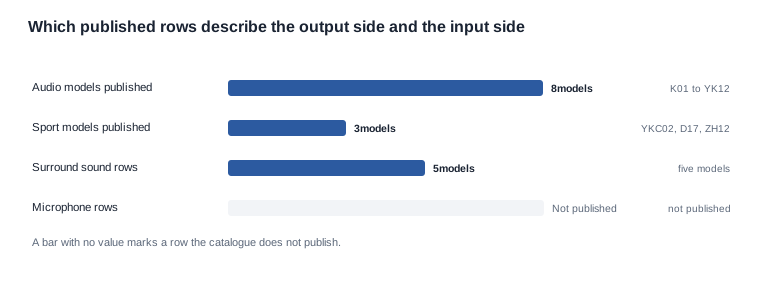
Search the catalogue for anything at the microphone and the result is empty. There is no microphone count, so a buyer cannot tell whether one transducer or two is fitted. There is no microphone type, so a buyer cannot tell whether the design relies on a physical barrier to moving air or on signal processing after the fact. There is no signal-to-noise figure, which is the single number that would settle the question. There is no noise-processing description, so a buyer cannot tell whether any handling exists. There is no audio codec, no driver size, no impedance and no volume figure.
The output side has the same thinness, but the thinness there is survivable because a buyer can work with a published feature label in a way that cannot be substituted for an input specification. On the input side there is no proxy at all. Runtime does not predict wind performance. The Bluetooth version does not predict it. A charge-time ceiling says nothing about it. The one structural fact that helps — the tier a model sits in — tells a buyer where wind pressure is physically greatest, and that is a framing device rather than an answer.
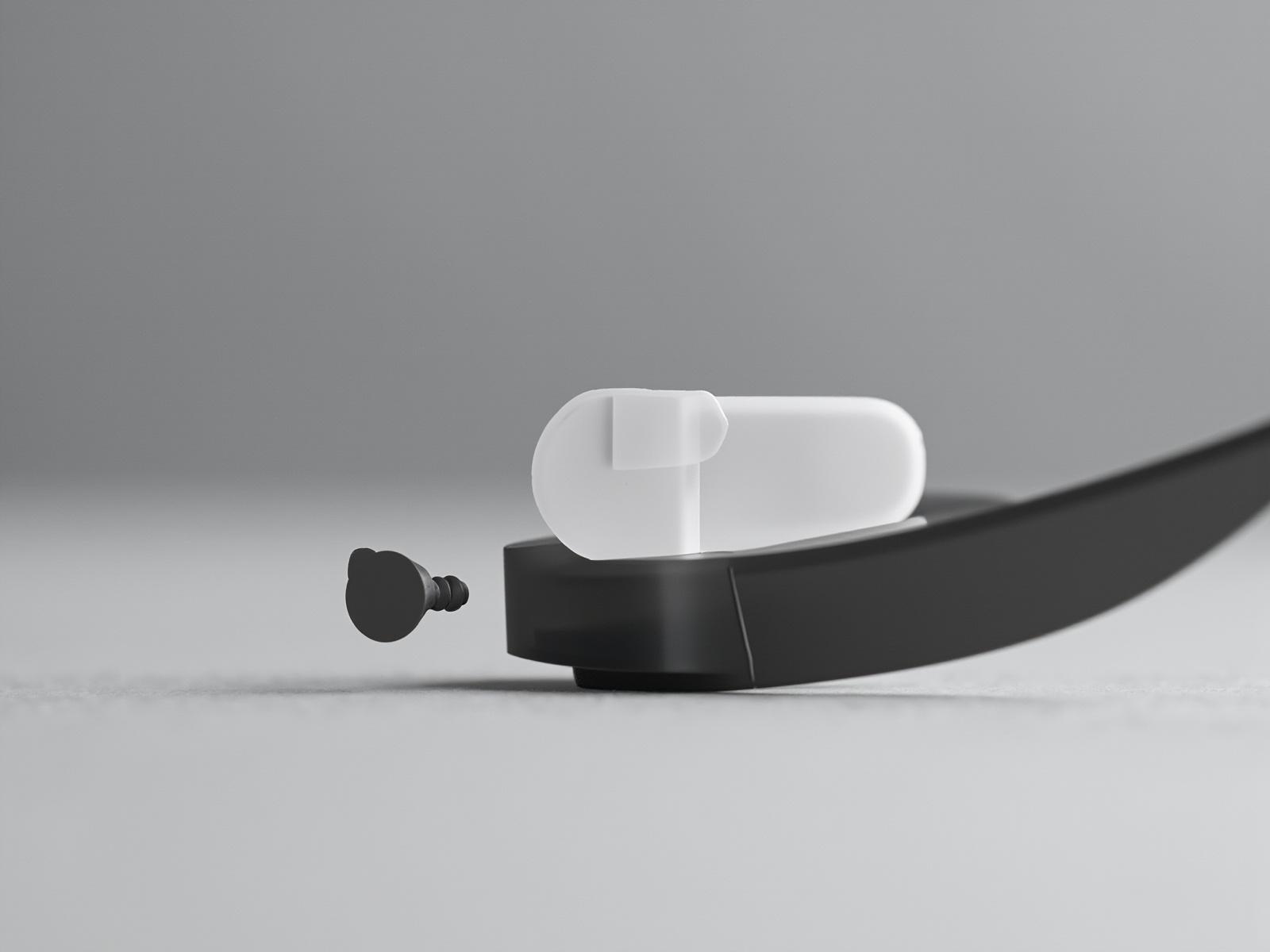
Why an output-side row cannot answer an input-side question
The frequency argument that decides the answer
Wind noise and speech occupy different parts of the spectrum, and this is the physics that makes the question tractable once it is asked properly. The energy in moving air is concentrated at low frequencies, largely below the range in which speech carries its intelligibility. A voice, by contrast, sits mostly in the middle of the audible band. The consequence is that a microphone which responds evenly across the audible range will admit a large amount of wind energy and a normal amount of speech, while a microphone whose response is deliberately reduced at low frequencies admits far less wind energy while passing speech through largely unchanged.
That gives a buyer the right question to ask, and it is a much better question than "is it wind resistant". The question is what happens to the response below the speech band: is it reduced mechanically, by the geometry of the port and the chamber behind it, or electronically, by filtering after the signal is captured. Both routes work, and they fail differently. A mechanical approach is a property of the hardware and travels with the unit to any phone or any channel. An electronic approach is a property of a processing stage that may live in the device firmware or in a companion application on the phone, and a property that lives in the application is a property the buyer does not control and cannot guarantee across the phone base of a channel's customers.
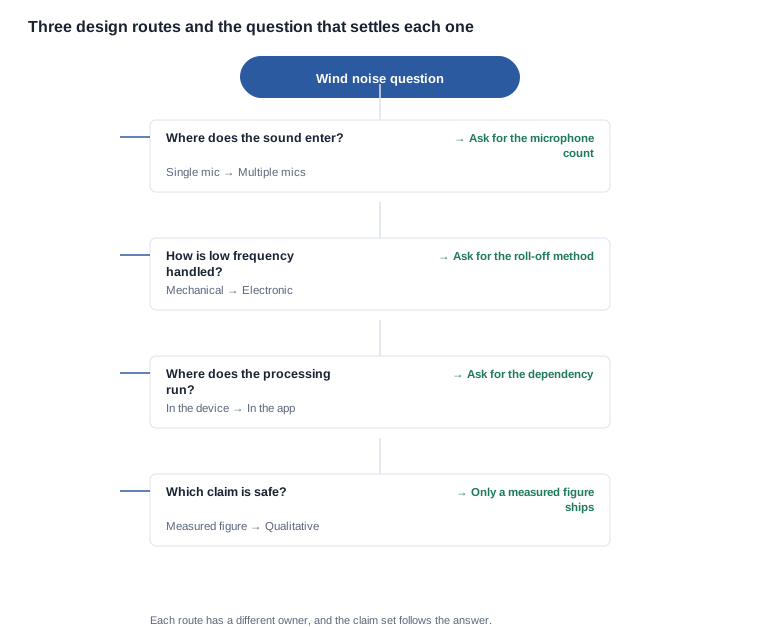
Where the processing runs is a commercial question, not a technical one
If the noise handling sits in the device, then the behaviour is fixed at the factory, is the same for every customer, and can be described in a listing and defended in a contract. If it sits in an application, then the behaviour depends on a phone the buyer does not supply, and the channel inherits a support load that cannot be controlled by any agreement with the supplier of the glasses. The third possibility — a split, where part of the processing is in the device and part in the application — is the one that produces the most expensive misunderstandings, because the product appears to work in a demonstration held in an office and degrades in the conditions it was designed for.
A buyer therefore needs to know the location of the processing before the order, not after the first review of customer feedback. The question has a precise form: on a named model, is any noise handling applied in the device, and if so at which firmware version; and if any part is applied in the application, does the unit remain usable with that part absent. And because the catalogue names no firmware build for any model and sets out no update policy, a claim about processing behaviour has to be filed against a build identifier recorded by the buyer, not against a model name.
The tier argument that sharpens the question
Not every model in the range faces the same wind exposure, and the catalogue's own tiering says so structurally. The three sport models — the YKC02, the D17 and the ZH12 — are the units intended for movement at speed, and the YKC02 publishes surround sound with a long-battery line, the D17 publishes surround sound with a remote-shutter line, and the ZH12 publishes 立体环绕音 with 遥控拍照. The eight audio models sit in the general tier, where the exposure is lower and the published rows are correspondingly thinner.
The interesting question for a buyer is not which tier is better. It is whether the models meant for movement carry the input-side work, because if a cycling customer is sold a general-tier model, the expectation gap has to be managed rather than discovered. Note also that the two sport models with the shortest published charge time are the D17 at about one hour and the ZH12 at about one hour, with the D17 at 115 mAh and about seven hours of use and the ZH12 at 100 mAh and about eight hours. Whatever a buyer concludes about wind performance, the endurance and recharge interval on those two models is a separate constraint that has to be planned for.
Testing wind performance on a sample without a wind tunnel
The verification method here is simpler than it looks, because what matters is a ratio, not an absolute figure, and a ratio can be measured with a phone, a fixed signal and a repeatable airflow source. The discipline is in fixing the conditions, because a wind figure without a condition is not evidence.
Fixing the test condition
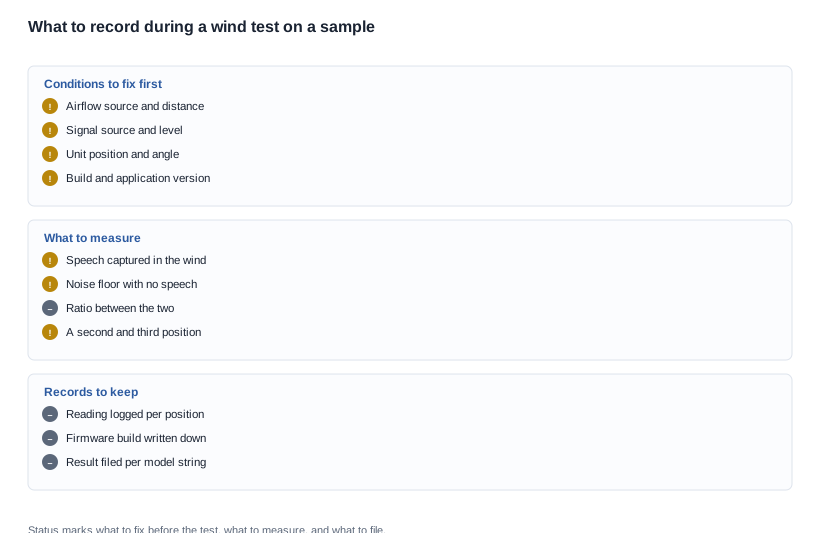
Four things must be written down before the first measurement, and if any of them changes between readings the readings cannot be compared. The airflow source and its distance from the unit — a fan at a stated distance, a fan at a stated speed, or natural wind on a route, and these are not interchangeable. The signal source and its level, played through a fixed source at a fixed volume, because a louder signal raises the ratio without improving the microphone. The unit's position and angle to the airflow, since the direction of a port relative to moving air changes the result substantially. And the firmware build and the phone and application versions in use, because processing location is exactly the variable that a build change would move.
Measuring the two things separately
The measurement itself is two readings and a subtraction. The first is the speech level captured with the airflow running. The second is the captured level with the same airflow and no speech, which is the noise floor. The difference between them is the usable ratio, and it is the only figure that transfers between conditions. A single reading of speech over wind is worthless, because it tells the reader nothing about whether the microphone is overwhelmed or merely accompanied by noise.
Record the reading at two or three unit positions rather than one, because the port geometry means that a unit oriented differently against the airflow can behave quite differently, and the worst position is the one a customer will find. Keep the readings against the model string, because the buyer needs to know whether the behaviour is a property of the model or of one unit, and a single sample can only ever describe one unit.
What the result does and does not license
A measured ratio on one unit, on one build, at one airflow condition, licenses a claim of exactly that shape. It does not license a general claim about the model, and it does not license a claim about a condition the buyer did not test. The commercially honest use of the result is a claim set that names the condition — a fan at a stated distance and speed, a stated signal source, a stated ratio — which is a claim a competitor cannot dispute and a customer can understand. A claim of the form "wind noise is handled" is not a claim at all, and it is the form most often used by suppliers who have not measured.
Scoring the answers against a fixed set of criteria
Two suppliers asked the same wind questions will usually return answers of very different quality, and the comparison a buyer needs is not between two performance figures — the catalogue publishes none — but between the evidence behind them. Before you commit to a supplier, assess each answer against four criteria: whether it names the model string, whether the measurement condition is written down beside the figure, whether a third party could repeat the test, and whether the answer separates what the device does from what the application does. How to choose between the two is then a scoring exercise rather than an opinion, and the criteria can be written down before the first request goes out so that the first reply to arrive does not decide the scoring on its own.
The red flags are consistent across this category and worth recognising early. A figure with no condition attached is not a measurement. A claim that mixes the published surround-sound descriptor with an input-side performance statement is a claim assembled from two unrelated rows. An answer that says the feature is present without naming the model is an answer about the range, and the range is not what ships. Every one of them means the evidence has to be asked for again rather than treated as a gap to be closed later on.
The trade-offs between two comparable products are frequently trade-offs in documentation rather than in hardware, and the questions to ask are identical for every supplier, so a shortlist can be scored on a common scale. Which model a channel ends up with often follows from the quality of the answer rather than from the specification, and the pitfall to avoid is scoring on the descriptor that is easiest to quote: the surround-sound line appears on five models and has no bearing on the wind.
The request schedule for wind-noise performance
The requests below are ordered so that the cheapest ones come first and each one either opens the next or closes the file. A supplier who answers them all in writing has given a buyer everything needed to write a defensible listing; a supplier who answers only the first two has confirmed that the product is audio equipment, which is useful but not sufficient.
- Microphone count and type. Published: nothing; no microphone row appears on any page of the catalogue. Not published: how many transducers are fitted, and what kind. Ask: the count and the type for a named model, and whether the count varies by configuration.
- Noise handling and where it runs. Published: nothing; no processing description appears. Not published: whether any low-frequency reduction exists, whether it is mechanical or electronic, and whether it is in the device or in an application. Ask: the mechanism in one sentence, plus the location.
- Measured performance under a defined condition. Published: nothing; no signal-to-noise figure appears for any model. Not published: the ratio, the condition behind it and the test method. Ask: a figure with its condition and method attached, so a buyer can repeat the test rather than accept it.
- Behaviour with the application absent. Published: nothing. Not published: whether the unit degrades, keeps working, or changes behaviour when the companion application is not running or is not installed. Ask: the behaviour in writing for a named model.
- Firmware and update position. Published: no firmware version for any model and no stated update policy. Not published: the build in which a behaviour was observed, and how a unit already in the field receives a change. Ask: the build identifier and the update route, so that a verified behaviour can be re-checked later.
- The output side. Published: surround-sound lines on the YKC02 and the D17, the ZH12 and the YK12, and the D11, and Bluetooth V5.3 on the K01 and the K02 with V5.4 on the other six audio models. Not published: volume, frequency response and the conditions under which the surround-sound description holds. Ask: the output specification for a named model, so that a channel can describe what the product sounds like when the wind is not a factor.
- The compliance position. Published: the catalogue holds no per-model compliance row, and nowhere in its text does CE, FCC or RoHS appear. Not published: the radio compliance scope of the exact configuration. Ask: the written position for the named configuration, addressing the European radio-equipment rules numbered 2014/53/EUwhere it applies.
The cost of leaving the question open is usually larger than it appears in a product comparison, because the consequences arrive after the channel is built rather than before it. The total cost to a channel of an unverified wind claim includes the returns that follow the first season of complaints, the support time spent explaining a difference that was never documented, and the review cycles needed before the listing can be corrected. Due diligence on this question costs one request and one test; the alternative costs a season. A buyer who treats the wind answer as a gating item rather than a documentation item is making the cheaper decision.
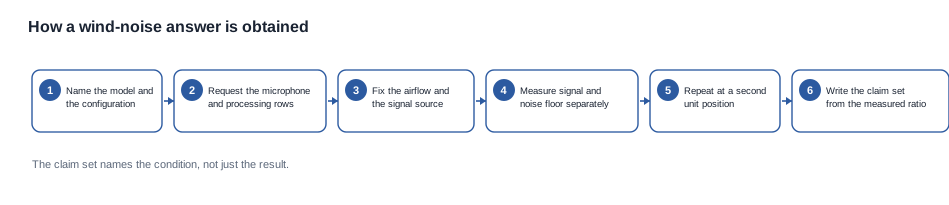
Two of these requests carry more weight than the rest, and a buyer should know which. The third — a measured figure with its condition — is the one that ends the discussion, because it can be repeated by anyone. The second — where the processing runs — is the one that determines whether the result will hold across a customer's phone base, and it is the one most often left unasked because it sounds like a technical detail rather than a contractual one.
The channel-side consequences are set out in the open-ear audio notes, and the endurance side of the same decision is in battery life notes. The broader microphone question for this range is covered in smart glasses microphone quality, and the sport-tier controls are in sport smart glasses remote control options. The eight audio entries sit together on the bluetooth audio glasses page.
Related reading
- The measurement method behind the microphone question — smart glasses microphone quality
- How the audio tier is assembled — bluetooth audio glasses
- The acoustic reference for the tier — open-ear audio notes
- The endurance constraint on the same models — battery life notes
- Controls that matter for the sport tier — sport smart glasses remote control options
Send the model, the airflow condition and whether the listing will quote a measured figure, and we will tell you which rows you can cite and which have to come back in writing.


