

"Is the remote waterproof" is two questions wearing one sentence, and the catalogue answers both of them in the same way — by publishing nothing about the remote at all. There is a deeper problem underneath, and it is the reason this article is worth reading on its own: the two models in the range that publish a remote shutter are exactly the two models that carry no ingress marking, and the two models that carry an ingress marking publish no remote shutter. The sets do not overlap. So a buyer cannot take a water-resistance fact from the product and transfer it to the accessory, and a buyer cannot find a model where both questions have a published answer.
That leaves the question answerable only one way, which is as a document request attached to a specific model, with the body and the accessory treated as two separate items in the purchase order and two separate lines in the compliance file. This article sets out what the catalogue does publish about each, why the gap exists, and what to ask so that the answer is attachable to the accessory rather than to the product.
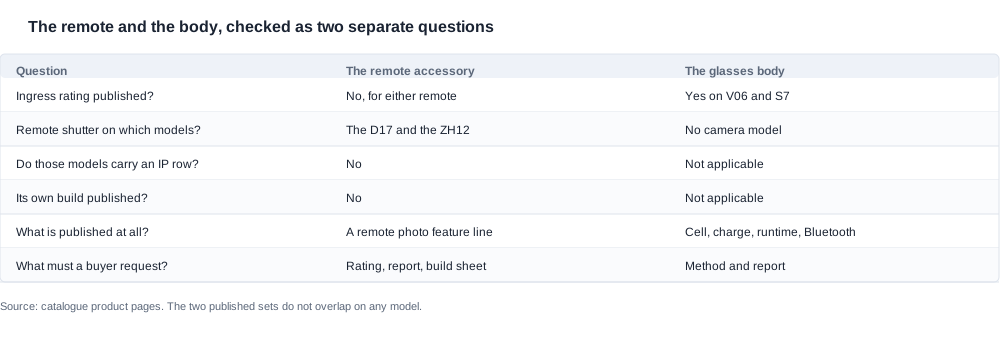
is the remote waterproof: what the catalogue publishes about each side
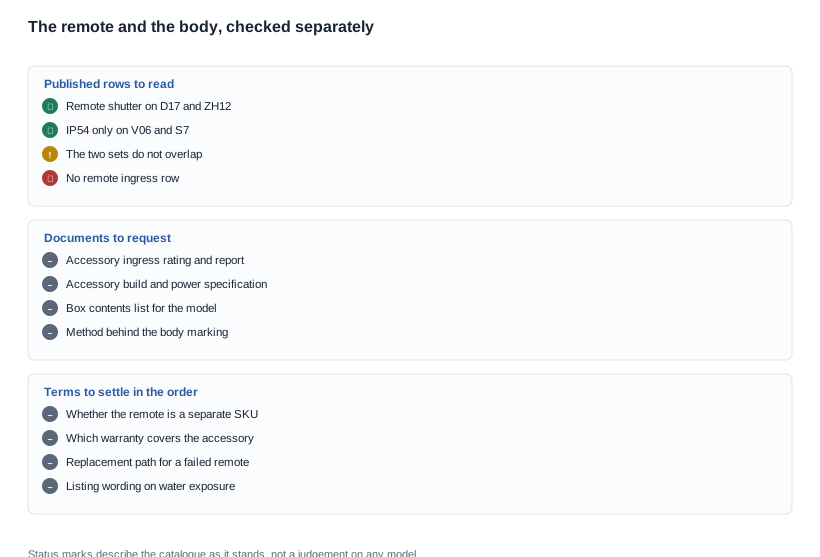
Start with the accessory, because it is the narrower side. Across the whole range there are exactly two published remote shutter rows. The D17 publishes a remote control photo line together with a surround sound line, and it publishes a 115 mAh cell, a charge time of about one hour, a rated runtime of about seven hours, Type-C charging and a Bluetooth version of 5.4. The ZH12 publishes a remote photo line together with a stereo surround sound line in the original wording, and it publishes a 100 mAh cell, a charge time of about one hour, a rated runtime of about eight hours, Type-C charging and a Bluetooth version of 5.4. Both are sport models. Between them, those two rows establish that a remote shutter exists as a published feature on two products and on no others in the range.
Beyond that, the catalogue is silent about the accessory. It does not publish the remote's own battery, its build, its charging method, its transmission method, its ingress rating, its weight, its dimensions, its warranty, or whether it is included in the box. It does not publish a box-content list for any model. It does not publish a model designation for the remote itself, which means a buyer cannot tell whether the remote is a separately orderable item, a bundled accessory, or both, and cannot order a spare without establishing that first.
Now the product side, and here the catalogue is more informative, which is precisely what makes the mistake easy to make. Two models carry an IP54 marking: the V06 and the S7. The V06 publishes an ergonomic design line, a long-runtime line, a removable inner frame and an IP54 waterproof line, along with four colour options. The S7 publishes an ergonomic design line, a thirteen-megapixel line, a removable inner frame and an IP54 waterproof line. The marking appears on the catalogue page with no third-party report number attached, which makes it a catalogue statement rather than a certified test result.
The critical observation is the one that separates this article from the general question about water resistance. The V06 and the S7 are camera models with removable inner frames, and neither publishes a remote shutter row. The D17 and the ZH12 are the two models with a remote shutter, and neither carries an ingress marking or an IP row of any kind. The four models are four different models. Twenty-four models in the range publish neither an ingress marking nor a remote shutter row, and the remaining two — the AR entry and the photochromic entry — carry no SKU at all.
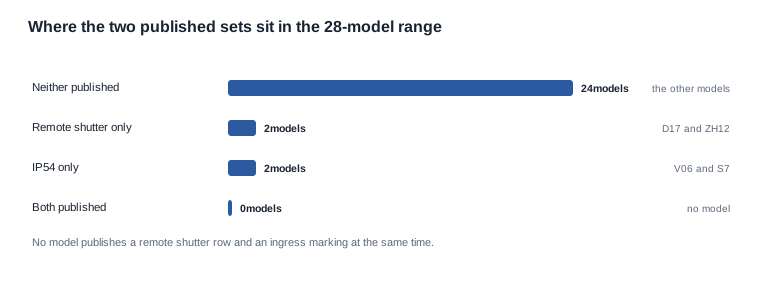
One more structural observation is worth making, because it explains why the accessory question is harder here than in a category where accessories are documented. An ingress rating is normally published as a property of a finished item, and finished items get rated. An accessory attached to a product is usually a different enclosure that nobody has rated, because nobody owns the rating decision for it. Where the catalogue lists the remote as a feature line on the product page, the remote is functionally inside the product boundary for the purposes of the page, and functionally outside it for the purposes of the test. A buyer who wants to know whether the accessory is protected needs a supplier who has decided that it is a rated item, and a supplier who has made that decision will have a document for it. A supplier who has not made that decision will not have one, and will not invent it to win an order.
There is also a supply-chain consequence here that a procurement team should price in. Accessory questions that are answered late tend to be answered with tooling changes rather than with paperwork, because a supplier facing an unmappable accessory requirement at the point of production has three options: change the enclosure, change the claim, or carry the risk. The first costs money and time, the second weakens the listing, and the third is what lands in the returns data. Any one of the three is more expensive than asking for the accessory specification during the sample round, which is the practical argument for treating the remote as a first-class item in the requirement brief rather than as an accessory line.
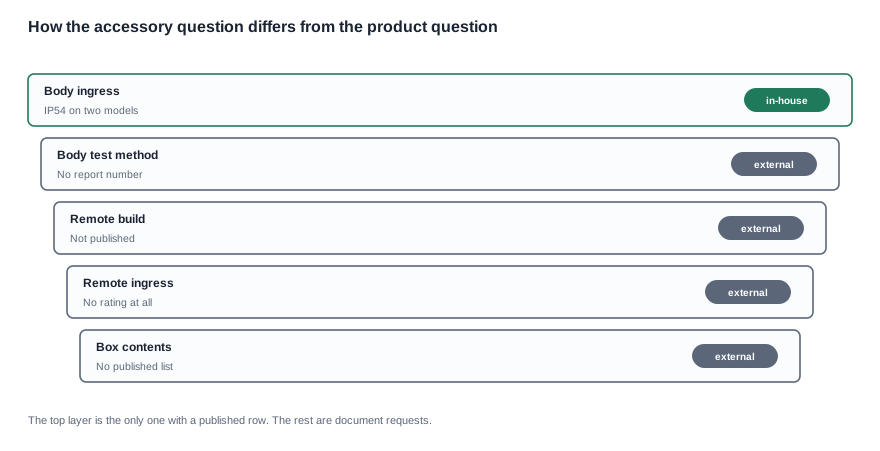
The two sides, side by side
| Question | The remote accessory | The glasses body |
|---|---|---|
| Does an ingress rating appear for it? | No, for either remote | Yes on the V06 and the S7 only |
| Which models publish a remote shutter? | The D17 and the ZH12 | No camera model publishes one |
| Do those models carry an IP row? | No | Not applicable |
| Is its own build published? | No | Not applicable |
| What is published about it? | Remote Control Photo on the D17, remote photo on the ZH12 | Cell, charge ceiling, runtime, Bluetooth version |
| What must a buyer request? | An ingress rating, a test report, a build specification | The method and report behind the marking |
Read across that table and the reason for the gap is visible. The catalogue treats the remote as a feature line on the product page rather than as a product in its own right, and a feature line does not carry an ingress rating, a test report or a specification of its own. A marking on the product page is evidence about the product; it is not evidence about the accessory, and the two have entirely different failure modes in the field — a wet remote and a wet frame are different returns, with different causes and different remedies.
There is a second reason a buyer should resist transferring the body marking to the accessory even in principle. An ingress rating describes a specific enclosure, under a specific test method, at a specific severity, and it does not survive being attached to a different enclosure. The D17 and the ZH12 are the two models whose remote shutter rows are published, and neither has an ingress row, so there is no body rating available to transfer in the first place. If a supplier offers one in conversation, the question is not whether it applies to the remote. The question is whether it applies to the body of the D17 or the ZH12 at all.
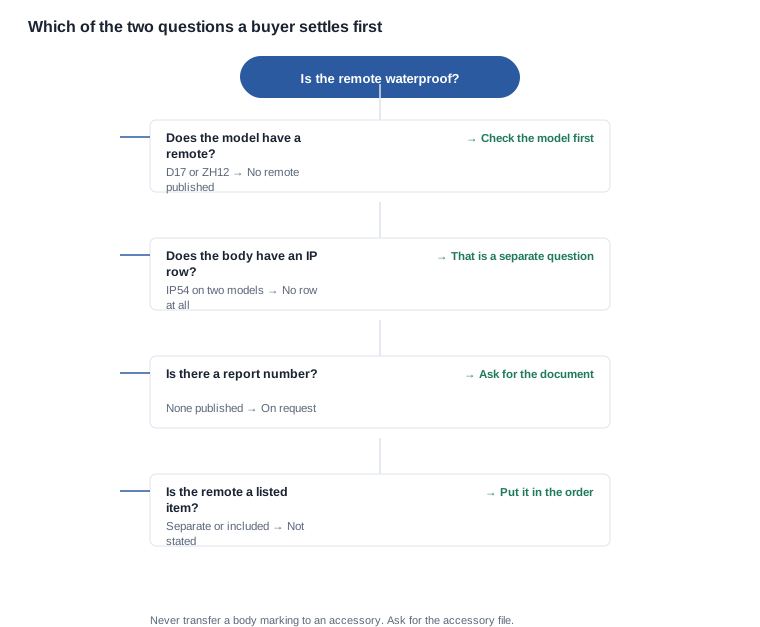

What a buyer can ask for, and how to file the answer
Because nothing about the accessory is published, the work is a set of document requests, and their value depends on being attached to the right object. A request that says "is it waterproof" will be answered with a marking. A request that says "provide the ingress rating and the test report for the remote accessory supplied with the named model, identifying the enclosure that was tested" will be answered with something that can be filed.
Five requests close the gap in practice. The first is the ingress rating for the accessory, with the standard and the severity level stated rather than described. The second is the test report behind it, with the tested sample identified and the test date present, because a rating without a report is a marketing line and the buyer has to be able to file it. The third is the accessory specification sheet, covering its own battery or power source, its transmission method, its charging method and its dimensions, none of which the catalogue carries. The fourth is the box-content list for the named model, which settles whether the remote is included, whether it is separately orderable, and whether a spare can be bought without ordering the whole product. The fifth is the warranty position for the accessory, because a warranty written against the product and a warranty written against the accessory are different instruments and the difference becomes visible the first time a remote fails.
The warranty position deserves more attention than it usually gets, because it is the term that determines what happens when the accessory fails. Three instruments are possible and they are not interchangeable. A warranty written against the product may or may not extend to a bundled accessory, and the answer is usually in a schedule rather than in the summary text. A warranty written against the accessory is a separate term with its own period and its own exclusions. And a position of no separate warranty on a bundled accessory is a commercial choice that the buyer can accept, negotiate against, or price into the total cost of the programme by budgeting for replacement units. What a buyer should not do is discover which of the three applies after a remote has failed in the field, because the failure rate of a small accessory in a sport programme is a number the supplier knows and the buyer does not.
The related question is the replacement path. If the remote is a separately orderable item, a replacement can be bought, and the programme's spare ratio can be set from the failure rate the supplier provides. If it is bundled only, a failed remote may mean a new product, and the effective cost of the accessory in the field is the price of the whole unit rather than the price of the accessory. Establishing which of the two applies is one sentence in the requirement brief, and it changes the aftersales budget by more than any other line in the accessory file.
There is a sixth request that sounds administrative and is not: the wording of the listing itself. A listing for the D17 or the ZH12 that mentions the remote shutter should say what the remote is and what it does, and should not extend any water-resistance wording to it. A listing for the V06 or the S7 that mentions IP54 should attach the marking to the frame and to nothing else, and should keep the catalogue's own ceiling — a marking without a third-party report number. Both points are straightforward to write, and both are the kind of thing a marketplace reviewer or a channel partner will test.
The commercial consequence of getting this wrong is smaller than the consequence of getting a product claim wrong and more awkward than a single return. A remote that fails is a small item, but a buyer who has described it as water-resistant on a listing has made a claim about an accessory that has no published evidence behind it. The claim does not disappear when the accessory fails; it becomes the subject of the complaint, and it is answered with a document the buyer never requested.
Where this sits against the wider water question
Two points of context keep this article from being read as a narrow accessory matter. The first is that the general water question for this category is settled by design rather than by documentation, because an open-ear product has openings in it by definition: the acoustic port that lets sound out and the microphone port that lets the voice in. That question is covered on the are they waterproof page and the rain question page, and it is worth reading before the accessory question, because it establishes how much weight an ingress marking carries in this category.
The second is that the two models carrying the IP54 marking are the two camera models with removable inner frames, which means a detachable part and a water rating exist in the same product. The V06 and the S7 therefore raise their own accessory question — whether the removed inner frame carries the marking, whether it is a separate sealed item, and what happens to the rating when the product is disassembled. That is a different question from the remote question, and it is the one a buyer selecting an IP54 model needs to ask.
The remaining practical point concerns the sport models themselves. The D17 and the ZH12 are the two models in the range with a charge time of about one hour and Type-C charging, and the two with a remote shutter. Neither publishes an ingress marking. A sport programme built around these two models is therefore a programme whose entire water position is undocumented, body and accessory alike, and whose due diligence has to cover both. The controls and buttons page covers how a remote is used and what the per-model instruction card is authoritative for, and the swimming question covers what an IP54 marking actually permits in water.

is the remote waterproof: what to settle in the order
The written answer to this question has three parts.
What the catalogue publishes is a remote shutter row on two models — a remote control photo line on the D17 and a remote photo line on the ZH12 — and an IP54 marking on two different models, the V06 and the S7. It publishes no ingress rating for any accessory, no accessory specification, no box-content list, and no third-party report number behind the two markings that do exist.
What it does not publish is anything at all about the remote's own build, its battery, its transmission method, its charging method, its weight, its warranty, or whether it is a separately orderable item. We do not publish an ingress rating for the remote accessory on the D17 or the ZH12, and there is no published body marking on either of those models to transfer to it.
What to ask is the five document requests above, plus the listing wording, plus the accessory warranty position — and to file every one of them against the accessory rather than against the product.
The line to hold on this is narrow and worth stating plainly, and it is the line that keeps the negotiation short: is the remote waterproof is two separate questions, one about an accessory enclosure and one about a product enclosure, and the catalogue answers neither for the models where the remote exists. A buyer who writes them as two requests against two files will get two answers. A buyer who writes one combined question will get a marking, and a marking is not an answer to the question that was actually asked. a water-resistance fact about a product is a fact about that product. It says nothing about a remote, a case, a removable frame, a mount or a cable, and each of those accessories carries its own enclosure, its own failure modes and its own file. A buyer who keeps the product question and the accessory question separate will answer both; a buyer who merges them will answer one and believe they have answered both.
A buyer working to a target cost per unit should also price the aftersales consequence of the accessory being undocumented, because it is the term that decides whether the remote is an operating expense or a rounding error. If the remote has its own rated enclosure and its own spare part, it belongs in the spare ratio alongside the units. If it is bundled and unprotected, it belongs in the return rate assumption, and the return rate assumption is what a programme's margin is actually built on. Those two treatments are far apart commercially, and the difference between them is decided by a document that a buyer can request during the sample round at no meaningful cost. A procurement checklist for this item is short: the accessory specification, the ingress rating and report if one exists, the box contents, the spare-part position and the warranty term. Everything else in the requirement brief can wait, and a shortlist built on those five lines is usually enough to tell two quotations apart from each other before anyone spends a sample round on them.
For the wider position, the sport smart glasses page covers the models that carry the remote, what rain does to the speakers covers the acoustic side of the same question, and the smart glasses OEM requirements checklist covers how an accessory requirement gets written into a requirement brief.
Related reading
- The product-side question in full: are they waterproof.
- What an IP54 marking permits: can IP54 smart glasses get wet in the rain.
- Using a remote and reading the instruction card: how to use the remote and buttons.
- What water means for a marking: can I swim with IP54 glasses.
- Turning accessory requirements into a brief: smart glasses OEM requirements checklist.
Treat the remote and the frame as two files, and the question that looks unanswerable becomes two answerable requests.


