

Rain affects an open-ear speaker in three separate ways, and only one of them is a specification question. A little water on an open driver grille can change how the product sounds without doing it lasting harm. Water that gets into the enclosure and then sits there is a completely different problem. And water that arrives after the product has already been exposed to salt or chlorine is a third problem again, and it is the one that ends the product's life.
Separating those three is most of the answer, and it is the part most listings skip. A listing that says "water resistant" and moves on has collapsed a behaviour question, a damage question and a warranty question into one word, and the three of them need different answers in different parts of your operation.
Our published position is narrow and we will state it up front. This catalogue publishes an ingress marking on exactly two models, the V06 and the S7, both in the camera range, both marked IP54, and no third-party test report number is published for either. No model in the audio range carries an ingress marking. No model in the sport range — YKC02, D17 and ZH12 — carries one either. No charging case carries one. On the audio side specifically, the published rows are the interface, the battery, the runtime and the charge time, and there is no water figure to quote.
That means the honest answer to the question is a method rather than a number: what the rain does, what it leaves behind, what a claim can rest on, and how to establish the behaviour on a sample before you write a word of copy. The technical background is on our open-ear audio page, the outdoor and cycling context is in smart glasses for sports and outdoor, and the two adjacent buying discussions are charging advanced considerations and open-ear audio buying mistakes to avoid.
It is worth saying why this question is asked so often by people who are not buyers. A customer who has worn a pair of open-ear glasses in rain has usually noticed the sound change, and they have usually been told by a listing that the product is water resistant. The gap between what they experienced and what they were told is what generates the question, and it is a documentation gap rather than a product gap in most cases. That framing matters commercially, because the fix for most of these enquiries is a sentence in the listing and four lines in the care insert rather than a redesign.
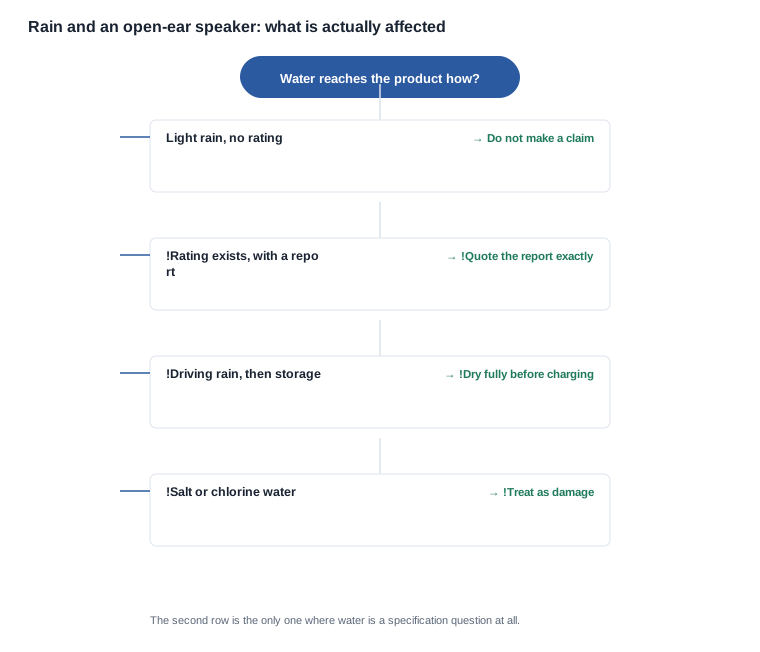
Does rain affect the speakers: three separate questions inside one
One: does the sound change while the product is wet? This is an acoustic question, and the answer is usually yes, and often the sound gets thinner rather than quieter.
Two: does water get in and stay in? This is an enclosure question, and it is the one that decides whether the effect is temporary. Water on the outside of a grille is a surface condition. Water past the grille and sitting against a driver or a board is a different state of affairs entirely, and the difference is invisible from the outside.
Three: what was in the water? This is a chemistry question, and it is the one that turns a warranty event into a refusal. Rain is water. Sea water and chlorinated pool water are not, in the ways that matter for electronics.
Each of the three has a different owner inside a business. The first belongs to the product description and the support script. The second belongs to the care instruction and the enclosure design. The third belongs to the warranty terms and, for some channels, to the product development decision. A buyer who treats the question as one question will end up with a listing that promises the first and a returns line that is caused by the second.
It is worth adding a fourth question that buyers rarely ask but that turns out to matter most in an outdoor channel: what does the product do about the water in the first place? That is a design question rather than a behaviour question, and the answer is visible in the enclosure, the acoustic opening, the seal material and the interface. A product designed to be rinsed and dried behaves very differently from one designed to be kept dry, even when neither carries an ingress marking. If your channel sells into wet environments, this is the question to put to the supplier before you ask about the behaviour, because it determines whether the behaviour is a problem you manage or a product you should not have chosen.
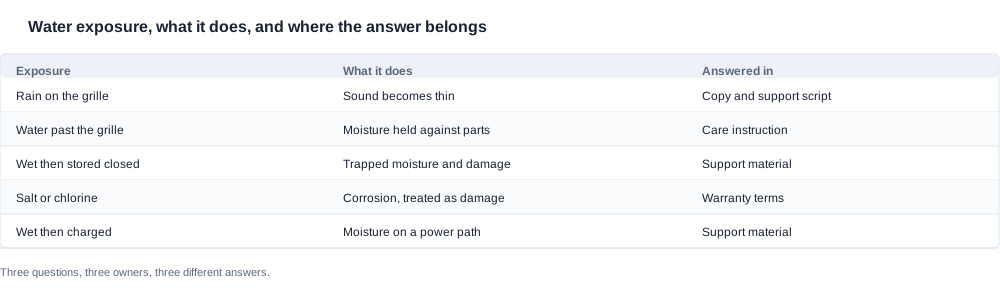
What does rain affect the speakers sound like, and why
Usually different, and usually less rather than more.
An open-ear driver sits behind a grille, and a wet grille behaves like a partial acoustic filter. Some frequencies are damped more than others, so the effect a user notices is that the audio becomes thin or muffled rather than simply quieter. Bass is typically the first thing to go, which matters commercially because low-frequency response is usually what a product page leads with. A customer who has read "deep bass" on the listing and hears a thin, honky sound in the rain has a complaint about the product, not about the weather, and no amount of copy will change that.
Two further points about the acoustic behaviour are worth knowing before you write the product page. The first is that a wet grille can affect a product that is still functioning perfectly, which is why "it stopped working" and "it sounded different" are different support conversations and need different scripts. The second is that the effect is not always immediate. Some products sound normal while wet and change once they have been inside a pocket, where the water is held against the grille and the enclosure at body temperature. That is why a test performed in the rain and a test performed after twenty minutes in a pocket are different tests, and only one of them matches what a customer experiences on a commute.
There is a form-factor reason this category is more exposed than an earbud category, and it is worth putting in front of a buyer who is comparing products. In an open-ear design the driver sits on the outside of the frame, close to the temple, and it is deliberately exposed to the air so the wearer can hear the world. That is the entire design premise, and it is also the premise that puts the driver in the rain. A sealed earbud has a different problem — the seal in the ear canal — but it does not have an open grille exposed to falling water. Any comparison between an open-ear frame and a conventional earbud on wet-weather behaviour is therefore comparing two different products, and the frame loses that comparison by design rather than by defect.
On the audio side of our catalogue, the published rows are limited and worth stating exactly. Only the D11 publishes surround audio in this range, while the D17 publishes "Surround Sound" and the ZH12 publishes a stereoscopic surround label, and no microphone row is published for any model. The charging method is magnetic on seventeen models and Type-C on seven. Charge time is 2 hours or less for twenty-six models, with only the D17 and the ZH12 publishing about one hour. None of that is a water figure, and the absence of a water figure is not a hidden negative — it is simply an unpublished row.
The practical behaviour, meanwhile, is a daily-use habit rather than a defect: carry something to dry the frame with, or accept that a wet pair in a pocket is a wet pair. That sentence belongs in a care instruction and in a support script, and it belongs there rather than in a specification.
Does rain affect the speakers in storage, which is where the damage happens
This is the mechanism that actually destroys products, and it is the one most likely to be missed by a buyer who has tested in the rain and been satisfied.
A product that has been rained on and then goes into a closed case, a drawer, a car glovebox or a bag holds moisture against the driver, the acoustic chamber and the electronics. Two conditions are then present at once — residual moisture and a closed volume — and the combination is what turns a temporary effect into a permanent one. The same is true of a product docked in a charging case while damp, where moisture is held against a power path.
The mitigations are simple, and they belong in your support material rather than in a product feature list:
- Let it dry before charging. This is the single most damaging avoidable sequence in the whole category, because it combines trapped moisture with a power path. It is also the sequence a customer is most likely to get wrong, because the instinct after a rain shower is to put the product on charge so it is ready for tomorrow.
- Let it dry before storing. A dry product in a closed case is a product that will be fine; a damp product in a closed case is a product that will not.
- Dry the grille and the ports rather than shaking the product. Shaking drives water past the grille into the enclosure, which is the opposite of what is wanted.
- Keep the charging case dry independently. No case in this range carries an ingress marking, so the case is the least protected part of the package and the part most often left in a wet bag.
The commercial point is that these four lines are cheap to publish and expensive to omit. They convert a returns event into a support reply, and in a channel where the product is used outdoors they will be read by a meaningful share of customers every month.


How to test does rain affect the speakers on a sample, and what a claim can rest on
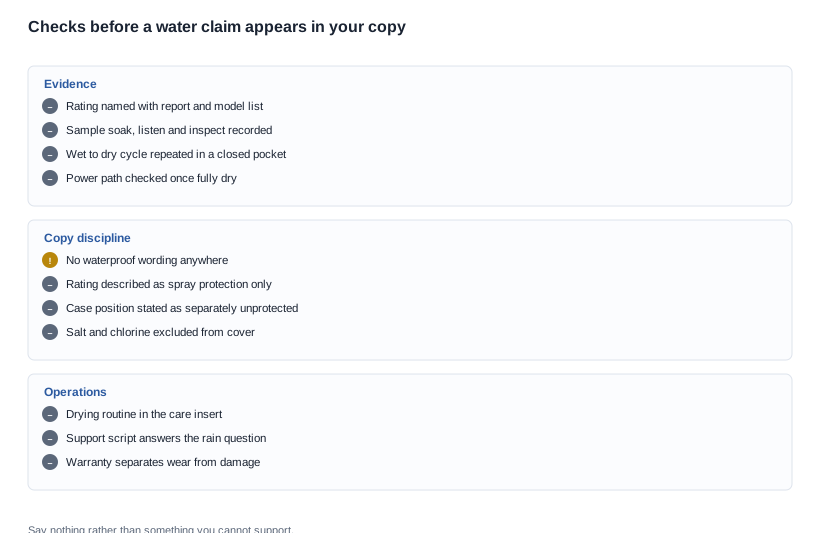
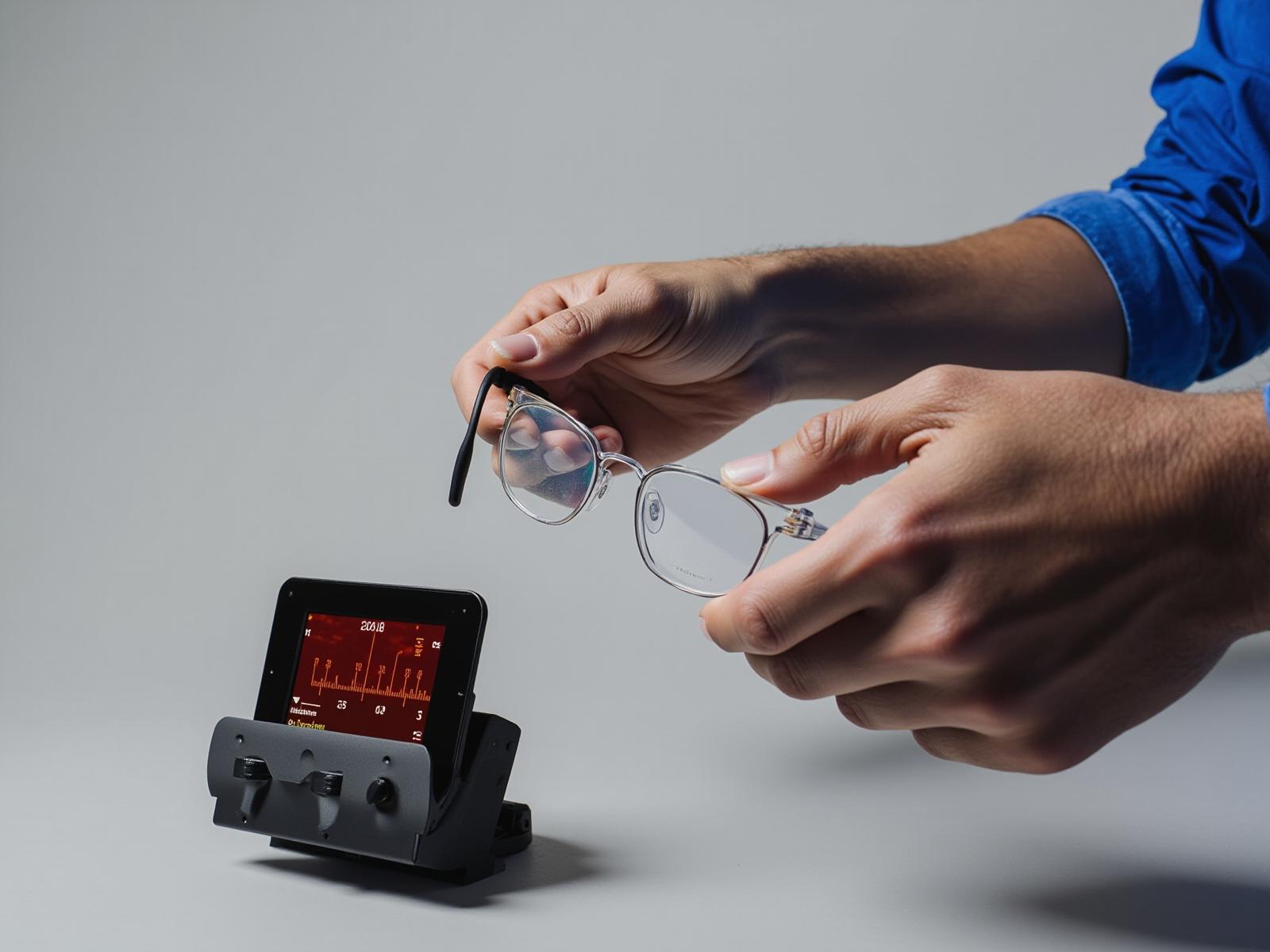
Four checks, and none of them requires a laboratory. The point is to establish behaviour, not to certify a rating, and the wording of what you publish should reflect that difference.
- Soak and listen. Wet the grille thoroughly, then play something with a wide frequency range, ideally with bass content you recognise. Note what changes and by how much. This establishes the acoustic effect and gives you the words for the support script.
- Check the grille and the openings for ingress. After the soak, look for water inside the grille or behind it, and check any port or opening on the frame. This is the step that separates a surface condition from an enclosure fault, and it is the step most often skipped.
- Run the wet-to-dry cycle. Put the product in a closed pocket or a closed case while still wet, leave it for an hour, then listen again and inspect. This is the sequence a customer actually performs, and it is where a temporary effect turns into a permanent one.
- Then check the power path. Once it is dry, charge it normally and confirm the behaviour is unchanged. A unit that charges oddly after being wet is a support script, and one that does not charge at all is a warranty event.
If the product ships with a case, repeat the wet-to-dry cycle with the case in the loop, because the case is the closed volume that makes the difference and it carries no marking of its own. Record what you find with the conditions attached — how wet, how long, in what enclosure — because "it sounded different" is an anecdote and "after twenty minutes in a closed pocket at roughly 20 degrees, the treble was noticeably reduced and the grille held standing water" is a specification you can act on.
For an outdoor or cycling programme, the same four checks should be run on more than one unit and repeated after a season of use, because the acoustic opening is also a wear point and the seal around it moves with the temple flex. Our sports and outdoor use case covers that channel in more detail.
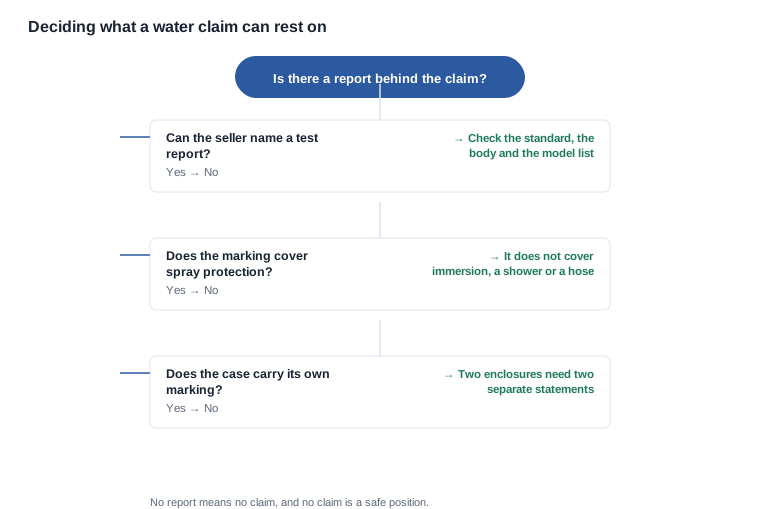
Nothing in this catalogue gives you a rating to publish for an audio or sport product. The two models that carry a marking are the V06 and the S7, both camera models, and no test report number is published for either. For the audio range there is no ingress figure at all.
That matters because the second digit in an IP54 marking is routinely over-read. It describes protection against water spray. It does not describe immersion, a shower, a hose, or a product that is cycled in the rain for an hour. If a listing builds "rain-proof" positioning on a marking, that is the claim most likely to be wrong in front of a customer, and it is the claim that produces a returns line rather than a question.
Two rules follow, and they are the whole of the compliance position for this category.
Treat "water resistant" in any listing as a claim the seller is making personally, unless they can name a report, the body that issued it, the standard it followed, the sample batch and the configuration it covered. A supplier with a real rating answers all of those immediately. A supplier without one will hedge, and the hedge is the answer.
Say nothing rather than something you cannot support. We would rather your listing makes no water claim at all than make one we cannot stand behind. An empty water section is a small commercial cost. A water claim that a customer disproves in a rainstorm is a returns cost, a review cost and a support cost, and it lands on whoever published it.
What does rain affect the speakers mean for your channel and your copy
The last part of the answer is commercial, and it depends on which channel you are in.
For a general e-commerce channel, the rain question is an occasional one and the cost of getting it wrong is a small number of returns. The most valuable thing you can do is put the drying routine in the support material and in the care insert, because it prevents the majority of the damage that produces those returns.
For an outdoor, cycling or running channel, the product is used in rain by design, and the question becomes a design question rather than a copy question. A channel buyer should be asking whether the acoustic openings are sealed, what the seal material is, and whether the frame is designed to be rinsed. Our charging advanced considerations page covers the interface side of the same problem, and open-ear audio buying mistakes to avoid covers the errors buyers make when they treat an open-ear design as if it were a sealed one.
For a swim or surf channel, treat salt and chlorine as damage rather than as a warranty question, and recognise that it is a product development conversation rather than a listing-copy one. No published rating in this category covers immersion or a corrosive environment, and a product sold into that channel needs an enclosure and a materials decision that a listing cannot fix.
The commercial lines that carry the same logic into the agreement: unit price and volume tiers, minimum order quantities for the models you are actually listing, sample policy and whether the sample demonstrates the wet behaviour, lead time, the warranty period with a stated response, and return terms for a seasonal outdoor channel. The warranty is the line that matters most here, because the rain exposure is a behaviour rather than a defect, and a warranty that does not distinguish them will be argued about rather than applied.
Two terms deserve particular attention in a channel where the product is used outdoors. The first is the packing and shipping specification, because a product that arrives having been stored in a damp container is a product that arrives with a problem, and freight terms that place responsibility on the seller for the condition on arrival are worth negotiating explicitly. The second is the return window against the season rather than against the delivery date, because an outdoor programme bought in the spring and used in the autumn has a long gap between the sale and the first complaint, and a short return window measured from delivery can expire before the product has ever been in the rain.
One last point for the shortlist. Between two audio suppliers quoting the same price with the same lead time, the question that decides between them is which one will tell you the seal material, the acoustic opening design and the drying behaviour, and which one will say plainly that it has no water rating. That is a due diligence question with a commercial answer, and it is worth more than a small unit price difference.
What we publish about does rain affect the speakers today
We publish the interface, the battery, the runtime and the charge time for our audio models. We publish the two ingress markings that exist in this catalogue, on the V06 and the S7. We do not publish an ingress figure for the audio range, for the sport range or for any charging case, because we do not hold one, and we will not put one on your listing.
What we can do is tell you which models carry a marking and which do not, describe the published rows for the model you are working with, and give you the four-step wet behaviour test so that your own copy is built on an observation rather than on a word. Where a water claim is wanted, the report has to be obtained from the manufacturer, and the model list on it has to be checked against the configuration you are actually shipping.
Tell us the models, the channels and whether your range is sold into wet environments, and we will tell you what is published, what can be established on a sample, and what we would and would not put in writing.


