
A buyer who asks whether a pair of glasses can be taken into a pool is rarely after a technical opinion. The question usually arrives attached to a decision that has already been taken — a beach product line, a rental programme for a waterside club, a listing draft in which the word waterproof was typed before the specification was ever opened. So the answer has to do three jobs at once, and the reason it gets mishandled is that buyers ask for one of the three and expect the other two to follow without being requested. What does the code on the product page permit? What does the published document leave open? And which of those gaps is the supplier the only party able to close?
That third distinction matters commercially, because a printed claim travels much further than a private answer. A word on a carton is read by a shopper, repeated by a distributor, quoted back by a consumer-protection office and inherited by whoever owns the brand in that market next. The question behind "can I swim with IP54 glasses" is therefore not really about water. It is about which sentences the documentation can carry.
In this catalogue the published position is narrow and specific. The catalogue marks two models IP54 — the V06 and the S7 — as one of four feature lines on each of their product pages, and no third-party test report number is published for either of them. For the other 26 entries in the range, the catalogue publishes no ingress rating at all. That second sentence is a statement about the limits of the published record rather than about how the hardware behaves, and keeping the two apart is the whole discipline this subject requires.
The structure below is the same in every section: what the catalogue publishes, what the catalogue does not publish, and what has to be asked of the supplier. A buyer who works through those three in order can write a defensible carton, a defensible listing and a defensible specification without inventing a single figure to fill a gap.
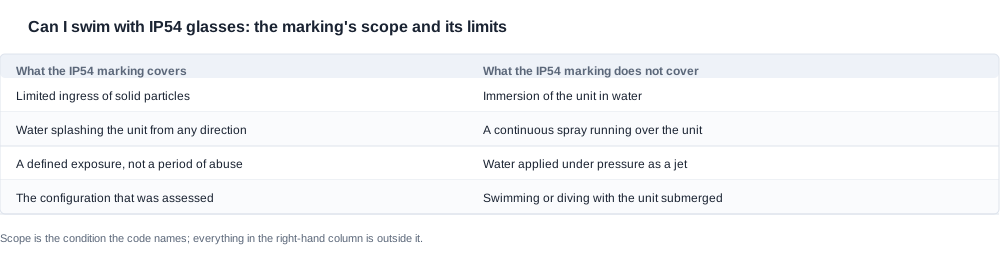
What the IP54 marking covers
An ingress code is two digits attached to two separate hazards, and reading either digit on its own is how procurement arguments go wrong. The first digit of IP54 is a five, which addresses solid particles and describes a limited ingress of dust rather than a dust-tight seal. The second digit is a four, and that is the digit this question turns on: it describes protection against splashing water striking the unit from any direction.
What "splashing water from any direction" describes is a condition with a shape. Water arrives from outside, strikes a surface and leaves. It is a short, directional event rather than a sustained state, and the standard that governs it fixes the volume, the duration and the orientation of the exposure. Two properties of that definition are worth holding onto, because they are the ones lost when the code is repeated around a table. First, a rating describes a condition rather than a period of abuse: it characterises a new unit in a defined situation, and it does not license a unit to be splashed for the length of a season. Second, a rating describes a configuration rather than a name, so a change of frame, a different accessory or a different regional build sits outside what was assessed.
Applied to the two marked models here, that configuration point is not academic. Both the V06 and the S7 publish a detachable inner frame, which means each product can be assembled in more than one state, and both publish magnetic charging, which leaves an exposed metal contact at the temple whenever the unit is off its accessory. Neither observation says anything adverse about the product. Both describe the specific configuration question a buyer has to put to a supplier, and neither can be answered from the catalogue alone.
The catalogue publishes the two-digit code and the scope that the code carries in the standard: limited ingress of solids, and protection against water splashing the unit from any direction. The catalogue does not publish anything that would make the code auditable — the standard and its edition, the laboratory, the sample size, the assessed configuration, the date, or any report number. The IP54 line sits among descriptors on a product page, next to ergonomic design and a detachable inner frame, and no third-party test report number is published for either marked model. What the supplier can be asked is precisely the list that is missing: which standard and which edition the marking was taken against, which laboratory performed the work, how many units were assessed, in which assembly configuration, and on what date.
| Water question a buyer brings | What the catalogue publishes | What the catalogue does not publish | What to ask the supplier |
|---|---|---|---|
| Can the unit be splashed? | The IP54 marking on the V06 and the S7 | The standard, the laboratory, the sample size and any report number | Which standard and edition, which laboratory, how many units, and when |
| Can the unit be submerged? | Nothing on this point | Any immersion rating and any immersion test of any kind | Whether an immersion-rated variant exists for the programme at all |
| Can the unit be sprayed continuously? | Nothing beyond the splash condition | Any duration, water volume or orientation limit | The exposure limits the marking was taken under, in writing |
| Can the unit be used in salt water? | Nothing on this point | Any fluid or environment qualification | Which media the assessment covered, and which it excluded |

What it does not cover
The exclusions matter more than the coverage, because a coverage statement is easy to repeat and an exclusion is easy to drop. Four conditions sit outside what IP54 describes, and naming all four is more useful than relying on the single word waterproof to carry the opposite meaning.
The four conditions the code does not describe
The first is immersion. A unit held under water is surrounded by water rather than struck by it, and the geometry of that exposure is different enough that the two conditions are handled separately. The second is continuous spray — a shower running over the unit, or a hose left pointed at it — where volume and duration both exceed the splash condition. The third is water under pressure, whether from a jet, a pressure washer or a high-pressure nozzle, where the force itself does the work. The fourth is the one this article was asked about: swimming, which is immersion combined with motion, with repeated flexing of the frame, with salt or chlorinated water, and with a camera assembly running while the unit is under.
None of these four is a finding about a fault in the product, and it is worth being precise about that, because the two get confused constantly. What an exclusion means is much narrower: the marking does not describe that condition, so the marking cannot serve as the evidence for a claim about it. A claim the documentation does not support is a claim a retailer or a regulator will pull, and the cost of pulling it lands on the business that printed it rather than on the factory that never wrote it.
Two further exclusions sit outside the water conversation entirely and are easy to miss. Nothing in the code addresses drop or impact resistance, which is a separate test with a separate marking. And nothing in it addresses temperature extremes, or salt water as a corrosive medium rather than as a wetting agent. A buyer building a waterside line is often choosing on the second set of questions while assuming the first set has already been answered.
Published, then, is a splash-and-solids condition and a two-digit code on two product pages. Not published is any statement about immersion, about continuous spray, about pressurised water, about swimming, about impact, about temperature extremes or about salt water, and there is no report number standing behind the marking. The supplier has to be asked what the marking excludes in their own words, which media were covered, what duration and pressure applied, and whether an immersion-rated product exists for the programme — because if the answer is that none exists, the correct output of this exercise is a different model, not a different sentence on the same one.

Where the marking appears in this catalogue
The range holds 28 models, and an ingress row appears on two of the catalogue pages. That is a fact about the catalogue rather than about the products, and it is worth stating in the form a specification can carry.
The two catalogue pages that carry an IP54 line
The two marked pages are both camera models. The V06 publishes an eight-megapixel resolution class, a 260 mAh cell, a rated endurance band of five to eight hours, a charge time of two hours or less, magnetic charging, four feature lines and four colour names — orange, white ice blue, black and black ice blue. Its feature lines read ergonomic design, a long battery line, a detachable inner frame and the IP54 marking. The S7 sits beside it in the same group: a thirteen-megapixel resolution class, the same 260 mAh cell, the same five-to-eight-hour band, the same two-hours-or-less charge ceiling, magnetic charging, and feature lines reading ergonomic design, a thirteen-megapixel line, a detachable inner frame and the same IP54 marking. The S7 publishes no colour row at all. The published rows on both pages are set out in the model-level records for the V06 and the S7.
The camera group is the largest in the catalogue, with eleven models, and it divides cleanly on this question. The eight-megapixel class holds eight of them — the V06 and the V03 Pro, the CY05 and the V03, and the CY03 and the MT6, and the MT5 and the KY06 — and the thirteen-megapixel class holds three, the L1 Pro and the L2 Utral, and the S7. Two of those eleven pages carry the marking and nine do not. The other seventeen entries in the range, spanning the audio models, the sport models, the child models and the entries listed without a model number, carry no marking either.
How the other 26 entries are described
For the remaining 26 entries the catalogue publishes no ingress rating. That sentence has to be written exactly like that, because the tempting compression is "not waterproof", and the compression is a different claim with a different owner. The catalogue is silent on the subject for those entries; it does not publish a lower rating, a failed result, or a statement that water damages them. A buyer who writes "no water protection" onto a product page has converted an editorial gap into a warranty term, and a buyer who writes "IP54" onto the wrong product page has converted an annotation into a performance promise. Both conversions are made by the buyer, and both are expensive to unwind in a market where the listing has already been indexed.
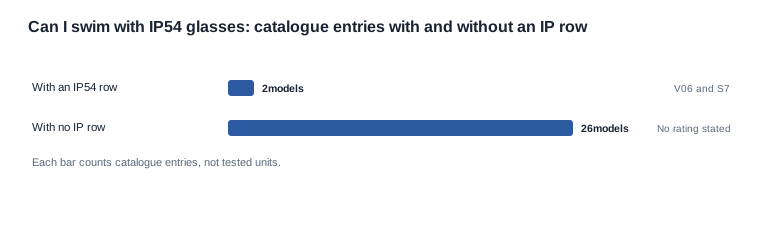
The bars above count catalogue entries rather than tested units, because that is the number a range plan actually needs: how many models inside a group can carry an ingress line at all. The second group is large, and its size is not evidence that those products are exposed. It is evidence that the published record on this question stops early, and that a buyer planning a wet-adjacent channel has to decide whether to work inside that record or to request the evidence that closes it.
One structural point belongs with those counts. The two models carrying the marking are also the only two that publish a detachable inner frame, and the marking sits in a list of descriptors rather than among the measured specifications. A merchandising team copies descriptors; a technical team copies specifications. That placement is the reason the marking travels so easily into marketing copy, and the reason the evidence request has to be made deliberately rather than discovered after the artwork is approved. The wider question of how the sport-oriented models divide is covered separately in the water resistance options for the sport range.
The published record, then, is an IP54 feature line on the V06 page and on the S7 page, and nothing else in the range carries one. The unpublished part is any ingress rating for the other 26 entries, and any report number, standard, laboratory or sample behind either of the two that do carry it. The supplier has to be asked which model strings the marking applies to beyond these two pages, whether any regional variant or successor build carries it, and what the answer is for a model whose page has no such line.
What to ask before a water claim goes on a carton
Carton artwork is the hardest surface to change. A listing page can be edited in a day, a product title can be corrected before a campaign runs, and a specification annex can be reissued between production runs. Printed packaging has an artwork approval date, a print run and a delivery window, and a carton printed with a claim that cannot be supported stays in a warehouse for as long as the stock lasts. That is why the water question has to be closed before artwork sign-off rather than after it, and why the questions below are ordered by who can answer them.
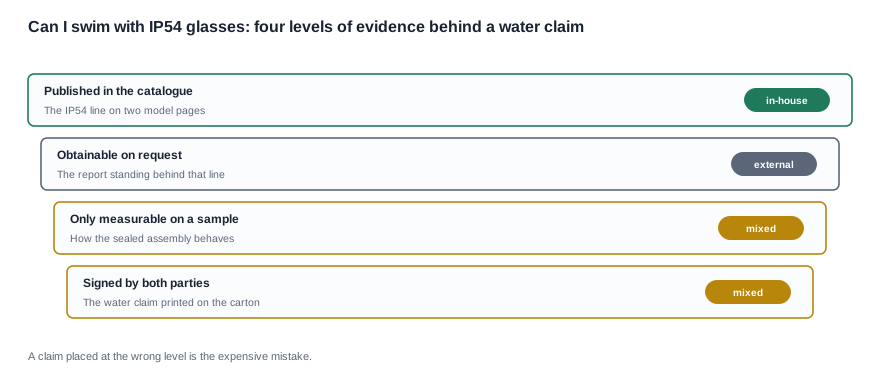
Four levels of evidence, and who holds each one
The layers chart sorts a protection claim by where its support comes from, and the four levels behave very differently inside a procurement file. At the bottom sits what the catalogue already states, which is free to use and costs nothing to repeat. Above it sits what a supplier can send on request, which costs a question and a week of waiting. Above that sits what only a sample can settle, which costs money, a written protocol and a schedule slot. At the top sits what has to be agreed in writing by both parties, which costs a negotiation and is the only level that survives an audit. Placing a claim at the wrong level is the expensive mistake: printing a catalogue line as though it were a signed agreement, or asking a supplier to sign something the catalogue never promised.
The questions to send before artwork sign-off
The following are the questions to send, in the order they narrow the answer.
- Which model strings does the marking apply to, and is it carried by any regional variant or successor build of those models?
- Which standard and which edition was the marking taken against, and is it written as IP54 in the supplier's own file or under another designation?
- Which laboratory performed the assessment, was it accredited for that method, and how many units were tested?
- On what date, and does the production batch match the assessed sample in housing, seal and accessory configuration?
- Was the unit assessed with the detachable inner frame in place, and in which of the available inner frame configurations?
- Was the magnetic charging contact capped, exposed, or connected to an accessory at the time of the assessment?
- Is the result a single type test or part of a routine production control, and if the latter, how often does that control run?
- What does the marking exclude in the supplier's own wording, including immersion, continuous spray, pressurised water, salt water and temperature extremes?
- What is the written disposition for a unit that has been immersed — returned to service, or written off, and by whose decision?
- Which of these documents may be forwarded to a retailer, a marketplace compliance team or a market-access file, and under what conditions?
The first eight of those are closed by a document. The ninth is closed by a procedure and usually belongs in the purchase agreement rather than in an email, because the people who handle the answer are not the people who write the warranty wording. The tenth is the one buyers forget, and it decides whether the evidence request is worth making at all: a report that cannot be forwarded does not close a compliance question, and a buyer who assumes it can will discover the limit after the packaging is already on a press. The mechanics of assembling a supplier evidence file are set out in the supplier verification note.
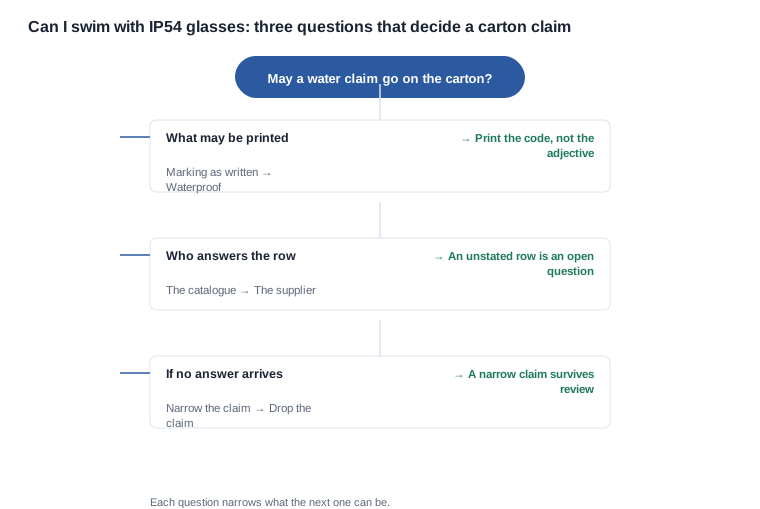
The decision chart is the practical version of the same list. What may be printed is the code and the scope that goes with it, in the wording the documentation supports. Who answers the row determines who has to be asked: a published catalogue line is closed, an unpublished row is open, and an open row that nobody owns is the one that gets printed by accident. And when an answer does not arrive, the claim has to be rewritten so that it rests only on what can be evidenced, or the model comes out of the water programme altogether. Both outcomes are acceptable; a broad claim that is later disputed is not.
Wording that survives review and wording that does not
There are specific wordings worth naming, because they are the ones that travel. "Waterproof" is a binary promise, and the code sitting next to it says something materially smaller. "IP54 waterproof" is the most common form and the most exposed, because it borrows the credibility of a coded rating while stating an uncoded and larger claim, and it is frequently copied verbatim by downstream resellers who never see the specification. "Pool-safe" and "perfect for swimming and surfing" are application claims rather than technical ones, and they are read as technical ones by the shopper. On the other side of the line, "splash resistant", "protected against splashing water from any direction" and "rated IP54" are the forms that survive review, provided the exclusions sit next to them and not on a policy page a customer reaches after the problem.
Four red flags recur in this category and are cheap to spot before artwork is approved. A marking quoted without its exclusions. An IP54 line copied onto a model whose catalogue page carries no such line. A water claim written into artwork that was signed off before the evidence request was even sent. A photograph of the unit in water on the listing page, which is a claim in its own right regardless of what the text beside it says.
The broader commercial terms a packaging programme needs are equally unpublished. The catalogue carries no unit price, no minimum order quantity, no lead time, no production capacity figure, no warranty period and no certificate identifier for any model, and the text of the range contains no reference to CE, FCC or RoHS anywhere. What can be named as frameworks for a market-access file are the Radio Equipment Directive (EU) 2014/53/EU and the EMC Directive 2014/32/EU, and both need per-model evidence that has to be requested in writing rather than inferred from a feature line. A buyer assembling a compliance file is therefore requesting two separate things — an ingress document and a conformity file — and they are worth keeping apart on the request list, because they are closed by different documents and answered by different people. What a sample can settle that a page cannot is covered in the measuring note.
The can i swim with ip54 glasses answer
The answer a buyer needs has three parts, and the order matters because each one constrains the next.
The three-part answer in the form a buyer can use
Published is narrow. The catalogue marks two models IP54 — the V06 and the S7 — as a feature line on each product page, and no third-party test report number is published for either of them. The code covers a limited ingress of solid particles and protection against water splashing the unit from any direction. The same two pages publish a 260 mAh cell, a rated endurance band of five to eight hours, a charge time of two hours or less, magnetic charging and a detachable inner frame; the V06 adds four colour names, and the S7 adds a thirteen-megapixel resolution class where the V06 publishes the eight-megapixel class.
Not published is everything that would turn that code into evidence. There is no standard, no laboratory, no sample designation, no date and no report number for either model. There is no immersion rating anywhere in the range, and no statement about continuous spray, pressurised water, salt water, temperature extremes or impact. And for the other 26 entries, the catalogue publishes no ingress rating at all — which is a statement about the published record, not a statement that those products are unprotected.
The supplier has to be asked for the closing set: the report behind the marking on the exact model string, the standard and edition it was taken against, the laboratory and the sample size, the configuration that was assessed with the inner frame in place and the charging contact in a stated state, the exclusions in the supplier's own wording, and the written disposition for an immersed unit. If the programme needs a product that can actually be submerged, that requirement belongs on a separate model string as a separate evidence request, because the answer to it decides whether the swim channel is sourced at all.
There is a version of this question worth putting in writing before anything is printed, because it converts a hypothetical into a document request. A buyer can ask: for the V06 and the S7, does a third-party ingress test report exist that identifies the standard, the laboratory, the sample and the assessed configuration, and does that report or that marking exclude immersion. The answer, in either direction, produces a carton. A yes produces a carton that carries the code and its scope. A no produces a carton that carries the code, carries the scope, and carries a phrase that narrows the claim to what the documentation actually describes.
What to do with the answer
The final part of the answer is a category judgement rather than a technical one. A question about swimming is a product-selection question, not a copy question, and the two are easy to confuse. If the channel genuinely requires immersion, no wording available on this range will satisfy it, because the range publishes no immersion rating and no immersion evidence. If the channel requires splash and rain protection in an outdoor setting, the V06 and the S7 carry a marking that supports that narrower position, and the carton has to say exactly that much and no more. Where a buyer sits between those two positions determines what the artwork can carry, and the cheapest way to find out is to ask before the artwork is signed.
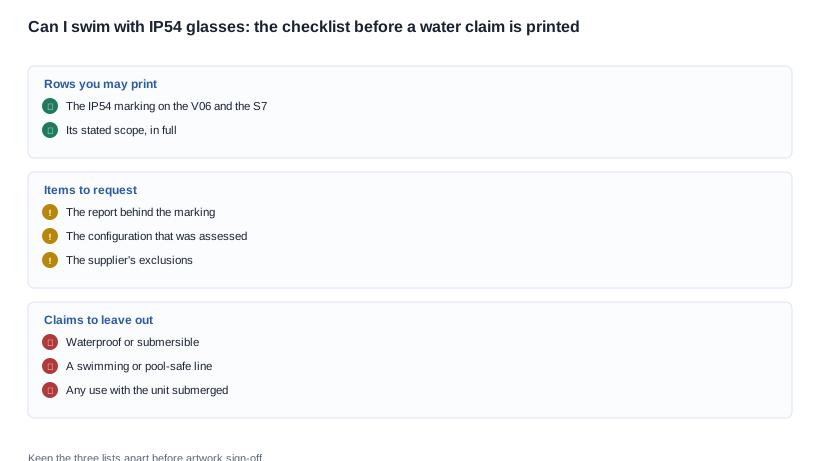
The checklist above is the short form of the whole argument. Rows you may print are the rows the documentation already supports, quoted in the words the documentation uses. Items to request are the rows that need a document or a supplier answer before they can appear anywhere. Claims to leave out are the ones a retailer or a regulator will pull and that the documentation cannot carry, and keeping the three lists apart is what stops a reasonable question from turning into an unreasonable claim.
The boundary on this subject is a boundary about documentation rather than about hardware, and we do not convert an absence into a claim in either direction. The marking is published on two pages, it is published as it stands with no report number attached, and the catalogue publishes no ingress rating for the other 26 entries. Where a programme needs a swim-capable product, that requirement belongs on a separate model string with its own evidence request, and the honest answer to can i swim with ip54 glasses is that the documentation in front of you describes splash rather than swimming, and only a supplier can say whether anything further exists.
Related reading
- The marked models and the models without a marking — water resistance options for the sport range
- Where water enters an open-ear audio product, which is a different design problem — are they waterproof
- Building the evidence file a claim needs — IP rating supplier verification
- What a sample can settle that a page cannot — measuring an IP rating
- The published rows on the two marked models — V06 limitations and S7 limitations
If the swim requirement is a real specification rather than marketing shorthand, the two things that decide it are the model string it attaches to and the document that closes it — and both can be settled before anything goes on press.


