
Kids eye protection glasses technology: the silent failure
Children's smart glasses carry a set of advanced considerations that adult products do not have, and the reason is not regulatory sentiment. It is that the user is the least able to report a problem, the least likely to keep using a product that has become irritating, and the least likely to be consulted when the purchase goes wrong. Every advanced consideration in this article is a consequence of that one property, and each of them changes what a buyer has to verify before a launch and in what order.
Four conclusions follow. First, in a children's line the deciding opinion belongs to the user, and the user has neither purchasing power nor a voice in the approval, so the buyer's only way to reach that opinion is to observe it. Second, the growth curve and the household charging habit determine whether the product is worn at all, and neither is answered by a datasheet — a frame that fits at eight and not at twelve has a short commercial life, and the cell is irrelevant if the device is not charged when it is needed. Third, a children's line inherits a compliance cycle that an adult line does not: the frameworks are reissued, and each reissue is a second launch. Fourth, and this is the one most often skipped, the certification position for our children's models is not published to us, which makes it the first question in the programme rather than the last.
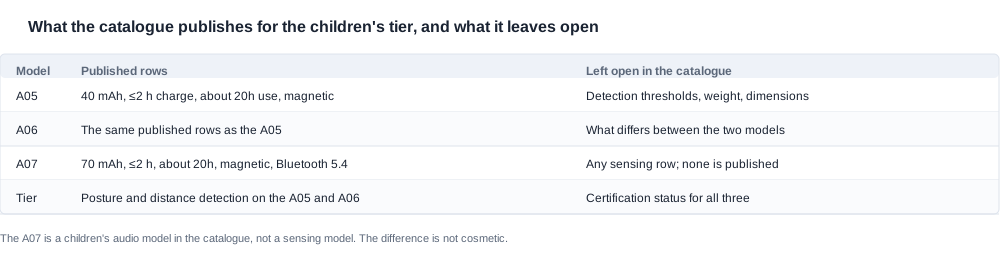
What our catalogue holds for this tier is narrower than the feature list suggests. Two of the three models run a 40 mAh cell, charge in two hours or less, give roughly twenty hours of rated use, charge magnetically, and carry posture and viewing-distance detection alongside a lens-based electronic fogging arrangement; the third adds Bluetooth 5.4 on a 70 mAh cell with the same charging and runtime figures, and is listed as a children's audio model rather than a sensing one. How far the detection reaches is not published to us, and neither is the certification status, the frame weight or the frame dimensions across the range.
The buyer, the user and the decision-maker are three parties
There are two buyers in this category and they are not the same person. The purchaser is a parent, a school administrator, a district procurement officer, or a distributor buying on someone else's behalf. The user is a child. The purchaser is deciding whether to trust a device with their child; the child is deciding whether to keep wearing it — and the second decision is the one that determines your return rate.
That split has a direct commercial consequence. A parent's decision is made on documentation, on certification and on the claim wording, because that is what a parent can evaluate. A child's decision is made on comfort, on whether the thing nags, and on whether it is embarrassing to be seen wearing it. Both of those produce returns, and only one of them is fixed by paperwork. A buyer who treats the two as one decision will ship a well-documented product that is taken off within a fortnight, and the return will arrive with no stated reason.
There is a third party who is not in the room. The parent who approves the purchase is often not the parent who handles the support call, and the household's charging routine is usually set by someone who was never asked. Designing the setup and the reminder defaults for the approver rather than for the household is a routine way to lose a product in week two without anyone being able to explain why.
Five considerations that only appear inside a household
The silent failure, and the sibling that does not match
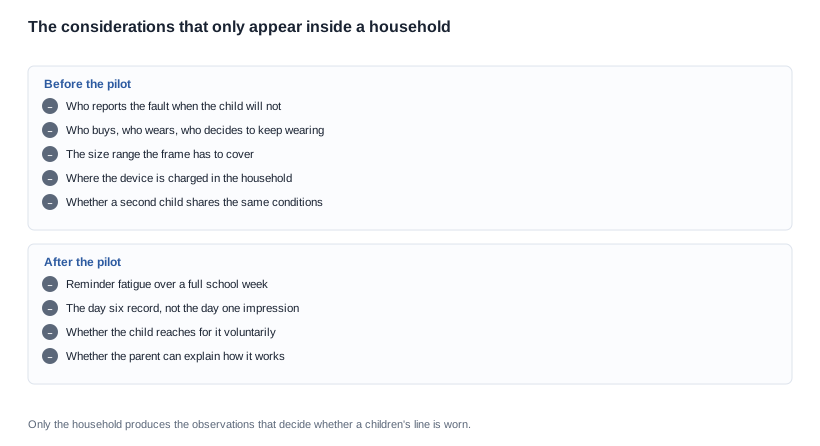
The child cannot report the failure. A worn-out charging contact, a loose temple, an intermittent charge — an adult describes these; a six-year-old does not. The product fails silently, and the parent's conclusion is that the product does not work. Every support case in this category is an observation made by somebody else, which is why the observation has to be collected before the purchase rather than after it.
The user is not the buyer and the buyer is not the user. The parent buys on the basis of a claim; the child uses it; the child decides whether to keep using it. The only one of the three whose opinion determines the product's success is the one with no purchasing power and no voice at all.
The sibling and peer effect. A product that works for one child in a household and not for another is a support and a returns problem, and it is a problem no specification can address. If two children in the same home with the same routine produce different results, the variable is the child, and the only way to know is to watch both of them.
The household's charging habit. The roughly twenty-hour runtime is the longest in our catalogue, and it is also the figure most likely to be irrelevant, because the constraint is whether the device is charged when the child puts it on. A household where charging happens in a kitchen and the child gets dressed in another room has a different product from one where the glasses live on a desk and are charged nightly.
The parent who has to explain the device. If the parent cannot answer the child's question about how it works, the child stops asking and starts taking it off. This is a support-cost question as much as an adoption one, because every such question lands in the same queue as a distributor's stock query.
The growth curve and the length of the commercial life
A product that fits at eight and not at twelve is a product with a short commercial life, and a retailer or a distributor working on a two-year plan needs to know whether the sizing covers that plan. The frame dimensions are not published for any model in our range, so this is a sampling exercise rather than a comparison, and the sampling has to happen against real children across the age range you intend to sell into.
There is a second growth-related variable that is not about size at all: the distance at which the product is used. A child in a small classroom and a child at a school desk are different distances, and a detection threshold tuned for one is wrong for the other. This is another reason the threshold has to be a number with a unit rather than a setting — a number can be retuned for a room, a quality cannot.
The charging routine decides the product, not the cell
The two models with the fogging arrangement run a 40 mAh cell and the third runs a 70 mAh cell, and all three are quoted at roughly twenty hours of rated use. Those two facts together are informative in a way that a buyer should not skip past: a cell that is nearly twice the size producing a similar rated runtime implies a different load profile, and the difference has to be somewhere. The most likely place is the reminder duty cycle — the published figure describes a use pattern that is not published, and the reminder frequency is a setting the brand or the parent controls.
The practical consequence is that the runtime is a duty-cycle number rather than a continuous one, and a household that leaves the reminder on a high setting will reach the end of the day sooner than the published figure suggests on a 40 mAh model. Which means the charging routine is a design variable for this category: how many charging points the household needs, whether the product charges away from the frame or in a case, and how a parent knows that it is charged. None of those questions is answered by the cell capacity, and all three are decided by the supplier's answer.
The compliance questions a children's line inherits
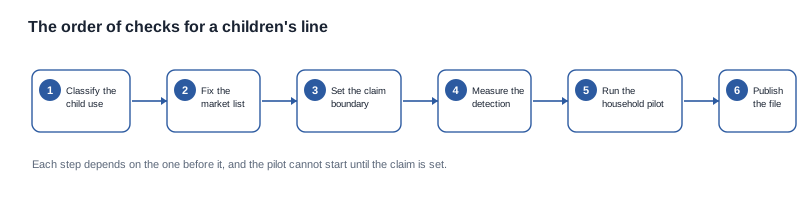
Standards are reissued on a cycle, and each reissue is a second launch. The European frameworks that reach children's products, EN 71 among them, and the United States ASTM F963 together with the Consumer Product Safety Improvement Act, can call for retesting when a new edition appears. A model that clears one edition carries an obligation for the next, and that obligation belongs in the product plan rather than in the certification file, because it is a schedule item with a cost attached to it.
The certification position in our range is not published. For these three models it is not published to us, which makes it the first question rather than the last, because it determines whether the product may be sold at all. A buyer's request should be per model and per market, and the answer should be a document reference rather than a description of the process.
The data position of a connected device in a children's product. A device worn by a child, connected to an app, raises a different set of questions than an adult product, and the published position in our range is that the app customisation, the firmware position and the data-handling details are not published for any model in this tier. A school, a district procurement officer or a retailer's technical team will ask what the device collects, where it is stored and who can see it, and in a children's product the answer has to be defensible rather than reassuring.
The lens-based electronic fogging arrangement. Two models in our range publish this feature, and the published position on its certification is not provided to us. Whatever the arrangement is intended to do, its regulatory position has to be established rather than assumed, and it has to be established per market rather than once.
The claim boundary. A product that monitors posture and viewing distance is one step away from a product that claims to protect eyesight, and in several jurisdictions that step is a regulated claim. The published position in our range is that medical and health claims are not ours to make, and the same discipline applies to the copy a buyer writes for a listing.
Where the certification gate sits in the launch
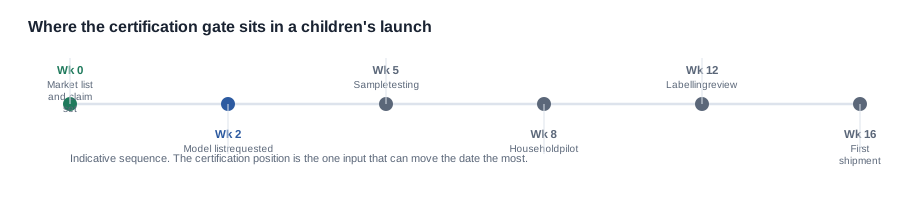
The gate that moves the date most is not the laboratory. It is the answer to the question "what is the certification position for this exact model in this exact market", because that answer determines whether the launch is a scheduling exercise or a qualification exercise. Everything else — the samples, the pilot, the labelling review — can be compressed against a date. A certification position that is unknown cannot be compressed at all, because there is no known duration to compress against.
The data question nobody asks until a school does
The commercial consequence of an unanswered data question is asymmetric. A retail channel may never raise it, in which case the cost of not answering it is zero. A school or a district may raise it during a tender, at which point the answer has to exist, and it has to exist in a form a compliance officer can read rather than a sentence in a marketing deck.
That asymmetry is why it belongs at the front of the request list rather than in the legal annex. The three questions worth asking are: what does the device collect, where is it stored, and who can access it. A supplier who answers all three has a data position; a supplier who answers "we take privacy seriously" has a marketing position, and the difference will surface at exactly the wrong moment.

The pilot that produces evidence the catalogue does not carry
A household pilot is the only instrument in this category that generates the data nobody publishes, and a supplier who has run one knows more about their own product than any datasheet can say. The reason to treat it as a stage with a gate rather than as a courtesy is that it is the only place where the user speaks.
Five questions to ask before the pilot rather than after
What are the detection thresholds, the delays, and the behaviour on a repeated trigger? These are the parameters that decide whether the reminder survives week two, and they are not published for any model in our range. Ask for them as numbers with units, and ask what the default value is on a unit that ships to a household, because the default is what a parent will never change.
What are the frame dimensions and the weight, and what size range do they cover? Not published for any model in this tier, and the only published frame weight in the whole catalogue is 158 g for the MT6, which is not a children's model. This is a measurement you run, not a number you request.
Which standards, which edition, on which model designations, and by which laboratory? The edition matters as much as the standard, and the model list matters as much as both.
What is the runtime measured under, with the detection load included? A runtime without a load is not a measurement.
What happens at a flat battery, and how does the parent know? A child does not report a flat battery; they stop wearing the device. If the parent's information about charge state is worse than the child's, the product has a design fault that no datasheet records.
What a pilot has to record to be worth repeating
The point of the pilot is not to feel good about the product. It is to produce a record that a second programme can reuse, and that means recording conditions rather than impressions.
Record the reminder behaviour over a real school week, with the actual child, and write down how many reminders fired and how many were acted on. The ratio between those two numbers is the single most predictive observation in this category, and it is the observation that tells you whether the false-positive rate is acceptable for a household rather than for a demonstration.
Record day six rather than day one. Everything that matters — the fit, the setup flow, the reminder fatigue, the charging routine — is settled in the first week and none of it is settled in the first hour. Record the sibling case separately, because a product that works for one child and not another is a different finding from one that works for nobody.
Record the parent's questions. They are the support load in advance, and a question that appears in every household is a question the quick start guide should answer, and one that appears in one household is a question the support script should answer.
What we will and will not put in a children's file
We publish the children's models' electrical rows as the catalogue holds them, and we say plainly that the detection parameters, the certification status, the frame dimensions and the weight are not published. We will not fill a children's product file with a plausible threshold or a certification claim, because in this category an invented number stops being a specification and becomes a safety statement on a page that a parent will act on.
We make no claim regarding vision, health or eye-protection efficacy for any of our products, in any market, and no hearing-related claim either. A device that detects a position or a distance and reminds is not a clinical device, and we will not describe it as though it were. If your channel's proposition is an eyesight concern, we would rather say so before the first order than after the packaging is printed.
We also publish no ageing data for the seal or the battery, and we will not estimate a service life for something we have not tested. That is a general position across the catalogue and it applies more sharply here, because a service-life estimate in a children's file is a promise made to somebody who cannot evaluate it.
Why the detection thresholds stay blank
A threshold expressed as a number with a unit can be tested on a sample, compared across suppliers and written into an acceptance criterion. A threshold expressed as a quality cannot be tested at all. The difference between the two is the difference between a feature and a specification, and in a children's product it is the difference between a product that is used and a product that is switched off in week two.
Publishing a threshold we have not measured would remove that difference in appearance while making it worse in practice: the buyer would have a number and no way of knowing whether the number was measured under the conditions they will use. We would rather publish the absence than a figure that would fail the first comparison.
Markets, age range and household pattern
Send the destination markets, the age range and the household pattern. Markets because the frameworks differ by market and the answer changes with them; age range because the fit question changes with it; household pattern because the charging routine and the reminder setting are what determine whether the roughly twenty-hour figure is relevant.
Send the two models you are comparing. The A05 and the A06 publish identical rows, and the difference between them is not published to us. The A07 is a different configuration with a 70 mAh cell and Bluetooth 5.4 and no published sensing rows. Which of the two lines you are actually comparing changes which of these considerations are decisive for you.
Send the questions you would put to any supplier, and we will answer ours. We will tell you which of the considerations above we can answer from our own documentation, which have to come from a supplier, and which need a week in a household. The background is under kids eye care technology, the practical list is in the children's buying checklist, the scenario splits are in kids glasses for different use cases, and the range itself is on the kids smart glasses page.
Where the advanced considerations come from
- Kids eye care technology
- Kids buying checklist
- Kids for different use cases
- Kids smart glasses range
Tell us the destination markets, the age range and the household pattern, and we will say which considerations are decisive.


