
Kids eye protection glasses technology: an instrument, not a story
A case study in this category is not a marketing document; it is a reusable measurement protocol with a filled-in table. The value is not the case study you write once — it is the case study you can hand to a colleague, a factory and a compliance team without rewriting it. That distinction decides everything about its shape, and it is the reason the template below is organised as rows with pass lines rather than as a narrative with a conclusion.
Our catalogue for this tier publishes a 40 mAh battery for the two models that carry the lens-based electronic fogging arrangement, charging in two hours or less, roughly twenty hours of runtime, magnetic charging, and posture and viewing-distance detection, with the certification position not published. The A07 in the same tier publishes a 70 mAh cell, Bluetooth 5.4, the same charge and runtime figures, and no sensing rows. So a case study in this category has to be honest about the fact that the interesting part of the project was the qualification rather than the specification, and a template that cannot hold an honest "not published" answer is the wrong instrument.
Two conclusions follow. First, every answer in a reusable case study has to be recorded against a condition and a date, because the whole point of the template is to know whether the answer still holds for the next project, which will be a new model, a new market or a new supplier. Second, the rows that came back empty are as valuable as the rows that came back full, because the empty ones are exactly the work the next programme will have to do again, and a template that records them turns a repeated cost into a known one.
Who builds the template, and what they already hold
A buyer building a template is usually a brand or an engineering lead who has just run one children's project, and they hold a pile of notes, a set of samples and a supplier relationship. What they will not hold is a decision about what the template is for, and that decision changes its shape completely. A template for comparing two suppliers is a measurement sheet. A template for defending a decision internally is a case study. A template for onboarding a colleague is a checklist with a record attached.
The template has to be built for the second project, which is usually a new model, a new market or a new supplier. That means every answer has to be recorded against a condition and a date, because the whole point is to know whether it still holds. A template written to explain the first project is a document. A template written to be executed on the second is an instrument, and the difference shows in whether someone else can fill it in without asking a question.
Why the second project is always more expensive than the first
The reason is almost never that the product got harder. It is that the first project's evidence was written for a reader rather than for the next buyer. A conclusion written to persuade cannot be reused, because the next project needs the measurement that the conclusion was drawn from, and that measurement was never recorded anywhere.
The second cost is that the first project never wrote down what it did not establish. The rows that came back as not published, the questions that were never asked, the conditions nobody recorded — those are the rows that get re-asked from scratch on the next programme, at the cost of a full round trip each, and they are the most expensive part of the second project precisely because nobody remembers them.
The third cost is the configuration. A rating, a detection threshold or a runtime attaches to a configuration, and a case study that says "the product" cannot be cited when a variant ships. Every configuration decision taken in the first project has to be re-established in the second unless the case study recorded it.

The six sections the template has to carry
Section one, the scope. The models, the configurations, the markets, the date and the build. This is the section that makes every other section interpretable, and it is the section that is most often written loosely. If the scope does not say which model designation was tested, with which variant and against which market, no other section can be read.
Section two, the documentary position. The conformity file references with standard names, edition numbers and model lists; the certificate numbers with the issuing body and the validity dates; the battery transport test summary for the fitted cell. The purpose of this section is to record what exists rather than to argue about what it means.
Section three, the measurements. Every measured figure with its condition attached — the detection threshold and its unit, the delay and the repeat behaviour, the false-positive rate over a stated number of attempts, the runtime with its reminder interval and ambient condition, the frame dimensions and weight with the size range covered and the measurement method.
Section four, the field work. The unboxing and setup flow with the steps a parent performs and the time they take; the wearing trial with the number of days, the children involved and the day-six result. This is the section nobody publishes and everybody needs, because it is the only source of the observations the catalogue cannot carry.
Section five, the commercial position. The total-cost build with its components, the acceptance criteria that were actually written into the purchase order, the deviations that were accepted and by whom. The deviations matter most, because an accepted deviation is a decision that will otherwise be re-litigated on the next programme.
Section six, the open items. Every row that came back empty, every question that was never answered, every condition that was never recorded, each one with an owner and a date. This is the section that turns a case study into a template, and the section that decides what the next project costs.
The section that decides whether the template survives
Section six is the one that gets skipped, and it is the one that matters. A template whose open-items section is always empty is a template that is not being used honestly — because in this category there is always something open, and the reason it looks empty is that the person filling it in assumed the question would be asked again anyway.
Written properly, section six is a short list of unresolved rows with an owner against each one. It is also the list that makes the template cumulative: a buyer picking up the template on the second programme can see, before starting, that the detection threshold was asked for and never answered, and can therefore decide in advance to make it a condition of the order rather than a question.
The eleven evaluation rows and their pass lines
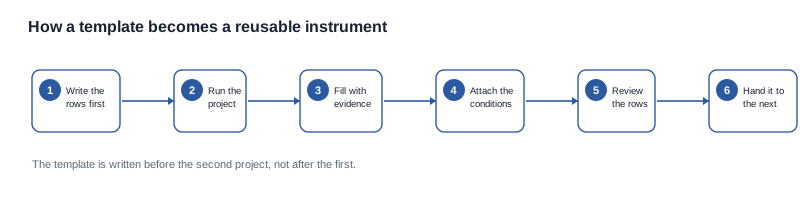
The table at the top of this article is the evaluation table the template carries. Use it as the request list as well as the record sheet, and fill the answer column with the evidence rather than with the summary. A link to a test log, a photograph of a measurement or a certificate reference is evidence; a paragraph describing the result is not, and it cannot be reused.
The certification row is the one that changes the project
A case study that records "certified" without the standards, the editions and the model list is a case study that has to be redone before the first shipment, which is the worst possible moment to discover it. In the European Union the frameworks that reach children's products include EN 71; in the United States ASTM F963 and the Consumer Product Safety Improvement Act apply; and both work on an edition cycle, so a file prepared against a superseded edition is a retest waiting to happen.
The pass line for this row is deliberately strict: the file names the model being bought. Not the family, not the platform, not the SKU the factory uses. A record that stops at the family level has not settled the question, and the second programme will ask it again.
The wearing trial is the row that predicts the return rate
A twenty-hour runtime is irrelevant if the child removes the product in an hour, and the day-six result is the only observation that predicts the return rate. That makes the wearing trial the row with the highest commercial value in the template and the row most often left as a sentence rather than a record.
The pass line is that it was recorded rather than summarised: the number of days, the children involved, and the result on day six, with the conditions written alongside. A trial reported as "went well" tells the next programme nothing. A trial reported as "six days, one child, reminder ignored by day four, worn on day six after the setting was changed" tells it everything.
Every row needs a condition, or it cannot be compared
A detection threshold without a room condition, a runtime without a reminder interval, a fit dimension without a size range — each of these is a claim rather than a measurement, and none of them can go into a purchase order. The general rule for the template is that a row is not complete until the condition is attached, and the condition column should not be optional in any version of the document.
The same rule applies to the date and the build row. A record without a date and a hardware revision cannot be compared with the next project's record, and the template's value is in exactly that comparison. A supplier who changes a firmware default between two builds has changed the product, and without the build row there is no way to know that the earlier answer no longer applies.

Filling a row with evidence instead of with a conclusion
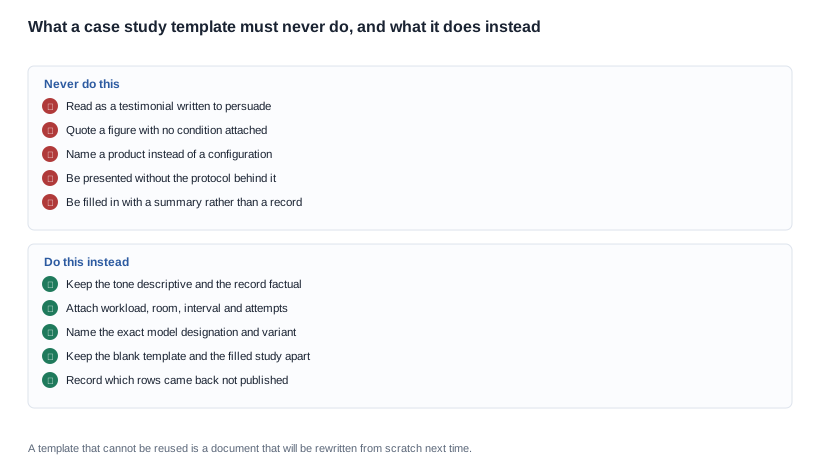
What a template must never do
Never read as a testimonial. The moment a document exists to persuade rather than to record, it stops being usable as evidence, and the next project inherits nothing from it. The test is simple: would this document still be useful to a buyer who had no intention of buying from you?
Never quote a figure without its condition. Twenty hours with no reminder interval, a runtime with no workload, a detection rate with no denominator — each of these is unusable in a negotiation and worse than useless in a file, because it looks like a figure and behaves like a slogan.
Never name a product rather than a configuration. A rating, a detection threshold or a runtime attaches to a configuration, and a record that says "the product" cannot be cited when a variant ships.
Never be presented without the protocol that produced it. A measurement without its method cannot be repeated, and a repeated measurement is the only thing that makes the second programme cheaper than the first.
Never be filled in with a summary rather than a record. The summary is what gets written for an audience. The record is what gets carried forward.
The review step, and the rows nobody fills
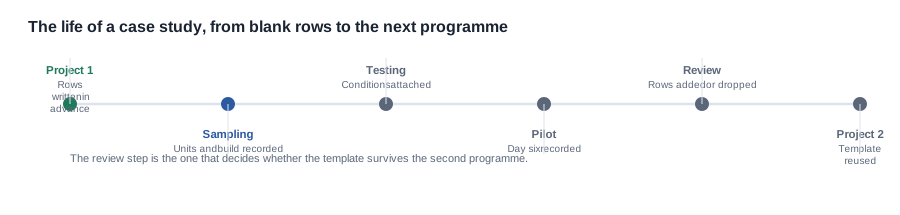
A template should be reviewed at the end of every project, and the review has two parts. Remove the rows that never get filled, and add the ones that turned out to matter. The rows that get skipped are not noise — they are telling you where the risk is concentrated, and a row that nobody fills across three projects is either a row nobody cares about or a row everyone found uncomfortable, and the second is worth investigating.
Add the rows that a project turned out to need and the original template did not have. In this category the rows that get added most often are the ones about the household rather than the hardware: where the product is charged, what the parent sees when the charge is low, what happens at a flat battery, and what the support queue actually receives. None of these appear in a typical supplier datasheet, and all of them determine the return rate.
Keep the template and the case study separate. The template is blank and owned by the organisation; the case study is filled in and owned by the project. Mixing them is how a template becomes a document nobody dares to change, and a document nobody dares to change is a document that stops being current — which is the failure the template exists to prevent.
Filling this template in with you
What our own rows answer today
It is worth being precise: we publish the children's models' electrical rows — the 40 mAh and 70 mAh cells, the charge time of two hours or less, the roughly twenty-hour runtime, magnetic charging, Bluetooth 5.4 on the A07, and the presence of posture and viewing-distance detection on the two sensing models — and we say plainly that the detection parameters and the certification status are not published. We publish no frame weight, no dimension and no size range for this tier, and we will not fill a template with plausible thresholds, because in this category an invented number becomes a safety statement on a product page that a parent will rely on.
We also make no vision, health or eye-protection outcome claim for any of our products, in any market, and we would rather a template recorded that as a hard rule than have it assumed. The rows that we can close today are the electrical ones, and they close the first three lines of the scope section. Everything below that line has to come from a supplier, from a sample or from a week in a household, and the template's job is to make sure each of those rows is filled by somebody with a date against it.
What the template changes in the negotiation
A filled template changes what is negotiable, and the change is larger than it looks. Without a record, the only negotiable numbers in a children's programme are the unit price and the minimum order quantity, and both are small. With a record, three larger numbers come into scope: the per-model and per-market documentation scope, the per-variant re-validation cost and its trigger, and the acceptance criteria that a lot has to meet before it ships.
The documentation scope is the first of these and the most valuable. A supplier who has seen a written record of what the previous programme cost in document sets will quote the next programme against the same count, and the buyer who can state "three models, four markets, two colours" is negotiating from a number rather than from a hope. That is the difference between a total-cost conversation and a unit-price conversation, and it is worth more than any discount a supplier could offer on the hardware.
The acceptance criteria are the second. A criterion that lives in an email is not binding, and a criterion written into the purchase order is an acceptance standard — a lot that fails it is a lot the buyer can refuse. The template's role here is to make sure the criteria exist before the sample is accepted rather than after the first lot arrives, because the cost of refusing a late lot is several times the cost of refusing a sample. The supplier's willingness to accept written criteria is itself a due-diligence signal, and a factory that resists it is telling you something about how the first dispute will go.
The third is tooling and packaging, which a template makes visible in a way that a quotation does not. Both the moulding tooling and the sealing tooling are one-off charges, and the volume they are spread across is normally the opening order; a template should surface that volume and the position on both tools once the programme ends. Packaging carries the per-market label sets and the documentation language, and in a children's line it is a low-cost negotiation with no tooling implication — which makes it the easiest concession available to a supplier and the easiest one to win.
What does not move, and is worth saying so in the first meeting rather than the last, is the certification cost and the certification time. Those are a fixed cost per model and per market, and the elapsed time is set by the test body rather than by the order size. A buyer who spends the negotiation trying to move them will have spent the negotiation, and will come away with a small unit-price concession and an unchanged schedule.
The rows you already track, and what is missing
Send the rows you already track, and we will mark the ones you are missing. The eleven rows above are not exhaustive and they are not ours; a template that only covers what one supplier can answer is a template for comparing that supplier.
Send the models and the markets, and we will tell you which rows our documentation closes. That answer is short, and it is the honest starting position for a first programme.
Send the measurement protocol, and we will run it with you. The methods are set out in how to test kids eye protection glasses; the background is under kids eye care technology; the range and the configuration questions are covered in kids compatibility; and the models themselves are on the kids smart glasses page.
Where the template comes from
Send us the rows you already track and we will tell you which of the eleven you are missing.


